Modern BI Architecture: From Data Warehouses to Self-Service Analytics
Modern BI architecture explained: from data warehouses to lakehouse and self-service analytics, with a referen...
Big data architecture in 2026: Lambda vs Kappa vs lakehouse compared, with streaming trade-offs and a clear decision framework.
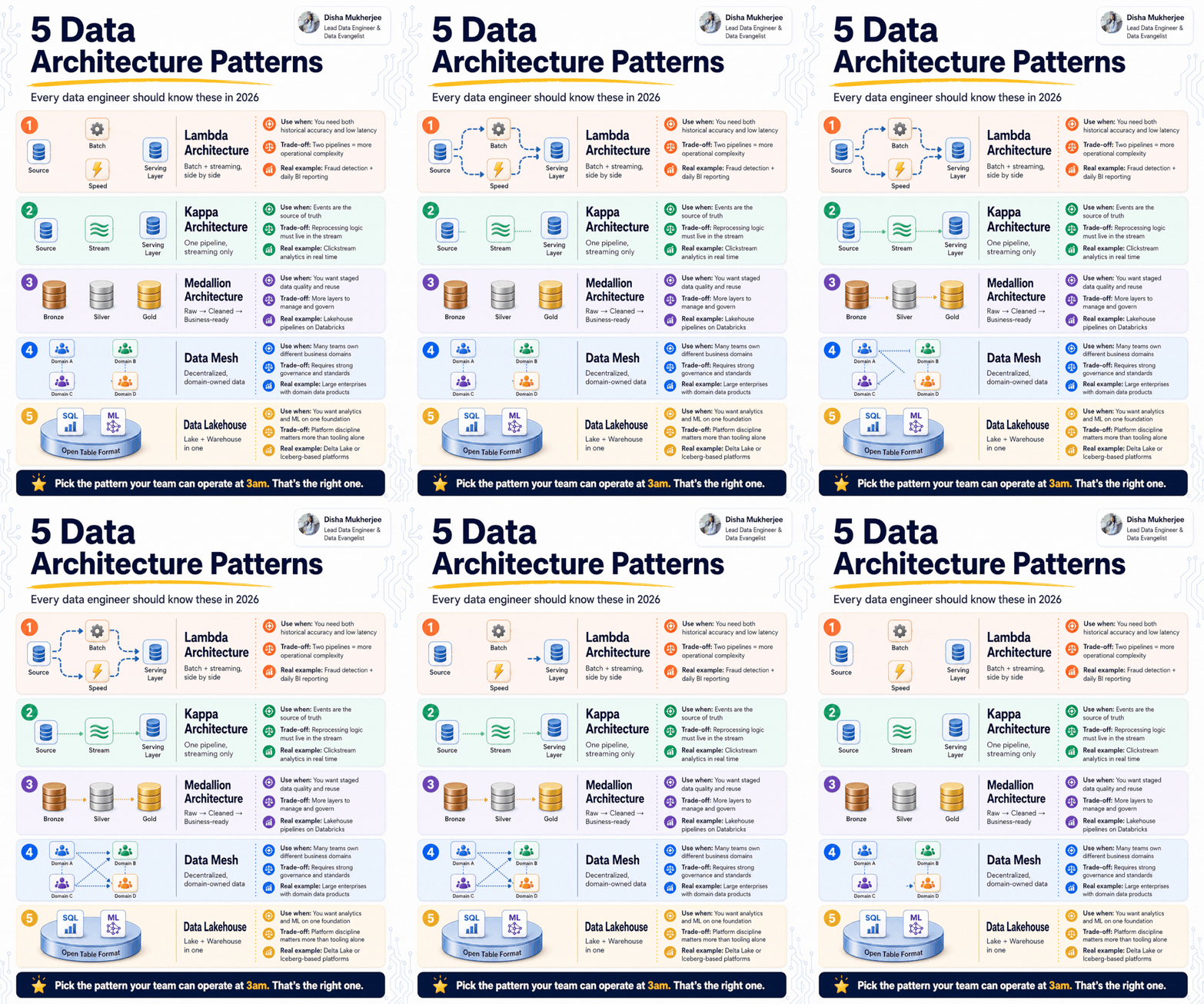
Big data architecture in 2026 comes down to three patterns: Lambda (parallel batch and streaming layers), Kappa (a single streaming pipeline with replay), and the data lakehouse (one storage layer serving both batch and stream workloads). The right choice depends on your latency requirements, your team's operational maturity, and whether you can tolerate maintaining two codebases for the same logic. Most enterprises now default toward the lakehouse, because it removes the duplication that made Lambda expensive to run.
The harder question is not which pattern is fashionable. It is which one your organization can operate reliably at 2am when a pipeline fails. This guide compares Lambda, Kappa, and lakehouse architectures head to head, gives you a decision framework, and walks through the trade-offs that vendor marketing tends to skip. We also look at the Databricks and Snowflake convergence that has quietly redrawn the build-versus-buy calculation.
If you are weighing these patterns for a live programme and want a second opinion before committing budget, you can talk to our engineering team. Teams like Mind Supernova help enterprises design and operate data platforms without locking themselves into a pattern they later regret.
Key Takeaways
- Lambda runs separate batch and streaming layers for the same logic, which doubles maintenance cost and creates reconciliation risk between the two paths.
- Kappa collapses everything into one streaming pipeline and reprocesses history by replaying the log, which is simpler operationally but demands strong streaming skills and long log retention.
- The data lakehouse (Delta Lake, Apache Iceberg, Apache Hudi) unifies storage with ACID transactions, letting one table serve both batch and incremental streaming reads, which is why it has become the 2026 default.
- Apache Kafka is used by more than 80 percent of the Fortune 100, making it the de facto backbone for both Kappa and lakehouse streaming ingestion.
- Build the platform yourself only when data is a genuine competitive moat. For most enterprises, buying a managed lakehouse (Databricks or Snowflake) and owning the pipeline logic is the better economic call.
Before comparing patterns, it helps to name the problem they all attack. A big data architecture has to ingest high-volume, high-velocity data, store it durably and cheaply, process it for both historical analysis and near-real-time decisions, and serve results to dashboards, applications, and machine learning models. The friction has always lived in one place: batch and streaming workloads have different shapes, and forcing them through one system used to be impossible.
Lambda, Kappa, and the lakehouse are three answers to that friction. Lambda accepts the duplication and engineers around it. Kappa refuses the duplication and pushes everything through a stream. The lakehouse changes the storage layer so the duplication is no longer necessary in the first place.
The reason this matters in 2026 is cost discipline. With worldwide IT spend forecast at 6.31 trillion dollars in 2026 [1], data teams are under the same pressure as the rest of IT, where 84 percent of organizations name cost as their top cloud challenge and roughly 27 percent of cloud spend is wasted [2]. An architecture that forces you to run and maintain two pipelines for one business metric is a tax you pay every quarter. That tax is the central reason the field has moved.
Lambda architecture, coined by Nathan Marz, splits processing into three layers. The batch layer recomputes accurate views over the full historical dataset. The speed layer handles recent data with low latency to fill the gap while the batch layer catches up. The serving layer merges both so queries see a complete picture.
The appeal was correctness plus freshness. The batch layer guarantees an accurate, recomputable source of truth, and the speed layer gives you immediacy without waiting for the next batch run. For a long time this was the only credible way to get both at scale.
The problem is the duplication. You implement the same business logic twice, once in a batch framework and once in a stream framework, in two different programming models. When a metric definition changes, you change it in two places and hope they agree. Reconciliation bugs between the batch and speed layers are the classic Lambda failure mode, and they are painful to debug because the two paths are genuinely different code.
Lambda is not dead. It remains defensible when your batch computations are genuinely different from your streaming ones, for example heavy ML model training in batch and lightweight alerting in stream. It also fits organizations with deep, separate batch and streaming teams who are not going to merge. If the two layers are different by nature rather than by accident, the duplication is not waste.
Kappa architecture, proposed by Jay Kreps, removes the batch layer entirely. Everything is a stream. Historical reprocessing is handled not by a separate batch system but by replaying the log from the beginning through the same streaming code. One codebase, one processing model, one mental model.
This is elegant. You define your logic once. When you need to recompute history, perhaps because you fixed a bug or changed a definition, you replay the retained log through a new version of the job and swap the output. Apache Kafka, used by more than 80 percent of the Fortune 100, is the typical log backbone, with Apache Flink or Kafka Streams as the processing engine.
Kappa's costs are real, though. Replaying months of history through a stream processor can be slow and resource-heavy compared to an optimized batch job. You need long log retention, which means storage and operational overhead. And the whole thing depends on your team being genuinely strong at stream processing, exactly-once semantics, and state management. Kappa is simpler in architecture but more demanding in skill.
Teams underestimate replay. If your business logic is complex and your data volume is large, a full replay can take hours and consume a lot of compute. Many Kappa adopters keep a tiered approach: recent data lives in the hot log, older data lands in cheap object storage, and large historical recomputes pull from there. At that point the line between Kappa and a lakehouse starts to blur, which is the direction the industry has moved.
The lakehouse attacks the problem from a different angle. Instead of debating how many processing layers you need, it fixes the storage layer. Open table formats, namely Delta Lake, Apache Iceberg, and Apache Hudi, add ACID transactions, schema enforcement, time travel, and incremental reads on top of cheap object storage like S3, ADLS, or GCS.
That single change is what removes the Lambda duplication. A lakehouse table can be written by both a streaming job and a batch job, read incrementally for near-real-time needs, and read in full for historical analysis. You no longer maintain two separate stores reconciled by a serving layer. One governed table serves everything, with the warehouse-grade reliability of transactions and the lake-grade economics of object storage.
This is why the lakehouse has become the 2026 default for new builds. It gives you most of Kappa's single-codebase benefit without forcing every workload through a stream, and it gives you Lambda's correctness without the dual maintenance. The trade-off moves from architecture complexity to table and metadata management, which is a more tractable engineering problem. For a fuller treatment of how this fits into the warehouse-to-lakehouse evolution, see our companion piece on modern BI architecture.
The most important shift of the last two years is that the two category leaders have converged. Databricks, which originated the lakehouse and Delta Lake, has pushed hard into SQL warehousing and governance. Snowflake, which started as a cloud data warehouse, has embraced open table formats and now supports Apache Iceberg natively, opening its storage to external engines.
The practical effect is that the old "warehouse versus lake" decision has softened into a "which managed lakehouse" decision. Both vendors now support open formats, both run batch and streaming, and both court the same buyer. This convergence is good for enterprises because it reduces lock-in pressure: choosing Iceberg or Delta as your table format keeps your data readable by multiple engines, which is leverage you did not have five years ago.
This is the table most readers come for. It compares the three patterns across the dimensions that actually drive the decision: not theoretical purity, but what each costs you to build and run.
| Dimension | Lambda | Kappa | Data Lakehouse |
|---|---|---|---|
| Core idea | Separate batch and speed layers, merged at serving | Single streaming pipeline, replay for history | Unified ACID storage serving batch and stream |
| Codebases for one metric | Two (batch and stream) | One (stream) | One (logic decoupled from layer) |
| Latency | Low (speed layer) plus accurate batch | Low (stream-native) | Near-real-time to batch, configurable |
| Operational complexity | High (two systems plus reconciliation) | Medium (one system, hard skills) | Medium (table and metadata management) |
| Reprocessing history | Native via batch layer | Replay log (slow, resource-heavy) | Time travel and incremental rebuilds |
| Storage cost | Higher (duplicated stores) | Medium (long log retention) | Lower (single object-store copy) |
| Team skill demand | Batch and streaming both | Strong streaming and state management | SQL plus moderate streaming |
| Main failure mode | Batch and speed layers disagree | Slow or failed replays | Small-file and metadata bloat |
| 2026 fit | Legacy or genuinely split workloads | Stream-first, event-heavy orgs | Default for most new builds |
A clean way to choose is to ask a short series of questions in order and stop at the first that gives a clear answer. The framework below is the one we use with clients, and it deliberately defaults to the lakehouse unless something pushes you off it.
                         +------------------------+
  Sources (apps, CDC,    |   Ingestion / Log      |
  IoT, SaaS, DBs)  --->  |   Apache Kafka         |
                         +-----------+------------+
                                     |
                 +-------------------+--------------------+
                 |                                        |
        (stream path)                            (batch / micro-batch)
         Flink / Kafka                            Spark Structured
         Streams                                  Streaming or batch
                 |                                        |
                 v                                        v
        +-------------------------------------------------------+
        |   Lakehouse storage (Delta / Iceberg / Hudi on S3)    |
        |   ACID tables, schema enforcement, time travel        |
        +------------------------+------------------------------+
                                 |
              +------------------+-------------------+
              |                  |                   |
              v                  v                   v
        BI / semantic      ML feature store    Reverse ETL /
        layer + dashboards  + model serving     operational apps
In a lakehouse, the stream and batch paths both land in the same governed tables. In a pure Kappa design you would drop the batch path and replay from Kafka. In Lambda you would keep two separate serving stores and merge at query time.
Every pattern trades something. Lambda trades engineering effort and reconciliation risk for clean separation of batch and stream concerns. Kappa trades replay cost and a high streaming skill bar for a single, elegant codebase. The lakehouse trades a new class of operational chores (compaction, small-file management, metadata maintenance) for the removal of dual pipelines.
The lakehouse trade is usually the best deal, because small-file and metadata problems are well understood and increasingly automated by the platforms themselves. Reconciliation bugs across two Lambda layers, by contrast, are bespoke to your business logic and never fully go away. You are choosing which class of problem you would rather have, and most teams prefer the tractable one.
Consider a pattern common in retail and digital media: a company ingesting clickstream and transaction events at high volume to power both real-time personalization and overnight financial reporting. The classic 2018-era build would be Lambda, with Spark batch jobs computing daily aggregates and a Storm or Flink speed layer feeding live dashboards. Two codebases, constant reconciliation.
The 2026 version of that same workload lands events in Kafka, processes them with Flink or Spark Structured Streaming, and writes to Delta or Iceberg tables. The same tables feed live dashboards through incremental reads and feed overnight reporting through full scans. The personalization team and the finance team read from one governed source, so they stop arguing about why their numbers differ. This is the convergence in practice, and it is why streaming-heavy organizations migrate off Lambda first.
The lesson worth taking from named cases like Uber's data platform, which pioneered Apache Hudi precisely to get incremental processing on a lake, is that the storage-layer innovation is what unlocked the simplification. The pattern is more durable than any single vendor. If you want to see how a real-time path is engineered end to end, our guide to building a real-time data pipeline for enterprise scale goes deep on Kafka, Flink, CDC, and exactly-once semantics.
You do not migrate a data platform in one cutover. The following phased roadmap reduces risk by proving each layer before the next depends on it. It assumes you are moving toward a lakehouse, which is the most common 2026 target.
| Phase | Timeline | Focus | Exit criteria |
|---|---|---|---|
| 0. Assess | Weeks 1–3 | Catalog sources, latency needs, current pipelines, skills | Pattern chosen via decision framework; target table format selected |
| 1. Foundation | Weeks 4–9 | Stand up Kafka ingestion and lakehouse storage with governance and catalog | One source flowing into a governed ACID table end to end |
| 2. First workload | Weeks 10–16 | Migrate one high-value pipeline; run old and new in parallel | New output matches legacy within tolerance for two weeks |
| 3. Streaming layer | Weeks 17–24 | Add incremental and streaming reads; retire one Lambda speed layer | Live dashboard served from lakehouse table, no separate store |
| 4. Scale and decommission | Months 7–12 | Migrate remaining workloads; turn off duplicated pipelines | Single governed source of truth; legacy stores retired |
The non-negotiable rule across every phase is parallel running. You keep the legacy pipeline alive until the new one matches it within an agreed tolerance for a sustained period. Cutting over on day one is how teams end up explaining to the CFO why last quarter's numbers moved.
Most failures are not exotic. They repeat across organizations, and they are avoidable once named.
Cost is where the patterns diverge most sharply, and where vendor pricing models can surprise you. The three big cost drivers are storage, compute, and engineering time. Engineering time is the one teams chronically underweight.
Lambda's storage cost is higher because you maintain duplicated stores, and its engineering cost is the highest of the three because two codebases need building, testing, and reconciling. Kappa lowers storage duplication but raises retention costs for long logs and demands scarce, expensive streaming talent. The lakehouse keeps a single copy of data in cheap object storage and lets you scale compute independently, which is usually the lowest total cost of ownership.
The pricing trap to watch is compute. Managed lakehouse platforms bill heavily on compute, and a poorly tuned job or an always-on warehouse can dwarf your storage bill. With roughly 27 percent of cloud spend wasted across the industry, idle and oversized compute is the data team's version of that waste [2]. Auto-suspend, right-sizing, and workload isolation are cost controls, not nice-to-haves. If your platform also feeds AI workloads, the economics intersect with broader data foundation decisions covered in modern data platforms for AI-driven organizations.
The build-versus-buy decision in 2026 is clearer than it used to be, mostly because the managed platforms got good and the convergence reduced lock-in fear. The honest recommendation: buy the platform, build the logic.
Buy a managed lakehouse (Databricks, Snowflake, or a cloud-native equivalent) unless your data processing is itself the product or a defensible moat. The number of companies that genuinely need a hand-rolled platform is small: hyperscale consumer firms, specialized real-time trading or adtech, and a handful of others. For everyone else, building the infrastructure means you now operate Kafka clusters, Spark tuning, and metadata services instead of shipping business value.
What you should always own is the pipeline logic, the data models, and the governance. These encode your business and should never be outsourced wholesale to a vendor's opaque feature. Choosing an open table format (Iceberg or Delta) protects that ownership by keeping your data portable across engines. For multi-engine and portability questions, the trade-offs overlap heavily with the multi-cloud versus single-cloud decision that CTOs are making in parallel.
Where partners add value is in the design and the migration, not in owning your data forever. Mind Supernova, a Vietnam-based software and data engineering partner founded in 2023, works with enterprises on exactly this split: designing the lakehouse, building and operating the pipelines, then handing over a platform the in-house team can run. Engineers work async-first with 4+ hours of daily UK overlap and can typically start within 5 to 7 days, which matters when a migration window is fixed. Our team's collective experience spans both the Lambda-era builds being retired and the lakehouse-era builds replacing them.
Not obsolete, but rarely the right choice for new builds. Lambda still fits organizations whose batch and streaming computations are genuinely different and who run separate teams. For most workloads, the lakehouse delivers the same correctness and freshness without maintaining two codebases, so new projects default away from Lambda.
Kappa is a processing pattern: everything flows through one streaming pipeline, and history is recomputed by replaying the log. A lakehouse is a storage pattern: ACID tables on object storage serve both batch and stream reads. They are complementary. Many teams run streaming jobs that write into lakehouse tables, combining both.
Usually yes, if you have real streaming ingestion. Kafka, used by more than 80 percent of the Fortune 100, is the standard log for high-volume event ingestion and decouples producers from consumers. The lakehouse handles storage and processing downstream. For pure batch-from-databases workloads, change-data-capture into the lakehouse may suffice without Kafka. Note too that with Kubernetes now in production at 82 percent of organizations, many streaming and lakehouse engines run on the same orchestration layer your platform teams already operate [3].
It reduces the risk of picking wrong. Both now support open table formats, batch, and streaming, so the old warehouse-versus-lake decision has softened. Choosing an open format like Iceberg or Delta keeps your data readable by multiple engines, which limits lock-in and lets you switch or run hybrid setups later.
Almost never. Building means operating Kafka, Spark, and metadata services yourself instead of shipping value. Buy a managed lakehouse and own only your pipeline logic, data models, and governance. Build a bespoke platform only when data processing is your actual product or a defensible competitive moat.
The strongest big data architecture is not the most elegant one on a slide. It is the one your team can run reliably, evolve safely, and afford long term. For most enterprises in 2026 that means a lakehouse on open table formats, with Kafka for ingestion and streaming jobs writing into governed tables. Lambda survives for genuinely split workloads, and Kappa shines for stream-first organizations with deep streaming skills.
This quarter: run the decision framework against your top three workloads and pick a target table format. Next 90 days: stand up Kafka ingestion plus one governed lakehouse table, migrate a single high-value pipeline in parallel, and prove the numbers match before you decommission anything.
If you want experienced data engineers to pressure-test the design or carry the migration, schedule a call with our engineering team. The goal is a platform you own and can operate, not a dependency you regret.
Modern BI architecture explained: from data warehouses to lakehouse and self-service analytics, with a referen...
Power BI vs Looker vs Tableau in 2026: a deep comparison of cost, modeling, governance, and embedding, with be...
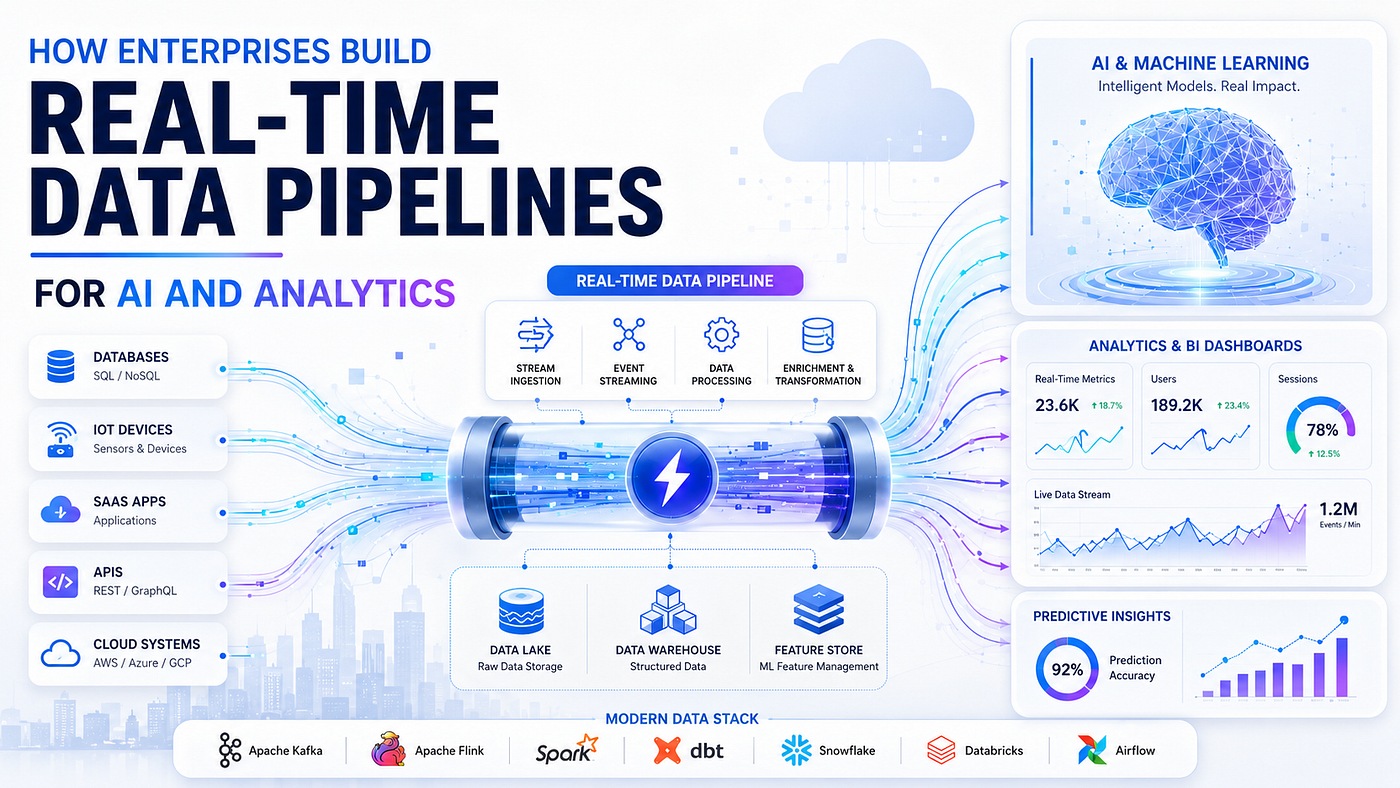
How to build a real-time data pipeline at enterprise scale: Kafka, Flink, CDC, exactly-once, schema management...