
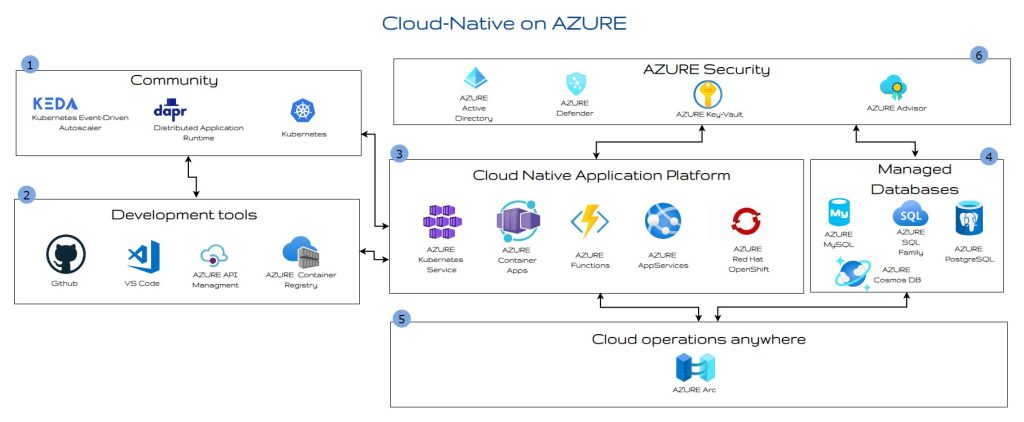
Cloud-Native Application Development: Containers, Kubernetes, and Serverless Explained
Cloud-native application development explained: containers, Kubernetes, and serverless, when each fits, and ho...
Multi-cloud vs single-cloud in 2026: drivers, lock-in, cost, and complexity, with a decision framework and what enterprise CTOs actually choose.
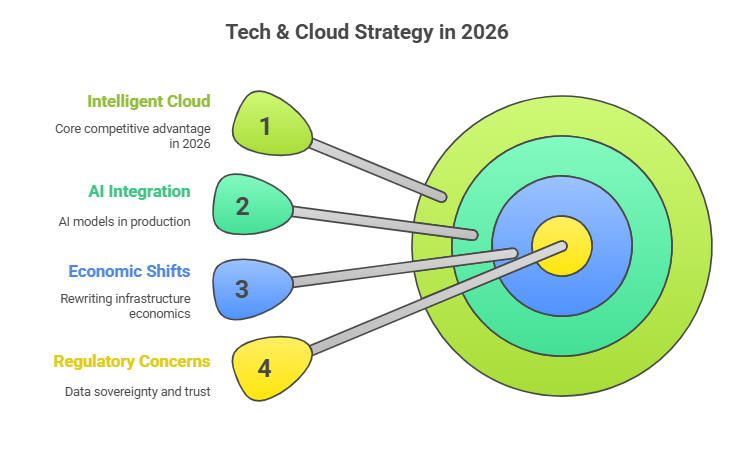
Most enterprise CTOs in 2026 are not choosing between multi-cloud and single-cloud as a binary. They are choosing a deliberate posture: a primary cloud for most workloads, with selective use of a second provider where regulation, resilience, or commercial leverage justifies the cost. The Flexera 2025 State of the Cloud report puts hard numbers behind this: 70% of organisations now run hybrid environments, the average enterprise uses 2.4 clouds, and 21% of workloads have already been repatriated from public cloud [2]. The multi-cloud vs single-cloud strategy decision is no longer about ideology. It is about matching architecture to the specific risks and costs your business actually carries.
This matters because the wrong default is expensive in both directions. Spreading every workload across three providers to "avoid lock-in" multiplies your operational surface and dilutes the volume discounts that make cloud affordable. Standardising blindly on one provider can leave you exposed when a region fails, a price increase lands, or a data-residency rule changes overnight. The right answer depends on workload economics, regulatory exposure, and the maturity of your platform team.
This guide gives senior technology leaders a decision framework, a trade-off analysis, real cost considerations, a phased roadmap, and a build-versus-buy recommendation for the abstraction layer. If you want a second opinion on your own cloud posture, our team is happy to talk through it with your engineering leads.
Key Takeaways
- The real-world default in 2026 is hybrid plus a primary cloud, not pure multi-cloud: 70% of organisations run hybrid and the average enterprise uses 2.4 clouds [2].
- Cost is the number one cloud challenge for 84% of organisations, and roughly 27% of cloud spend is wasted, so multi-cloud only pays off when the resilience or commercial benefit exceeds the duplicated operational cost [2].
- Repatriation is now mainstream: 21% of workloads have moved off public cloud, usually for predictable high-utilisation systems where owned or single-cloud hosting is cheaper [2].
- Lock-in is overstated for compute and Kubernetes (in production at 82% of organisations) and understated for managed data, identity, and networking services, which is where switching costs actually concentrate [2][3].
- Pick the narrowest strategy that meets your resilience and compliance requirements, then add providers only when a specific workload demands it.
The terms get used loosely, so it helps to separate them before choosing. The strategies sit on a spectrum, and most enterprises occupy more than one point at once.
Single-cloud means standardising on one provider (AWS, Microsoft Azure, or Google Cloud) for the large majority of workloads. You accept concentration risk in exchange for deeper discounts, simpler operations, and a smaller skills surface.
Multi-cloud means running production workloads on two or more public clouds by design. This can be active-active (the same workload spread across providers) or, more commonly, partitioned (different applications live on different clouds).
Hybrid cloud mixes public cloud with private cloud or on-premises infrastructure. This is the most common shape in practice, with 70% of organisations reporting it [2]. Repatriation, where workloads move back from public cloud to owned infrastructure, is a hybrid manoeuvre, and 21% of workloads have already made that move [2].
The distinction that matters for a CTO: multi-cloud is a deliberate architectural commitment with ongoing operational cost. Hybrid is often an outcome of legacy reality, acquisitions, and data-gravity decisions. Confusing the two leads teams to build expensive cross-cloud abstraction for what is really a hybrid hosting problem.
When CTOs do choose multi-cloud, the decision usually traces back to one or more of five concrete drivers. Naming them precisely keeps the conversation out of the abstract.
Financial services and critical infrastructure in the UK, Australia, and Singapore increasingly face supervisory expectations around concentration risk and operational resilience. The UK PRA and FCA operational resilience rules, and the EU DORA regime, push regulated firms to demonstrate they are not fatally dependent on a single cloud provider. For these organisations, a second cloud is a compliance artefact, not just an engineering preference.
Singapore, Australia, and several EU jurisdictions impose data-localisation requirements that a single provider may not satisfy across every region. A second cloud, or a sovereign cloud partner, can fill specific geographic gaps.
Some teams want Google Cloud BigQuery and Vertex AI for analytics and machine learning while keeping core applications on AWS or Azure. Pulling the best managed service from each provider is a legitimate driver, though it carries the highest hidden integration cost.
The ability to credibly threaten to move workloads improves negotiating position at renewal. This is real, but the leverage only exists if your architecture could actually move, which most cannot without significant rework.
Many enterprises are multi-cloud by accident. An acquired company runs on Azure, the parent runs on AWS, and consolidation never reaches the top of the backlog. This is the least strategic driver and the one most worth examining honestly.
The table below compares the two postures across the dimensions a CTO is actually accountable for. Treat the cost figures as directional, not absolute; they reflect industry patterns rather than a single audited source.
| Dimension | Single-cloud (primary provider) | Multi-cloud (by design) |
|---|---|---|
| Resilience to provider outage | Limited to provider's own multi-region capability | Strong if active-active; weak if merely partitioned |
| Negotiating leverage | Lower; high switching cost weakens your position | Higher, but only if workloads are genuinely portable |
| Operational complexity | Lower; one control plane, one skills profile | High; duplicated tooling, IAM, networking, monitoring |
| Cost (volume discounts) | Better; consolidated spend earns larger commitments | Worse; spend fragments across providers |
| Egress and inter-cloud data cost | Minimal between same-provider services | Significant; cross-cloud data transfer is a recurring tax |
| Talent and hiring | One certification path; easier to staff | Need expertise in two or more platforms |
| Best-of-breed access | Limited to one provider's catalogue | Full access to each provider's strengths |
| Data residency coverage | Constrained by one provider's region map | Flexible across providers and sovereign options |
| Time to value | Faster; less abstraction to build | Slower; portability layer adds engineering lead time |
The honest reading: single-cloud wins on cost, simplicity, and speed; multi-cloud wins on resilience, sovereignty, and leverage, but only when implemented deliberately. Partitioned multi-cloud, where you simply run different apps on different clouds, captures the costs of multi-cloud without the resilience benefit. That is the most common and least defensible position.
Lock-in fear drives more multi-cloud decisions than any other factor, and it is frequently misdirected. The portable layers of the stack are not where you are actually trapped.
Containers and Kubernetes have become the great equaliser. Kubernetes is in production at 82% of organisations in 2025 [3], and a well-built Kubernetes workload moves between EKS, AKS, and GKE with manageable effort. Compute, in general, is a commodity. If your concern is being unable to move your application code, that concern is mostly solved.
The deep hooks are elsewhere. Managed databases (Amazon Aurora, Azure Cosmos DB, Google Spanner), serverless event ecosystems, proprietary identity and access management, and provider-specific networking constructs are where re-platforming costs balloon. Serverless adoption underlines this: more than 70% of AWS customers used serverless services as of 2023 [4], and serverless designs are among the hardest to lift to another provider.
The practical implication: if avoiding lock-in is your goal, you get most of the benefit by standardising on portable abstractions (containers, open-source data engines, open standards for identity) on a single cloud. You do not need to run two clouds to reduce lock-in. You need to make disciplined choices about which managed services you adopt. Cloud-native patterns deserve their own treatment, which we cover in cloud-native application development.
Cost is the number one cloud challenge for 84% of organisations, and around 27% of cloud spend is wasted [2]. Adding a second cloud rarely reduces either figure; it usually worsens both unless tightly governed. Worldwide public cloud end-user spend reached $723.4B in 2025 [1], so even small percentage improvements in efficiency represent large absolute numbers for any sizeable enterprise.
The table below breaks down the cost categories that change when you move from single-cloud to multi-cloud. Figures are illustrative of direction, not precise benchmarks.
| Cost category | Single-cloud impact | Multi-cloud impact | Why it changes |
|---|---|---|---|
| Committed-use discounts | Maximised | Diluted | Spend fragments below higher discount tiers |
| Data egress and transfer | Low (intra-provider) | High (cross-cloud) | Inter-cloud traffic is billed and recurring |
| Tooling and observability | One stack | Duplicated or abstracted | Cross-cloud tooling costs more to license and run |
| Engineering time | Lower | Higher | Two control planes to learn, automate, and patch |
| FinOps overhead | Manageable | Significant | Cost allocation across providers is harder to normalise |
| Idle and waste | ~27% typical | Often higher | Fragmentation reduces visibility and rightsizing |
This is why FinOps maturity is a prerequisite, not an afterthought. 59% of organisations now have a FinOps function [2]. If yours does not, adding a second cloud before establishing cost governance is a reliable way to grow the 27% waste figure. Repatriation often follows the same logic in reverse: predictable, high-utilisation workloads with steady demand frequently cost less on owned or single-cloud infrastructure than on elastic public cloud, which is why 21% of workloads have been moved back [2].
This is the section to act on. The framework below routes each workload, not your whole estate, to the right posture. The most common mistake is choosing a single strategy for everything; mature organisations choose per workload class.
Ask these questions in order. The first "yes" usually sets your direction.
                    [ New or migrating workload ]
                              |
        +---------------------+---------------------+
        |                                           |
[ Regulatory / residency      ]            [ No mandate ]
[ mandate for diversity?      ]                   |
        | yes                                      |
[ Multi-cloud or sovereign    ]          [ Single-provider outage = ]
[ hybrid (scoped narrowly)    ]          [ unacceptable loss?       ]
                                                   |
                              +--------------------+--------------------+
                              | yes                                     | no
                  [ Active-active resilience ]              [ Best-of-breed service ]
                  [ multi-region first,      ]              [ on another cloud worth ]
                  [ multi-cloud if needed    ]              [ the integration cost?  ]
                                                                       |
                                                  +--------------------+-------------------+
                                                  | yes                                    | no
                                        [ Partition workload to       ]      [ Single-cloud default ]
                                        [ that provider deliberately   ]      [ + portable abstractions ]
Every strategy trades one risk for another. Single-cloud trades concentration risk for cost efficiency and operational simplicity. Multi-cloud trades cost and complexity for resilience and leverage. Partitioned multi-cloud, the accidental default, trades away cost and simplicity while gaining little resilience, because each application still has a single point of failure. Active-active multi-cloud earns the resilience but at the highest engineering cost, since you must keep data consistent across providers and manage cross-cloud failover that actually works under load. The discipline is to be explicit about which trade you are making for each workload, rather than letting the estate drift into the worst combination of all of them.
The dominant 2026 pattern among large enterprises is what the Flexera data describes: a clear primary cloud holding most workloads, a secondary cloud for specific needs, and an average of 2.4 clouds across the estate [2]. This is not pure multi-cloud and not pure single-cloud. It is a managed posture.
A representative shape, drawn from common enterprise practice rather than a single named company: a financial-services firm in the UK or Singapore runs its core transactional systems and customer applications on a primary cloud where it holds large committed-use agreements. It maintains a thin, regularly tested standby of its most critical customer-facing service on a second cloud to satisfy operational-resilience expectations. Its data and analytics team uses a specific best-of-breed analytics service on a third provider, accepting the egress cost as a deliberate line item. Everything else stays on the primary cloud.
Contrast that with the Amazon Prime Video engineering team's well-documented 2023 decision to move a video-monitoring service from a distributed serverless and microservices design back to a monolith, achieving a reported 90% cost reduction [5]. The lesson is not about cloud count; it is the same discipline applied within a cloud. The cheapest, simplest architecture that meets the requirement usually wins, and the instinct to distribute (across services or across clouds) often adds cost without adding value. Multi-cloud, like microservices, should be a considered choice for a specific reason, not a default posture.
If your estate has drifted into accidental multi-cloud, or you are weighing a deliberate move, the following phased roadmap brings order without a high-risk big-bang migration. Each phase is independently valuable.
Teams without the platform-engineering depth to run this often bring in an external partner for a phase or two. This is a natural fit for a dedicated engineering team or targeted staff augmentation, and it is where teams like Mind Supernova help enterprises build the FinOps tooling and portability layer without permanently growing headcount. Legacy systems caught in this transition usually need their own modernisation plan, which we cover in legacy system modernization approaches.
Most cloud-strategy failures are predictable. These are the patterns that recur across enterprise reviews.
The central build-versus-buy question in multi-cloud is whether to build your own abstraction and management layer or adopt platforms that provide it. The recommendation for most enterprises is clear: do not build a proprietary cross-cloud abstraction layer. It is a large, ongoing engineering commitment that rarely pays back, and it tends to constrain you to the lowest common denominator of features across providers.
Buy or adopt open standards and managed tooling instead: Kubernetes for portable orchestration, Terraform or OpenTofu for infrastructure as code across providers, and established observability and FinOps platforms that already speak to multiple clouds. These give you portability and visibility without a bespoke maintenance burden.
Build only the thin, business-specific glue: your deployment golden paths, your cost-allocation logic, and your failover orchestration for the specific critical workloads that require it. Keep that surface as small as the requirement allows.
| Capability | Recommendation | Rationale |
|---|---|---|
| Cross-cloud orchestration | Buy / adopt (Kubernetes) | Mature, portable, widely staffed (82% production use) [3] |
| Infrastructure as code | Buy / adopt (Terraform / OpenTofu) | Multi-provider support already exists |
| Observability and FinOps | Buy | Vendors already normalise across clouds |
| Generic abstraction layer | Do not build | High cost, lowest-common-denominator features |
| Failover for critical workloads | Build (thin, scoped) | Business-specific and must be tested |
| Deployment golden paths | Build (thin) | Encodes your conventions and guardrails |
For the data and analytics dimension of this decision, the underlying architecture of where your data lives shapes much of the lock-in calculus; that is explored in big data architecture in 2026. If you are weighing whether to staff this capability internally or partner for it, our guide on choosing an outsourcing partner without getting burned applies the same diligence to engineering partners. For organisations building a broader offshore engineering capability to own cloud and platform work, the patterns in building an offshore engineering center are directly relevant.
Only if it is active-active and tested. Multi-region within one provider often delivers comparable reliability with far less complexity. Partitioned multi-cloud, where different apps run on different clouds, gives you no resilience benefit because each application still depends on a single provider. Resilience comes from tested redundancy, not from the number of cloud vendors.
According to the Flexera 2025 State of the Cloud report, 70% of organisations run hybrid environments and the average enterprise uses 2.4 clouds [2]. So most enterprises touch more than one cloud, but the dominant pattern is a primary cloud plus selective secondary use, not equal distribution across many providers.
Partly, and mainly for compute. Kubernetes and containers (in production at 82% of organisations) move between clouds with manageable effort [3]. The real lock-in lives in managed databases, serverless ecosystems, identity, and networking. You reduce most lock-in by choosing portable abstractions on a single cloud, without running two clouds at all.
The Flexera 2025 report found 21% of workloads have been repatriated [2]. The usual reason is economics: predictable, high-utilisation workloads with steady demand often cost less on owned or single-cloud infrastructure than on elastic public cloud. Cost is the top cloud challenge for 84% of organisations, and repatriation is one lever to control it [2].
For most workloads, yes. Single-cloud maximises committed-use discounts, simplifies operations, and reduces the talent surface. Add a second cloud only where a regulator requires diversity, a critical workload needs cross-provider resilience, or a specific managed service is materially better elsewhere and worth the integration and egress cost.
The CTOs getting this right in 2026 are not picking a side in the multi-cloud versus single-cloud debate. They are matching a posture to each workload: single-cloud by default, multi-cloud where a regulator, a resilience requirement, or a specific service demands it, and repatriation where the economics favour owned infrastructure. The Flexera 2025 data confirms this is the mainstream path, with 70% hybrid, an average of 2.4 clouds, and 21% of workloads repatriated [2].
This quarter: inventory every workload, confirm or stand up your FinOps function, and surface the true cross-cloud cost picture including egress and the roughly 27% waste typical across estates [2].
Next 90 days: designate a primary cloud, consolidate accidental workloads, document the explicit reason each multi-cloud workload stays where it is, and test the failover for any workload you claim is resilient.
If you want experienced engineers to help build the FinOps tooling, the portable abstraction layer, or the tested failover for your critical workloads, schedule a call with our engineering team. We work async-first with several hours of daily UK overlap, and engineers can typically start within a week.
Cloud-native application development explained: containers, Kubernetes, and serverless, when each fits, and ho...
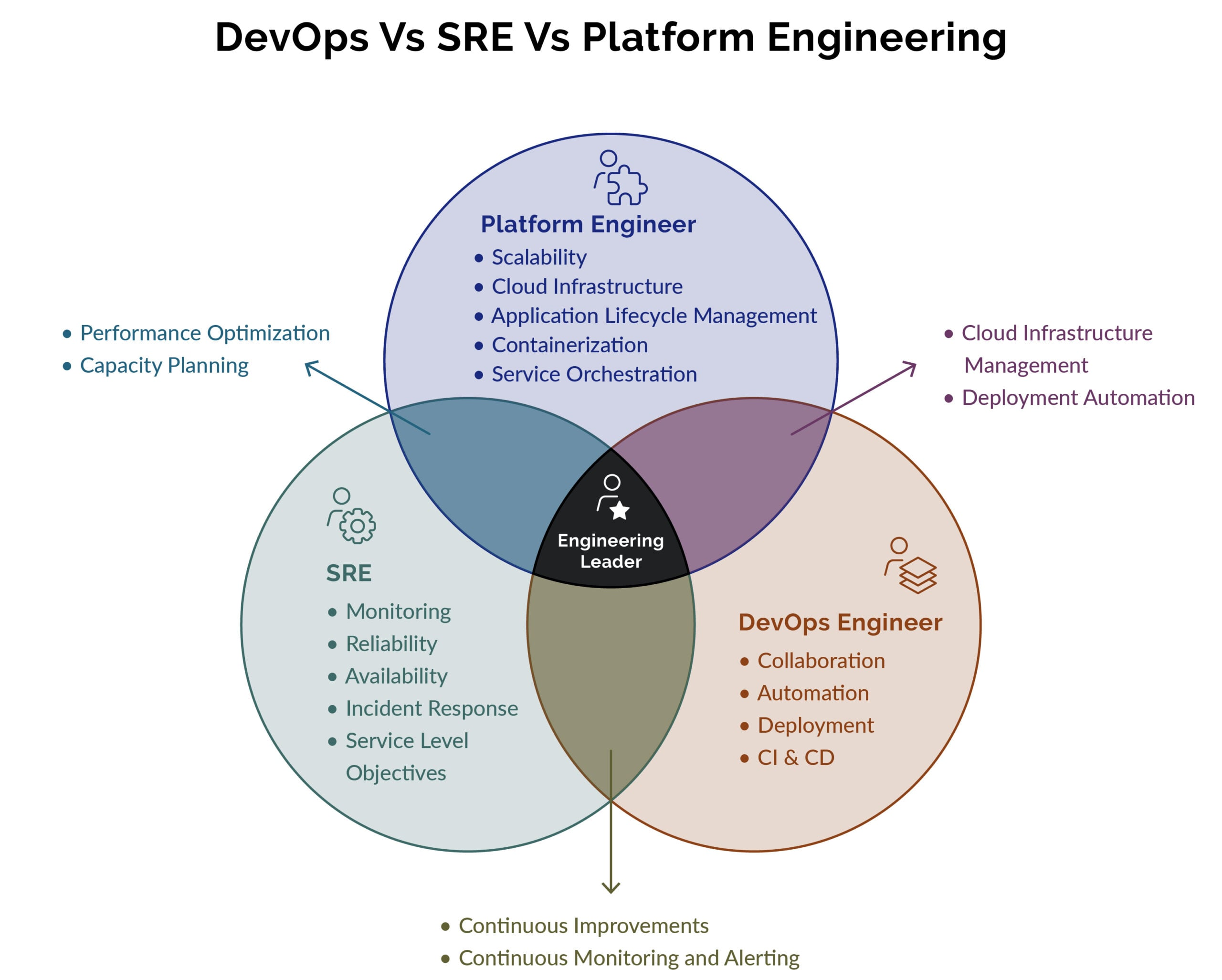
Platform engineering vs DevOps: what internal developer platforms are, when to build a platform team, and the...
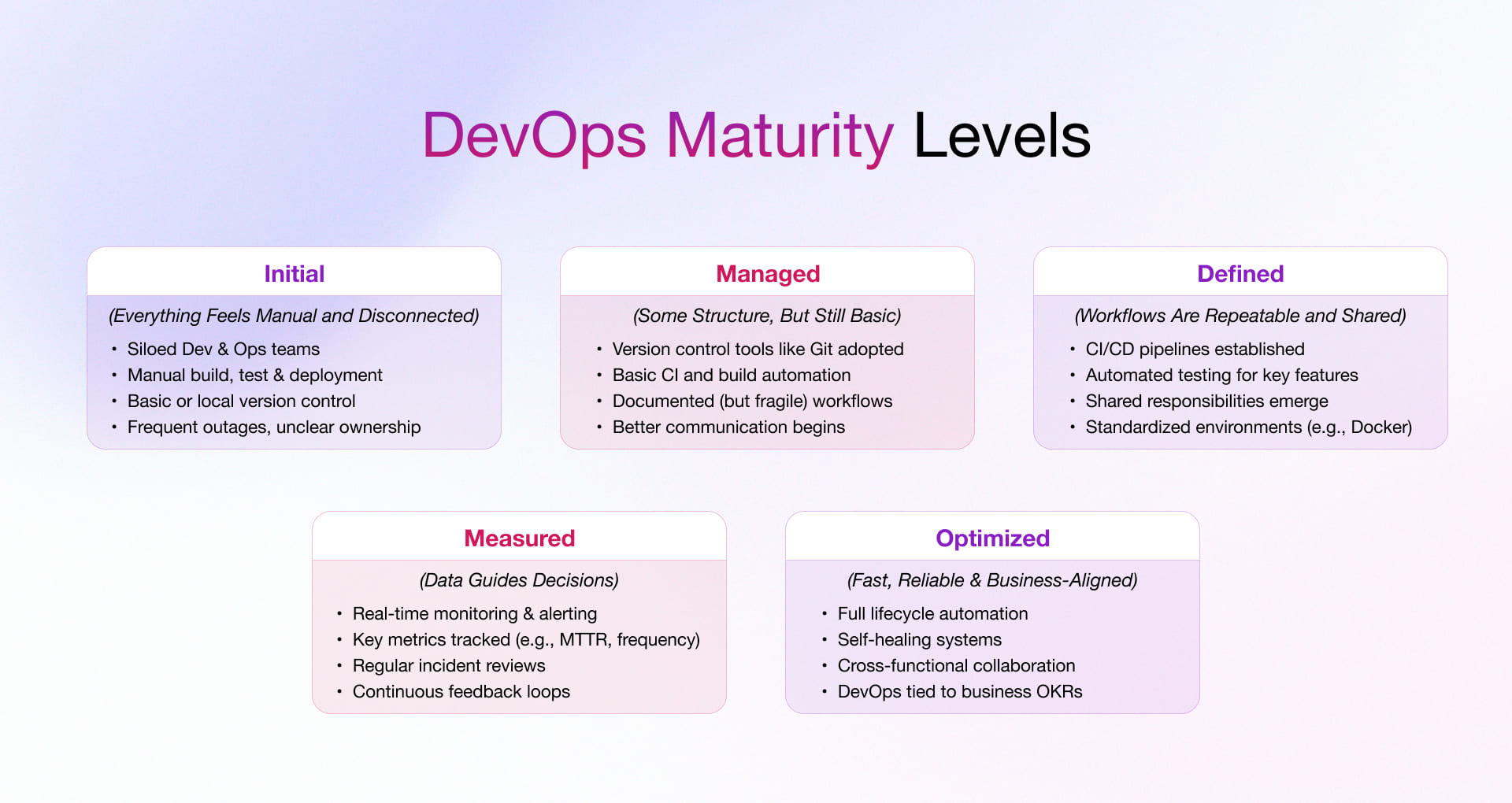
A practical DevOps maturity model and DORA metrics to assess where your engineering org stands today, plus a r...