
Clinical Operations AI Transformation: Improving Efficiency, Outcomes, and Patient Experience
How clinical operations AI transforms care delivery: ambient documentation, scheduling, patient flow, prior au...
A practical engineering and compliance guide to building HIPAA-compliant AI: PHI rules, BAAs for LLM vendors, architecture patterns, controls, and a roadmap.
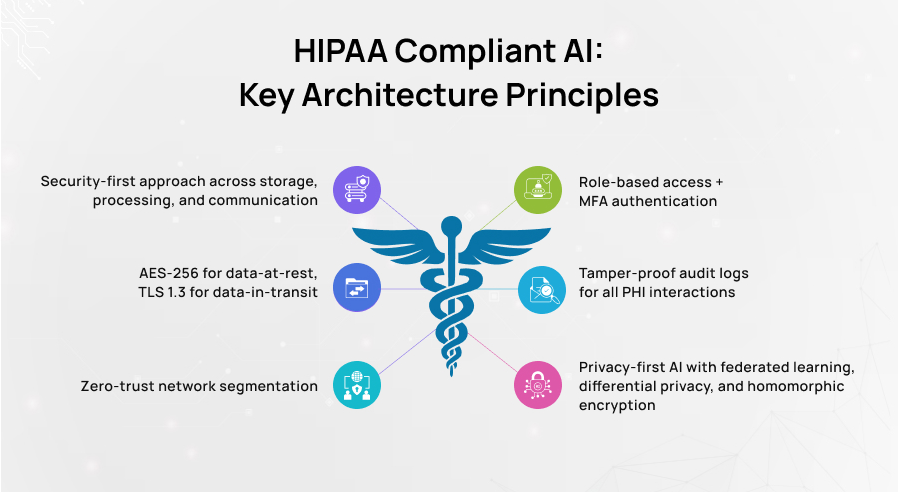
HIPAA-compliant AI is artificial intelligence built and operated so that any protected health information (PHI) it touches is handled in accordance with the HIPAA Privacy Rule and Security Rule, including signed Business Associate Agreements with every vendor in the data path, the minimum-necessary use of PHI, strong access controls, encryption, audit logging, and a documented risk analysis. It is less a product feature than a set of engineering and contractual disciplines layered around an AI system so that patient data never leaks, never trains a third party's model without authorization, and never moves outside a controlled boundary.
For healthcare CTOs, CISOs, compliance officers, and health-tech founders, the pressure is two-sided. The clinical and operational upside of AI is real and increasingly expected by boards and customers, from ambient documentation to coding to patient triage. At the same time, HIPAA enforcement carries civil penalties that scale with culpability, and the reputational cost of a breach involving an AI vendor is severe. The hard part is that large language models and many AI services were not designed with PHI in mind, so compliance has to be engineered in deliberately rather than assumed.
This guide is a practical map for building it. We cover what HIPAA actually requires of an AI system, the Business Associate problem with LLM and AI vendors and which providers will sign a BAA, the architecture patterns that keep PHI inside a defensible boundary, the access-control and audit-logging discipline regulators expect, a vendor due-diligence checklist, a phased implementation roadmap, the common pitfalls, and a short set of executive recommendations. One note up front: this is engineering and strategy guidance, not legal advice. Confirm your specific obligations with qualified healthcare counsel and your compliance team before you ship.
Key Takeaways
HIPAA requires that any AI system touching protected health information satisfy the same obligations as any other system that handles PHI: it must use PHI only for permitted purposes and only the minimum necessary, protect it with the Security Rule's safeguards, and operate under Business Associate Agreements with every external party in the data path. AI does not get a special exemption, and that is the single most important thing to internalize before building.
Start with the definition. Protected health information is individually identifiable health information held or transmitted by a covered entity or business associate, in any form. It is broader than a medical record number; it includes names, dates tied to an individual, contact details, device identifiers, and free-text clinical notes that reference a person. The moment your model's input or output can be tied back to an individual, you are handling PHI, and free-text prompts are a notorious place where PHI leaks in unnoticed.
The Privacy Rule governs how PHI may be used and disclosed. Two principles dominate AI design. First, PHI may only be used for permitted purposes such as treatment, payment, and healthcare operations, or with authorization. Second, the minimum-necessary standard requires you to limit PHI use and disclosure to the least amount needed for the task. For AI, that translates directly into architecture: do not feed an entire patient record into a prompt when a summary of the relevant fields will do, and do not retain PHI in logs or training sets you do not need.
The Security Rule applies specifically to electronic PHI (ePHI) and organizes protection into three categories of safeguards. Administrative safeguards include a documented risk analysis, workforce training, and access management policies. Physical safeguards cover facility and device controls. Technical safeguards cover access control, audit controls, integrity, authentication, and transmission security, which in practice means role-based access, audit logging, encryption, and authentication on every system that touches ePHI, including your AI services.
This matters more in 2026 than it did a few years ago. In January 2025, HHS published a Notice of Proposed Rulemaking proposing the most significant changes to the Security Rule since 2003, moving many previously "addressable" controls toward mandatory ones, including encryption of ePHI in transit and at rest, multi-factor authentication, network segmentation, and an annual written certification from business associates that they have deployed the required safeguards. The proposed rule also expects entities to fold AI-vendor risk explicitly into their security risk analysis. As of mid-2026 this NPRM is not yet final, but it signals the clear direction of travel, and building to its standard now is the prudent move.
The Business Associate problem is simple to state and consequential to solve: under HIPAA, any vendor that creates, receives, maintains, or transmits PHI on your behalf is a business associate and must sign a Business Associate Agreement (BAA) before it touches PHI, and many popular AI tools either will not sign one or only do so on specific enterprise tiers. A BAA contractually binds the vendor to safeguard PHI, restricts how it may use the data, and obligates breach notification.
The trap is that the most accessible AI products, the consumer and free tiers of chatbots and APIs, are explicitly not covered by a BAA. Pasting a clinical note into a consumer chatbot is a HIPAA violation, full stop. Compliant use requires a deliberate choice of a service and tier that the vendor will cover under a BAA, and then configuring it correctly.
The good news is that as of 2026, every major model platform offers a path to a signed BAA, though the mechanics differ. The cleanest routes are through the hyperscalers, where the cloud provider's BAA covers the AI service running inside your account.
| Provider / route | BAA available? | Notes |
|---|---|---|
| Azure OpenAI Service | Yes | Covered under the Microsoft BAA; often the default for regulated workloads because compliance coverage ships on the standard enterprise contract. |
| AWS Bedrock | Yes | Included in the AWS BAA for HIPAA-eligible accounts; PHI may be processed when the account is HIPAA-eligible and workloads run in eligible regions. |
| Google Cloud Vertex AI | Yes | Google Cloud's BAA covers Vertex AI and Gemini on Vertex, alongside the Healthcare API. |
| OpenAI (enterprise / API) | Yes, on enterprise terms | Available on enterprise tiers with data-residency options; the BAA process and indemnification terms are typically more involved than at the hyperscalers. Consumer ChatGPT tiers are not covered. |
| Anthropic (Claude) | Yes, via cloud or enterprise | HIPAA-ready Claude is available on enterprise plans and, more commonly, through AWS Bedrock, Google Vertex AI, and Azure, where the underlying cloud BAA covers the model. |
In practice, most healthcare teams run Azure OpenAI or AWS Bedrock as the primary platform because the BAA coverage is straightforward and the model stays inside their cloud tenancy. Pure-play API access tends to sit behind a separate compliance review. Whatever you choose, the rule is absolute: no PHI reaches any service, sub-processor, or logging pipeline that is not covered by an executed BAA, and you must read each BAA to confirm what it actually covers, including sub-processors and whether your data can be used to train shared models.
The architecture patterns that keep AI compliant all share one goal: keep PHI inside a controlled boundary, minimize how much of it the AI sees, and make every access provable. Good architecture does more for compliance than any policy document, because it makes the safe path the default and the unsafe path impossible.
Begin by drawing an explicit boundary around where PHI is allowed to exist and ensuring every component inside it is BAA-covered, encrypted, access-controlled, and logged. Nothing leaves that boundary unless it has been de-identified or the destination is itself inside a BAA. This boundary is the spine of the whole design; data-flow diagrams that mark exactly where PHI enters, rests, and exits are among the first artifacts your compliance team and auditors will ask for. A well-governed modern data platform makes this boundary far easier to enforce, because access policies, encryption, and lineage are applied consistently rather than per-application.
Where a use case does not strictly require identifiable data, removing PHI from the equation is the strongest control available, because de-identified data is no longer PHI under HIPAA and falls outside its restrictions. HIPAA recognizes two methods. The Safe Harbor method requires removing all 18 specified identifiers, including names, most date elements, geographic subdivisions smaller than a state (with narrow exceptions for certain three-digit ZIP areas), contact details, and biometric identifiers. The Expert Determination method lets a qualified statistician certify, with documentation, that the re-identification risk is very small even if some elements remain. For AI, this enables an entire class of lower-risk work: training, evaluation, and analytics on de-identified datasets.
Synthetic data goes a step further by generating artificial records that preserve statistical patterns without corresponding to real patients, which is valuable for model development and testing. Two cautions apply: free-text de-identification is genuinely hard, because clinical notes hide identifiers in prose, so automated redaction needs validation; and synthetic data generated from real PHI must itself be produced inside the boundary and assessed for any residual leakage of real records.
For PHI that must remain identifiable, keep the model inside your controlled cloud environment, a private deployment or a virtual private cloud (VPC) endpoint, so data never traverses a shared public endpoint. Running a model through a BAA-covered service inside your own tenancy means PHI is processed within a boundary you control and monitor. For the most sensitive workloads, some organizations self-host open-weight models in their VPC so no PHI ever leaves their infrastructure at all, trading some model capability and operational overhead for maximum control.
Retrieval-augmented generation (RAG) is the dominant pattern for letting an AI answer questions grounded in patient data, and it is also where access control becomes critical. In a compliant design, the retrieval layer enforces the same authorization the user would have in the source system, so a clinician only retrieves records they are permitted to see, and the model never receives PHI the requester is not entitled to. That means row-level and document-level access controls on the vector store and retrieval layer, not just on the application UI. Done correctly, RAG also reduces hallucination risk by grounding answers in the verified record. Our deeper treatment of enterprise RAG systems covers the retrieval and grounding mechanics; the HIPAA addition is that authorization and minimum-necessary filtering must happen before retrieval, inside the boundary.
Logs are a frequently overlooked PHI leak. Prompts and model outputs often contain PHI, and the observability, debugging, and analytics pipelines that capture them can quietly move that PHI to systems with no BAA. Compliant designs redact or tokenize PHI before it reaches general-purpose logging, restrict and encrypt any logs that must retain PHI, and keep those logs inside the boundary. The same applies to caches, telemetry, and any third-party monitoring tool.
Finally, you must contractually and technically ensure that PHI sent to a model is never used to train or improve a shared model. The BAA and the service configuration should both confirm a no-train, no-retention (or limited-retention) posture, and you should verify the actual data-handling settings rather than assuming the default. This is one of the most important questions to resolve before any PHI flows.
Access control, audit logging, and encryption are the technical safeguards the Security Rule requires, and for AI they apply not only to the data stores but to the model endpoints, retrieval layers, and logs as well. These are the controls auditors test first, so build them in from day one.
Access control should be role-based and follow least privilege, with unique user identification so every action is attributable to a person, and authorization enforced at the data layer so the AI can never surface PHI a user is not entitled to see. Audit logging must record who accessed which PHI through the AI, when, and for what purpose, in tamper-evident logs retained per policy; if a regulator or patient asks how their data was used by your AI, you must be able to answer from the logs. Encryption must protect ePHI in transit (TLS) and at rest (strong, managed keys), a control the 2025 NPRM proposes to make explicitly mandatory rather than addressable. Authentication should include multi-factor authentication for access to systems handling ePHI, also elevated toward mandatory in the proposed rule.
Two AI-specific additions deserve attention. First, monitor the AI's behavior, not just access: track prompt and output patterns for anomalies that could indicate data exfiltration or prompt-injection attempts. Second, treat the retrieval and prompt-construction layer as a security control surface in its own right, because that is where minimum-necessary filtering and authorization are enforced in practice.
Vendor due diligence for AI is where many programs succeed or fail, because the obligations flow to every party that touches PHI, including sub-processors you may not see. Before any PHI reaches a vendor, work through a concrete checklist.
Document the outcome of this review. Under both the current rule and the proposed updates, vendor risk is part of your security risk analysis, and an auditor will expect to see that you assessed each AI vendor before trusting it with PHI.
The table below summarizes the core controls, mapping each to the HIPAA requirement it satisfies and the engineering action it implies. Use it as a build-time checklist, not a substitute for your own risk analysis.
| Control | HIPAA basis | Engineering action |
|---|---|---|
| Signed BAA with every PHI-path vendor | Privacy & Security Rules | Execute BAAs before integration; cover sub-processors; verify no-train terms. |
| Minimum-necessary PHI in prompts | Privacy Rule | Send only relevant fields; summarize; avoid dumping full records into prompts. |
| PHI data boundary | Security Rule (technical) | Diagram and enforce where PHI may exist; nothing exits without de-identification or a BAA. |
| De-identification / synthetic data | Privacy Rule (de-identification) | Use Safe Harbor or Expert Determination for training, eval, and analytics where possible. |
| Private / VPC model deployment | Security Rule (transmission) | Keep identifiable PHI inside your tenancy; avoid shared public endpoints. |
| Authorization-aware RAG | Privacy & Security Rules | Enforce row/document-level access in the retrieval layer before the model sees data. |
| Prompt & log redaction | Security Rule (technical) | Redact or tokenize PHI before general logging; keep PHI logs inside the boundary. |
| Role-based access & MFA | Security Rule (access control) | Least privilege, unique IDs, multi-factor authentication on ePHI systems. |
| Audit logging | Security Rule (audit controls) | Record who accessed which PHI via the AI, when, and why; tamper-evident. |
| Encryption in transit & at rest | Security Rule (transmission/integrity) | TLS plus managed at-rest encryption with key management. |
| Documented risk analysis | Security Rule (administrative) | Assess AI-specific risks and vendors; update at least annually. |
A sound roadmap moves from low-risk, de-identified work inside a proven boundary toward PHI-in-the-loop production, building the controls and the evidence trail at each step. Sequencing keeps risk contained while the organization learns.
Most healthcare organizations will combine approaches: buy BAA-covered platform components from a hyperscaler, and build or co-develop the application layer, the data boundary, the authorization-aware retrieval, and the redaction and audit controls that are specific to their data and workflows. The model is rarely the hard part. The hard part is the compliant scaffolding around it, the boundary enforcement, the access-aware RAG, the redaction pipelines, the audit trail, and the documentation that survives an audit.
Many teams have clinical and product expertise but limited in-house AI engineering capacity to build that scaffolding to a regulated standard. This is where an experienced engineering partner earns its place. Mind Supernova works with enterprise and health-tech organizations as an Enterprise AI Engineering partner, helping teams design the PHI data boundary, build authorization-aware RAG and de-identification pipelines, deploy models inside BAA-covered private environments, and stand up the audit logging and controls that make AI defensible rather than merely demonstrable. The right partner accelerates the unglamorous middle, the integration, controls, and evidence, where compliant healthcare AI projects actually succeed or stall. For the broader governance frame around model risk, security, and compliance, our enterprise AI governance guide complements the HIPAA-specific controls here, and our overview of clinical operations AI transformation shows where these compliant applications create operational value.
The common pitfalls are predictable, and most stem from treating compliance as an afterthought rather than an architectural input. Knowing them in advance is the cheapest insurance available.
For healthcare CTOs, CISOs, compliance officers, and health-tech founders, the priorities are clear and sequenced.
An AI application is HIPAA-compliant when every vendor in the PHI path has signed a Business Associate Agreement, the application uses only the minimum necessary PHI for permitted purposes, and it implements the Security Rule's safeguards, role-based access control, audit logging, encryption in transit and at rest, and a documented risk analysis, across the data stores, model endpoints, retrieval layer, and logs. Compliance is engineered into the architecture, not added afterward.
As of 2026, the major platforms offer a BAA path. Azure OpenAI, AWS Bedrock, and Google Vertex AI cover their AI services under the cloud provider's BAA, and the enterprise tiers of OpenAI and Anthropic can sign BAAs on direct contracts (Anthropic's Claude is also covered when used through those clouds). Consumer chatbot tiers are not covered and must never receive PHI. Always read the specific BAA to confirm sub-processor coverage and no-train terms.
No. Consumer and free chatbot tiers are not covered by a Business Associate Agreement, so sending PHI to them is a HIPAA violation. Compliant use requires an enterprise service and tier the vendor will cover under a BAA, configured for no-train and PHI handling, and accessed inside your controlled boundary.
De-identification removes identifiers from real patient data, by Safe Harbor (stripping all 18 identifiers) or Expert Determination (a statistician certifies low re-identification risk), so the data is no longer PHI. Synthetic data is artificially generated to mirror statistical patterns without corresponding to real patients. Both reduce risk; de-identification still derives from real records and must be validated, while synthetic data must be generated inside the boundary and checked for residual leakage.
Enforce authorization in the retrieval layer so the system only fetches records the requesting user is permitted to see, apply minimum-necessary filtering before the model receives anything, keep the vector store and model inside a BAA-covered boundary, and redact PHI from logs. Authorization at the application UI alone is insufficient; it must be enforced at the data and retrieval layer.
No. HIPAA does not prohibit AI; it requires that AI handling PHI meet the same Privacy and Security Rule obligations as any other system, with signed BAAs, minimum-necessary use, and the required safeguards. The proposed 2025 Security Rule updates explicitly contemplate AI vendors in the risk analysis, signaling that AI is permitted when properly governed.
No. Data that has been de-identified in accordance with HIPAA's Safe Harbor or Expert Determination methods is no longer considered PHI and falls outside HIPAA's restrictions, which is why de-identification is such a powerful control for AI development and analytics. The caveat is that de-identification, especially of free-text clinical notes, must be done correctly and validated, because residual identifiers can re-expose the data.
Building HIPAA-compliant AI is an exercise in disciplined engineering, not a checkbox you buy. The Privacy Rule's minimum-necessary principle, the Security Rule's safeguards, and the requirement for a signed BAA with every vendor in the PHI path all apply the moment patient data enters an AI pipeline, and the 2025 proposed Security Rule changes only sharpen those expectations. The organizations that get this right will be the ones that make the PHI data boundary their first design decision, default to de-identified data, standardize on BAA-covered platforms with verified no-train terms, enforce authorization in the retrieval layer, redact PHI from logs, and keep an audit trail that can answer a regulator's questions.
If your team is weighing how to architect a compliant AI application or how to retrofit controls onto one already in flight, it helps to work through the design with engineers who have built governed AI in regulated environments. Mind Supernova partners with health-tech and enterprise organizations on exactly that work, the data boundaries, access-aware retrieval, de-identification pipelines, and audit controls that turn a promising prototype into a defensible production system. Wherever you start, begin with de-identified data inside a proven boundary, prove your controls, and let evidence and documentation, not optimism, set the pace. And confirm your specific obligations with qualified counsel; this guide is engineering direction, not legal advice.
How clinical operations AI transforms care delivery: ambient documentation, scheduling, patient flow, prior au...
How retailers use AI to personalize the end-to-end customer journey at scale: the enabling stack, use cases, m...
How AI supercharges embedded finance: the BaaS stack, contextual underwriting, real-time risk, agentic finance...