
Agentic AI in Banking: Beyond Chatbots to Autonomous Operations
A CIO-level guide to agentic AI in banking: high-value use cases, a human-in-the-loop reference architecture,...
How retailers use AI to personalize the end-to-end customer journey at scale: the enabling stack, use cases, measurement, privacy, ROI, and a phased roadmap.
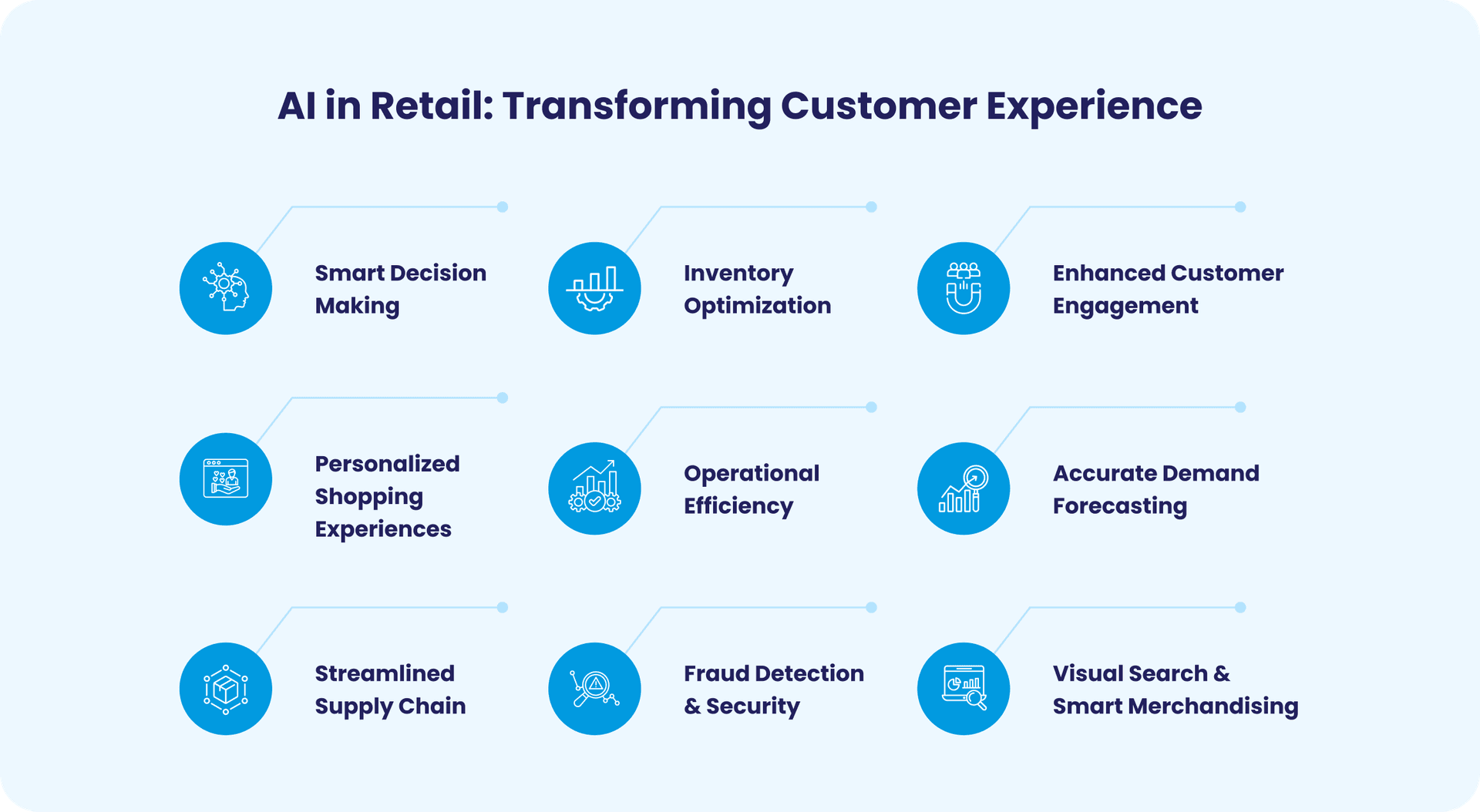
AI customer journey optimization is the practice of using machine learning, real-time data, and automated decisioning to personalize every interaction a shopper has with a brand, from the first discovery touchpoint through purchase, support, and long-term loyalty. Instead of routing customers down a handful of fixed campaign paths, AI continuously evaluates who each person is, what they are trying to do, and what action is most likely to help them, then delivers a tailored experience in milliseconds and learns from the outcome.
For retail, this is the difference between marketing to a segment and serving an individual. The old model grouped shoppers into broad buckets, "lapsed customers," "high-value loyalists," "cart abandoners", and sent each bucket the same message. The AI-driven model treats the journey as a living system in which two customers in the same campaign can experience entirely different sequences of content, offers, and recommendations because the system is reacting to their behavior as it happens.
This shift matters because customer expectations have hardened. Industry research consistently shows that the large majority of consumers now expect personalized interactions and feel frustrated when brands fail to deliver, while McKinsey has repeatedly found that personalization leaders generate roughly 5 to 15 percent revenue uplift and 10 to 30 percent improvements in marketing efficiency. The retailers pulling ahead are not simply buying more software; they are building the data foundations, decisioning logic, and operating discipline that make 1:1 personalization reliable at scale. This guide explains how.
Key Takeaways
It means treating personalization as a real-time decision rather than a pre-built campaign. In a traditional setup, a marketer designs a flow in advance: if a shopper abandons a cart, wait two hours, send email A, then email B the next day. Every shopper who triggers the rule gets the same treatment. AI customer journey optimization replaces that rigid logic with a model that scores, for each individual at each moment, which action, channel, message, and offer is most likely to move them toward a desired outcome.
Three properties distinguish the AI approach. First, it is individual-level: the unit of personalization is the person, not the segment. Second, it is real-time: decisions are made in the moment of interaction, drawing on behavior that happened seconds ago. Third, it is closed-loop: every decision produces an observed outcome, and that outcome feeds back into the model so the system gets better over time. Remove any one of these and you have a more sophisticated version of the old playbook, not a genuinely adaptive journey.
The closed loop is the part most retailers underestimate. The pattern is simple to state, read the customer profile, decide the next action, act, observe the result, update the model, but hard to operationalize because it requires data, decisioning, delivery, and measurement to be wired together rather than living in separate tools that exchange files overnight. When the loop runs inside a coherent architecture, the system learns from every interaction. When it is stitched across disconnected platforms with batch handoffs, personalization degrades into stale recommendations and the dreaded experience of being chased around the web by a product you already bought.
Personalization at scale rests on a connected set of capabilities, each handling one job in the closed loop. Treating these as a single integrated platform, rather than a pile of point solutions, is what makes real-time 1:1 possible.
A customer data platform unifies first-party data from every source, website, app, email, CRM, point of sale, loyalty program, into a single persistent customer profile. The CDP normalizes data across touchpoints and builds the unified identity graph that makes targeting viable in a world without third-party cookies. Identity resolution is the connective tissue: it stitches a shopper's activity across devices, browsers, and channels into one coherent identity, even when they are not logged in. Without reliable identity, every downstream model is reasoning about fragments rather than a person, and personalization becomes guesswork. A modern data foundation is the prerequisite here; we cover that broader architecture in our guide to modern data platforms for AI-driven organizations.
A real-time decisioning engine combines AI models, business rules, and live customer context to determine the optimal action, offer, or piece of content for an individual within milliseconds of an interaction. This is the brain of the journey. It answers questions like: given everything we know about this shopper and what they just did, should we surface a recommendation, hold back, offer a discount, or route them to support? Decisioning sits between raw data and delivery, and its quality determines whether personalization feels helpful or intrusive.
Recommendation engines predict which products a shopper is most likely to want, powering "recommended for you," "frequently bought together," and personalized search ranking. Next-best-action models go a step further: rather than only recommending products, they recommend the optimal action across the entire relationship, which might be a product, a content piece, a loyalty nudge, a service intervention, or doing nothing. The recommendation engine market has grown rapidly as retailers have realized that ranking quality directly drives conversion and average order value.
Customer journey orchestration is the layer that coordinates decisions across channels and over time, so the email, the app push, the on-site banner, and the call-center script all reflect the same understanding of the customer. Orchestration is what prevents the fragmented experiences that erode trust, the customer who gets a "win-back" offer the day after they made a purchase, or contradictory messages from different teams. Orchestration turns a set of individually smart decisions into a coherent journey.
Generative AI adds two capabilities. First, content generation at scale: producing and adapting product descriptions, subject lines, and creative variants so that personalization is not bottlenecked by how fast a content team can write. Second, conversational assistants: AI shopping helpers that answer questions, compare products, and guide discovery in natural language. To stay accurate and grounded in real catalog and policy data rather than hallucinating, these assistants increasingly rely on retrieval-grounded architectures; we explain that pattern in our piece on enterprise RAG systems. The newest frontier is agentic commerce, where AI agents act on the shopper's behalf to discover and even purchase products, a development that is part of a broader pattern of AI agents replacing traditional software workflows across industries.
AI adds value at every stage, but the specific capability and the metric that matters change as the shopper moves from discovery to loyalty. The table below maps the journey stages to the AI capabilities that drive them and the outcomes retailers should track.
| Journey stage | Primary AI capability | Example application | Outcome metric |
|---|---|---|---|
| Discovery / awareness | Look-alike modeling, content personalization, AI-assisted search | Personalized landing experiences and ranked search results for first-time visitors | Engaged sessions, bounce rate, cost per acquisition |
| Product exploration | Recommendation engines, conversational assistants | "Recommended for you," guided product finders, GenAI shopping help | Product detail page views, add-to-cart rate |
| Cart / consideration | Real-time decisioning, next-best-action | Dynamic incentives, bundle suggestions, abandonment intervention timed to intent | Cart conversion rate, average order value |
| Checkout | Friction prediction, intelligent assistance | Predicting and resolving checkout friction, proactive support prompts | Checkout completion rate, support deflection |
| Post-purchase | Journey orchestration, generative content | Personalized order updates, cross-sell timing, proactive service | Repeat purchase rate, support contact rate |
| Retention / loyalty | Churn prediction, next-best-action | Predictive win-back, tailored loyalty rewards, lifecycle nudges | Churn rate, customer lifetime value |
At the top of the journey, AI personalizes what a shopper sees before the brand knows much about them, using contextual signals, look-alike modeling, and increasingly AI-assisted search and conversational discovery. Adobe reported that traffic to US retail sites from generative AI browsers and chat services rose dramatically through 2025, and that visitors arriving from AI sources tended to browse more pages and bounce less, an early signal that AI-mediated discovery is becoming a meaningful front door to the store. Retailers that rank and present products well for these higher-intent visitors capture disproportionate value.
The middle of the journey is where decisioning earns its keep. Rather than blanketing every cart abandoner with the same discount, next-best-action models distinguish the shopper who needs reassurance from the one who needs a reminder from the one who simply got distracted, and respond accordingly, often without giving away margin. After purchase, orchestration keeps the experience coherent: order updates, relevant cross-sell timed to when the customer is actually likely to buy again, and proactive service when a model predicts a problem. This is also where poor coordination is most visible, which is why orchestration belongs in the core stack rather than bolted on later.
The highest-leverage stage is often the least glamorous. Churn-prediction and customer-lifetime-value models let retailers concentrate retention spend on the customers most worth keeping and most at risk of leaving, while next-best-action personalizes loyalty rewards and lifecycle nudges to each member. Because retained customers are far cheaper to serve than acquired ones, even modest improvements here compound. Personalization at the loyalty stage also benefits from physical-world signals; computer vision and in-store data increasingly feed the same profiles, a topic we explore in computer vision in retail store operations.
Measurement is what separates personalization that genuinely lifts the business from personalization that merely looks busy. The discipline is straightforward to describe and hard to enforce: hold out a randomized control group, run controlled experiments, and measure incremental lift rather than raw conversion among targeted users.
The trap is attribution flattery. A recommendation model will always appear to "drive" sales because it surfaces products to people already inclined to buy. The only honest way to know whether AI is creating value is to compare treated customers against a matched holdout that received the default experience, and to look at the delta. Mature retail personalization programs run a continuous calendar of A/B and multivariate tests, maintain permanent holdouts for headline metrics, and treat every model deployment as an experiment with a measurable hypothesis.
On ROI, the published evidence is encouraging but must be read with care. McKinsey's widely cited finding is that personalization can reduce acquisition costs by as much as 50 percent, lift revenue by 5 to 15 percent, and improve marketing ROI by 10 to 30 percent. Various 2025 industry surveys report that the majority of marketers see positive ROI from personalization and that a large share of retailers investing in it report strong returns. Use these as directional context for building a business case, not as guarantees; results depend heavily on data quality, the value of the products, and execution discipline. The defensible internal number is the one your own holdout tests produce.
Privacy is now a design constraint that shapes the entire architecture, not a compliance checkbox added at the end. The deprecation of third-party cookies and the tightening of regulation, GDPR in Europe, CCPA and CPRA in the United States, have pushed personalization decisively toward first-party data collected with clear consent.
Three principles guide privacy-respecting personalization. First, build on first-party data and a value exchange: collect data systematically and consensually through accounts, loyalty programs, purchase history, and on-site behavior, and give the customer a clear benefit in return. Second, make consent a first-class part of the data flow: every collection touchpoint needs transparent disclosure, and downstream activation should respect consent state, which is far easier when consent enforcement is centralized rather than scattered across tags. Server-side data collection helps here by centralizing where consent is checked and reducing reliance on browser-based tracking that regulators increasingly restrict.
Third, treat identity resolution as the engine of privacy-safe personalization, not its enemy. A well-governed identity graph built from authenticated first-party signals lets a retailer recognize and serve a known customer without third-party tracking. The flywheel is real: better identity enables better personalization, which increases the incentive for customers to authenticate, which improves identity. The regulatory stakes are not theoretical, cumulative GDPR fines reached billions of euros, so governance, data minimization, and auditable consent are board-level concerns, not just engineering details.
The most common failure mode is trying to personalize the entire journey at once across every channel. The retailers that succeed start narrow, prove the loop, and expand. A pragmatic phased roadmap looks like this.
Each phase should ship something measurable. A roadmap that spends nine months on platform plumbing before producing a single customer-facing improvement will lose executive sponsorship before it delivers value.
Most personalization programs underperform for predictable, avoidable reasons rather than because the technology failed.
The decision is rarely all-or-nothing. The customer data platform, recommendation engine, and orchestration layer are often best sourced from established vendors, the category is mature and reinventing it is poor use of engineering time. The differentiation, and the hardest engineering, lives in the integration, the decisioning logic, the data pipelines, the model operations, and the measurement framework that turn those tools into a coherent, learning journey tailored to a specific catalog and customer base.
That integration and applied-AI work is where many retailers are capacity-constrained, because it sits at the intersection of data engineering, machine learning, and real-time systems. This is the kind of work an enterprise AI engineering partner such as Mind Supernova takes on, building the data foundations, decisioning pipelines, and MLOps practices that make personalization reliable in production, while the retailer keeps ownership of strategy, brand, and customer relationships. The goal of a good partner is to accelerate the closed loop and then hand over a system the in-house team can run, not to create a permanent dependency.
For CMOs, heads of digital and CX, and retail CTOs evaluating where to invest, a few recommendations hold up across most situations.
Personalization is any tailoring of content or offers to a customer. AI customer journey optimization is the broader, real-time, closed-loop practice of using AI to decide the best next action for each individual across the entire journey, then learning from every outcome. Personalization is a tactic; journey optimization is the system that coordinates and improves those tactics.
A customer data platform (CDP) unifies first-party data from every source, web, app, email, CRM, point of sale, loyalty, into a single persistent customer profile and identity graph. It is essential because every downstream model, recommendations, decisioning, orchestration, reasons over those profiles. Without a unified profile, personalization works from fragments and produces inconsistent, often incorrect experiences.
A recommendation engine predicts which products a shopper is most likely to want. Next-best-action is broader: it predicts the optimal action across the whole relationship, which might be a product recommendation, a content piece, a loyalty offer, a service intervention, or no action at all. Recommendations answer "what to show," while next-best-action answers "what to do."
By building on first-party data collected with consent, accounts, loyalty programs, purchase history, on-site behavior, and using identity resolution to recognize known customers across devices. A CDP-based identity graph makes privacy-respecting recognition possible without third-party tracking, which also improves compliance with GDPR, CCPA, and CPRA.
Through incrementality testing. Hold out a randomized control group that receives the default experience, run controlled A/B and multivariate experiments, and measure the lift between treated and untreated customers rather than raw conversion among targeted users. This is the only way to separate genuine value from sales that would have happened anyway.
A focused first use case with a clean feedback loop, such as on-site recommendations or cart-abandonment decisioning, can show measurable lift within a quarter once the data foundation is in place. The data and identity foundation itself typically takes longer, which is why fixing identity early and shipping a measurable use case quickly matters more than attempting a full rollout at once.
Increasingly, yes. Through 2025, major platforms introduced AI shopping assistants and agent-driven checkout, and traffic from AI sources to retail sites grew sharply. Retailers should treat AI-mediated discovery and agentic shopping as an emerging front door, ensuring their product data, pricing, and policies are structured so AI assistants can represent them accurately, while continuing to personalize the journeys customers navigate directly.
AI customer journey optimization is not a single product you buy; it is a connected system, identity and data, decisioning, recommendations and next-best-action, orchestration, and generative experiences, run as a closed loop and held to the standard of incremental lift. Retailers that win at it start by fixing identity and first-party data, prove value on one well-instrumented journey moment, expand deliberately, and treat privacy and measurement as core design choices rather than afterthoughts. The technology is increasingly commoditized; the durable advantage lives in the integration and the discipline.
If your team is mapping out how to deliver this in production, the practical questions are usually about data pipelines, real-time decisioning, model operations, and measurement, the engineering that turns good tools into a learning journey. That is the work an enterprise AI engineering partner like Mind Supernova helps retailers build, with the aim of accelerating the loop and leaving the in-house team a system they can own and run. Wherever you choose to build versus partner, anchor every decision in the closed loop and incremental lift, and the rest of the roadmap tends to fall into place.
A CIO-level guide to agentic AI in banking: high-value use cases, a human-in-the-loop reference architecture,...
What an AI control tower really is, how its architecture turns fragmented data into real-time visibility and p...
A practical guide to real-time AI fraud detection for banks, fintechs, and payment firms: streaming architectu...