
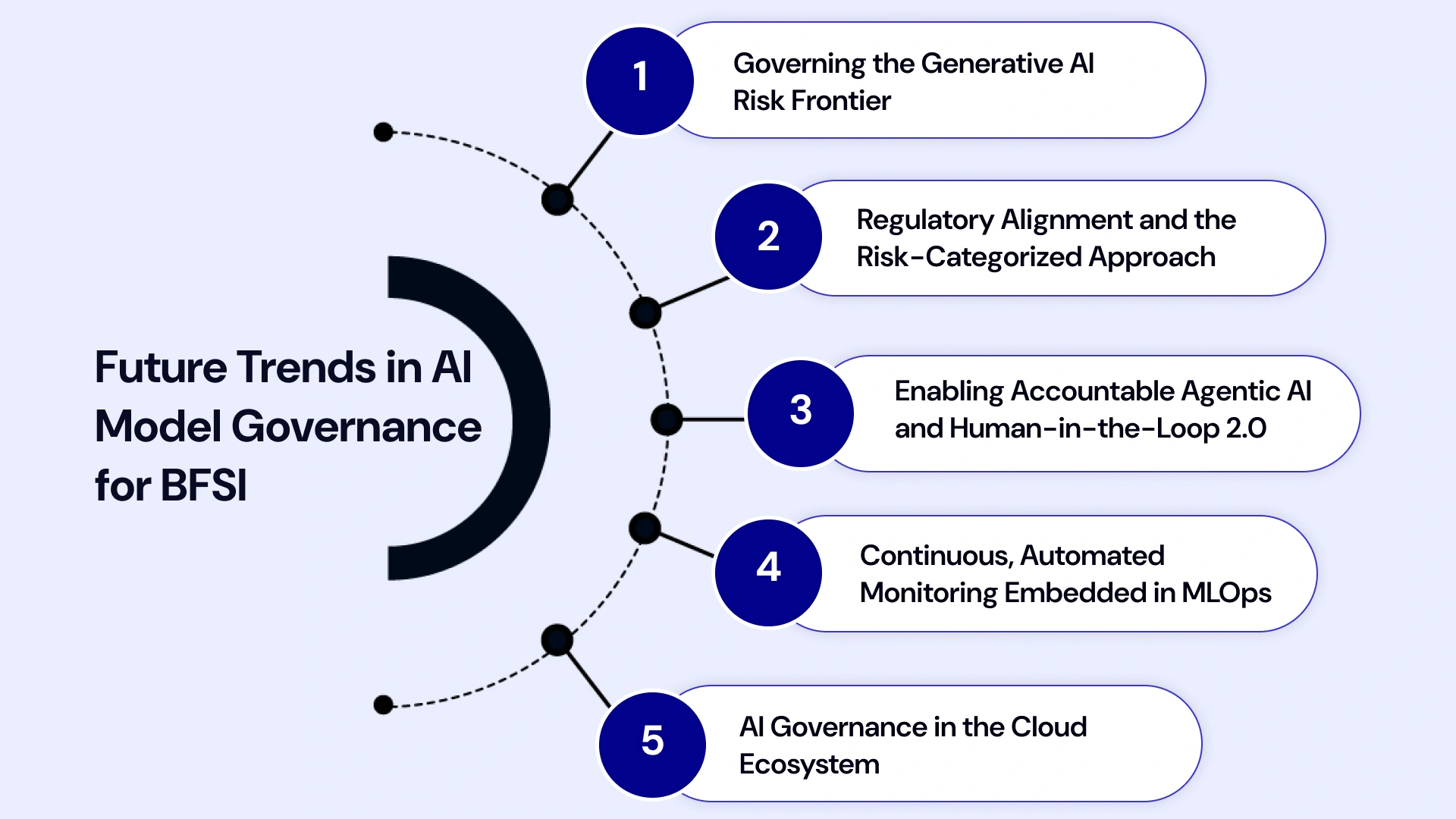
AI Governance in Financial Services: Risk, Compliance, and Innovation
A practical guide to AI governance in financial services: the FS regulatory landscape, a three-lines operating...
AI governance is now a board-level priority. Learn the frameworks (EU AI Act, NIST, ISO 42001), the top risks, and a controls checklist for 2026.
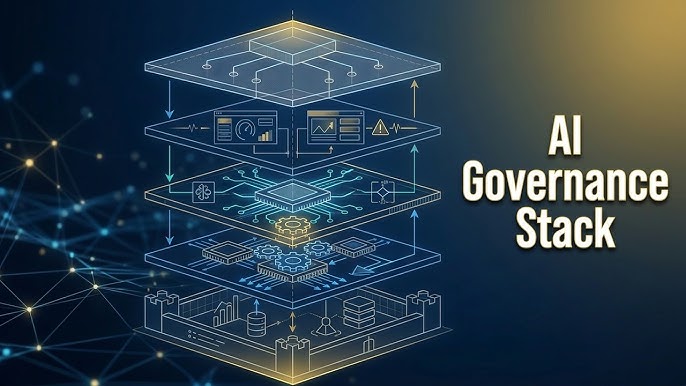
Every enterprise deploying AI in 2026 needs a governance, security, and compliance program built on four pillars: a recognized risk framework (NIST AI RMF or ISO/IEC 42001), regulatory mapping (the EU AI Act foremost), an LLM-specific threat model (OWASP Top 10 for LLM Applications), and a controls layer that catches prompt injection, data leakage, and shadow AI before they reach production. Without these, AI scales risk faster than it scales value.
That risk is no longer theoretical. Generative AI moved from novelty to daily infrastructure almost overnight, with regular use jumping from 33% in 2023 to 71% in 2024 [1]. The controls did not keep pace. Roughly 74% of organizations plan to deploy agentic AI within two years, yet only 21% have mature governance over those agents [2]. That gap is where breaches, regulatory penalties, and stalled pilots live.
This guide lays out the standards that matter, the threats they address, and a practical controls checklist enterprises can adopt now. If you want help operationalizing any of it, you can schedule a call with our team. Governance is not a document you write once. It's a system you run.

Key Takeaways
AI governance is the set of policies, controls, and accountability structures that ensure AI systems are safe, lawful, and aligned with business intent across their full lifecycle. It sits at the intersection of three disciplines that used to operate separately: data security, regulatory compliance, and model risk management. In 2026, they converge.
The pressure comes from three directions at once. Adoption is near-universal: any-AI use rose from 78% to 88% of organizations between 2024 and 2025 [6]. Autonomy is rising fast: Gartner projects that by 2028, 33% of enterprise software will embed agentic AI, up from less than 1% in 2024, and at least 15% of day-to-day work decisions will be made autonomously [7]. And regulation now has teeth.
The cost of getting this wrong is measurable. Gartner predicts that more than 40% of agentic-AI projects will be canceled by the end of 2027, citing escalating costs, unclear value, and inadequate risk controls [7]. Weak governance is not a compliance footnote. It's a primary reason AI initiatives fail to reach production.
There's an upside framing too. The organizations that capture EBIT impact from AI are the ones that redesign workflows and put controls around them, not the ones that bolt models onto broken processes [6]. Governance, done well, is a precondition for return, not a tax on it.
The EU AI Act is the world's first comprehensive horizontal AI law, and it applies extraterritorially: if your AI system's output is used in the EU, you're in scope regardless of where your company sits [8]. For international enterprises, it has become the de facto global baseline, much as GDPR did for privacy.
The Act uses a risk-tiered model. Unacceptable-risk practices (social scoring, certain biometric categorization) are banned. High-risk systems (Annex III use cases like hiring, credit, and critical infrastructure) carry the heaviest obligations: risk management, data governance, logging, human oversight, and conformity assessment. General-purpose AI (GPAI) models face transparency and documentation duties. Minimal-risk systems are largely unregulated.
The Act entered into force in August 2024. Prohibited-practice bans and AI-literacy duties have applied since February 2025. GPAI model obligations took effect in August 2025 [8]. These are not future commitments. They are current law, and enterprises should already be compliant.
Under the Digital Omnibus package, provisional as of June 2026, the high-risk Annex III obligations were deferred to December 2027, and product-embedded Annex I obligations to August 2028 [3]. This buys planning time, but it does not change the substance of what high-risk systems must eventually demonstrate. Treat the deferral as runway, not reprieve. The final text should be confirmed before you set internal milestones, since the dates remain provisional.
Practically, the smart move is to build to the high-risk standard now even if your deadline slips to 2027. The documentation, logging, and human-oversight controls that the Act demands are also good security and good engineering. You are not building compliance theater. You are building systems you can actually defend.

Regulation tells you what outcomes you must achieve. Frameworks tell you how to get there. Two dominate enterprise practice in 2026, and they are complementary rather than competing.
The NIST AI Risk Management Framework 1.0 (2023), with its Generative AI Profile added in 2024, organizes work into four functions: Govern, Map, Measure, and Manage [9]. It is voluntary, free, and widely adopted in the US and beyond. Its strength is the GenAI Profile, which spells out concrete risks like confabulation, data leakage, and harmful bias with suggested mitigations.
ISO/IEC 42001:2023 is the first certifiable AI management system standard. Where NIST gives you a risk vocabulary, ISO 42001 gives you an auditable management system you can be certified against, which matters for procurement, customer trust, and demonstrating EU AI Act diligence [8]. Many enterprises use NIST to structure the risk thinking and ISO 42001 to formalize the management system.

This is the part teams miss. NIST RMF, ISO 42001, OWASP LLM Top 10, and the EU AI Act overlap heavily. A single set of well-designed controls can satisfy several at once. The table below shows the practical alignment so you build one program, not four.
| CapabilityEU AI ActNIST AI RMFISO/IEC 42001OWASP LLM Top 10 | ||||
| Risk identification and triage | Art. 9 risk mgmt (high-risk) | Map function | Clause 6 (risk assessment) | Threat modeling per LLM risk |
| Data governance and quality | Art. 10 data governance | Govern + Measure | Annex A data controls | LLM03 supply chain, LLM06 leakage |
| Logging and traceability | Art. 12 record-keeping | Manage function | Clause 9 (monitoring) | LLM09 misinformation tracing |
| Human oversight | Art. 14 human oversight | Govern function | Annex A operational controls | LLM08 excessive agency |
| Input/output security | Art. 15 robustness | Measure + Manage | Annex A technical controls | LLM01 prompt injection |
| Transparency and disclosure | Art. 13 + GPAI duties | Govern function | Clause 7 (documentation) | LLM02 insecure output handling |
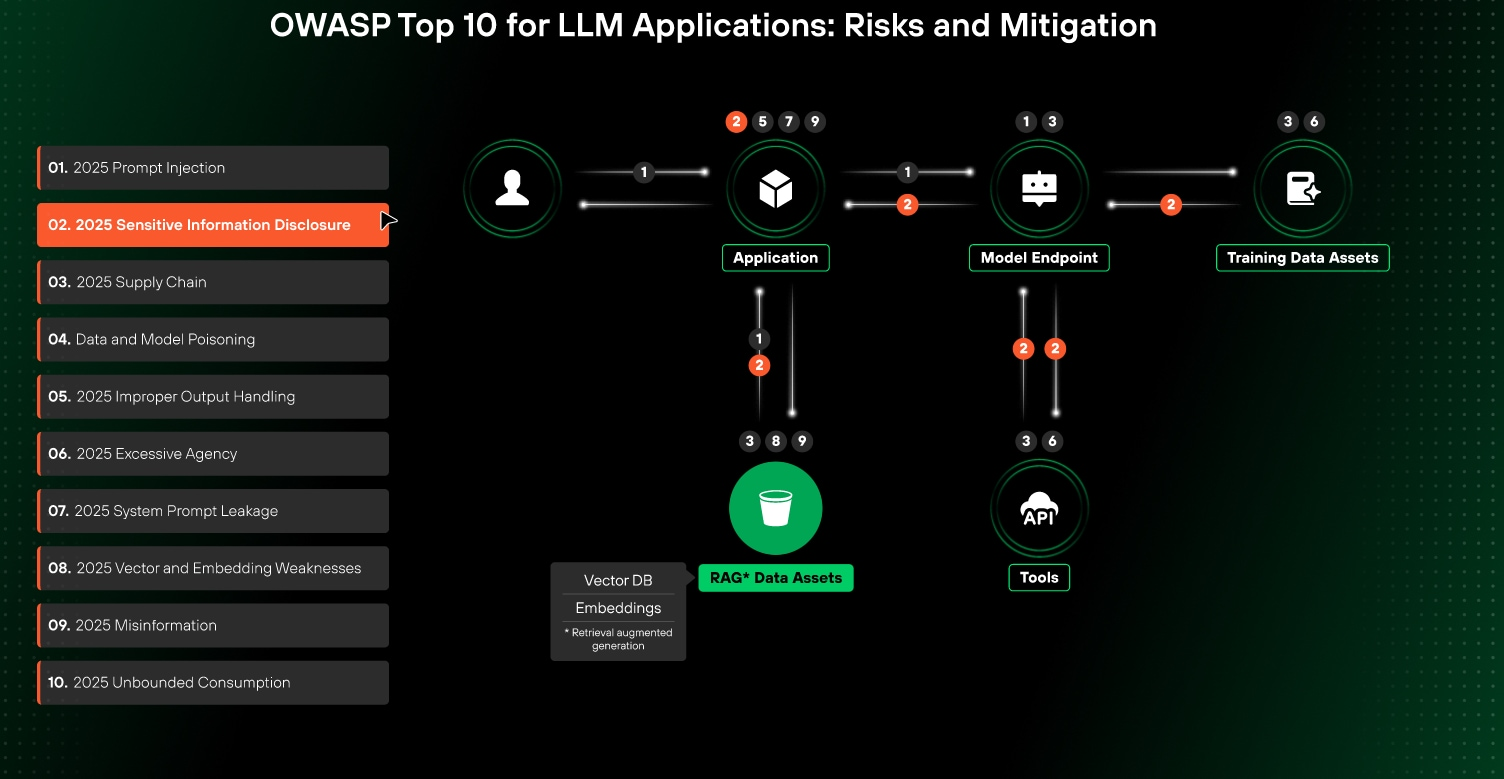
The OWASP Top 10 for LLM Applications (2025) is the canonical security checklist for generative and agentic systems [4]. Four risks deserve board-level attention because they are common, exploitable, and frequently under-controlled.
Prompt injection is the #1 risk on the OWASP list [4]. An attacker hides instructions in content the model processes, a web page, a PDF, an email, that override the system's intended behavior. Indirect injection is especially dangerous in agentic and RAG systems, where the model ingests untrusted external content and may act on it. Mitigations include input sanitization, strict output constraints, privilege separation, and treating all retrieved content as untrusted. Our deep dive on enterprise RAG systems covers grounding defenses in detail.
Models can leak training data, proprietary prompts, or data from one user's session into another's. The risk multiplies when employees paste confidential material into public chatbots. Controls include data classification, PII redaction at ingestion, output filtering, and strict tenancy isolation. Never let production secrets enter a context window you don't control.
Shadow AI is unsanctioned employee use of AI tools outside IT governance, and it's near-universal. Gartner projects that by 2027, 75% of employees will use technology outside IT visibility [5]. The danger is invisible data exfiltration: an employee uploads a customer list to summarize it, and that data now lives in a third-party model's logs. The answer is not prohibition, which fails. It's sanctioned, monitored alternatives plus discovery tooling and clear acceptable-use policy.
Hallucination (confabulation) produces confident, false output. In agentic systems, OWASP's "excessive agency" (LLM08) compounds it: an agent that can take real actions can act on a hallucination. As autonomy grows, this becomes the dominant operational risk. We explore the oversight implications in our analysis of the rise of autonomous AI systems and how AI agents are replacing traditional software workflows. The controls: retrieval grounding, confidence thresholds, human approval gates for high-impact actions, and tightly scoped permissions.
Standards are useless until they become controls someone owns. The checklist below translates the frameworks above into concrete, assignable controls grouped by lifecycle stage. Use it as a maturity baseline: score each control as absent, partial, or mature, and you have your roadmap.
| Lifecycle stageControlWhat good looks likePrimary frameworks | |||
| Govern | AI governance committee | Cross-functional body (legal, security, data, business) with a charter and decision rights | ISO 42001, NIST Govern |
| Govern | AI system inventory | Central registry of every AI system, owner, data sources, and risk tier | EU AI Act, ISO 42001 |
| Map | Risk classification | Each system tagged to EU AI Act risk tier and an internal risk score | EU AI Act, NIST Map |
| Map | Threat modeling | OWASP LLM Top 10 assessment per system before launch | OWASP, NIST Map |
| Build | Data governance | Classified, consented, lineage-tracked training and retrieval data | EU AI Act Art. 10, ISO 42001 |
| Build | Prompt injection defenses | Input sanitization, untrusted-content isolation, output constraints | OWASP LLM01 |
| Build | Access and tenancy isolation | Least-privilege agent permissions, no cross-tenant context bleed | OWASP LLM06, ISO 42001 |
| Measure | Evaluation and red-teaming | Automated eval suite plus adversarial testing pre-release and on change | NIST Measure, OWASP |
| Manage | Logging and traceability | Immutable logs of prompts, outputs, and agent actions for audit | EU AI Act Art. 12, NIST Manage |
| Manage | Human oversight gates | Approval checkpoints for high-impact autonomous actions | EU AI Act Art. 14, OWASP LLM08 |
| Manage | Shadow AI discovery | Network and SaaS monitoring plus sanctioned tool catalog | NIST Govern |
| Manage | Incident response | AI-specific runbook covering leakage, jailbreaks, and harmful output | ISO 42001, NIST Manage |
A control without an owner is a wish. Assign each row a named accountable person and a review cadence. That single discipline separates programs that pass an audit from documents that don't survive contact with reality.
Consider a European financial-services firm rolling out an autonomous customer-service agent that can read account data, answer questions, and execute low-value transactions. This is a realistic, illustrative scenario that shows the controls framework in motion, not a named client.
The system is high-risk under the EU AI Act because it touches creditworthiness-adjacent decisions, so Annex III obligations apply on the deferred December 2027 timeline [3]. The team starts governance at design, not after launch.
First, they register the system in the AI inventory and classify it as high-risk. Threat modeling against the OWASP list flags prompt injection (LLM01) as critical, because the agent reads customer messages, and excessive agency (LLM08) as critical, because it can move money. Data governance maps every field the agent can read, with PII redaction on logs.
The controls that ship: retrieved customer content is treated as untrusted and never executed as instruction; the agent's transaction permission is capped at a low monetary threshold with a human-approval gate above it; every prompt, retrieval, and action is logged immutably for Article 12 traceability; and a weekly red-team probes for jailbreaks. Six weeks in, the red team catches an indirect-injection vector in an email channel before any customer is exposed. That single catch justifies the entire program. The lesson generalizes: governance pays for itself the first time it prevents an incident you would otherwise have explained to a regulator.
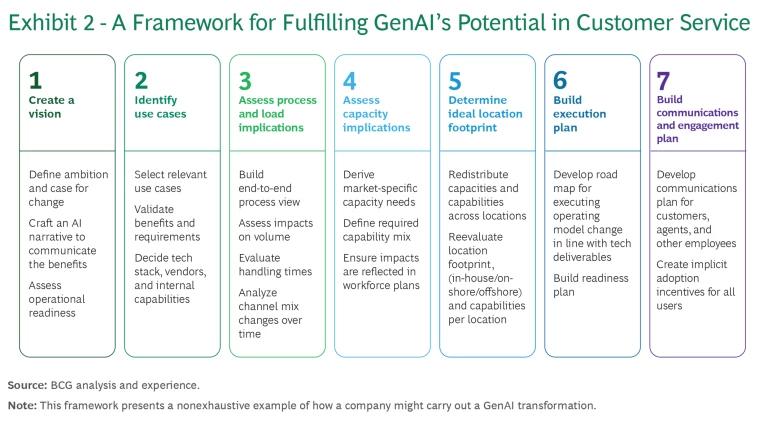
You don't need a perfect program before you ship anything. You need a credible, improving one. Here is a sequence that gets a real governance function operating in roughly a quarter.
Skills are usually the bottleneck. Across enterprises, 46% of leaders cite skills gaps as the top blocker to shipping generative AI [6], and only about 20% say their talent is highly prepared [2]. This is where the right delivery partner matters. As we cover in how to choose an AI outsourcing partner, vetting for security and governance maturity is as important as vetting for engineering skill.
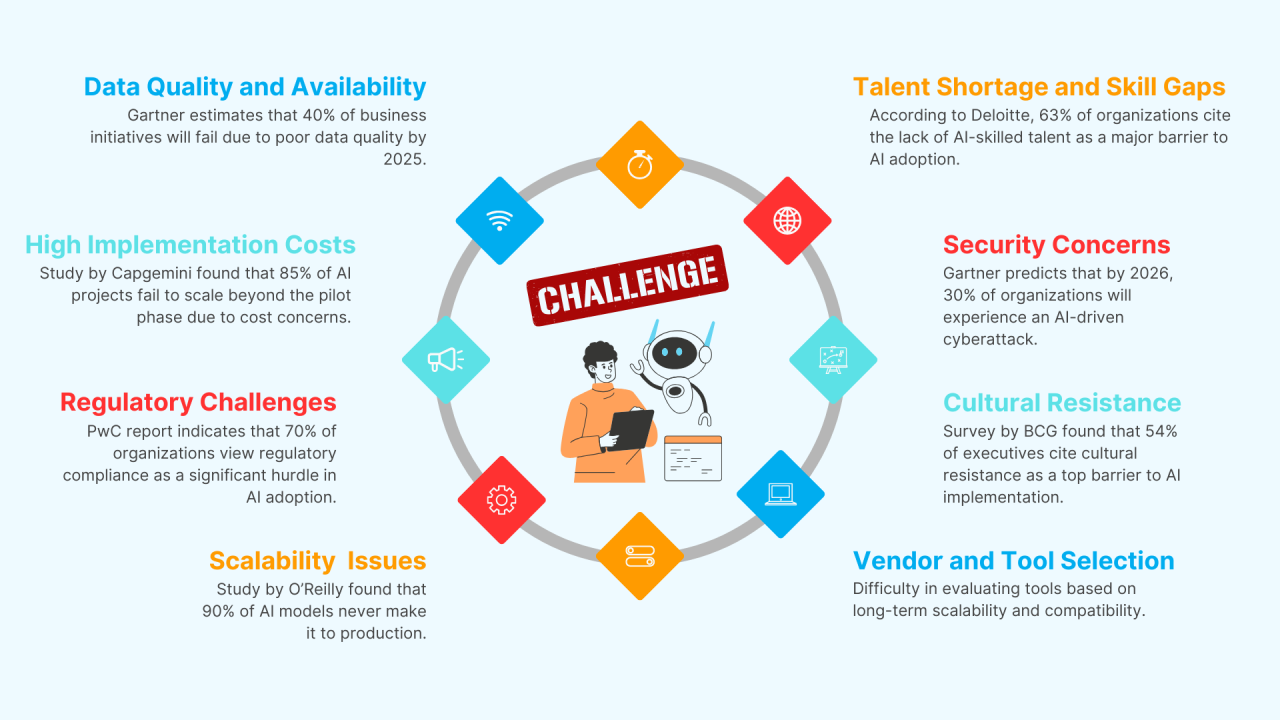
Knowing the frameworks is the easy part. Operationalizing them inside a real organization is where programs break. These are the recurring obstacles and the practical responses.
The numbers are stark: 74% of organizations plan agentic AI within two years, but only 21% have mature governance over agents [2]. The fix is to make governance a deployment gate, not a parallel workstream. No system reaches production without passing the controls checklist.
With 75% of employees expected to use tech outside IT visibility by 2027, prohibition fails [5]. The durable answer is enablement: offer fast, sanctioned tools that are better than the rogue ones, deploy discovery tooling, and write an acceptable-use policy people can actually follow.
The EU AI Act timeline shifted under the Digital Omnibus, and it remains provisional [3]. Build to the strictest plausible standard so date changes don't force rework. Good controls are stable even when deadlines move.
Governance competes for the same scarce AI engineers everyone else wants. With skills gaps cited as the top blocker by 46% of leaders [6], many enterprises augment internal teams with specialist partners. Mind Supernova, a Vietnam-based AI engineering firm founded in 2023, supports this with vetted senior engineers who can start in 5 to 7 days and async-first delivery with 4+ hours of daily UK overlap, plus a human-in-the-loop annotation workforce for the data-quality and evaluation work governance depends on. The point is not that you must outsource. It's that governance capacity, however you source it, is the constraint to solve. Our enterprise AI adoption trends analysis shows how leading firms close this gap.
AI governance is the system of policies, controls, and accountability that keeps AI safe, lawful, and aligned with business intent. Enterprises need it because adoption is near-universal while controls lag: only 21% of organizations have mature agent governance [2]. Without it, AI scales risk and regulatory exposure faster than value.
Yes. The EU AI Act applies extraterritorially: if your AI system's output is used in the EU, you are in scope regardless of where your company is based [8]. Prohibited practices and GPAI obligations are already in force, while high-risk deadlines were provisionally deferred to December 2027 under the Digital Omnibus [3].
Use both, complementarily. NIST AI RMF gives you a free, flexible risk vocabulary structured as Govern, Map, Measure, and Manage [9]. ISO/IEC 42001 gives you a certifiable management system useful for procurement and audit [8]. Map your controls to both so a single program satisfies multiple obligations.
Prompt injection ranks #1 on the OWASP Top 10 for LLM Applications (2025), where attackers hide malicious instructions in content the model processes [4]. It is especially dangerous in agentic and RAG systems that act on untrusted external content. Treat all retrieved content as untrusted and constrain outputs strictly.
Prohibition fails, since Gartner expects 75% of employees to use tech outside IT visibility by 2027 [5]. Instead, offer fast sanctioned alternatives that beat the rogue tools, deploy discovery tooling to find unmanaged usage, and publish a clear acceptable-use policy. Enablement plus monitoring beats blanket bans every time.

AI governance in 2026 is no longer a compliance afterthought. It's the precondition for shipping AI that actually returns value, given that more than 40% of agentic projects are predicted to fail partly on weak controls [7]. The enterprises that win build governance into the pipeline, not around it.
This week: stand up a cross-functional governance committee and start your AI system inventory, including the shadow tools you'll inevitably find. This quarter: classify every system against the EU AI Act, adopt NIST AI RMF or ISO/IEC 42001 as your backbone, and deploy prompt-injection defenses, logging, and human-oversight gates on your highest-risk systems first.
If you need senior AI engineers and a human-in-the-loop workforce to operationalize secure, compliant AI faster, schedule a call with Mind Supernova. Governance is a system you run, and the right team makes it run well. You can also explore our AI development services to see how we build governed systems from the ground up.
A practical guide to AI governance in financial services: the FS regulatory landscape, a three-lines operating...
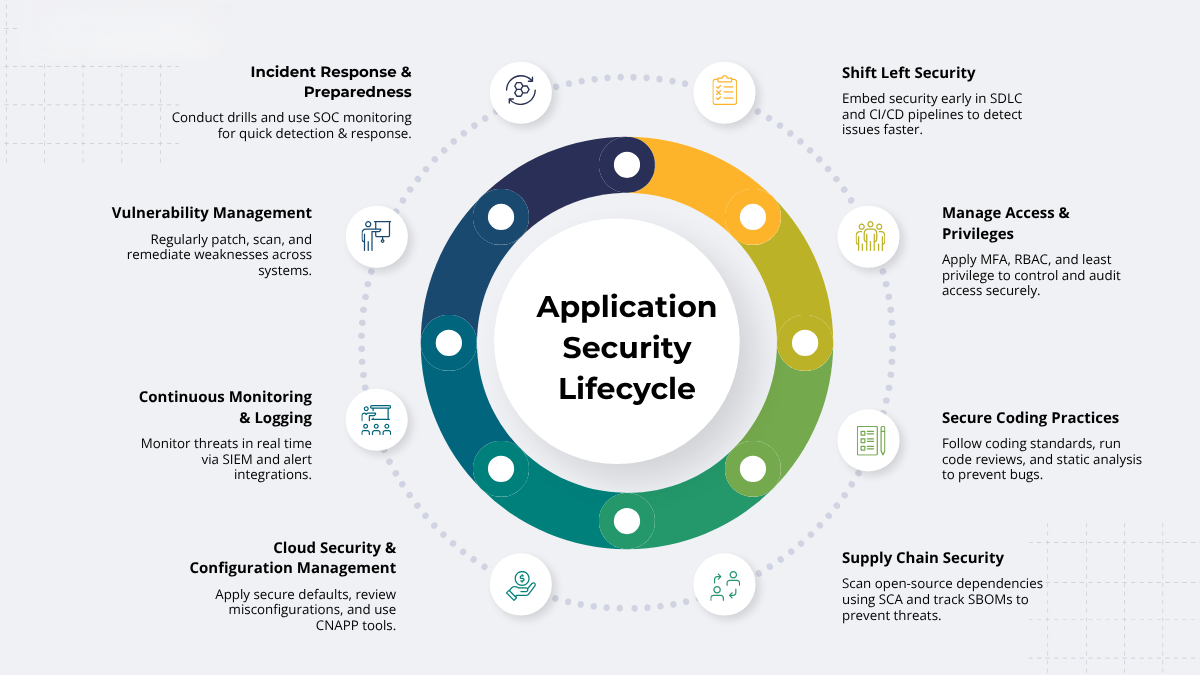
Enterprise application security in 2026: OWASP Top 10, LLM risks, STRIDE threat modeling, secure SDLC, and shi...
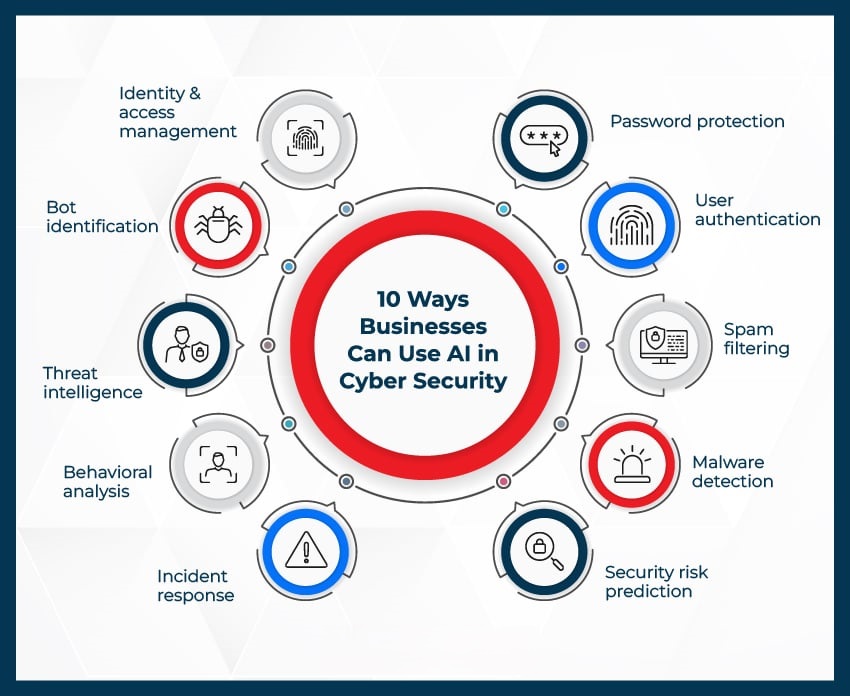
How AI is transforming enterprise cybersecurity operations: SOC automation, AI detection, SOAR, new LLM threat...