AI-Powered ERP: Moving Beyond Process Automation to Decision Intelligence
AI-powered ERP moves beyond automation to decision intelligence: agents in ERP, the data foundation required,...
Coding assistants are only the first step. Learn how AI-powered software development now spans the entire SDLC, what the productivity data actually shows, and how to roll it out safely.
AI-powered software development is the application of artificial intelligence across the entire software delivery lifecycle, not just inside the code editor. It spans requirements and specification, system design, code generation, test creation, code review, security scanning, CI/CD, incident response, and documentation. The popular framing reduces it to a coding assistant that autocompletes lines of code, but that is the smallest and least strategic part of the picture.
For VPs of Engineering, CTOs, and heads of platform, the more important question is not "should developers use a copilot?" Most already do. The real question is how AI changes the system of software delivery: the throughput of teams, the stability of releases, the cost of quality, and the governance burden that comes with letting machines write, review, and ship code. That is a far larger and more consequential conversation than autocomplete.
This article moves past the copilot-equals-autocomplete mental model. It looks honestly at what coding assistants do and do not deliver, maps AI across every stage of the lifecycle, examines the rise of agentic and autonomous development workflows, and lays out the governance, rollout, metrics, and pitfalls that determine whether AI becomes an accelerator or a liability. The goal is a clear, executive-level view you can act on without the hype.
Key Takeaways
AI-powered software development is the use of AI models and agents to assist or automate work across the software lifecycle, while a coding assistant is a narrow tool that suggests code inside the editor. The distinction matters because the two operate at completely different levels of leverage. A coding assistant speeds up the act of writing a function. AI across the lifecycle changes how requirements become specifications, how tests get written, how reviews happen, how vulnerabilities are caught, and how incidents get resolved.
Think of it as the difference between a faster typist and a redesigned assembly line. The typist is useful, but the assembly line is where the economics change. Most enterprises have adopted the typist and stopped there. According to the 2025 DORA report, AI adoption among software professionals has reached roughly 90%, with developers spending a median of about two hours a day working with AI. The tools are everywhere. The lifecycle redesign is not.
That gap is the opportunity. The organizations getting real value are not the ones with the most copilot licenses. They are the ones rethinking each lifecycle stage around what AI can now do reliably, while keeping humans firmly in control of judgment, architecture, and accountability.
Coding assistants improve individual developer experience and speed on certain tasks, but the evidence that they multiply whole-team delivery is weak and conditional. This is the most important honesty check in the entire topic, and engineering leaders who skip it tend to over-invest and under-govern.
The most-cited optimistic data comes from controlled studies. GitHub's research, including a randomized controlled trial run with Accenture and structured around the SPACE productivity framework, reported strong satisfaction and flow gains: large majorities of developers felt more fulfilled, enjoyed coding more, and reported less mental effort on repetitive tasks. Earlier internal task-based studies found developers completing isolated tasks meaningfully faster. These are real and worth having. Developer experience matters for retention and for the quality of deep work.
But satisfaction and task speed are not the same as system throughput. The 2024 DORA report surfaced a now-famous paradox: while a majority of respondents reported feeling more productive with AI, the modeling estimated that a 25% increase in AI adoption was associated with a small decrease in delivery throughput and a more notable decrease in delivery stability. In other words, individual productivity gains did not automatically translate into faster, more reliable delivery for the organization as a whole.
The 2025 DORA report refined this picture. The relationship with throughput turned positive as teams matured their practices, but the relationship with stability remained negative. The framing that stuck was that AI acts as an amplifier: in organizations with strong testing, version control, and feedback loops, AI boosts effectiveness, while in fragmented organizations it magnifies the weaknesses. AI does not fix a broken delivery system. It makes a good one faster and a bad one more chaotic.
The honest executive summary: coding assistants help developers, but they do not 10x teams. They amplify whatever engineering discipline you already have. Invest in the discipline first.
This is why frameworks like DORA (which measures delivery throughput and stability) and SPACE (which measures the human dimensions of productivity) matter more than vendor dashboards. They keep leaders focused on whether AI is improving the system, not just whether developers feel faster.
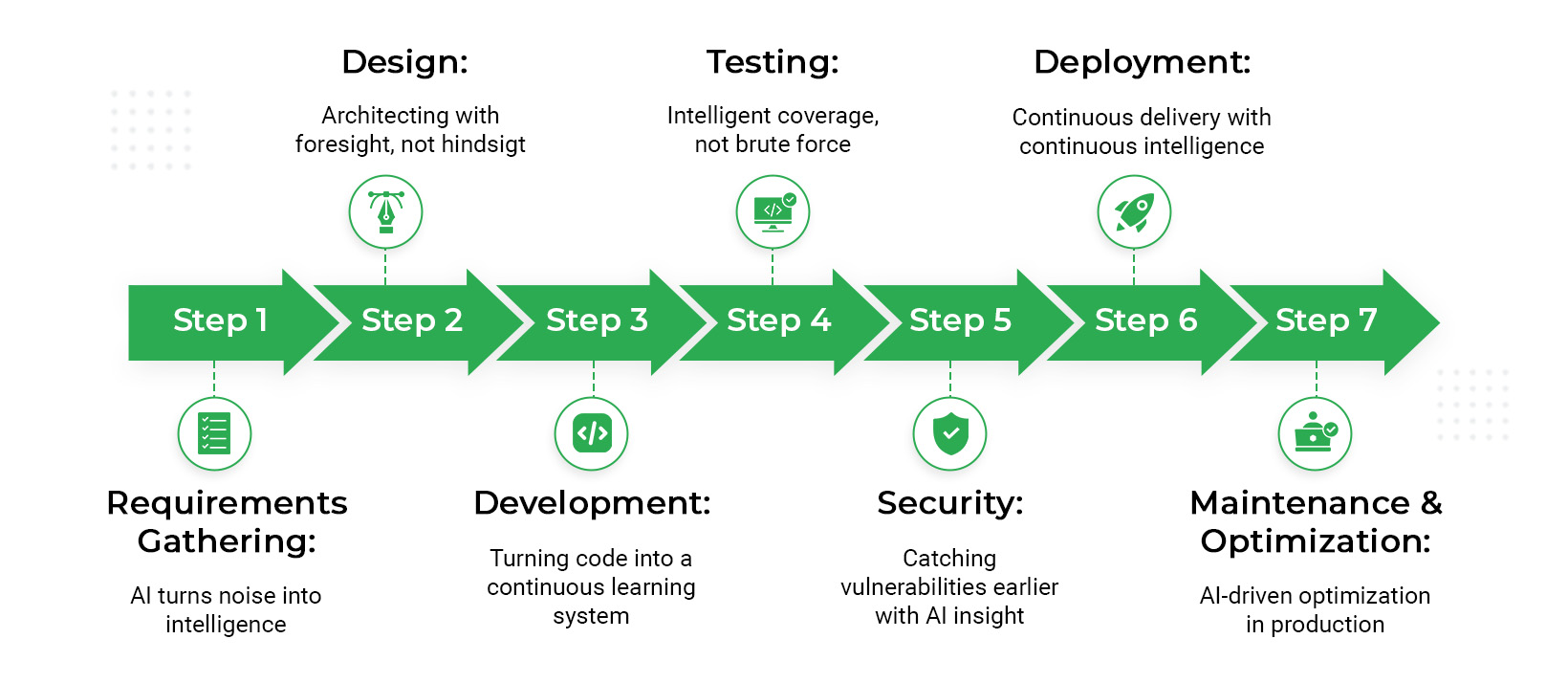
AI now has meaningful, distinct roles at every stage of the SDLC, and the value compounds when those stages are connected rather than treated as isolated tools. Below is a stage-by-stage view of where AI helps today, what it actually does, and where human judgment remains non-negotiable.
AI can turn rough product intent into structured specifications, draft user stories with acceptance criteria, identify ambiguous or conflicting requirements, and generate edge cases that humans overlook. Used well, it shortens the slow, error-prone translation from business intent to engineering-ready specs. The human role is to validate intent, prioritize, and own trade-offs. A model can draft a spec; it cannot decide what the business should build.
AI assists with design exploration: proposing architectural options, surfacing relevant patterns, drafting interface contracts, and pressure-testing a design against scalability or failure scenarios. It is a strong thinking partner for senior engineers and a useful leveler for less experienced ones. It is not a substitute for architectural ownership, because design decisions carry long-term cost and risk that require accountable human judgment.
This is the familiar copilot territory: autocompletion, function and module generation, boilerplate, refactoring, and language or framework translation. It is genuinely useful for well-bounded tasks and repetitive code. Its weaknesses are equally well known: confident-but-wrong output, subtle logic errors, outdated patterns, and a tendency to produce plausible code that does not match the real codebase. The mitigation is review and tests, not trust.
AI is increasingly valuable for generating unit tests, suggesting edge cases, building test data, and improving coverage on legacy code that was never properly tested. This is one of the highest-leverage uses, because tests are exactly the control system that keeps AI-accelerated change from destabilizing delivery. AI that writes code without AI that strengthens tests is a recipe for the DORA stability problem.
AI code review tools can flag bugs, style issues, anti-patterns, and missing tests before a human reviewer looks at the change. They reduce reviewer load and catch the obvious problems, freeing senior engineers to focus on architecture, intent, and risk. The danger is review debt: if AI generates the code and AI reviews the code, no human has truly understood the change. Human review of consequential changes remains a hard requirement.
AI augments static application security testing (SAST), dependency and supply-chain scanning, secrets detection, and vulnerability triage. It can prioritize findings, suggest fixes, and reduce false-positive fatigue. It also introduces new risks: AI-generated code can carry insecure patterns, and AI tools themselves expand the attack surface. Security review must explicitly cover AI-authored code, not assume it is clean because it looks polished.
In the pipeline, AI helps generate and maintain CI/CD configuration, analyze build and test failures, optimize pipeline performance, and assist with infrastructure-as-code. AI in DevOps is where throughput gains and stability risks meet most directly. Faster pipelines that ship more change need stronger automated gates, or they simply ship defects faster.
AI assists with anomaly detection, log and trace analysis, root-cause hypotheses, runbook generation, and faster triage during incidents. For platform and SRE teams, this is among the most promising frontiers because it directly targets stability and mean time to recovery. As with everything else, AI proposes; on-call engineers decide and act.
AI generates and maintains code documentation, API references, architecture decision records, and onboarding material, and keeps them in sync as code changes. Documentation is chronically neglected and a natural fit for AI because the cost of imperfection is low and the value of coverage is high.
| Lifecycle stage | What AI does today | Primary risk | Human stays in control of |
|---|---|---|---|
| Requirements / specs | Drafts specs, user stories, acceptance criteria, edge cases | Hallucinated or misaligned requirements | Business intent and prioritization |
| Design / architecture | Proposes options, contracts, failure-mode analysis | Plausible but unsound designs | Architectural ownership and trade-offs |
| Code generation | Autocomplete, modules, refactoring, translation | Confident-but-wrong code | Correctness via review and tests |
| Test generation | Unit tests, edge cases, coverage, test data | Tests that assert the wrong behavior | Test intent and coverage strategy |
| Code review | Flags bugs, style, anti-patterns, missing tests | Review debt and over-trust | Review of consequential changes |
| Security / SAST | Vulnerability scanning, triage, fix suggestions | Insecure AI-authored code | Security sign-off and threat modeling |
| CI/CD / DevOps | Pipeline config, failure analysis, IaC | Shipping defects faster | Release gates and rollback policy |
| Incident response | Anomaly detection, root-cause, runbooks | Misleading hypotheses | Decisions and remediation actions |
| Documentation | Code docs, API refs, ADRs, onboarding | Drift and inaccuracy | Accuracy of critical references |
Agentic software development is the use of AI agents that can plan multi-step work, use tools, read and write across a codebase, run tests, and act with a degree of autonomy, rather than just suggesting code one line at a time. This is the genuine leap beyond coding assistants. A copilot responds to your cursor. An agent takes a task such as "fix this failing test and update the affected callers," then plans, edits multiple files, runs the suite, and proposes a complete change.
The shift from suggestion to action is what makes agentic workflows powerful and what makes them risky. An agent that can run commands, modify infrastructure, and open pull requests is operating much closer to production than an autocomplete tool ever did. That is precisely why orchestration, permissions, and review gates move from nice-to-have to mandatory. For a deeper treatment of building agents that hold up under real enterprise conditions, see our guide on AI agent development for enterprises.
The connective tissue making agentic development practical is the Model Context Protocol (MCP), an open standard introduced by Anthropic in late 2024 to give AI models and agents a consistent way to connect to tools, data, and systems. Instead of every tool integration being bespoke, MCP provides a universal interface, and it has since been broadly adopted across the industry and major AI products. For development, this means agents can reliably reach version control, issue trackers, test runners, observability platforms, and internal services through a common protocol. We cover the standard in depth in our explainer on the Model Context Protocol.
Orchestration matters because real software work is multi-step and crosses many systems. An agentic workflow that implements a feature might read the ticket, query the codebase, draft an implementation, generate tests, run the suite, scan for vulnerabilities, and open a pull request for human approval. The orchestration layer decides which tools the agent may call, in what order, with what permissions, and where a human must approve before the workflow continues. Done well, this is genuine leverage. Done carelessly, it is an autonomous system making unreviewed changes to production code.
The strategic point for leaders: agentic development is not a more powerful copilot. It is a new operating model for engineering work, and it should be governed as such. The business-model implications of this shift, where capabilities are delivered as autonomous agents rather than static software, are explored in our analysis of the move from SaaS to agent-as-a-service.
Governance is the single biggest determinant of whether AI-powered software development creates value or risk, and it must cover quality, security, intellectual property, and the human review gates that keep accountability with people. The DORA finding that AI degrades stability without strong controls is, in practice, a governance finding. The controls are what convert raw AI speed into safe delivery.
Every AI-generated change should pass the same automated quality gates as human-written change, ideally stronger ones: comprehensive test suites, coverage thresholds, linting, and required passing builds before merge. Because AI increases the volume of change, the gates must be robust enough to catch a higher flow of potential defects. Weak gates plus high AI throughput is the stability problem made manifest.
AI-authored code must be treated as untrusted until reviewed. That means SAST and dependency scanning on every change, explicit checks for insecure patterns AI tends to produce, secrets detection, and threat modeling for any agent that can take actions. The AI tooling itself, including any agent with system access, must be inside your security perimeter and monitored.
AI code generation raises real IP and licensing questions. Generated code may resemble training data, and dependencies the AI introduces may carry licenses incompatible with your distribution model. Enterprises need policy and tooling for license scanning, provenance tracking where possible, and clarity on ownership of AI-assisted output. This is a legal and compliance concern, not just an engineering one, and it should be settled before agentic workflows touch shipping code.
The most important governance principle is that a human remains accountable for every consequential change. AI can draft, test, scan, and propose, but a qualified engineer approves what merges and what ships, especially for security-sensitive, customer-facing, or architecturally significant changes. The failure mode to design against is review debt: a steady accumulation of AI-generated change that no human has genuinely understood. Permissions should be scoped tightly, with agents granted the least access necessary and human approval required at clearly defined points.
A successful rollout is staged: prove value on low-risk lifecycle stages, build the governance and metrics scaffolding, then expand to higher-leverage and more autonomous workflows. Skipping straight to autonomous agents in production is the most common and most expensive mistake.
Many enterprises do not have spare senior engineering capacity to redesign their lifecycle, harden their control systems, and stand up agentic workflows safely while still shipping the roadmap. This is where an experienced engineering partner earns its place. As an Enterprise AI Engineering and AI Development partner, Mind Supernova helps engineering organizations integrate AI across the SDLC, strengthen testing and CI/CD foundations, and build and govern agentic workflows, with delivery teams that operate async-first and maintain 4+ hours of daily UK overlap. The aim is not to bolt on more tools but to make AI a reliable, governed part of how your teams build software. For the investment and build-versus-buy view of these decisions, see our CTO guide to agentic AI strategic investments.
The metrics that matter measure delivery outcomes and quality, not AI activity, because activity metrics are easy to game and tell you nothing about whether the system improved. The instinct to track AI suggestion acceptance rate or AI-generated lines of code is exactly the trap to avoid. High acceptance of bad suggestions is worse than low acceptance of good ones.
| Track these (outcomes) | Be skeptical of these (vanity) |
|---|---|
| Deployment frequency and lead time for change (DORA throughput) | Lines of code written or AI-generated |
| Change failure rate and time to restore service (DORA stability) | AI suggestion acceptance rate |
| Test coverage and defect escape rate | Number of AI tool licenses or prompts |
| Security findings caught pre-production | "AI usage hours" as a goal in itself |
| Developer experience and flow (SPACE dimensions) | Velocity / story points inflated by AI |
| Review throughput vs. review debt | Raw PR count without quality context |
Watch the balance between throughput and stability together. If AI increases deployment frequency but change failure rate climbs, you have a control-system problem, not a success. The point of measurement is to catch that early, before it shows up as production incidents and eroded trust.
The ROI is real but conditional, and it comes more from lifecycle-wide quality and cycle-time improvements than from raw typing speed in the editor. Leaders who model ROI purely as "developers code X% faster" tend to be disappointed, because that gain is the smallest and least durable component.
The durable returns come from elsewhere: faster, better test coverage that reduces defect-escape and rework; AI code review and security scanning that catch issues earlier, where they are cheaper to fix; faster incident triage that protects revenue and reputation; and documentation and onboarding that reduce the hidden tax of knowledge gaps. These compound, and they show up in DORA metrics and reduced cost of quality rather than in a simple velocity number.
Against the returns, account honestly for the costs: tooling and licenses, the engineering investment to strengthen the control system, governance and security overhead, training and change management, and the risk cost of defects or incidents from over-trusting AI. A credible ROI model nets these together and tracks them against the baseline you established before rollout. Organizations with mature delivery practices see the strongest returns, which is consistent with the amplifier framing throughout this article. AI is leverage on engineering quality, and leverage works in both directions.
The recurring failures in AI-powered software development are predictable, and most trace back to over-trust and under-investment in the control system. Knowing them in advance is the cheapest insurance available.
Engineering leaders should reframe AI from a developer tool to a lifecycle and operating-model decision, invest in the control system first, and govern adoption with outcome metrics. The following recommendations distill the article into action.
No. AI changes what developers spend time on and raises the leverage of skilled engineers, but it does not remove the need for human judgment, architectural ownership, security sign-off, and accountability for what ships. The clearest evidence is the stability data: AI accelerates change, and someone with engineering judgment has to ensure that acceleration does not break delivery. AI shifts the work toward review, design, and oversight rather than eliminating it.
They improve developer experience and speed on bounded tasks, and that is well supported by research using the SPACE framework. What is not supported is the claim that they automatically multiply whole-team delivery. Industry research, including the DORA reports, shows that individual gains translate into system improvement only when teams have strong testing, version control, and feedback loops. The honest summary is that assistants help but do not 10x teams.
A coding assistant suggests code in response to what you are typing, staying inside the editor. An AI agent plans multi-step work, uses tools, edits across a codebase, runs tests, and can take actions with some autonomy. Agents operate much closer to production and therefore require orchestration, scoped permissions, and human approval gates that a simple assistant does not.
The Model Context Protocol (MCP) is an open standard, introduced by Anthropic in late 2024 and since widely adopted, that gives AI agents a consistent way to connect to tools and data. In software development, it lets agents reliably reach version control, issue trackers, test runners, and observability systems through a common interface, which is what makes orchestrated, agentic development workflows practical at enterprise scale.
Not automatically. AI-generated code can contain insecure patterns and can introduce dependencies with vulnerabilities or incompatible licenses. It must be treated as untrusted until reviewed, with SAST, dependency and secrets scanning, and threat modeling applied to it. Any agent with system access also expands the attack surface and must sit inside your security perimeter.
Use outcome metrics: the DORA measures of throughput (deployment frequency, lead time) and stability (change failure rate, time to restore), plus test coverage, defect-escape rate, security findings caught pre-production, and SPACE-style developer experience. Avoid vanity metrics like AI-generated lines of code or suggestion acceptance rate, which are easy to game and do not indicate that the delivery system improved.
It depends heavily on engineering maturity. Organizations with strong testing, CI/CD, and review practices tend to see measurable gains relatively quickly because AI amplifies what already works. Organizations with weaker control systems often need to invest in those foundations first, which delays returns but is necessary to avoid the stability and security problems that erode any short-term speed gains.
AI-powered software development is far bigger than the coding assistant most teams have already adopted. The strategic value lies in applying AI across the entire lifecycle, from requirements to operations, and in the emerging agentic workflows that turn AI from a suggestion engine into a tool-using collaborator. But the evidence is clear and worth repeating: AI is an amplifier. It makes disciplined engineering organizations faster and exposes the weaknesses of fragmented ones. Copilots help; they do not 10x teams.
For VPs of Engineering, CTOs, and heads of platform, the mandate is therefore not to buy more AI tools but to build the system that lets AI pay off: strong testing and CI/CD, real code review, security scanning, IP governance, and metrics that measure outcomes rather than activity. Get those right, govern agentic workflows like the production-adjacent systems they are, and AI becomes durable leverage rather than a source of review debt and instability.
If your organization is working through how to integrate AI across the SDLC, strengthen its delivery foundations, or stand up governed agentic workflows without slowing the roadmap, Mind Supernova works with enterprise engineering teams as an AI Development and Enterprise AI Engineering partner to do exactly that. Wherever you are in the journey, the principle holds: invest in engineering discipline first, and let AI amplify it.
AI-powered ERP moves beyond automation to decision intelligence: agents in ERP, the data foundation required,...
How AI is reshaping the enterprise SDLC across plan, design, code, test, release, and operate, with productivi...
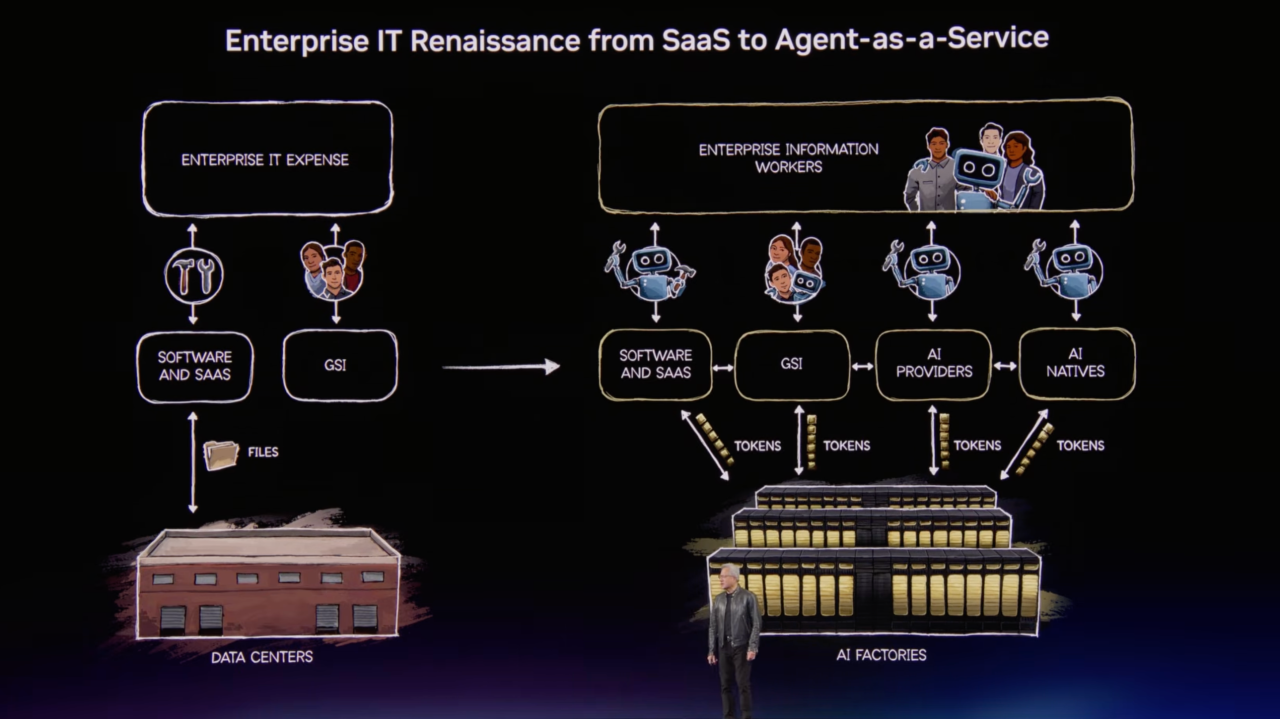
Agent-as-a-service (AaaS) sells completed work, not software seats. Here is how the SaaS-to-AaaS shift rewrite...