
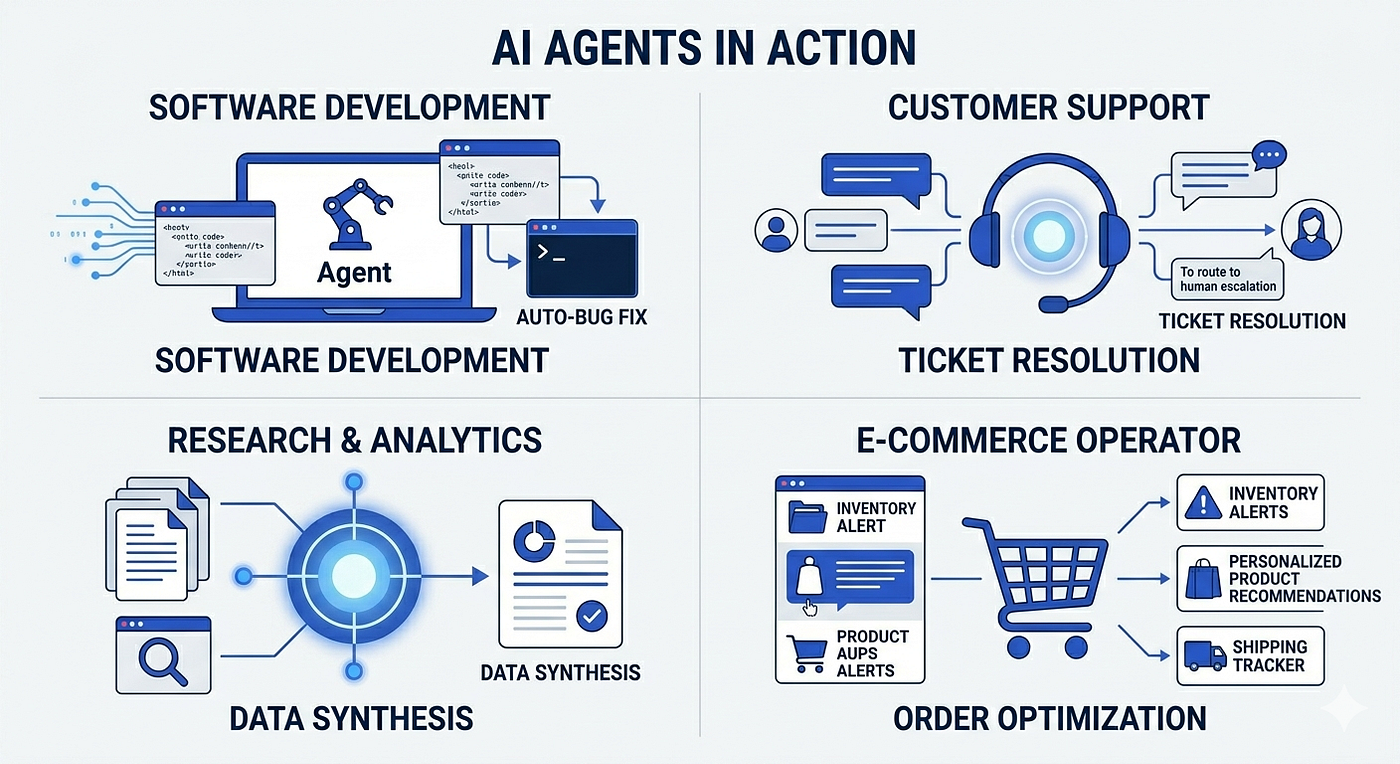
How AI Agents Are Quietly Replacing Traditional Software Workflows Across Every Industry
AI agents are automating multi-step workflows across finance, support, IT, and supply chain. Here is how they...
A strategic investment framework for CTOs evaluating agentic AI: where it actually creates value, build vs buy vs partner, total cost of ownership, the risk surface, and how to pilot.
Agentic AI for CTOs is less a technology question than an investment question: where do autonomous, goal-directed AI systems create durable value, what do they truly cost to run safely at scale, and how do you decide between building, buying, and partnering for them? This guide is a decision framework for answering those questions, not another explainer on what agents are.
If you want the crisp definition first: an agentic AI system is software that uses a large language model as a reasoning engine to pursue a goal across multiple steps, calling tools, retrieving data, and making decisions with limited human intervention. The line that matters for a CTO is autonomy. A generative AI feature produces an output for a human to act on; an agentic system takes actions on its own. We unpack that distinction and its budget implications in our guide to generative AI vs. agentic AI, so this article will not re-litigate the definition.
What it will do is give you a defensible way to allocate capital. The pressure is real: Gartner projects that up to 40% of enterprise applications will include task-specific AI agents by 2026, up from less than 5% in 2025, while also predicting that more than 40% of agentic AI projects will be cancelled by the end of 2027 because of escalating costs, unclear business value, or inadequate risk controls. Both numbers are true at once, and the gap between them is exactly where a CTO earns their keep.
Key Takeaways
Agentic AI creates the most value where work is multi-step, rule-bounded, data-rich, and measurable, and the least where autonomy is high-stakes, ambiguous, and hard to observe. The single most useful filter a CTO can apply is to separate problems by how much the cost of an error rises with autonomy.
The economic prize is large enough to demand discipline rather than dismissal. McKinsey has estimated that generative and agentic AI could unlock trillions of dollars in additional value across the economy, yet its 2025 research also describes a "gen AI paradox": a large majority of companies use the technology while a similar majority report no significant bottom-line impact yet. The value is real, but it is unevenly distributed and easy to miss by chasing the wrong use cases.
In practice, agentic investments tend to pay off in a recognizable set of patterns:
The hype, by contrast, clusters around fully autonomous agents making irreversible, high-stakes decisions without human review, such as unsupervised financial transactions, autonomous changes to production systems, or customer commitments with legal weight. These are not impossible, but they demand a level of evaluation, guardrails, and reliability that most enterprises have not yet built, and the failure cost is asymmetric. A practical rule for 2026: invest where a human-in-the-loop checkpoint is cheap and a mistake is recoverable; be skeptical wherever neither is true.
A CTO should evaluate each agentic AI investment against three gates in sequence: problem fit, organizational readiness, and data and infrastructure prerequisites. If a candidate use case fails an earlier gate, no amount of spend on the later ones rescues it.
Start with the business, not the technology. A good agentic candidate has a clearly measurable outcome (a metric that moves), a multi-step nature that genuinely benefits from autonomy rather than a single model call, a recoverable failure mode, and a volume high enough to justify the engineering and oversight cost. If the same outcome is achievable with a simpler workflow, a rules engine, or a single retrieval-augmented prompt, that is usually the better investment. Autonomy is a cost as well as a capability; only pay for it when the problem needs it.
The second gate asks whether your organization can operate the agent once it ships. That means an accountable owner outside the data science team, a human-in-the-loop process designed for the decisions the agent will make, security and risk functions engaged early, and a change-management plan for the people whose work the agent changes. Industry analyses in 2025 consistently found that pilots stall for organizational reasons, including governance friction and unclear ownership, far more often than for model limitations. Readiness is the gate most often skipped and most often fatal.
The third gate is the foundation the agent runs on: governed, accessible data; a retrieval or context layer that grounds the agent in your proprietary knowledge; identity and access controls that the agent inherits rather than bypasses; and observability so you can see what the agent did and why. McKinsey's 2025 research found that data limitations are the single most-cited roadblock to scaling agents. If your data foundation is not ready, the highest-ROI agentic investment you can make is often the platform underneath it. Our enterprise AI stack guide details the architectural layers this depends on, and the broader sequencing lives in our enterprise AI transformation roadmap.
| Gate | Core question | Green light | Red flag |
|---|---|---|---|
| Problem fit | Does this problem need autonomy? | Measurable, multi-step, recoverable, high-volume | Achievable with a simpler workflow; high-stakes and irreversible |
| Readiness | Can we operate it safely? | Named owner, HITL designed, risk engaged | No owner; governance treated as a launch gate |
| Data & infra | Is the foundation there? | Governed data, context layer, access controls, observability | Ungoverned data; agent bypasses identity controls |
You should build when the agent is core, differentiating IP or requires sovereign control of sensitive data; buy when a mature platform already solves a common problem well; and partner when you need to move fast on a custom build but lack the specialist capacity to do it safely in-house. Most enterprises end up with all three across their portfolio, and the mistake is applying one answer everywhere.
The economics are more subtle than vendor pitches suggest. Buying typically compresses time-to-value from many months to weeks and removes infrastructure maintenance from your plate, which makes it the right call for the large majority of common, non-differentiating use cases. But the simple year-one comparison is misleading: building often looks cheaper in year one because internal engineering time is treated as free, while buying looks expensive because the license is the only number on the page. By year three those patterns can reverse, especially at high volume where per-seat or per-action licensing compounds. The honest comparison is a three-year TCO, not a first-invoice comparison.
| Approach | Best when | Strengths | Watch-outs |
|---|---|---|---|
| Buy (platform/SaaS agent) | Common problem; not differentiating; speed matters | Fast time-to-value; vendor maintains infra and evals | Vendor lock-in; data residency; per-action cost at scale; limited control of guardrails |
| Build (in-house) | Core IP; sovereign data control; deep customization | Full control of behavior, data, and economics; differentiation | Talent scarcity; long time-to-value; you own all the operating burden |
| Partner (specialist engineering) | Custom build needed fast; in-house capacity is the constraint | Speed of build plus capability transfer; de-risks foundation | Requires clear IP ownership and an exit-to-in-house plan |
A practical heuristic: buy the commodity, build the crown jewels, and partner for the gap between the two. The agent that encodes your proprietary process or touches your most sensitive data is worth owning. The agent that summarizes meetings or drafts routine replies is worth renting. And when a differentiating build is on the critical path but you cannot hire senior AI engineers fast enough, a delivery partner that builds production-grade systems and transfers capability to your team is often the fastest safe route. This is the role Mind Supernova plays for enterprise clients as an Enterprise AI Engineering and AI Development partner: standing up the data and evaluation foundation, engineering production-grade agentic and RAG systems, and leaving a stronger in-house capability behind rather than a dependency.
The total cost of ownership of an agentic AI system is dominated by integration, human oversight, and evaluation, not by model inference, which is why so many budgets underestimate it. Industry analyses in 2025 and 2026 repeatedly warned that enterprises underestimate true TCO by a wide margin, often because they price the model and the license while ignoring the operating model around it. Treating tokens as the main cost is the single most common budgeting error.
A complete TCO model for an enterprise agent spans six categories:
| Cost category | What it covers | Why it is underestimated |
|---|---|---|
| Model / inference | LLM API calls or hosted model compute, including multi-step reasoning and tool calls | Agents make many model calls per task; reasoning loops multiply token use versus a single prompt |
| Infrastructure | Orchestration, vector and context stores, hosting, networking, scaling | Treated as a one-time setup rather than an ongoing run cost |
| Integration | Connecting the agent to systems of record, APIs, identity, and legacy tools | Often the largest single line; integration and QA can dominate enterprise build cost |
| Human oversight | Review of agent actions, escalation handling, exception management | The point of agents is autonomy, so oversight cost is assumed away, then reappears in operations |
| Evaluation & monitoring | Eval harnesses, regression testing, drift detection, observability, red-teaming | Skipped in pilots; non-negotiable in production for any risk-aware enterprise |
| Governance & compliance | Risk reviews, audit logging, documentation, data governance maintenance | Recurring, not one-time; grows with regulatory scope and agent count |
Two patterns deserve a CTO's attention. First, ongoing cost is driven by operations and governance more than by consumption, which means the cheapest model rarely produces the cheapest system. Second, cost scales with autonomy and action volume, not just user count, so an agent that takes ten actions per task costs very differently from one that answers a single question. Build the TCO model before you commit to a use case, include the human-in-the-loop explicitly, and apply FinOps discipline to inference and orchestration so a profitable pilot does not become an unprofitable product.
The risk surface of agentic AI is genuinely larger than that of generative AI because agents take actions, hold privileges, and chain steps, which turns a bad output into a bad action. A CTO evaluating agentic investment has to price this risk, not just the upside. The good news is that the threat landscape is now well documented; the bad news is that most enterprises have not yet built the controls.
In December 2025 the OWASP GenAI Security Project published a Top 10 for agentic applications, developed with input from over 100 security researchers, that maps the new failure modes. The categories every CTO should recognize include:
Beyond individual threats sits a structural one. As agents proliferate, enterprises accumulate ungoverned, redundant, and unmonitored agents, each holding credentials and taking actions, a phenomenon increasingly called agent sprawl. It is the agentic-era version of shadow IT, and it expands the attack surface and the compliance burden quietly. The defense is an agent inventory and registry, ownership for every agent in production, and a lifecycle process to retire agents that are no longer needed, established before the portfolio grows rather than after.
The practical takeaway is that guardrails belong outside the model and independent of it: input and output filtering, least-privilege scoped credentials, human approval for high-impact actions, sandboxing of tool execution, and continuous monitoring. Our guide on how to prepare for the agentic AI revolution covers the organizational side of building this readiness.
Most enterprises are not yet ready to operate agentic AI at scale, and the binding constraint is usually talent and operating model rather than technology. The skills that matter for agents go beyond model fine-tuning to include agent orchestration, tool and API integration, evaluation engineering, and AI security, a combination that is scarce and expensive in every market.
Readiness has three dimensions a CTO should assess honestly:
The talent math pushes most enterprises toward a blend: build durable strategic capability in-house, while using partners to fill scarce specialist skills and clear the backlog of stalled pilots. Trying to hire an entire agentic engineering org from scratch typically delays the foundation past the point where executive patience and the mandate survive.
A high-signal agentic pilot is designed from day one to reach production, tied to a specific business metric, and bounded so the organization can actually finish it. The pilots that filled the proof-of-concept graveyard were science experiments; the ones that pay off are production rehearsals.
Run agentic pilots against a short, strict checklist:
The metric that separates serious programs from theater is the share of pilots that reach production with a measured business result. If that number is near zero after a year of activity, the problem is almost never the models.
Agentic programs fail in predictable ways. The pitfalls below account for a large share of the cancellations Gartner anticipates:
For CTOs ready to act, the decisions that matter most are few and concrete:
When evaluating an agentic AI vendor or platform, the questions below separate substance from slideware:
Agentic AI is software that uses a large language model to pursue a goal over multiple steps, calling tools and making decisions with limited human intervention. For a CTO, the defining feature is autonomy: where a generative AI feature produces an output for a person to act on, an agent takes actions itself, which is why it carries both more value potential and more risk.
Apply three gates in order: problem fit (is the work multi-step, measurable, and recoverable, and does it genuinely need autonomy), organizational readiness (is there an owner, a human-in-the-loop process, and risk engagement), and data and infrastructure prerequisites (governed data, a context layer, access controls, and observability). Fund only the use cases that clear all three.
Buy when the problem is common and not differentiating and speed matters; build when the agent is core IP or requires sovereign control of sensitive data; and partner when you need a custom build fast but lack in-house capacity. Most enterprises do all three across their portfolio. Compare options on a three-year total cost of ownership, not a first-year price, because build often looks artificially cheap and buy artificially expensive in year one.
More than the model. A realistic total cost of ownership spans inference, infrastructure, integration, human oversight, evaluation and monitoring, and governance. Integration and oversight frequently dominate, and ongoing cost is driven by operations rather than token consumption. Many enterprises underestimate total cost significantly by pricing the license and ignoring the operating model around it.
The largest are prompt injection and goal hijacking, tool misuse, identity and privilege abuse, memory poisoning, reliability and cascading failures, and compliance exposure, all catalogued in the 2025 OWASP Top 10 for agentic applications. A structural risk is agent sprawl, where ungoverned agents accumulate. The defenses are guardrails independent of the model, least-privilege access, evaluation, and an agent registry with clear ownership.
Far fewer than are started. Industry analyses in 2025 found a large majority of enterprises experimenting with agents but only a small fraction scaling them to tangible value, and Gartner expects more than 40% of agentic AI projects to be cancelled by the end of 2027. Most failures stem from evaluation gaps, governance friction, and unclear ownership rather than model limitations, which is why pilot design and readiness matter more than model choice.
Usually, yes. Beyond a model, agents need orchestration, a retrieval or context layer, identity-aware access controls, evaluation harnesses, and observability. If your data foundation is not governed and accessible, the highest-return agentic investment is often the platform underneath the agents rather than the agents themselves.
Agentic AI is one of the most consequential technology bets a CTO will make this decade, and the difference between a bet that pays off and one that gets cancelled is rarely the model. It is the discipline applied to the decision: choosing problems that genuinely need autonomy, modeling the true cost of ownership rather than the license, designing guardrails and least-privilege access from the start, building the evaluation that earns trust, and deciding deliberately what to build, what to buy, and where to partner. The enterprises pulling ahead are not the ones running the most agents; they are the ones running a few that clear every gate and reach production safely.
If your organization is weighing where to place its agentic bets and how to deliver them without overextending a scarce engineering team, the most valuable next step is a clear-eyed assessment of which use cases pass the three gates and where your real constraint sits, whether that is data, platform, talent, or governance. When the constraint is engineering capacity, a partner like Mind Supernova can help build the foundation and the first production agents while your team owns the strategy around them. The framework is knowable. The advantage goes to the CTOs disciplined enough to apply it.
AI agents are automating multi-step workflows across finance, support, IT, and supply chain. Here is how they...
Autonomous AI systems are moving from pilots to operations. Learn the levels of autonomy, the operational impa...
Generative AI creates content; agentic AI takes actions. This comparison shows the capabilities, costs, risks,...