Custom ERP vs Off-the-Shelf Solutions: When SAP and Oracle Are Not the Right Answer
Custom ERP vs off-the-shelf SAP and Oracle: when packaged ERP fails, the composable alternative, and a clear b...
How AI is reshaping the enterprise SDLC across plan, design, code, test, release, and operate, with productivity data and governance guidance.
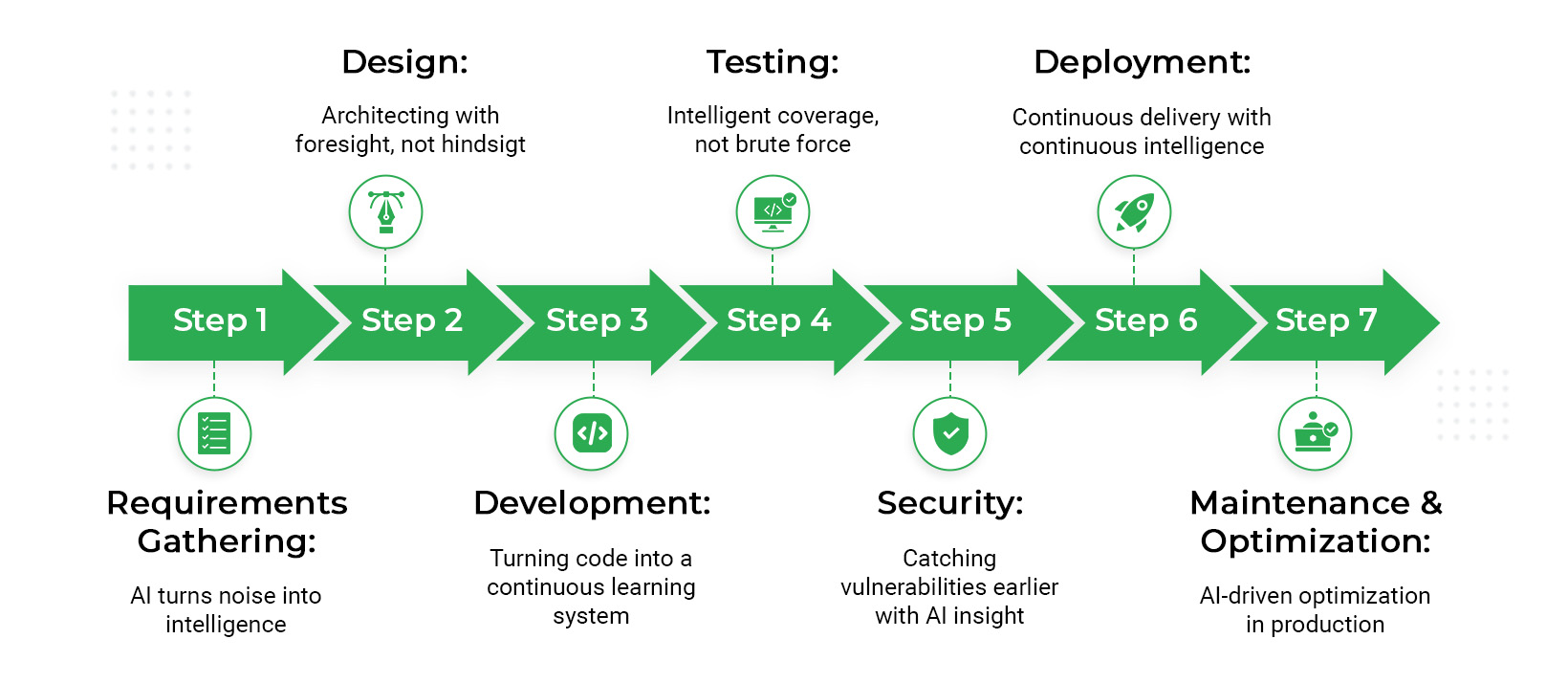
AI is reshaping the enterprise software development lifecycle by injecting machine assistance into every stage, from planning and design through coding, testing, release, and operations, not just the code editor. The headline metric everyone quotes (GitHub Copilot users finishing a task 55% faster in a lab study [10]) describes a single keystroke-level moment. The harder, more valuable question for technology leaders is what happens to the whole SDLC, and to the organization that runs it, once AI touches every phase.
This article takes the lifecycle view. We walk each stage, weigh the productivity claims against the uncomfortable DORA 2024 evidence, and lay out the governance, organizational, and build-vs-buy decisions that actually determine whether AI accelerates delivery or quietly erodes it. If you want a focused treatment of coding assistants specifically, read our companion piece on AI-powered software development beyond coding assistants. Here we deliberately zoom out to the operating model.
The audience here is the CIO, VP of Engineering, or Head of Platform deciding where to invest, what to govern, and how to restructure teams. Teams like Mind Supernova, a Vietnam-based software engineering partner founded in 2023, increasingly help enterprises wire AI into their delivery pipeline rather than into a single tool, so the framing throughout is practical and lifecycle-wide. Want to pressure-test your own SDLC plan? Schedule a call with our engineering team.
Key Takeaways
- AI now touches all six SDLC stages (plan, design, code, test, release, operate); treating it as a coding-only tool leaves the biggest value (requirements, testing, and operations) on the table.
- The 55% Copilot speed-up is a lab task-completion figure [10], not a delivery-throughput figure. DORA 2024 found each 25% rise in AI adoption correlated with roughly a 1.5% drop in throughput and a 7.2% drop in stability [4].
- Trust is the bottleneck: about 84% of developers use or plan to use AI tools, yet roughly 46% distrust the accuracy of AI output [11]. Review and verification become the new constraint.
- Governance is not optional. Prompt injection ranks #1 on the OWASP LLM Top 10 (2025) [8], and AI-generated code expands the attack surface and the license-provenance risk.
- Build the platform, buy the models. Most enterprises should buy foundation models and assistants, and build the golden-path integration, evaluation, and guardrails that fit their codebase.
Most AI-in-engineering programs start and stall at the IDE. A team buys assistant seats, measures acceptance rates, and declares victory. The trouble is that coding is only one phase, and rarely the slowest one. Requirements churn, ambiguous design, flaky tests, slow release approvals, and noisy operations consume far more elapsed time than typing.
When you look at the lifecycle as a system, AI's leverage shifts. The fastest typist on the team does not ship faster if pull requests sit for two days awaiting review, or if every release needs a manual change-approval board. AI applied only to code can even make this worse: it produces more code, faster, which floods the slower downstream stages.
This is the core reason throughput sometimes falls when AI adoption rises. You have accelerated the cheap step and overloaded the expensive ones. The lifecycle view forces you to ask where the real constraint sits before you point AI at it.
Here is how AI is reshaping each phase in practice, with the realistic payoff and the catch for each. One idea per row: where AI helps, and where it bites.
| SDLC stage | How AI reshapes it | Realistic payoff | The catch |
|---|---|---|---|
| Plan | Drafting requirements, user stories, acceptance criteria, and estimates from briefs and tickets | Faster backlog grooming; fewer ambiguous tickets reaching engineers | Hallucinated requirements; false precision in estimates |
| Design | Generating architecture options, API contracts, schema drafts, and diagrams from specs | More options explored early; faster ADR drafting | Plausible-but-wrong patterns; poor fit to existing constraints |
| Code | Inline completion, refactoring, scaffolding, and code-to-code translation | Up to 55% faster on isolated tasks in lab conditions [10] | Review backlog; subtle bugs; license and provenance risk |
| Test | Generating unit, integration, and property tests; synthesizing edge cases; triaging failures | Higher coverage on previously untested code paths | Tests that pass without asserting anything meaningful |
| Release | Summarizing changes, drafting release notes, risk-scoring deploys, and assisting rollbacks | Faster change documentation; better-informed go/no-go calls | Over-trust in AI risk scores; weakened human approval |
| Operate | Anomaly detection, log summarization, incident triage, and runbook drafting (AIOps) | Faster mean time to detect and to first hypothesis | Alert noise; confident misattribution of root cause |
The earliest stages are where most teams under-invest. AI is good at converting a messy product brief into structured stories, surfacing missing acceptance criteria, and proposing two or three architecture options with trade-offs. Used well, this shifts effort left, catching ambiguity before it reaches a sprint.
The discipline that matters: treat AI output as a draft, not a decision. An architecture decision record (ADR) drafted by a model still needs an engineer who understands your constraints to own it. The win is speed-to-draft, not abdication of judgment.
The coding gains are genuine and well documented, but narrow. The 55% figure comes from a controlled task (implementing an HTTP server) where the work was self-contained [10]. Enterprise work is rarely self-contained. Most real tickets involve reading existing code, understanding constraints, and integrating safely. For deeper coverage of assistants specifically, see the companion post linked above; the lifecycle point here is that faster code creation raises pressure on review and test.
The downstream stages decide whether faster coding becomes faster delivery. AI-generated tests can lift coverage quickly, but coverage is not correctness; a test that never asserts a meaningful condition is worse than no test because it signals false safety. At release, AI risk-scoring is a useful input to a human go/no-go, not a replacement for it. In operations, AIOps shortens detection and triage, but a confident wrong root cause can send an incident sideways. Strong security practices matter most here, which our sibling piece on enterprise application security in 2026 covers in depth.
Two evidence sets sit in tension, and senior leaders need to hold both. The optimistic one: GitHub reports Copilot users completed a defined task 55% faster than the control group [10], and Stack Overflow's 2025 survey finds roughly 84% of developers use or plan to use AI tools [11]. The cautionary one: DORA's 2024 research found that each 25% increase in AI adoption correlated with about a 1.5% decrease in delivery throughput and a 7.2% decrease in delivery stability [4].
How can both be true? Because they measure different things. The 55% is task-level speed in a lab. DORA measures system-level delivery performance in the wild. Faster individual coding does not automatically improve the system, and can degrade it when more code overwhelms review, test, and release capacity. DORA also found about 76% of developers use AI in some part of their work daily [4], so this is not a niche effect.
Trust is the third variable. Stack Overflow 2025 reports that around 46% of developers actively distrust the accuracy of AI tools even while using them [11]. Distrust is rational: it forces verification. But verification is exactly the downstream capacity that gets squeezed. The implication is clear: invest in review throughput and test quality at the same rate you invest in code generation, or the paradox bites you.
| Metric | Source | What it actually measures | Leadership implication |
|---|---|---|---|
| 55% faster task completion | GitHub Copilot study [10] | Individual speed on an isolated task (lab) | Real coding gain; does not equal delivery gain |
| ~84% use or plan to use AI tools | Stack Overflow 2025 [11] | Adoption intent across developers | Assume AI is already in your codebase; govern it |
| ~46% distrust AI accuracy | Stack Overflow 2025 [11] | Developer confidence in output | Verification is the new constraint; resource it |
| −1.5% throughput / −7.2% stability per +25% AI | DORA 2024 [4] | System-level delivery performance | Fix the downstream bottleneck before scaling AI |
| ~76% use AI daily in some work | DORA 2024 [4] | Daily AI usage breadth | The effect is system-wide, not isolated |
An AI-enabled SDLC is a layered system, not a set of plugins. The reference shape below separates the model layer (bought) from the platform layer (built to fit your org) and the governance layer that wraps both. The principle: standardize the golden path so AI assistance is consistent, observable, and governed across teams, rather than a scatter of individual tool choices.
+-------------------------------------------------------------+
|  GOVERNANCE & GUARDRAILS                                    |
|  policy-as-code | license/provenance scan | secrets | audit |
+-------------------------------------------------------------+
|  PLATFORM LAYER (build to fit)                              |
|  golden-path templates | eval harness | prompt/context mgmt |
|  RAG over your codebase & docs | metrics (DORA + AI usage)  |
+-------------------------------------------------------------+
|  SDLC INTEGRATION POINTS                                    |
|  Plan -> Design -> Code -> Test -> Release -> Operate        |
|   (AI assist wired into IDE, CI/CD, review, AIOps)          |
+-------------------------------------------------------------+
|  MODEL LAYER (buy)                                          |
|  foundation models | coding assistants | embeddings         |
+-------------------------------------------------------------+
Grounding the assistants in your own code and documentation through retrieval matters because ungrounded models hallucinate against unfamiliar internal patterns. Our existing guide to enterprise RAG systems for reliable AI explains the retrieval pattern that keeps suggestions anchored to your reality.
Do not spread AI evenly across the lifecycle. Apply it where the constraint is, and only after the downstream stage can absorb the extra flow. Use this sequence.
| Decision axis | Aggressive AI adoption | Conservative AI adoption | Recommended posture |
|---|---|---|---|
| Throughput | High potential, high variance | Steady, predictable | Aggressive on plan/test, measured on code |
| Stability | At risk per DORA [4] | Protected | Gate scaling on stability metrics holding |
| Security | Wider attack surface; prompt injection [8] | Lower exposure | Mandatory guardrails before scale |
| Skill growth | Risk of skill atrophy for juniors | Deeper fundamentals retained | Pair AI with mentoring, not instead of it |
| Cost | Seat + token + platform cost | Minimal tool cost | Measure cost per shipped change, not per seat |
The most instructive real example is the DORA 2024 finding itself, because it is drawn from thousands of teams rather than one anecdote [4]. Teams that increased AI adoption often saw individual productivity perceptions rise while measured delivery throughput and stability fell. That is a named, evidence-led pattern, not a hypothetical.
The mechanism is consistent across the organizations that report it. AI lifts code output. Pull requests grow larger and arrive faster. Review, which is still human-bound, becomes the bottleneck. Larger changes are harder to review well, so either review quality drops (stability falls) or PRs queue (throughput falls). The fix is structural: smaller changes, faster review, and AI applied to review and testing, not only to authoring.
This is why the lifecycle view is not academic. A team that responds by adding AI-assisted review, automated test generation with meaningful assertions, and trunk-based small-batch delivery can convert the coding speed-up into genuine delivery improvement. The same AI tools produce opposite outcomes depending on the surrounding process.
AI in the SDLC is a security and governance problem before it is a productivity story. Generated code can carry vulnerabilities, license obligations, or leaked secrets. The OWASP LLM Top 10 (2025) ranks prompt injection (LLM01) as the number one risk to LLM-integrated systems [8], and any AI tool wired into your pipeline that ingests untrusted input is exposed. Meanwhile, the IBM Cost of a Data Breach 2025 puts the average breach at $4.44M, down from $4.88M in 2024, with security AI and automation saving roughly $1.9M per breach where deployed [9]. AI cuts both ways: it can defend, and it can widen the attack surface.
For the broader control framework, our existing guide on AI governance, security, and compliance maps the policy and compliance layer in detail.
The org changes are larger than the tooling. Review becomes a first-class engineering activity, not an afterthought, because it is now the constraint. Junior development needs deliberate mentoring so that AI assistance builds skill instead of replacing it. Platform engineering becomes central: the golden path that delivers AI assistance consistently is itself a product. The team that owns that platform decides whether AI is governed or chaotic.
Roll this out in phases. Each phase has an exit condition; do not advance until it is met.
| Phase | Timeline | Focus | Exit condition |
|---|---|---|---|
| 0. Baseline | Weeks 1–4 | Measure DORA metrics and current AI usage; find the constraint | You know your slowest stage and your baseline four metrics |
| 1. Pilot | Months 2–3 | One team, one or two stages where AI fits the constraint | Metrics improve or hold; no stability regression |
| 2. Govern | Months 3–4 | Guardrails: provenance, security gates, audit, eval harness | Policy-as-code enforced in CI; AI usage logged |
| 3. Platform | Months 4–8 | Build the golden path: templates, RAG grounding, shared evals | Two or more teams on the same governed path |
| 4. Scale | Months 8–12+ | Roll out lifecycle-wide; expand to test, release, operate | Org-wide DORA holding or improving with AI scaled |
Note that release and operate maturity depend on pipeline maturity. If your delivery pipeline cannot scale across teams yet, fix that first; our sibling guide on building a CI/CD pipeline that scales across multiple teams and products is the prerequisite for phases 3 and 4. The broader integrated platform target is covered in our sibling piece on building intelligent enterprise platforms with AI, automation, and analytics.
The visible cost is assistant seats and model tokens. The fuller picture is total cost of ownership across four lines, and the right unit of measure is cost per shipped change, not cost per seat. These are planning estimates, not quotes.
| Cost line | What it covers | Notes |
|---|---|---|
| Licensing / seats | Per-developer assistant subscriptions | Easy to see; usually the smallest line at scale |
| Inference / tokens | API and model usage for agents, RAG, evals | Scales with usage; can dominate for agentic workflows |
| Platform build & run | Golden path, eval harness, RAG, observability | The real investment; this is what you build, not buy |
| Governance & review | Security gates, audit, added review capacity | Hidden but essential; under-funding it causes the paradox |
For enterprises building the engineering capacity to run this, an offshore model can lower the platform-and-review cost line. Our existing guide on building an offshore AI engineering center covers that operating model. Teams like Mind Supernova provide senior engineers (offshore with 4+ hours daily UK overlap, able to start in 5–7 days) for exactly the platform and review capacity that AI adoption demands.
The clean rule: buy the models, build the platform. Foundation models and coding assistants are commodities improving monthly; building your own is rarely justified. The defensible, durable investment is the platform layer that integrates AI into your specific lifecycle: golden-path templates, retrieval grounded in your codebase, an evaluation harness that catches regressions, and governance enforced as code.
| Component | Recommendation | Why |
|---|---|---|
| Foundation models | Buy | Capital-intensive, commoditizing fast |
| Coding assistants | Buy | Mature market; integration is the value, not the tool |
| RAG grounding over your code | Build (on bought components) | Specific to your codebase; the differentiator |
| Evaluation & guardrails | Build | Must encode your standards, risk, and compliance |
| Golden-path platform | Build | Where governance and consistency live |
If you lack the senior platform-engineering capacity to build that layer, a partner can supply it. Mind Supernova works with enterprises to stand up the integration and governance layer rather than reselling a model. The point is to own the fit-to-your-org parts and rent the rest.
At the task level, yes: Copilot users were 55% faster on an isolated task in a lab study [10]. At the system level it is conditional. DORA 2024 found AI adoption correlated with lower throughput and stability unless review and testing capacity scaled too [4]. Fix the bottleneck first.
DORA 2024 observed that each 25% increase in AI adoption correlated with roughly a 1.5% drop in delivery throughput and a 7.2% drop in stability [4]. Faster code creation floods slower downstream stages like review and testing, so individual speed does not translate into delivery speed.
Apply AI where your constraint is, not where it is easiest. Map elapsed time across all six stages. If review is your bottleneck, start with AI-assisted review and test generation, not code authoring. Always confirm downstream stages can absorb extra flow first.
Coding assistants address one stage: writing code. The lifecycle view applies AI to planning, design, testing, release, and operations too, and addresses the organizational and governance changes that decide whether assistants help or hurt. Our companion post covers assistants specifically; this post covers the whole system.
Prompt injection ranks #1 on the OWASP LLM Top 10 (2025) [8], alongside license and provenance risk in generated code, leaked secrets, and over-trust in AI risk scores. Mitigate with provenance scanning, secure-SDLC gates, constrained agent permissions, audit logging, and named human accountability.
AI is reshaping the entire enterprise SDLC, but the value and the risk both live in the system, not the IDE. The teams that win treat AI as a lifecycle program: they measure delivery, fix the real constraint, govern the output, and build the platform layer that makes assistance consistent and safe. The teams that lose buy seats, chase acceptance rates, and walk straight into the DORA paradox.
This quarter: baseline your four DORA metrics and your AI usage, identify your slowest stage, and run one governed pilot where AI fits the constraint. Next 90 days: stand up the governance minimum (provenance, security gates, audit) and begin building the golden-path platform so you can scale beyond one team without losing control.
If you want senior engineers to help map your SDLC, build the platform layer, or add the review and platform capacity that AI adoption demands, talk to our engineering team. Mind Supernova works with enterprises across the UK, US, Australia, and Singapore to make AI a delivery improvement, not a delivery risk.
Custom ERP vs off-the-shelf SAP and Oracle: when packaged ERP fails, the composable alternative, and a clear b...
How to build a compliant digital wallet in 2026: architecture, double-entry ledgers, PCI DSS, PSD2, KYC/AML, s...
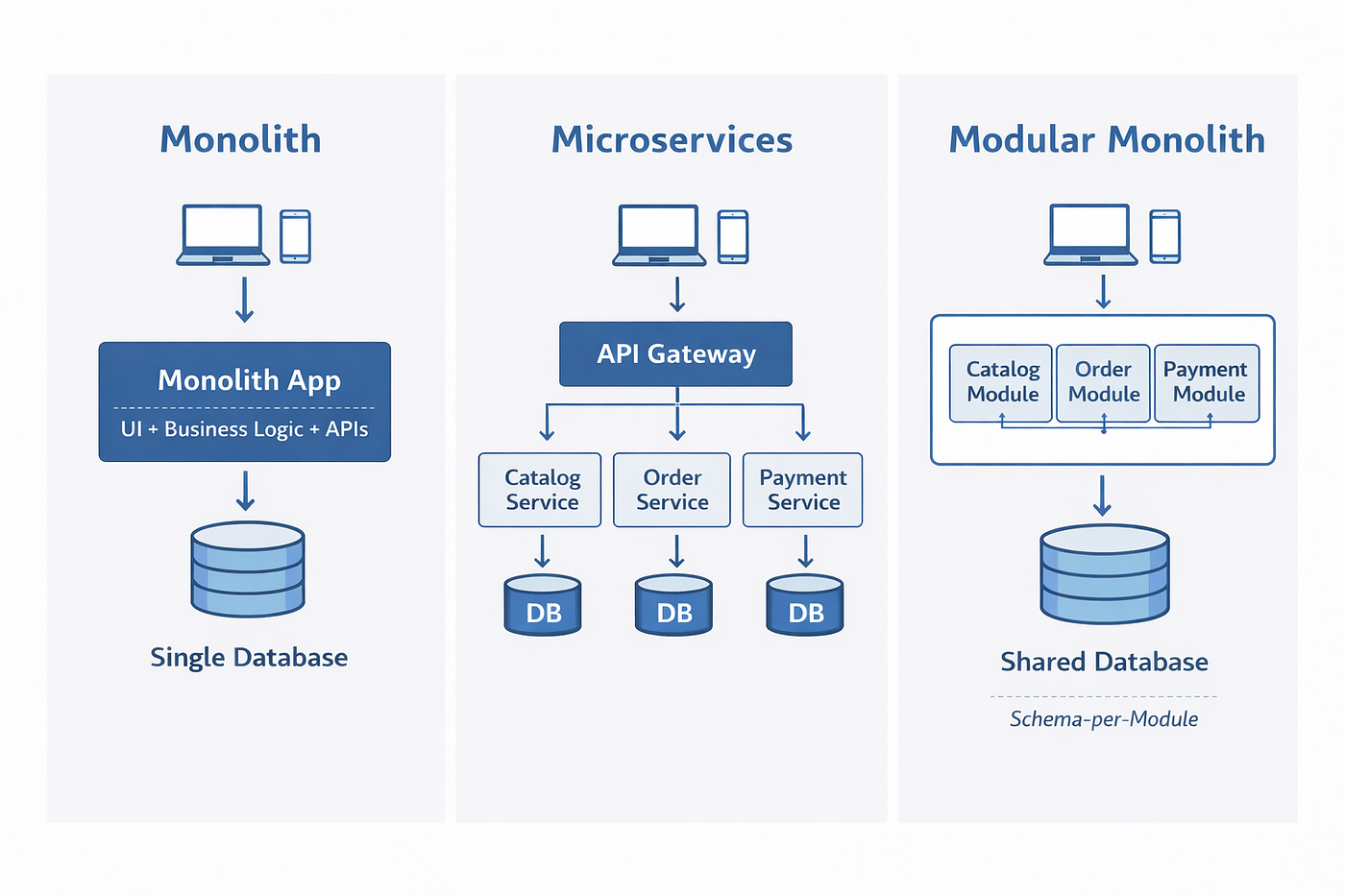
Monolith, microservices, or modular monolith in 2026? A decision framework, trade-offs, and real cases to choo...