
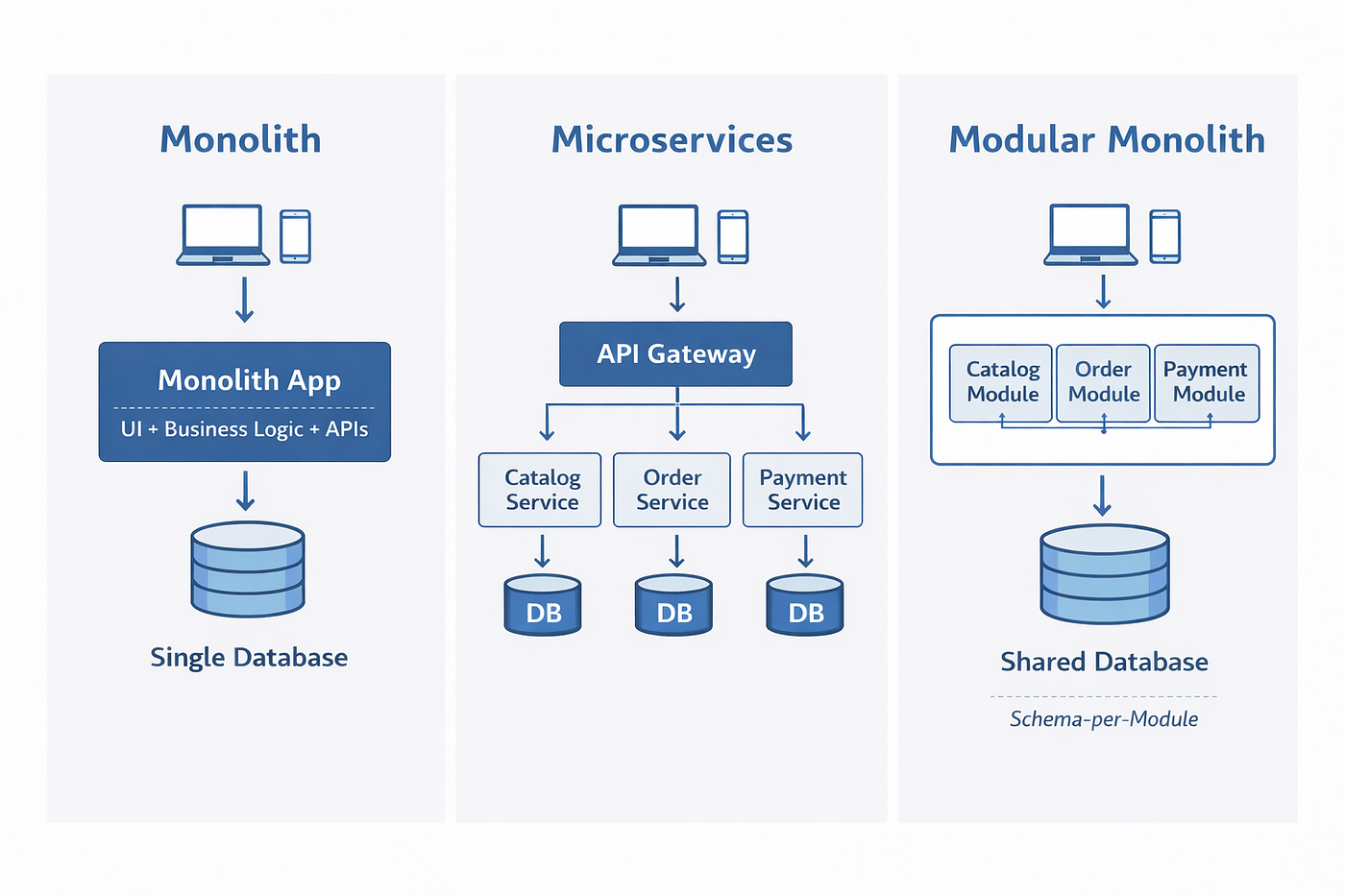
Web Application Architecture in 2026: Monolith, Microservices, or Modular Monolith?
Monolith, microservices, or modular monolith in 2026? A decision framework, trade-offs, and real cases to choo...
AI-powered ERP moves beyond automation to decision intelligence: agents in ERP, the data foundation required, and a build-vs-buy framework.
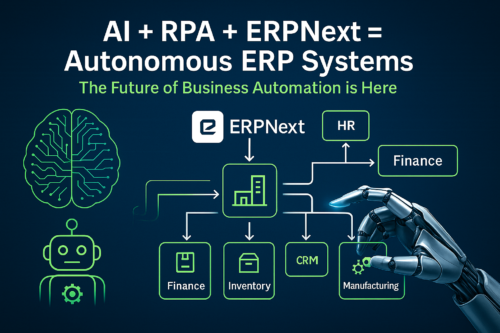
AI-powered ERP moves the system of record beyond process automation and into decision intelligence: instead of only executing predefined workflows, the ERP now recommends, forecasts, and in narrow cases acts on decisions using your operational data. That shift is the real story of 2026, and it is also where most enterprises get the economics wrong. The technology demos beautifully. The data foundation underneath it usually does not.
For senior technology buyers in the UK, Australia, the US, and Singapore, the question is no longer whether your ERP vendor will ship AI. SAP, Oracle, and Microsoft already have. The question is whether your master data, your integration layer, and your governance model are good enough to make that AI trustworthy. This article separates what is genuinely changing from what is still a vendor claim, and gives you a decision framework for build, buy, or extend.
We will cover the architecture of an AI-powered ERP, where agents realistically fit, the data foundation that makes or breaks the whole thing, and an honest build-vs-buy recommendation. If you are mid-evaluation and want a second opinion on your data readiness, you can talk to our engineering team before you commit a budget cycle.
Key Takeaways
- The jump from automation to decision intelligence is a jump in data quality requirements, not a jump in licensing. Clean, governed master data is the precondition, and most ERP estates fail it.
- Vendor copilots (SAP Joule, Microsoft Dynamics 365 Copilot, Oracle Fusion AI) are real products with real value, but their headline outcomes are vendor claims that you should validate on your own data before you trust them in decisions.
- Agents in ERP work best in bounded, reversible, high-volume tasks (invoice matching, demand sensing, exception triage). Autonomous action on irreversible financial postings is still a governance risk in 2026.
- Build the data and integration layer; buy the ERP core and its native AI; extend selectively with your own models where the decision is a genuine competitive differentiator.
- Budget realistically: the AI license is a small fraction. Data remediation, integration, and change management dominate total cost of ownership.
ERP has automated processes for thirty years. A purchase requisition routes for approval, a goods receipt updates inventory, a payment run clears invoices. That is workflow automation: deterministic rules executing on structured transactions. It is valuable and it is mature.
Decision intelligence is different. It asks the system to weigh options under uncertainty and recommend a course of action. Should we expedite this shipment given the demand signal and the carrier risk? Which customer credit limit should we raise? Which supplier is most likely to miss the next delivery window? These are not rule lookups. They are probabilistic judgments that previously sat in a human head or a spreadsheet.
Three capabilities define the AI-powered tier, and they build on each other.
The first layer is prediction surfaced at the point of decision. A demand forecast no longer lives in a separate planning tool that planners ignore. It appears in the ERP screen where the buyer raises the order, with a confidence band and the drivers behind it. Prescriptive analytics goes one step further and proposes the action, not just the number.
The second layer is conversational access. Vendor copilots let a finance manager ask "why did gross margin drop in the Singapore region last quarter" and get a grounded answer drawn from the ERP data, rather than building a report. The value here is real but narrow: it speeds up retrieval and explanation. It does not, by itself, improve the underlying decision.
The third layer is agentic execution: software that can take multi-step actions toward a goal with limited supervision. This is the frontier, and the place where hype and reality diverge most sharply. We treat it in its own section below. For the broader pattern of how these agents coordinate work, our existing primer on agentic workflows explained is a useful companion read.
An AI-powered ERP is not a single product. It is a layered architecture, and the AI sits near the top. The layers below it determine whether the AI is reliable or merely confident. This is the single most important thing for a CIO to internalise before signing a contract.
+--------------------------------------------------------------+
| 6. EXPERIENCE LAYER                                          |
|    NL copilot | recommendations in-screen | agent console    |
+--------------------------------------------------------------+
| 5. DECISION INTELLIGENCE LAYER                              |
|    forecasting | optimisation | anomaly detection | agents   |
+--------------------------------------------------------------+
| 4. AI / ML PLATFORM                                         |
|    model hosting | RAG | feature store | guardrails | eval   |
+--------------------------------------------------------------+
| 3. INTEGRATION & EVENT LAYER                                |
|    APIs | event streaming | CDC | iPaaS | data contracts     |
+--------------------------------------------------------------+
| 2. DATA FOUNDATION                                          |
|    master data mgmt | data warehouse/lakehouse | governance  |
+--------------------------------------------------------------+
| 1. ERP CORE (system of record)                             |
|    finance | supply chain | HR | procurement | manufacturing |
+--------------------------------------------------------------+
Read it from the bottom up. The ERP core is your system of record. The data foundation cleans, masters, and governs that record. The integration layer moves data in real time and enforces contracts. The AI platform hosts models and grounds them. Only then can the decision intelligence layer produce something a finance leader should trust. Vendors sell you layers 4 to 6 as a polished bundle. Layers 2 and 3 are mostly your problem, and they are where projects fail.
A forecast is only as good as the demand history feeding it. A supplier-risk score is only as good as the master data linking duplicate vendor records. If your customer master has the same account spelled four ways across three regions, no copilot will reconcile that for you. It will simply give a confident wrong answer.
This is why the modern pattern pairs the ERP with a governed analytical store. Many enterprises now feed ERP data into a lakehouse and apply retrieval-augmented generation so that copilots answer from grounded, current data rather than model memory. The discipline behind that is covered in our guide to enterprise RAG systems, and the wider platform context sits in the enterprise AI stack for 2026.
"Agentic ERP" is the phrase of 2026. It is worth being precise. An agent is software that pursues a goal across multiple steps, calls tools or APIs, and adapts based on intermediate results. In an ERP context, that could mean reading an exception queue, gathering context, drafting a resolution, and either acting or escalating.
The useful mental model is a spectrum of autonomy, scored against two axes: how reversible the action is, and how high the volume of decisions is. Agents earn their keep on high-volume, reversible, well-bounded work. They are a governance liability on low-volume, irreversible, ambiguous work.
| ERP process | Volume | Reversibility | 2026 recommended autonomy |
|---|---|---|---|
| Invoice-to-PO matching & exception triage | High | High | Agent acts, human reviews exceptions |
| Demand sensing & reorder suggestions | High | High | Agent recommends, human confirms |
| Vendor master deduplication | Medium | Medium | Agent proposes merges, human approves |
| Customer credit limit changes | Medium | Low | Recommend only, human decides |
| Period-end financial postings | Low | Very low | Assist only, no autonomous action |
| Statutory tax filing submission | Low | Very low | Human-controlled, audit trail required |
The pattern is clear. Let agents grind through the high-volume drudgery where a mistake is cheap to undo and easy to catch. Keep humans firmly in control of anything that touches the ledger irreversibly or carries statutory weight. An agent that auto-posts a journal entry it cannot explain is not innovation. It is an audit finding waiting to happen.
If you deploy ERP agents, three controls are not optional. First, every agent action needs an immutable audit trail tied to the prompt, the data it read, and the tool calls it made. Second, agents must operate under the same role-based permissions as the human they assist, never a superuser. Third, you need an evaluation harness that scores agent decisions against human ground truth before and during rollout. Without these, you have automated a process you can no longer explain to an auditor.
Most teams approach this backwards. They start with the vendor's AI feature list and work down to whether they need it. Start instead with the decision you are trying to improve, then ask whether AI inside the ERP is the right place to improve it.
Use this five-question framework before committing to any AI-ERP investment.
There are three realistic paths, and each trades cost, control, and time differently. Vendor-native AI is fastest and lowest-effort but least differentiated and most dependent on a single vendor. A composable approach (best-of-breed ERP plus your own AI/data layer) gives control and differentiation at the cost of integration work and ongoing ownership. A fully custom decision layer maximises differentiation but is rarely justified outside a genuine competitive moat.
| Dimension | Vendor-native AI (Joule, Copilot, Fusion AI) | Composable (ERP + your data/AI layer) | Custom decision layer |
|---|---|---|---|
| Time to value | Fastest (weeks) | Moderate (quarters) | Slowest (multi-quarter) |
| Differentiation | Low (everyone has it) | Medium to high | Highest |
| Control over logic | Low | High | Total |
| Vendor lock-in risk | High | Medium | Low |
| Upfront cost | Low (license uplift) | Medium | High |
| Ongoing ownership burden | Low | Medium | High |
| Data foundation required | Still required | Required | Required |
Notice the constant in the bottom row. Every road requires the data foundation. There is no version of AI-powered ERP where poor data is acceptable. That is why our build-vs-buy recommendation, further down, places the data and integration layer in the "build and own" column regardless of which ERP you choose.
The three dominant vendors all ship embedded AI. It is important to describe these accurately and to label the marketing outcomes as what they are: vendor claims, not independently verified results for your environment.
SAP Joule is SAP's generative AI copilot embedded across S/4HANA and the broader SAP suite. SAP positions it as a natural-language assistant that retrieves information, navigates the system, and increasingly orchestrates agents across processes. SAP also markets agentic capabilities for tasks like dispute and cash management. These productivity and accuracy figures are SAP's own claims [vendor]. They are a reasonable starting hypothesis, not a guarantee, and you should validate them against your data in a controlled pilot.
Microsoft Dynamics 365 Copilot embeds generative AI across finance, supply chain, sales, and service, with agent capabilities for collections, order management, and similar workflows. Microsoft's stated time-saving and automation benefits are again vendor claims [vendor]. The integration advantage for Microsoft-heavy estates is real, but it is an architectural fit point, not a measured outcome for your business.
Oracle Fusion Applications AI embeds generative and agentic features across ERP, SCM, and HCM, including document understanding and assistive analytics. Oracle's benefit statements are vendor claims [vendor] and should be treated the same way.
The pattern across all three is consistent and the lesson is simple. The vendors have built credible products. The headline numbers in their decks describe best-case results from their reference customers under their conditions. Run your own pilot, measure your own baseline, and trust your own data over the slide.
Consider the most widely deployed and least controversial use case: intelligent accounts payable. It is worth walking through because it shows the gap between automation and decision intelligence in concrete terms, and because it is the pattern most enterprises should start with.
The legacy automation flow is rule-based three-way matching. An invoice arrives, the system matches it to a purchase order and a goods receipt, and anything that matches within tolerance posts automatically. Everything else falls into an exception queue for a human to investigate. The exception queue is where the cost lives. In large enterprises it can absorb a significant share of the AP team's time.
The AI-powered flow changes the exception handling. A model reads the unstructured invoice (a PDF, often with vendor-specific quirks), extracts the line items, and matches them even when the format is non-standard. For genuine exceptions, an agent gathers context: the contract terms, the price history with that vendor, the receiving notes, and prior similar disputes. It then proposes a resolution and routes it to the right approver with the reasoning attached. The human approves, edits, or rejects.
The decision intelligence is in the proposal and the prioritisation, not the posting. Vendors including SAP, Microsoft, and Oracle market exactly this pattern, and the named "agentic" cash and dispute features map to it. The reason it works as a starting point is that it scores well on the framework: high volume, mostly reversible, measurable (touchless rate, exception cycle time, error rate), and governable with a clear human approval step.
Treat AI-powered ERP as a programme with phases, not a switch you flip at go-live. A phased approach lets you prove the data foundation on a narrow scope before you bet the finance close on it. The roadmap below assumes you already run a modern ERP core or are mid-migration.
| Phase | Duration (typical) | Focus | Exit criteria |
|---|---|---|---|
| 0. Readiness assessment | 4–6 weeks | Data quality audit, master data scoring, governance gaps, use-case shortlist | Scored data readiness, ranked use cases, baseline metrics defined |
| 1. Data foundation | 1–2 quarters | Master data remediation, MDM rules, lakehouse feed, data contracts | Trusted master data for the pilot domain, real-time feed live |
| 2. Pilot one decision | 1 quarter | One bounded use case (e.g. AP exceptions), recommend-only, full eval harness | Measured uplift vs baseline, governance controls validated |
| 3. Controlled autonomy | 1–2 quarters | Let the agent act on the safest slice, expand scope on evidence | Touchless rate target met, audit trail clean, no governance incidents |
| 4. Scale & govern | Ongoing | Roll out to adjacent processes, central AI governance, model monitoring | Portfolio of monitored use cases, drift detection, periodic re-eval |
The discipline that matters most: do not skip Phase 0 and Phase 1. The temptation is to jump straight to the exciting pilot because the vendor demo made it look like a configuration step. The teams that succeed earn the right to the pilot by fixing the data first. For a broader transformation view that situates this within the enterprise programme, the existing roadmap on enterprise AI transformation from pilot to scale is worth reading alongside this.
This is the decision most CIOs actually need answered, so we will be direct. The right answer is rarely "build everything" or "buy everything." It is a deliberate split.
Do not build an ERP. The system-of-record problem is solved, the vendors are mature, and the maintenance burden of a custom core is enormous. For the AI that ships natively (copilots, document extraction, standard forecasting), buy it. These are commodity capabilities where the vendor's scale beats anything you would build. This mirrors the conclusion in our sibling analysis of custom ERP versus off-the-shelf solutions: build the core only when off-the-shelf genuinely cannot fit your operating model.
This is the part you must own regardless of vendor. Your master data management, your governed analytical store, your integration and event layer, and your data contracts are the substrate every AI feature depends on. Owning it keeps you portable across vendors and keeps your AI grounded in trusted data. Partners like Mind Supernova, a Vietnam-based software engineering team founded in 2023, frequently help enterprises stand up exactly this layer with senior engineers, drawing on the team's collective experience in data and AI engineering.
Reserve custom model development for decisions that genuinely differentiate you: a pricing engine specific to your market, an allocation algorithm that reflects a hard-won commercial insight, a risk model tuned to your portfolio. Everywhere else, extend the vendor. A useful adjacency here is our wider piece on building intelligent enterprise platforms, which treats this composition problem across the whole estate rather than only the ERP.
| Component | Recommendation | Rationale |
|---|---|---|
| ERP core (system of record) | Buy | Mature, commodity, high maintenance cost to build |
| Native copilot / NL interface | Buy | Vendor scale; commodity capability |
| Standard forecasting / anomaly detection | Buy / extend | Good enough natively for most domains |
| Master data management | Build & own | Foundation for all AI; keeps you portable |
| Integration & event layer | Build & own | Real-time grounding; avoids lock-in |
| Data governance & AI guardrails | Build & own | Audit, permissions, evaluation are yours to enforce |
| Differentiating decision models | Build selectively | Only where the decision is a competitive moat |
The failure modes are consistent across markets and across vendors. Most are organisational, not technical.
The licensing line item is the smallest part of the bill, and that surprises buyers every time. The AI uplift on an ERP subscription is real but modest relative to the surrounding programme cost. The dominant costs are data remediation, integration, and the human change effort.
| Cost category | Relative share | Notes |
|---|---|---|
| AI license uplift | Smallest | Per-user or consumption-based add-on to ERP subscription |
| Data foundation & MDM remediation | Largest | Often underestimated; the true gating cost |
| Integration & event layer | Large | Real-time feeds, data contracts, iPaaS |
| Pilot & evaluation engineering | Moderate | Eval harness, guardrails, monitoring |
| Change management & training | Moderate to large | Adoption determines whether any of it returns value |
| Ongoing model monitoring | Recurring | Drift detection, periodic re-evaluation |
The numbers vary widely by estate size and data maturity, so we deliberately avoid quoting a single figure: anyone who promises a precise total before auditing your data is guessing. The defensible planning assumption is that for every unit you spend on AI licensing, you should budget several multiples on data, integration, and change. If your business case only counts the license, it is not a business case.
There is a build-vs-buy economic angle here too. Owning the data and integration layer is a cost, but it is a cost that protects you from vendor lock-in and from rebuilding the foundation every time you change a copilot. Treat it as durable infrastructure investment, not project overhead.
Automation executes predefined rules on structured transactions, such as routing an approval or posting a matched invoice. Decision intelligence weighs options under uncertainty and recommends or takes a course of action, such as proposing how to resolve an invoice dispute. The first is deterministic; the second is probabilistic and requires trusted data.
Only on bounded, reversible, high-volume tasks with full guardrails. Let agents act on work like invoice exception triage where mistakes are cheap to undo and easy to catch. Keep humans in control of irreversible or statutory actions such as financial postings and tax filings. Always enforce audit trails, scoped permissions, and evaluation.
Treat them as a starting hypothesis, not a guarantee. SAP, Microsoft, and Oracle ship credible AI products, but their headline productivity and accuracy figures are vendor claims from reference conditions. Run a controlled pilot on your own data, measure against a baseline you defined first, and trust your own results over the slide.
A clean, governed data foundation. AI amplifies data quality problems rather than absorbing them. Duplicate master records, stale data, and weak governance produce confident wrong answers. Most successful programmes spend their first one to two quarters on master data remediation and integration before running any AI pilot.
Buy the ERP core and its native AI for commodity capabilities. Build and own your data, integration, and governance layers regardless of vendor, because they keep you portable and grounded. Build custom models only where the decision is a genuine competitive moat, such as proprietary pricing or allocation logic.
AI-powered ERP is real, and the shift from automation to decision intelligence is worth pursuing. But the value is gated by the boring layers underneath: master data, integration, governance. The enterprises that win in 2026 are not the ones with the flashiest copilot. They are the ones whose data is clean enough to trust the copilot's answer.
This quarter: run a data readiness assessment, define a baseline metric for one high-volume decision (accounts payable exceptions are a strong first candidate), and shortlist a single recommend-only pilot. Resist the urge to switch on every AI feature at once.
Next 90 days: remediate the master data for that pilot domain, stand up the integration feed, and validate vendor claims against your own measured results before expanding autonomy. If you want a senior engineering partner to assess your data foundation or build the integration layer that the AI depends on, schedule a call with our engineering team. The AI is the easy part. The foundation is where the work is, and it is where the return is decided.
Monolith, microservices, or modular monolith in 2026? A decision framework, trade-offs, and real cases to choo...
A practical PHP to Go migration playbook: when it pays off, the strangler fig approach, performance trade-offs...
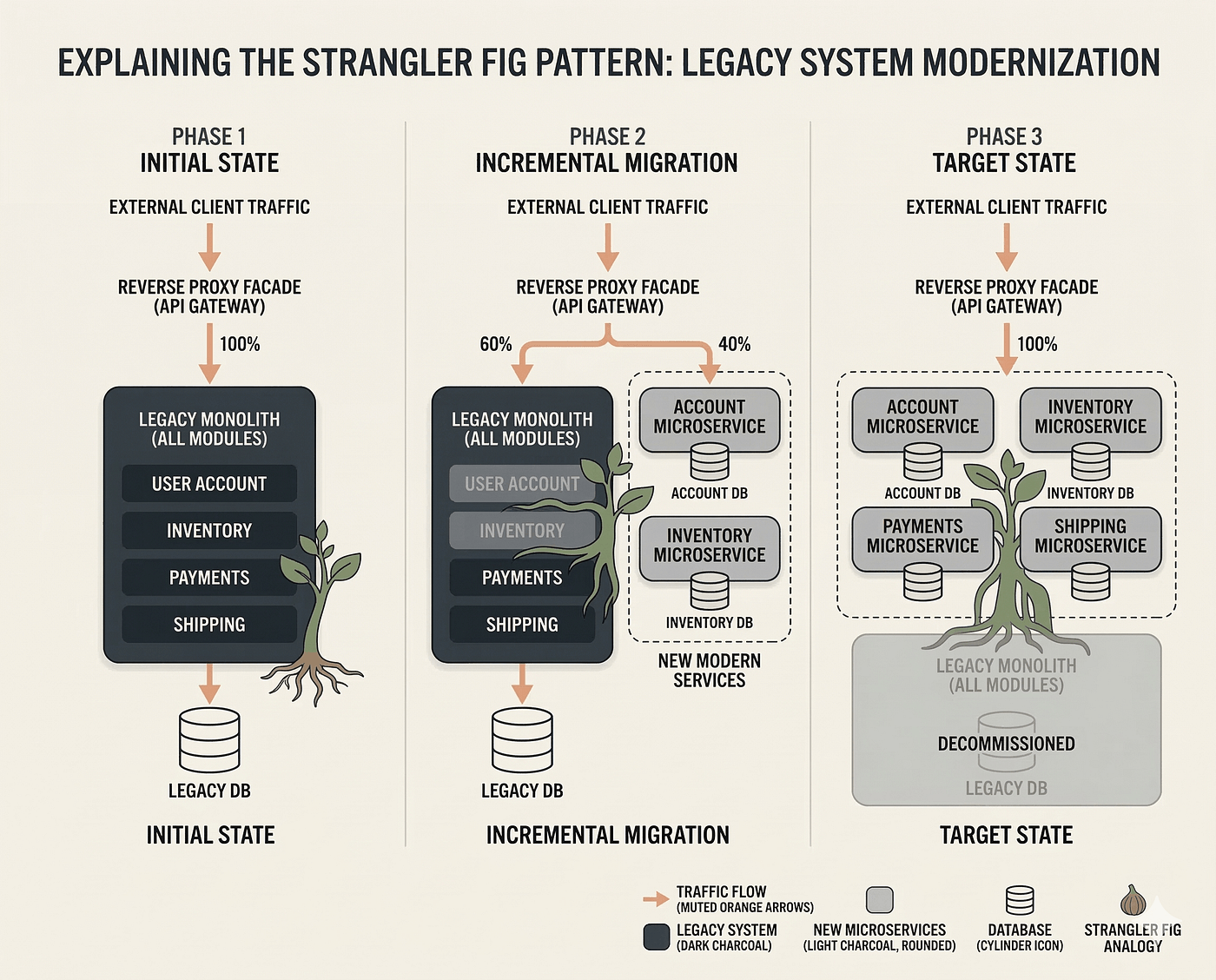
Legacy system modernization compared: strangler fig vs big bang vs incremental migration, with risk and cost t...