
AI Governance in Financial Services: Risk, Compliance, and Innovation
A practical guide to AI governance in financial services: the FS regulatory landscape, a three-lines operating...
Enterprise application security in 2026: OWASP Top 10, LLM risks, STRIDE threat modeling, secure SDLC, and shift-left practices that work.
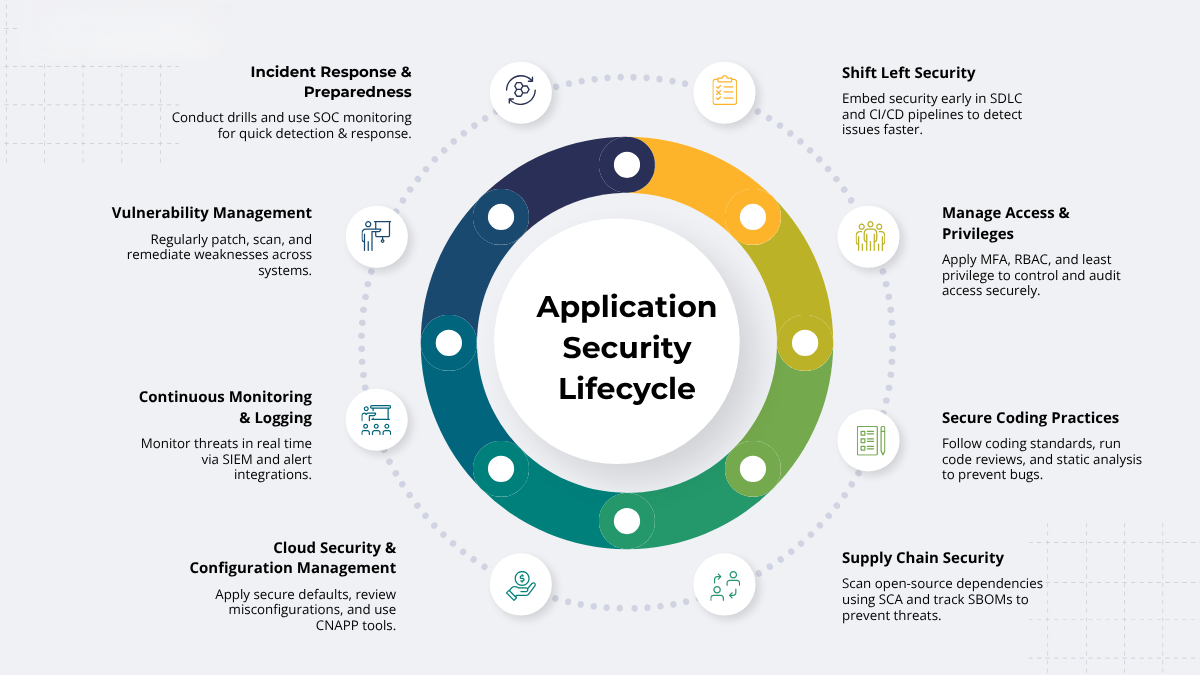
Enterprise application security in 2026 means treating security as a property of the software development lifecycle, not a gate at the end of it. The practices that hold up across audits and incidents are consistent: govern access first (the OWASP Top 10:2021 ranks Broken Access Control as the number one web risk), threat model with a structured method such as STRIDE, shift testing left into the pipeline, and add a dedicated control layer for the new attack surface that large language models introduce.
The financial stakes are concrete. IBM's Cost of a Data Breach 2025 puts the global average breach at $4.44M, down from $4.88M in 2024, with organisations that deployed security AI and automation extensively saving roughly $1.9M per breach. That gap is the business case for secure SDLC in a single number.
This guide is written for CIOs, CTOs, VPs of Engineering, and Heads of Architecture who own the security posture of software they build or commission. It covers the OWASP Top 10:2021 and the OWASP LLM Top 10 (2025), STRIDE threat modeling, secure SDLC and shift-left practice, a decision framework for where to invest, a phased roadmap, real costs, build-versus-buy guidance, and the mistakes that quietly create most breaches. If you are deciding how to staff this work, teams like Mind Supernova help enterprises embed secure SDLC practices into existing engineering groups. Want a second opinion on your current posture? Schedule a call with our engineering team.
Key Takeaways
- Broken Access Control is the number one web application risk in the OWASP Top 10:2021, and authorization logic is where most real-world enterprise breaches start.
- Prompt Injection (LLM01) leads the OWASP LLM Top 10 (2025); any application that passes user input to a model needs controls that classic AppSec tooling does not provide.
- STRIDE gives engineering teams a repeatable way to find design-level flaws before code exists, which is far cheaper than patching them in production.
- Shift-left and secure SDLC are about distributing security across plan, design, code, test, and operate stages rather than relying on a single pre-release scan.
- IBM's Cost of a Data Breach 2025 reports a $4.44M average breach, with extensive security AI and automation saving about $1.9M per incident, which frames the ROI of the entire programme.
The perimeter stopped being the control point years ago. Workloads run across hybrid cloud, third-party APIs carry sensitive data, and identity is the new boundary. In that world the application itself is the attack surface, and the security of the code, its dependencies, and its access logic decides whether an incident becomes a breach.
Two forces reshape the 2026 picture. First, software supply chains keep expanding: a typical service pulls in hundreds of transitive dependencies, any of which can introduce a vulnerable or outdated component. Second, generative AI features now sit inside enterprise applications, accepting untrusted input and acting on it. Both forces add risk that traditional network controls cannot see.
The encouraging signal is that the breach economics are improving for teams that invest. IBM's Cost of a Data Breach 2025 records the first year-on-year drop in average breach cost in several years, falling to $4.44M, and credits broad use of security AI and automation with cutting roughly $1.9M from the cost of incidents where they were deployed [1]. The lesson is not that breaches are getting cheap. It is that prepared organisations contain them faster and pay less.
The OWASP Top 10 is the most widely recognised awareness document for web application risk. The 2021 edition reordered the list to reflect how breaches actually happen, and the headline change matters: Broken Access Control moved to the number one position [2]. If you read only one category, read that one.
Below is the 2021 list with a plain reading of what each category means for an engineering organisation. Do not treat it as a checklist to tick. Treat it as a map of where design and review effort produces the most risk reduction.
| Rank | Category | What it really means | Primary defence |
|---|---|---|---|
| A01 | Broken Access Control | Users reach data or actions they should not, often via object IDs or missing server-side checks. | Deny by default, enforce authorization server-side on every request. |
| A02 | Cryptographic Failures | Sensitive data exposed through weak, missing, or misused encryption. | Encrypt in transit and at rest, manage keys, avoid home-grown crypto. |
| A03 | Injection | Untrusted input changes the meaning of a query or command (SQL, OS, LDAP). | Parameterised queries, input validation, safe APIs. |
| A04 | Insecure Design | Flaws that exist in the design itself, before a line of code is written. | Threat modeling, secure design patterns, reference architectures. |
| A05 | Security Misconfiguration | Default settings, open cloud storage, verbose errors, unpatched stacks. | Hardened baselines, infrastructure as code, configuration scanning. |
| A06 | Vulnerable and Outdated Components | Known-vulnerable libraries and frameworks shipped to production. | Software composition analysis, SBOM, patch SLAs. |
| A07 | Identification and Authentication Failures | Weak login, session, or credential handling. | MFA, strong session management, no default credentials. |
| A08 | Software and Data Integrity Failures | Unverified updates, insecure deserialization, compromised CI/CD. | Signed artefacts, verified pipelines, integrity checks. |
| A09 | Security Logging and Monitoring Failures | Breaches that go undetected because nothing meaningful is logged. | Structured security logging, alerting, tested response. |
| A10 | Server-Side Request Forgery (SSRF) | The server is tricked into making requests to internal systems. | Allowlists, network segmentation, validated outbound calls. |
Access control is hard because it is business logic, not a library you can drop in. A scanner can find an unparameterised query. It rarely knows that user 4012 should not be able to read invoice 9981. These flaws are common, they are easy to exploit, and they expose exactly the data that regulators care about. Enforce authorization on the server for every request, default to deny, and test it as a first-class requirement rather than an afterthought.
Generative AI features changed the threat model. When an application sends user-controlled text to a model and then acts on the output, it has created a new class of vulnerability that web AppSec tools were never designed to catch. The OWASP Top 10 for Large Language Model Applications (2025) is the reference here, and Prompt Injection (LLM01) holds the number one position [2].
Prompt injection is not a bug you patch once. It is a structural property of systems that mix instructions and untrusted data in the same channel. An attacker who can influence the input, directly or through a document the model retrieves, may be able to override the system prompt, exfiltrate context, or trigger downstream actions. If your application gives a model access to tools, data, or APIs, the blast radius of a successful injection is whatever those tools can do.
| Risk | LLM Top 10 (2025) example | Enterprise control |
|---|---|---|
| LLM01 Prompt Injection | Hidden instructions in user input or retrieved documents hijack model behaviour. | Treat all model input as untrusted, constrain tool scopes, isolate instructions from data. |
| Sensitive Information Disclosure | The model reveals secrets, PII, or proprietary data in its output. | Output filtering, minimise context, data classification before retrieval. |
| Supply chain risks | Compromised models, plugins, or training data. | Vet model and plugin provenance, pin versions, scan artefacts. |
| Improper Output Handling | Model output is trusted and rendered or executed without validation. | Validate and encode output, never execute it directly. |
| Excessive Agency | The model can take actions far beyond what the use case requires. | Least-privilege tool access, human approval for high-impact actions. |
For teams building retrieval and agent systems, these controls are inseparable from the architecture. A deeper treatment of secure retrieval design lives in our guide on enterprise RAG systems, and the governance side is covered in our AI governance, security, and compliance survival guide. Both pair well with the LLM controls above. Regulated workloads raise the bar further: applications such as a compliant digital wallet platform combine these AI controls with PCI and e-money requirements.
Insecure Design (A04 in the 2021 list) cannot be scanned away, because the flaw lives in the design. Threat modeling is how you find these issues at the cheapest possible point: the whiteboard. STRIDE is the most widely taught method, and it works because it gives engineers six concrete lenses to apply to every component and data flow.
| STRIDE category | Threat | Property violated | Typical mitigation |
|---|---|---|---|
| S - Spoofing | Pretending to be another user or system. | Authentication | Strong identity, MFA, mutual TLS. |
| T - Tampering | Modifying data or code in transit or at rest. | Integrity | Signing, hashing, access controls. |
| R - Repudiation | Denying an action with no proof it happened. | Non-repudiation | Audit logs, secure timestamps. |
| I - Information Disclosure | Exposing data to unauthorised parties. | Confidentiality | Encryption, access control, least privilege. |
| D - Denial of Service | Making a service unavailable. | Availability | Rate limiting, quotas, autoscaling. |
| E - Elevation of Privilege | Gaining rights beyond what was granted. | Authorization | Least privilege, server-side checks. |
Start with a data flow diagram. Identify the elements that matter: external entities, processes, data stores, and the trust boundaries the data crosses. Then walk each element and each flow through the six STRIDE lenses and ask a simple question for each: how could an attacker do this here, and what stops them today?
Keep sessions short and frequent. A 60-minute model on a new feature catches more than a one-day workshop held once a year. Record each threat, its mitigation, and an owner. The output is not a document for the shelf. It is a backlog of security work tied to real design decisions.
A secure SDLC spreads security activity across every phase of delivery instead of concentrating it in a pre-release gate. Shift-left is the principle behind it: the earlier a flaw is found, the cheaper it is to fix. A design flaw caught in threat modeling costs a meeting. The same flaw caught in production costs an incident.
The practical model is to attach the right activity to each phase. None of these are heavyweight on their own. The value comes from doing them consistently and automating what can be automated so security does not depend on heroics.
| SDLC phase | Security activity | Maps to OWASP / STRIDE |
|---|---|---|
| Plan | Security requirements, abuse cases, data classification. | Insecure Design (A04) |
| Design | STRIDE threat modeling, secure design patterns. | A04, Elevation of Privilege |
| Code | Secure coding standards, SAST in the editor and pipeline. | Injection (A03), Access Control (A01) |
| Build | SCA, SBOM generation, signed artefacts. | Vulnerable Components (A06), Integrity (A08) |
| Test | DAST, authorization tests, secrets scanning. | A01, Cryptographic Failures (A02) |
| Release | Hardened configuration, IaC scanning, change verification. | Misconfiguration (A05), A08 |
| Operate | Security logging, monitoring, incident response. | Logging Failures (A09) |
Embedding these checks into the delivery pipeline is where shift-left becomes real rather than aspirational. The same pipeline patterns that let teams ship quickly are the place to run SAST, SCA, secrets detection, and policy checks as automated gates. If you are designing that pipeline across several teams, our guide on building a CI/CD pipeline that scales covers the gating and stage design that secure SDLC depends on. Runtime hardening matters too: the patterns in cloud-native application development shape how these controls deploy across containers and serverless.
No team can do everything at once. The question is where limited security budget produces the most risk reduction for your specific application. The framework below scores each candidate control area on four factors, then prioritises by combined weight.
Every security control has a cost beyond licensing: developer friction, false positives, and slower delivery if applied bluntly. The trade-offs are real and worth naming so you can tune rather than abandon.
| Control | Benefit | Trade-off | How to tune it |
|---|---|---|---|
| SAST in pipeline | Catches code flaws early. | False positives slow merges. | Tune rulesets, fail only on high severity. |
| DAST pre-release | Finds runtime issues. | Slow, needs running environment. | Run nightly, not on every commit. |
| Strict access control | Cuts the top OWASP risk. | More design and test effort. | Centralise authorization, test it as a contract. |
| LLM input/output guards | Limits prompt injection impact. | Latency and occasional over-blocking. | Scope tools tightly, log and review blocks. |
| Mandatory MFA | Stops most credential attacks. | User friction. | Risk-based MFA, passkeys where possible. |
  DEVELOPER                  CI/CD PIPELINE                    RUNTIME
  ---------                  --------------                    -------
  IDE + SAST  --commit-->  [ SAST ] [ SCA/SBOM ]  --deploy-->  WAF / API gateway
  secrets hook             [ secrets scan ]                    |
       |                   [ IaC policy check ]                v
  threat model             [ DAST (nightly) ]            App (deny-by-default authz)
  (STRIDE)                 [ signed artefacts ]                |
       |                          |                            v
       +------ feedback ----------+                     LLM guardrails (input/output)
                                                               |
                                                               v
                                                     Security logging + monitoring
                                                     (SIEM / alerting / response)
The most instructive enterprise breaches are rarely exotic. A recurring pattern is the Insecure Direct Object Reference, a concrete form of Broken Access Control. An application exposes a record by its identifier, for example /api/orders/10231, and trusts the identifier without verifying that the authenticated user owns that order. Change the number, read someone else's data.
This pattern has caused real breaches across fintech, healthcare, and government services, and it sits squarely in OWASP A01. It is invisible to most automated scanners because the tool has no concept of who should own which record. It is also cheap to prevent: enforce ownership checks server-side on every object access, and add authorization tests that assert user A cannot read user B's data.
The lesson generalises. The categories at the top of the OWASP list are dominated by logic flaws, not missing libraries. That is why threat modeling and authorization testing earn their place ahead of buying another scanner. Tooling finds the known patterns. Design discipline finds the rest.
You cannot bolt a security culture on in a quarter, but you can make measurable progress in stages. The roadmap below assumes an organisation with existing engineering teams and no formal secure SDLC.
Throughout, measure something. Mean time to remediate critical findings, percentage of services with current threat models, and dependency patch latency are honest indicators of whether the programme is working.
Security spend splits into tooling, people, and the cost of incidents you avoid. The anchor figure is the avoided loss: IBM's Cost of a Data Breach 2025 reports a $4.44M average breach and roughly $1.9M saved per incident where security AI and automation were used extensively [1]. Against that backdrop, the cost of a competent secure SDLC programme is modest.
The ranges below are industry estimates and vary by organisation size and stack. Treat them as planning anchors, not quotes.
| Investment area | Indicative annual cost (estimate) | Build vs buy |
|---|---|---|
| SAST / SCA / secrets tooling | $20K–80K for a mid-size org | Buy. Mature commercial and open-source options exist. |
| DAST / pen testing | $15K–60K plus periodic external tests | Buy tooling, buy independent pen tests. |
| Threat modeling practice | Engineering time, low direct cost | Build. It is a practice, not a product. |
| Authorization framework | Engineering time | Build on proven patterns, do not invent crypto or auth primitives. |
| LLM guardrails | $10K–50K depending on volume | Hybrid. Buy a baseline, build use-case logic. |
| Security expertise | Senior security engineer or partner | Build core ownership, buy depth where you lack it. |
Buy commodity scanning and testing tools. The market is mature and building your own scanner is a poor use of engineering time. Build the practices that depend on your business logic: threat modeling, authorization design, and the use-case-specific guards around AI features. Never build cryptographic or authentication primitives from scratch; use vetted libraries and identity providers. For the expertise gap that most teams hit, a partner model works well. Mind Supernova, a Vietnam-based software engineering partner founded in 2023, places senior engineers who can embed secure SDLC practice into your teams, with 4+ hours of daily UK overlap and engineers who can start in 5 to 7 days. The aim is to leave your teams more capable, not dependent. Whether you build, buy, or blend, secure SDLC is a capability you grow, and our team's collective experience suggests the organisations that treat it that way contain incidents fastest.
Staffing this work alongside delivery is its own challenge. If you are weighing how to add security capacity without slowing roadmaps, our pages on staff augmentation and dedicated teams outline the two common models.
Broken Access Control (A01) sits at number one in the OWASP Top 10:2021 [2]. It covers cases where users reach data or actions they should not. It matters most because it is common, easy to exploit, and exposes the regulated data that drives breach cost. Enforce authorization server-side on every request.
LLM applications add risks that classic AppSec tools miss, led by Prompt Injection (LLM01) in the OWASP LLM Top 10 (2025) [2]. Because models mix instructions and untrusted data in one channel, you must treat all input as hostile, validate output, and tightly scope any tools or data the model can access.
STRIDE is a threat modeling method that examines a design through six lenses: Spoofing, Tampering, Repudiation, Information Disclosure, Denial of Service, and Elevation of Privilege. Use it during design and for major changes. Short, frequent sessions on data flow diagrams find design flaws before they reach code, where they are far cheaper to fix.
Done bluntly it can, through false positives and over-strict gates. Done well it speeds delivery by catching issues when they are cheap to fix. Tune scanners to fail only on high-severity findings, run slow tests nightly rather than per commit, and automate checks so security does not depend on manual review.
IBM's Cost of a Data Breach 2025 puts the global average at $4.44M, down from $4.88M in 2024 [1]. Organisations using security AI and automation extensively saved roughly $1.9M per incident. The figure varies by industry, region, and the speed at which an organisation detects and contains the incident.
Enterprise application security in 2026 rewards organisations that treat it as an engineering practice. Govern access first, model threats with STRIDE before writing code, shift testing left into the pipeline, and add a dedicated control layer for the LLM attack surface. The OWASP Top 10:2021 and LLM Top 10 (2025) tell you where the risk concentrates; IBM's $4.44M average breach tells you what inaction costs.
This quarter: add SCA and secrets scanning to every pipeline, enforce and test server-side authorization on your most exposed service, and run one STRIDE session. Next 90 days: tune SAST into the pipeline, set patch SLAs from an SBOM, and add input and output guards to any AI feature.
If you want senior engineers who can embed these practices into your teams without slowing delivery, talk to our engineering team. A short call is enough to map your current posture against the priorities above and agree a sensible first 90 days.
A practical guide to AI governance in financial services: the FS regulatory landscape, a three-lines operating...
How AI is transforming enterprise cybersecurity operations: SOC automation, AI detection, SOAR, new LLM threat...
AI governance is now a board-level priority. Learn the frameworks (EU AI Act, NIST, ISO 42001), the top risks,...