
AI Governance in Financial Services: Risk, Compliance, and Innovation
A practical guide to AI governance in financial services: the FS regulatory landscape, a three-lines operating...
How AI is transforming enterprise cybersecurity operations: SOC automation, AI detection, SOAR, new LLM threats, and governance that holds up.
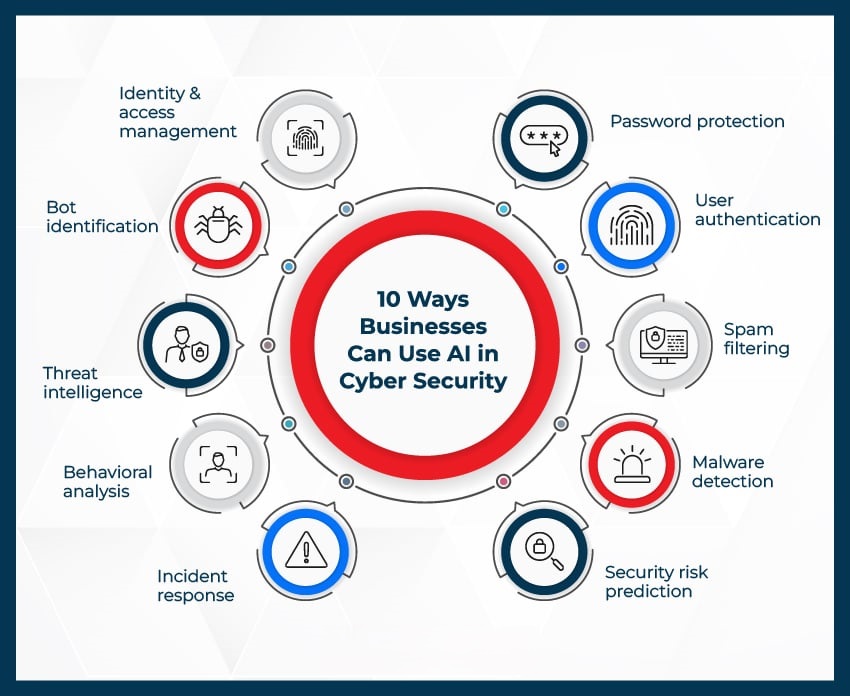
AI is transforming enterprise cybersecurity operations by automating detection, triage, and response inside the security operations center (SOC), compressing investigation timelines from hours to minutes while freeing scarce analysts for the judgment work machines cannot do. That is the headline, and it is real. The harder truth is that the same AI shifts the attack surface: large language models (LLMs) introduce prompt injection, data exfiltration, and model abuse as first-class risks that your SOC now has to defend.
This article is about security operations, not compliance. If you are building an AI governance program, control framework, or audit posture, read our companion piece on AI governance, security, and compliance and do not expect us to rehash it here. Our focus is the operational layer: how detection, SOAR, and the analyst workflow actually change when you put AI inside the SOC.
For a senior technology buyer, the question is no longer whether AI belongs in the SOC. It is which functions to automate, what to keep human-led, and how to avoid trading one class of risk for another. The economics are compelling: IBM put the global average breach cost at $4.44M in 2025, down from $4.88M in 2024, and credited security AI and automation with saving roughly $1.9M per breach for heavy adopters [1]. Used well, AI pays for itself. Used carelessly, it becomes the vulnerability.
Key Takeaways
- AI in the SOC delivers the most value in detection enrichment, alert triage, and SOAR-driven response, not in fully autonomous decision-making. Keep a human in the loop for containment that affects production.
- IBM's Cost of a Data Breach 2025 reports an average breach cost of $4.44M, with extensive security AI and automation associated with roughly $1.9M lower cost per breach [1].
- LLMs you deploy become attack surface. OWASP ranks LLM01 Prompt Injection as the top LLM risk for 2025, alongside the long-standing A01 Broken Access Control in the OWASP Top 10:2021 [2].
- Build-vs-buy is rarely all-or-nothing. Buy the detection and SOAR platform, build the integrations, prompts, and playbooks that encode your environment.
- Measure mean time to detect and respond (MTTD/MTTR), false-positive rate, and analyst hours reclaimed before and after. If AI does not move those numbers, it is theatre.
The phrase covers several distinct capabilities, and conflating them is the first mistake leaders make. AI in security operations is not one product. It is a set of functions layered onto your existing detection and response stack, each with its own maturity, risk profile, and return.
Machine learning has powered anomaly detection for over a decade: user and entity behaviour analytics (UEBA), network traffic baselining, and statistical outlier scoring. What is new is generative AI used to enrich and explain. An LLM can take a raw alert, pull related logs, summarise the asset and user context, and produce a plain-language hypothesis an analyst can act on in seconds.
Most SOCs drown in alerts. AI triage clusters related signals, suppresses known-benign noise, and scores incidents by likely severity. The goal is not to eliminate human review but to ensure analysts spend their attention on the 5% of alerts that matter rather than the 95% that do not.
Security orchestration, automation, and response (SOAR) platforms execute playbooks: isolate a host, disable an account, block an IP, open a ticket. AI extends SOAR by recommending or drafting the playbook, selecting the right one for a novel incident, and handling the language-heavy steps such as drafting incident comms. The containment action itself should still pass through an approval gate when it touches production.
LLMs are strong at digesting unstructured threat reports, mapping them to MITRE ATT&CK techniques, and generating hunt queries. This is where AI augments senior analysts rather than replacing junior ones, and where the returns compound over time.
Before choosing tools, locate yourself honestly. Most enterprises overestimate their maturity by at least one level. The model below maps capability to the degree of AI involvement, so you can sequence investment rather than buying a level-4 platform for a level-1 team.
| Level | Stage | AI role | Human role | Typical MTTR |
|---|---|---|---|---|
| 1 | Manual | None or basic correlation rules | Analysts triage every alert by hand | Hours to days |
| 2 | Assisted | ML anomaly detection, alert scoring | Humans investigate scored alerts | Hours |
| 3 | Augmented | LLM enrichment, automated triage, suggested actions | Humans approve and refine | Tens of minutes |
| 4 | Orchestrated | AI drives SOAR playbooks for defined incident classes | Humans handle exceptions and approvals | Minutes |
| 5 | Autonomous (constrained) | AI auto-contains low-risk, well-understood incidents end to end | Humans set policy, audit, handle novel threats | Sub-minute for in-scope classes |
Two practical notes. First, level 5 is appropriate only for narrow, high-confidence incident classes such as automated quarantine of a known-malicious phishing attachment. Treating it as a blanket goal invites self-inflicted outages. Second, you do not need to reach level 5 to capture most of the value. The jump from level 2 to level 3 typically delivers the largest reduction in analyst toil.
Concretely, here is what changes in the daily flow. In a traditional SOC, an alert fires, sits in a queue, and a tier-1 analyst eventually opens it, gathers context from five consoles, decides it is benign or escalates it, and moves on. The bottleneck is human attention applied serially to a flood of signals.
With AI in the loop, the same alert is enriched the moment it fires. Related events are correlated automatically, asset and identity context is attached, a severity score is assigned, and a draft narrative plus recommended action is presented. The analyst now makes a decision rather than assembling one. For well-understood incident classes, SOAR executes the response on approval, or autonomously within policy.
The reclaimed time is rarely in the response action itself, which scripts already automate. It is in investigation: the context-gathering and correlation that consumes most of an analyst's shift. Enrichment is where generative AI earns its keep, and it is the safest place to start because a wrong summary costs a few seconds of human review, not a production incident.
Deploying AI in security operations means you are running models that ingest untrusted data: logs, emails, tickets, threat feeds, user prompts. That data can carry instructions. This is the heart of why a SOC adopting AI must also defend AI, and it is distinct from the governance and policy concerns covered in our AI governance and compliance guide.
OWASP ranks prompt injection as the number-one LLM risk for 2025 [2]. An attacker embeds instructions inside content the model will process, for example a malicious comment in a log line or a hidden instruction in a phishing email your triage assistant summarises. The model may then leak data, misclassify the threat, or take an action the attacker chose. In a SOC, a successfully injected triage assistant could be told to mark an active intrusion as benign.
An AI agent wired into your SOAR with broad credentials is a high-value target. The same A01 Broken Access Control that tops the OWASP Top 10:2021 [2] applies directly: scope the agent's permissions to the minimum, never give a triage model standing write access to identity or production systems, and gate every consequential action.
| AI threat | Vector | Primary control |
|---|---|---|
| Prompt injection (LLM01) | Untrusted data in the context window | Input/output filtering, instruction-data separation, treat all ingested content as untrusted |
| Excessive agency | Over-permissioned SOAR agent | Least privilege, human-in-the-loop on consequential actions, action allow-lists |
| Sensitive data leakage | Model retains or echoes secrets | Data minimisation, redaction before inference, no logs to external model endpoints |
| Model evasion / poisoning | Adversarial inputs to detection ML | Ensemble detection, drift monitoring, do not rely on a single model |
| Hallucinated findings | Generative enrichment invents context | Cite source logs, require evidence links, keep humans on escalation decisions |
The principle is simple to state and hard to enforce: the AI in your SOC is software with a blast radius. Treat it with the same threat modelling discipline you apply to any privileged system. Our sibling article on enterprise application security and threat modeling covers the STRIDE and secure-SDLC practices that apply directly to the AI components you build.
A reference architecture for an AI-augmented SOC has five planes. Each plane is a place where you make a build-vs-buy and a degree-of-autonomy decision.
+-------------------------------------------------------------+
|  POLICY & GOVERNANCE PLANE                                  |
|  (autonomy limits, approval gates, audit, model registry)   |
+-------------------------------------------------------------+
            |                                   ^
            v                                   |  (decisions, audit trail)
+-------------------------------------------------------------+
|  RESPONSE PLANE  (SOAR)                                      |
|  playbooks  ->  human-in-the-loop gate  ->  containment      |
+-------------------------------------------------------------+
            ^                                   |
            |  (scored incidents)               v  (actions)
+-------------------------------------------------------------+
|  REASONING PLANE  (AI triage + LLM enrichment)              |
|  correlate -> enrich -> score -> recommend                   |
+-------------------------------------------------------------+
            ^
            |  (alerts, signals)
+-------------------------------------------------------------+
|  DETECTION PLANE  (SIEM, UEBA, EDR, ML anomaly)             |
+-------------------------------------------------------------+
            ^
            |  (telemetry)
+-------------------------------------------------------------+
|  DATA PLANE  (logs, identity, endpoint, network, threat int)|
+-------------------------------------------------------------+
Use two axes to decide the degree of AI involvement for any SOC function: the cost of an error and the confidence of the AI for that task. Plot each function and let the quadrant set the policy.
| Function | Error cost | AI confidence | Recommended autonomy |
|---|---|---|---|
| Alert enrichment / summarisation | Low | High | Full automation |
| Triage scoring and noise suppression | Low to medium | High | Automate, sample for QA |
| Phishing auto-quarantine (known patterns) | Low | High | Autonomous within policy |
| Account disable / production host isolation | High | Medium | Human-in-the-loop approval |
| Novel-incident classification | High | Low | Human-led, AI assists |
| Threat-intel-to-hunt-query generation | Low | Medium | Automate draft, human runs |
Every step up the autonomy ladder trades one cost for another. More automation cuts MTTR and analyst toil but raises the cost of a wrong automated action and the difficulty of explaining decisions to auditors. More enrichment improves analyst speed but increases the data exposed to models and the prompt-injection surface. More vendor consolidation simplifies operations but increases lock-in and concentrates risk in one supplier's roadmap.
The balanced position for most enterprises in 2026: automate aggressively where error cost is low and AI confidence is high, keep humans on consequential containment, and instrument everything so you can prove what the AI did and why. Speed without auditability is a liability, not a capability.
The instinct to build an in-house AI SOC platform usually fails the cost-benefit test. The detection engines, SOAR orchestration, and model plumbing are commodity capabilities that mature vendors do better than you will. What you should build is the layer that encodes your environment: integrations, prompts, playbooks, and the policies that govern autonomy.
| Component | Recommendation | Reasoning |
|---|---|---|
| SIEM / detection engine | Buy | Commodity, heavy maintenance, strong vendor field |
| SOAR orchestration platform | Buy | Mature market; building it diverts your scarce security engineers |
| LLM / model hosting | Buy (managed) or self-host for sensitive data | Self-host only when data residency or sensitivity demands it |
| Integrations to your stack | Build | Specific to your environment; the value lives here |
| Playbooks and prompts | Build | Encodes your runbooks, risk appetite, and incident classes |
| Autonomy and approval policy | Build | Reflects your governance, regulators, and risk tolerance |
For self-hosted models handling sensitive security telemetry, the retrieval and grounding layer matters enormously. A poorly grounded model hallucinates findings; a well-grounded one cites evidence. The patterns in our guide to secure enterprise RAG systems apply directly to keeping a SOC assistant accurate and auditable.
Many enterprises lack the in-house AI engineering depth to build the integration and grounding layer well. This is where an engineering partner earns its place. Teams like Mind Supernova, a Vietnam-based software engineering partner founded in 2023, help enterprises build the connectors, prompt pipelines, and evaluation harnesses around bought security platforms, working async-first with 4+ hours of daily UK overlap. If you want to talk through the build layer, schedule a call with our engineering team.
Consider how a mature SOC handles phishing, the most common initial-access vector, with AI in the loop. This is a concrete, accurate pattern rather than a vendor anecdote, and it shows where automation is safe and where it is not.
The result in well-run programs is that the bulk of phishing volume is contained in minutes without human touch, while the small fraction of high-stakes cases gets full analyst attention. The lesson generalises: automate the high-volume, low-risk path; reserve humans for the high-stakes minority.
Sequence the rollout to capture value early and contain risk. Skipping the foundation phase is the most common reason AI SOC programs stall, because models are only as good as the telemetry and identity data they reason over.
This operational rollout sits inside a broader transformation. If you are coordinating it with other initiatives, our sibling guides on the honest digital transformation playbook for CIOs and building intelligent enterprise platforms with AI, automation, and analytics set the wider context.
The business case rests on three levers: reduced breach cost, reclaimed analyst capacity, and faster response. IBM's Cost of a Data Breach 2025 anchors the first, reporting an average breach cost of $4.44M and associating extensive security AI and automation with roughly $1.9M lower cost per breach [1]. (Note that the larger $2.2M figure circulated in some coverage reflects the 2024 report, not 2025.)
| Cost category | Nature | What drives it |
|---|---|---|
| Platform licensing | Recurring | Data volume ingested, seats, automation actions |
| Model / inference | Recurring, usage-based | Enrichment volume; self-hosting trades inference fees for infrastructure and ops |
| Integration build | One-off plus maintenance | Number of source systems and playbooks; the value layer |
| Governance and red-teaming | Recurring | Audit, model monitoring, adversarial testing of AI components |
| Analyst retraining | One-off | Shifting analysts from triage to oversight and hunting |
Two cost cautions. Inference costs scale with enrichment volume, so a SOC that enriches every low-value alert can spend more than it saves: apply AI after triage, not before. And the governance and red-teaming line is not optional overhead; it is the control that keeps the savings from becoming a breach. Industry cost figures here are estimates and vary widely by environment, so model your own.
No. AI replaces toil, not judgment. It automates enrichment, triage, and well-understood responses, which lets analysts move from repetitive tier-1 work to threat hunting, oversight, and handling novel incidents. The role shifts upward; demand for skilled analysts who can supervise AI rises rather than falls.
Prompt injection is an attack where malicious instructions are hidden in data an LLM processes, causing it to behave against its intent. OWASP ranks it the top LLM risk for 2025 [2]. In a SOC, an injected triage assistant could mislabel a real intrusion as benign, so input filtering and treating all ingested content as untrusted are essential.
A SIEM collects and correlates security telemetry to detect threats; it answers "what is happening." SOAR orchestrates and automates the response; it answers "what do we do about it." AI augments both: enriching and scoring inside detection, and recommending or executing playbooks inside response, ideally with a human gate on consequential actions.
IBM's Cost of a Data Breach 2025 associates extensive use of security AI and automation with roughly $1.9M lower cost per breach against a $4.44M average [1]. The mechanism is faster detection and containment, which shrinks the window an attacker operates in. Actual savings depend heavily on your environment and how well the AI is deployed.
Buy the detection engine, SOAR platform, and managed model hosting, because these are commodity capabilities with strong vendor fields. Build the integrations, prompts, playbooks, and autonomy policy that encode your specific environment and risk appetite. That is where the differentiated value, and the auditability, actually live.
AI in the SOC is not a single purchase or a finished destination. It is a sequenced capability that, deployed well, compresses response times and reclaims scarce analyst attention, and deployed carelessly, adds attack surface and unexplained automated decisions. The discipline that separates the two is the same discipline you apply to any privileged system: least privilege, human gates on consequential actions, and provable audit trails.
This quarter: baseline your MTTD, MTTR, and false-positive rate, and stand up LLM enrichment in advisory mode only. Next 90 days: add prompt-injection controls and a governance plane, run a shadow period, then promote your first low-risk, high-confidence action to autonomous within policy.
If you need engineering help building the integration, grounding, and governance layer around your bought security platforms, that is exactly the build-vs-buy boundary where an experienced partner adds value. Talk to our engineering team about how to do it without trading one risk for another.
A practical guide to AI governance in financial services: the FS regulatory landscape, a three-lines operating...
Enterprise application security in 2026: OWASP Top 10, LLM risks, STRIDE threat modeling, secure SDLC, and shi...
AI governance is now a board-level priority. Learn the frameworks (EU AI Act, NIST, ISO 42001), the top risks,...