
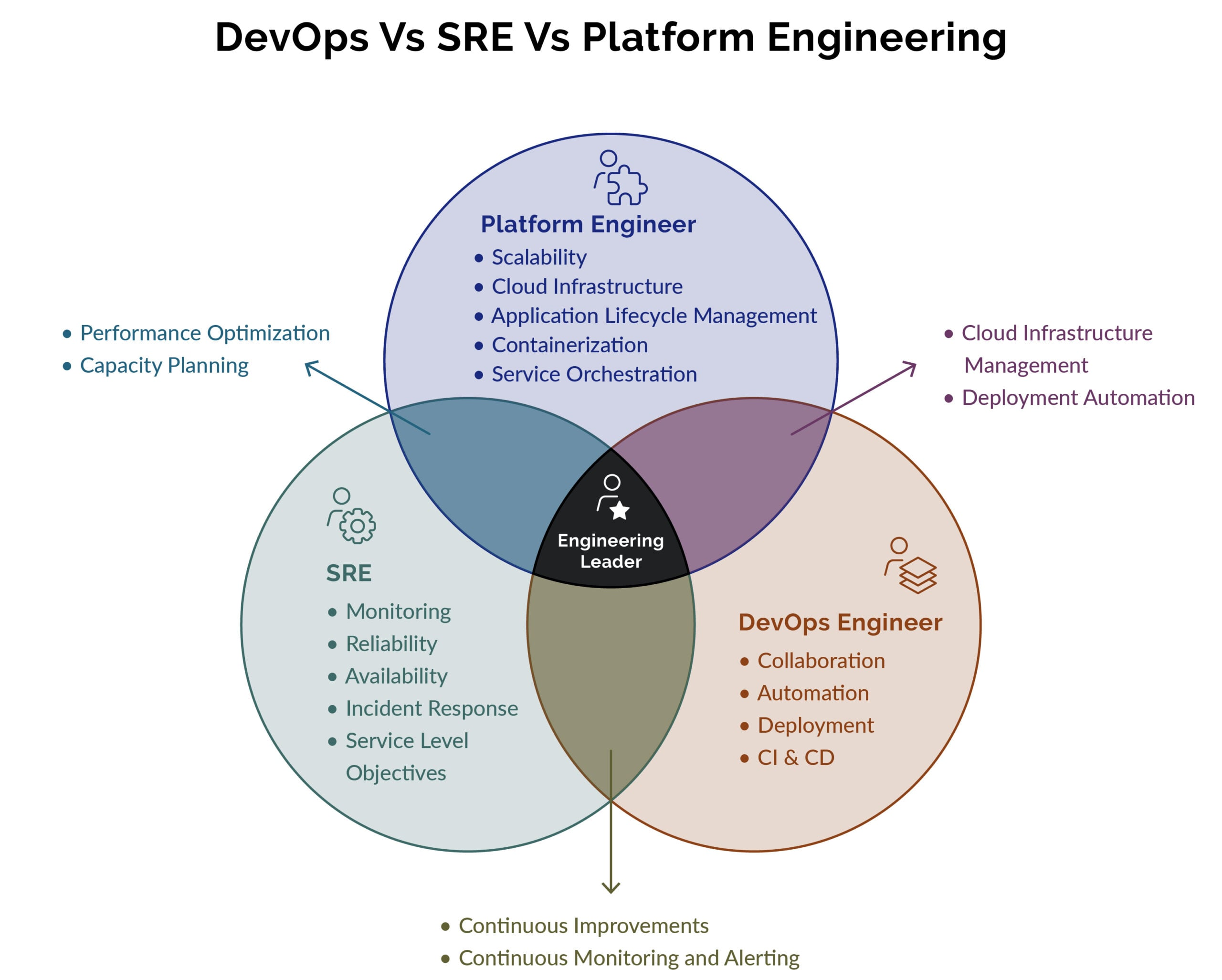
Platform Engineering vs DevOps: Why Modern Enterprises Are Building Internal Platforms
Platform engineering vs DevOps: what internal developer platforms are, when to build a platform team, and the...
Cloud-native application development explained: containers, Kubernetes, and serverless, when each fits, and how to choose with a clear framework.
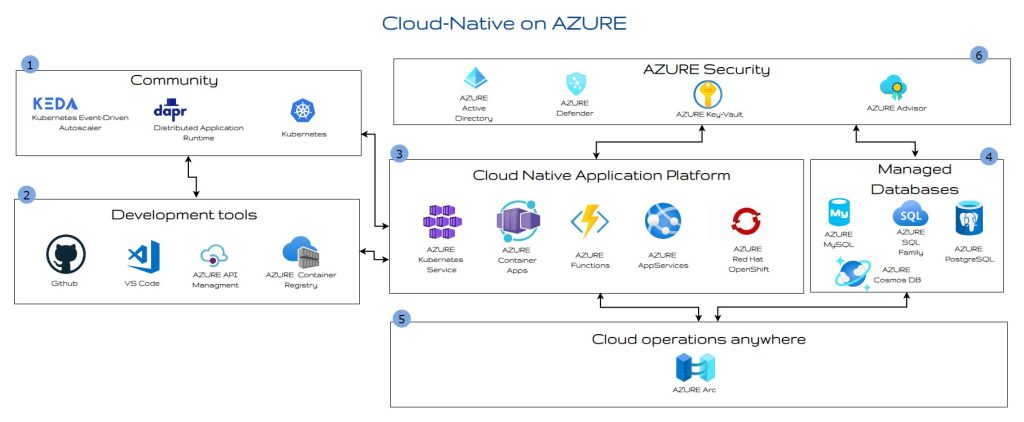
Cloud-native application development is the practice of building software as collections of independently deployable services that run in containers, orchestrate through platforms like Kubernetes, and scale elastically on cloud infrastructure. It is less about where the code runs and more about how you design, package, deploy, and operate it. Containers, Kubernetes, and serverless are the three pillars, and each one fits a different problem.
The market has already voted. Kubernetes is now in production at 82% of organisations surveyed [7], and more than 70% of AWS customers use serverless in some form [6]. Yet most teams still misuse all three, treating Kubernetes as a default rather than a deliberate choice, or reaching for serverless when a long-running container would be cheaper and simpler.
This guide explains what cloud-native actually means, where containers, Kubernetes, and serverless each earn their place, and how to decide between them with a framework rather than fashion. We cover the 12-factor methodology, a reference architecture, trade-offs, costs, a phased roadmap, the mistakes that quietly drain budgets, and a clear build-versus-buy recommendation for senior technology buyers.
Key Takeaways
- Cloud-native is an operating model, not a hosting location: independently deployable services, declarative infrastructure, automation, and elastic scaling.
- Kubernetes runs in production at 82% of organisations [7], but it is the right tool only when you have many services, multiple teams, and steady traffic that justifies its operational cost.
- Serverless wins for spiky, event-driven, and low-baseline workloads; containers on Kubernetes win for steady, high-throughput, or stateful services. Most enterprises run both.
- The 12-factor app methodology is the non-negotiable foundation: get config, statelessness, and disposability right before choosing a runtime.
- Cost is the top cloud challenge for 84% of organisations, with around 27% of spend wasted [6]. Cloud-native amplifies both savings and waste, so FinOps discipline is mandatory.
Cloud-native is frequently confused with "running in the cloud". Lifting a monolith onto a virtual machine in AWS is cloud hosting, not cloud-native. The distinction matters because the benefits people expect (elasticity, resilience, fast delivery) come from the architecture and operating model, not the data centre.
The Cloud Native Computing Foundation describes cloud-native as building and running scalable applications in modern, dynamic environments using containers, service meshes, microservices, immutable infrastructure, and declarative APIs. Strip away the jargon and four properties define it.
Notice that none of these properties require Kubernetes specifically. They require discipline. A well-built serverless application can be more cloud-native than a poorly run Kubernetes cluster. The runtime is a means, not the goal.
Before you argue about containers versus serverless, get the application design right. The 12-factor methodology, originally written by engineers at Heroku, remains the most practical checklist for software that runs well on any cloud-native platform. Skip it and you will fight your runtime forever.
The factors that matter most for the runtime decision are these four. Get them wrong and neither Kubernetes nor serverless will save you.
The other factors (codebase, dependencies, build/release/run separation, port binding, concurrency, logs as event streams, admin processes, and dev/prod parity) round out the model. Treat 12-factor as the entry exam. Teams that pass it move between runtimes with relative ease. Teams that fail it find every migration painful.
A container packages an application with its dependencies into a single, portable, immutable image that runs identically on a laptop, a build server, and production. Containers are the lowest common denominator of cloud-native. Almost everything else, including Kubernetes and many serverless platforms, builds on top of them.
The value is consistency. "Works on my machine" stops being a problem when the machine is shipped with the code. Containers also start in seconds rather than minutes, pack densely onto hosts, and form clean deployment boundaries between services.
A container is a single running process. The moment you have dozens of them, you need answers to harder questions. How do they find each other? What restarts a crashed instance? How do you roll out a new version without downtime? How do you scale on load? These are orchestration problems, and they are exactly what Kubernetes exists to solve.
If you only have a handful of services, you do not need an orchestrator. Managed container services such as AWS ECS Fargate, Google Cloud Run, or Azure Container Apps run containers without you operating a cluster. Many teams over-reach for Kubernetes when one of these would have been far cheaper to run. This is one of the most common and expensive mistakes in the space.
Kubernetes is the de facto standard for orchestrating containers at scale, in production at 82% of organisations surveyed by the CNCF [7]. It schedules containers across a fleet of machines, restarts failures, handles rolling deployments, manages service discovery and networking, and scales workloads up and down against demand. It does this declaratively: you describe the desired state and the control plane continuously reconciles reality to match.
Kubernetes is powerful and it is not free, in money or in attention. You inherit a control plane, networking (CNI), ingress, storage classes, RBAC, secrets management, observability, and a steady stream of version upgrades. The ecosystem is vast, which is a strength and a tax. Running a production-grade cluster safely is a platform engineering discipline in its own right.
This is why a managed control plane (EKS, GKE, AKS) is almost always the right starting point over self-managed clusters. It is also why many organisations build an internal developer platform on top of Kubernetes so application teams get "golden paths" rather than raw YAML. If your team is small or your services are few, the operational overhead may outweigh the benefit, and a managed container service will serve you better. We expand on architecture choices in our guide to web application architecture in 2026: monolith, microservices, or modular monolith.
Serverless lets you run code or containers without managing servers, scaling automatically from zero to thousands of concurrent executions and billing only for what you use. More than 70% of AWS customers already use serverless in some form [6]. It spans function platforms (AWS Lambda, Azure Functions, Google Cloud Functions) and container-based serverless (Cloud Run, AWS Fargate, container Lambda images).
Cold starts add latency to the first request after idle, which matters for user-facing, latency-sensitive paths. Execution time and memory limits make some long-running or compute-heavy jobs awkward. Steady, high-throughput workloads can become more expensive per request than a reserved container. And vendor coupling is real: deep use of a provider's event and function model is harder to move than a container.
The instructive cautionary tale is Amazon Prime Video. In 2023 its engineering team rewrote an audio/video monitoring service from a serverless and microservices design back into a single monolithic process, reporting a cost reduction of more than 90% at scale, a result that echoes the MonolithFirst principle [3]. The lesson is not that serverless is bad. It is that the right granularity and runtime depend on the workload's traffic and data flow, and that high-throughput steady work often favours a long-running process. Architecture is a per-workload decision, a theme we return to in legacy system modernization: strangler fig, big bang, or incremental migration.
This is the decision most teams agonise over, so here it is directly. The honest answer for most enterprises is "both", applied per workload. The table below is the comparison to keep on the wall.
| Dimension | Containers on Kubernetes | Serverless functions |
|---|---|---|
| Best for | Steady, high-throughput, stateful, or latency-critical services | Spiky, event-driven, low-baseline, bursty workloads |
| Scaling model | Horizontal pod and node autoscaling; minimum replicas warm | Automatic, scale to zero, near-instant burst |
| Cost model | Pay for provisioned capacity (often cheaper at steady high load) | Pay per invocation and duration (cheaper when idle or spiky) |
| Cold starts | None once running | Yes, on first request after idle |
| Operational burden | High: cluster, networking, upgrades, observability | Low: provider runs the platform |
| Long-running jobs | Native, no time limit | Constrained by execution-time limits |
| Portability | High (standard manifests, any conformant cluster) | Lower (provider event and function model) |
| Time to first deploy | Slower (platform setup) | Fast (no infrastructure to stand up) |
| Team skills needed | Platform engineering, SRE | Application engineering plus IaC |
Read the table as a spectrum, not a binary. A typical enterprise estate runs steady core services on Kubernetes, event glue and batch work on serverless, and managed container services for the middle ground that needs neither a function model nor a full cluster.
Cloud-native systems share a recognisable shape. Below is a described reference architecture, followed by the decision framework and the trade-offs that come with each choice.
        [ Clients / API consumers ]
                  |
            [ CDN / WAF ]
                  |
        [ API Gateway / Ingress ]
            /            \
   [ Kubernetes ]     [ Serverless ]
   steady services    event + bursty
   (core APIs,        (uploads, webhooks,
    stateful work)     stream/batch jobs)
            \            /
        [ Service mesh / messaging bus ]
                  |
   [ Managed data: SQL, NoSQL, cache, object store ]
                  |
   [ Observability: logs, metrics, traces ]
   [ CI/CD + GitOps reconciliation ]
   [ IaC + policy-as-code + secrets manager ]
The key idea is that containers and serverless coexist behind a shared gateway, share managed backing services, and are governed by one observability, delivery, and policy plane. You do not pick one runtime for the whole estate. You route each workload to the runtime that fits it.
Run each candidate workload through these five questions in order. The answers point clearly to a runtime.
| Approach | Strengths | Weaknesses | Choose when |
|---|---|---|---|
| Managed container service (Cloud Run, ECS Fargate, Container Apps) | Low ops, containers without a cluster, fast to ship | Less control and extensibility than full Kubernetes | Few services, small platform team, standard needs |
| Kubernetes | Maximum control, portability, rich ecosystem, scales to large estates | High operational cost; needs platform engineering | Many services, multiple teams, steady traffic, complex networking |
| Serverless functions | Scale to zero, pay per use, minimal ops, event-native | Cold starts, time limits, deeper provider coupling | Spiky, event-driven, low-baseline, glue and batch work |
If you remember one rule: start with the simplest runtime that meets the workload's traffic, latency, and team realities, and only add operational complexity when scale forces your hand. This mirrors the MonolithFirst principle in architecture. Complexity should be earned, not assumed.
Consider a financial-services platform team with a legacy monolith, a small SRE function, and pressure to ship faster. A pragmatic cloud-native path looks like this, and it is the pattern teams like Mind Supernova help enterprises execute without a high-risk rewrite.
They begin by containerising the monolith as-is and running it on a managed container service. No Kubernetes yet. This alone gives them reproducible builds, faster deploys, and clean staging parity. They then peel off the first event-driven concerns (document processing, notifications, audit logging) into serverless functions, because those workloads are spiky and map naturally to events.
Only when the service count grows past roughly fifteen, across three teams, do they introduce Kubernetes with a managed control plane and a thin internal platform on top, giving application teams golden paths rather than raw manifests. Steady core APIs migrate to the cluster; event glue stays serverless. The result is a hybrid estate where each runtime earns its place. The Prime Video lesson is respected throughout: granularity and runtime follow the workload, not a slide deck.
Sourcing senior platform and cloud engineers is often the constraint on this path, not the technology. For enterprises weighing an offshore partner, our guides to AI outsourcing in Vietnam: the complete 2026 guide to costs, vendors, and ROI and how to choose an AI outsourcing partner without getting burned set out how to add capacity without losing control or quality.
Treat cloud-native adoption as a sequence, not a big bang. Each phase delivers value and de-risks the next.
For the multi-cloud dimension of this roadmap (lock-in, portability, and where to standardise), pair this with our analysis of multi-cloud versus single-cloud strategy: what enterprise CTOs are choosing in 2026.
Most cloud-native failures are not technical surprises. They are predictable choices that looked reasonable at the time. Watch for these.
Cloud-native amplifies both savings and waste. Elastic scaling can cut idle spend dramatically, or it can autoscale a misconfigured workload into a runaway bill. The discipline that separates the two is FinOps, and 59% of organisations now run a FinOps practice [6].
The cost levers that matter most in a cloud-native estate are these.
Model the runtime decision in money terms. A workload that is cheaper on serverless at low volume can become much more expensive than a reserved container at high constant volume. The crossover point is real and should drive the choice.
The build-versus-buy question in cloud-native is rarely "build Kubernetes from scratch", because almost no one should. It is "how much of the platform do we operate ourselves, and how much do we buy as managed services?"
Buy the undifferentiated heavy lifting. Build only what differentiates you.
The deciding factors are platform maturity, the size of your platform team, and the regulatory environment. A small team should buy heavily and keep its own surface area minimal. A large organisation with a dedicated platform function can justify building more of the platform layer, though it should still buy the control plane.
For many enterprises the practical answer is a hybrid: buy the managed foundation, and bring in an external engineering partner to accelerate the build of services and the internal platform. This is where a partner such as Mind Supernova fits naturally, providing senior engineers who can start in five to seven days with 4+ hours of daily UK overlap, through models like staff augmentation or a dedicated team. The goal is to add senior delivery capacity without handing over control of your architecture. If you want to talk through your runtime mix, schedule a call with our engineering team.
No. Cloud-native is an operating model of independently deployable, automated, elastic, observable services. You can achieve it with managed container services or serverless. Kubernetes is the right choice when you run many services across multiple teams with steady traffic that justifies its operational cost, not as a default.
Choose serverless for spiky, event-driven, or low-baseline workloads where scale-to-zero and pay-per-use win, such as webhooks, uploads, and batch jobs. Choose containers for steady, high-throughput, stateful, or latency-critical services. Most enterprises run both and route each workload to the runtime that fits its traffic shape.
It is a set of twelve principles for building software that runs well on cloud platforms, covering config in the environment, stateless processes, disposability, backing services as attached resources, and dev/prod parity, among others. It is the foundation that makes any runtime, container or serverless, work cleanly. Get it right first.
Often, yes. A small team running a handful of services usually pays more in operational overhead than it gains. Managed container services like Cloud Run, ECS Fargate, or Azure Container Apps give you containers without a cluster. Adopt Kubernetes only when service and team count clearly justify it.
Run a FinOps practice. Right-size resource requests, use scale-to-zero for low-baseline workloads, buy commitment discounts for steady load, and tag every resource for per-team cost allocation. Cost is the top cloud challenge for 84% of organisations with around 27% of spend wasted [6], so model costs before deploying.
Cloud-native is a way of designing, packaging, deploying, and operating software, not a checkbox for Kubernetes. Containers give you portability, Kubernetes gives you orchestration at scale, and serverless gives you elasticity and pay-per-use economics. The mature pattern is a hybrid estate where each workload runs on the runtime that fits its traffic, latency, team, and cost profile.
This quarter: make your top services 12-factor compliant, containerise them, and run them on a managed container service. Stand up centralised observability and tag every resource for cost.
Next 90 days: move your first event-driven workloads to serverless, adopt GitOps, and use the decision framework above to place each new workload deliberately. Introduce Kubernetes only when service and team count justify it. If you want senior engineers to accelerate the work without losing architectural control, talk to our engineering team.
Platform engineering vs DevOps: what internal developer platforms are, when to build a platform team, and the...
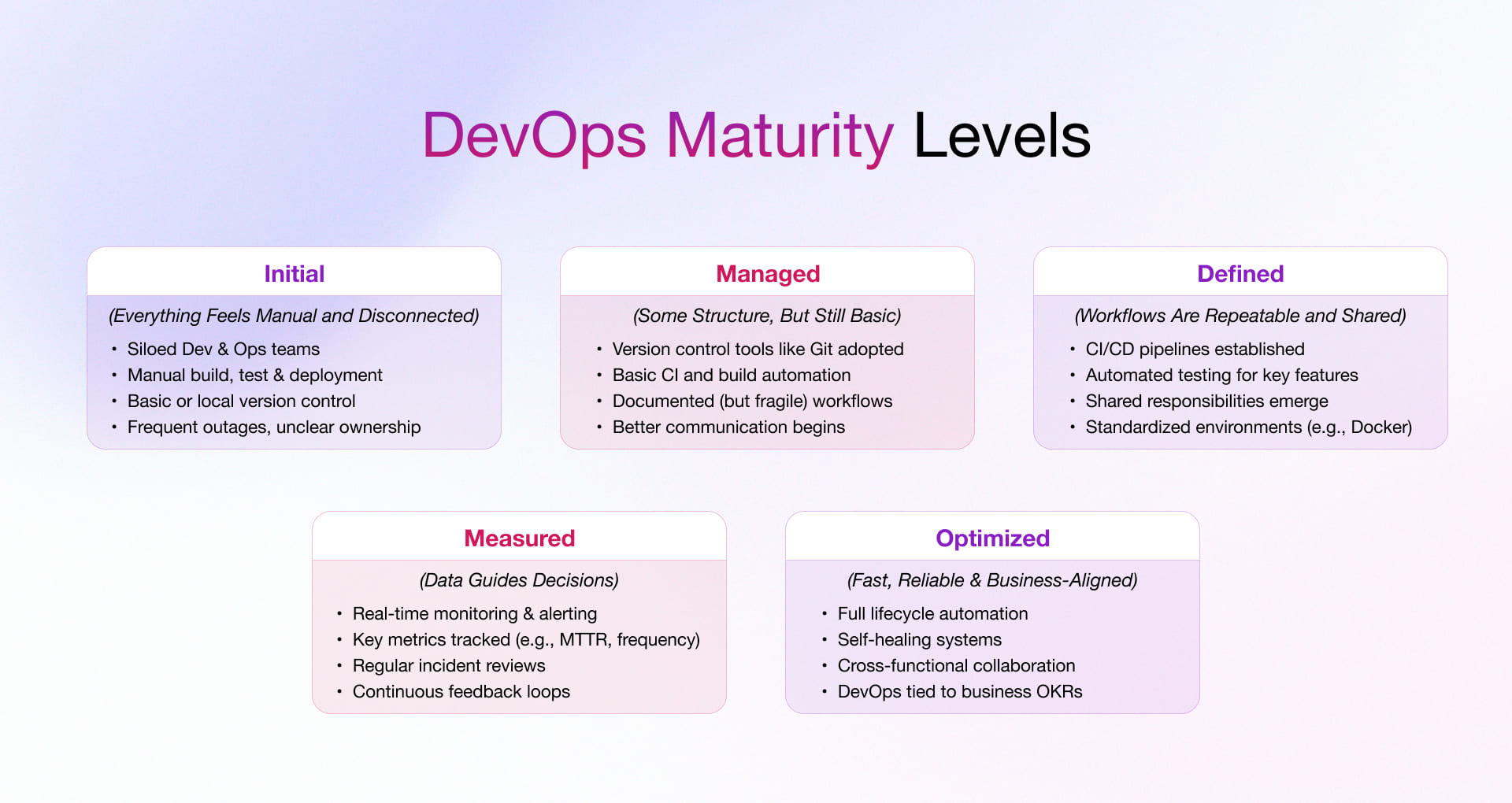
A practical DevOps maturity model and DORA metrics to assess where your engineering org stands today, plus a r...
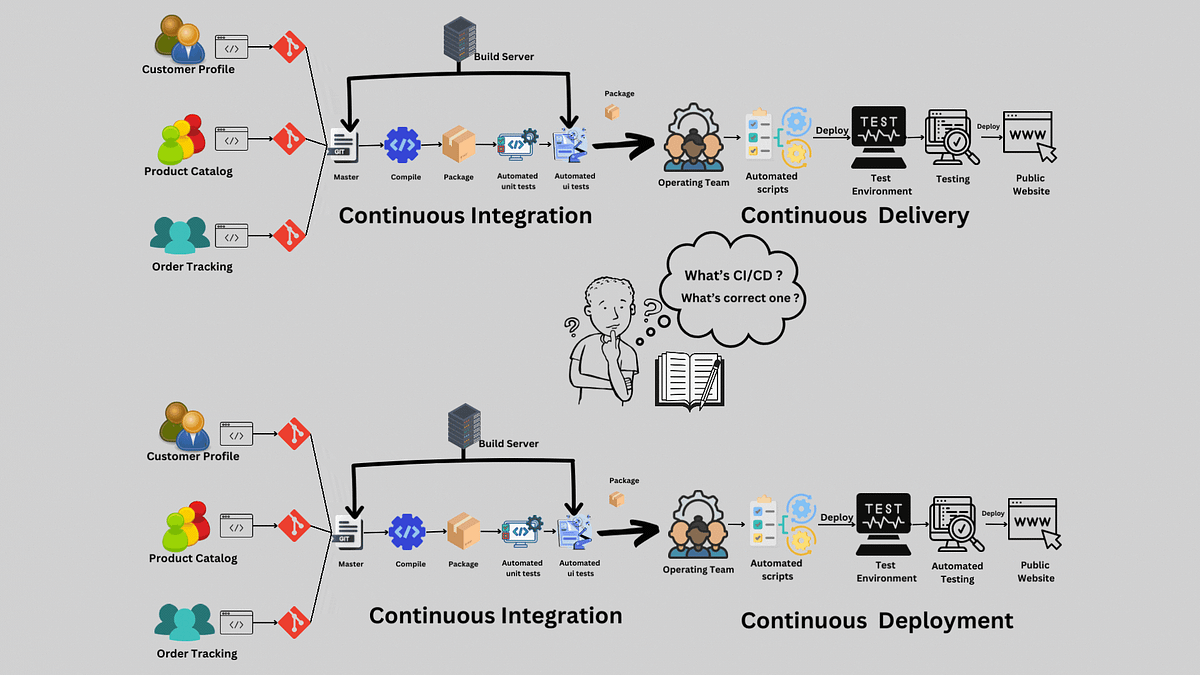
How to design a CI/CD pipeline that scales across many teams and products: golden templates, security gates, m...