
SaaS Development Costs in 2026: What It Really Takes to Build and Scale a Modern SaaS Product
What SaaS development really costs in 2026: cost drivers, MVP vs scale, team makeup, and build-vs-buy, with re...
How to build a compliant digital wallet in 2026: architecture, double-entry ledgers, PCI DSS, PSD2, KYC/AML, security, and build-vs-buy.
To build a compliant digital wallet platform in 2026, you need three things working together from day one: a correct money model (a double-entry ledger, not a balance column), the right regulatory permission (an e-money licence or a sponsor with one), and a security and KYC/AML stack that satisfies PCI DSS, PSD2 strong customer authentication, and your anti-money-laundering obligations. Get those three right and the rest is engineering. Get any one of them wrong and you are rebuilding under regulatory pressure.
This guide is written for the technical leaders who own that decision: the CTO weighing build versus buy, the Head of Architecture designing the ledger, the product director who has to ship a wallet without becoming an accidental bank. We will cover the reference architecture, the licensing paths across the UK, EU, Australia, Singapore, and the US, the ledger design that keeps your auditors calm, and an honest roadmap with real costs.
A digital wallet looks simple to a user: top up, hold a balance, pay, withdraw. Underneath, it is a regulated money-movement system where every fraction of a cent must reconcile and every transaction must survive a regulator's audit. If you are early in scoping this, talking to an engineering team that has shipped financial systems before saves expensive mistakes. Schedule a call with our engineering team if you want a second opinion on your architecture.
Key Takeaways
- The money model is the product. Use an immutable, double-entry ledger from line one. A mutable balance field is the single most common cause of unreconcilable wallet platforms.
- Licensing drives architecture more than scale does. An e-money licence (UK EMI, EU EMD2), an Australian AFSL/PFF, a Singapore MAS Major Payment Institution licence, or a US money transmitter web of state licences each impose different segregation, safeguarding, and reporting rules.
- PCI DSS scope is something you minimise, not maximise. Never let raw card data touch your servers. Tokenise through a provider so most of your stack stays out of scope.
- Build the ledger and orchestration. Buy KYC, sanctions screening, card issuing, and acquiring. A pure-build wallet typically costs $750K–2M and 9–15 months before first live transaction.
- Reconciliation and AML transaction monitoring are not phase-two features. Regulators ask for them at authorisation, and retrofitting them is far more expensive than building them in.
A digital wallet is a system that lets a user hold stored value, send and receive money, and pay merchants, all through a balance you maintain on their behalf. That last phrase is the regulated part. The moment you hold customer funds, you are issuing electronic money or transmitting money, and a regulator somewhere wants to know how those funds are protected.
It helps to separate three things that often get conflated. A pass wallet (storing loyalty cards or tickets) is barely regulated. A pass-through wallet (like a tokenised card in a phone) moves money but does not hold a balance, so it sits behind someone else's licence. A stored-value wallet holds customer funds, and that is the hard, regulated case this guide addresses.
Notice that only one of those four is purely technical. Wallet projects fail when engineering treats the other three as someone else's problem. They are not. The architecture has to encode them.
Start with a clean separation of concerns. The system splits into an edge layer, a core money layer, a compliance layer, and an integration layer. Keeping these as distinct services (or at least clearly bounded modules) lets you scope PCI DSS narrowly and reason about each regulatory obligation in isolation.
If you are also designing the tenancy and isolation model for a multi-product platform, the patterns in our guide on building a multi-tenant SaaS platform architecture apply directly here, because a wallet serving multiple programmes or brands has the same isolation questions.
 [ Mobile / Web Client ]
          | (TLS, SCA challenge)
          v
 +---------------------+        +-------------------------+
 |   API / Edge layer  | -----> |  Auth & SCA (PSD2)      |
 |  rate-limit, WAF    |        |  step-up, device bind   |
 +----------+----------+        +-------------------------+
            |
            v
 +---------------------+        +-------------------------+
 |  Wallet Core        | <----> |  Double-entry Ledger    |
 |  orchestration,     |        |  immutable, append-only |
 |  idempotency        |        |  accounts + entries     |
 +----+-----------+----+        +-------------------------+
      |           |
      v           v
 +---------+  +--------------------+   +----------------------+
 | KYC /   |  | AML monitoring &   |   | Payments integration |
 | onboard |  | sanctions screening|   | acquiring / issuing  |
 +---------+  +--------------------+   |  / bank rails / FX   |
                                      +----------------------+
                                                |
                                                v
                                   [ Safeguarding bank account ]
Every wallet balance must be a derived quantity, computed from an append-only sequence of ledger entries, never a number you mutate in place. A user's balance is the sum of credits minus debits against their account. This is the difference between a system you can audit and a system you cannot.
Use double-entry accounting. Each transaction creates at least two entries that sum to zero: money debited from one account is credited to another. A top-up debits a clearing account and credits the user. A payment debits the user and credits the merchant or a settlement account. The ledger never goes out of balance because, by construction, it cannot.
Money systems retry. Networks fail mid-request. Without idempotency keys on every write, a single retried top-up can credit a user twice. Require a client-supplied idempotency key on all mutating endpoints and store the result so a replay returns the original outcome rather than repeating the effect.
For the ledger itself, prefer strong consistency over eventual consistency on the balance-affecting path. You can be eventually consistent about analytics and notifications. You cannot be eventually consistent about whether a user has the funds to spend.
Before you write the ledger, decide how you will be allowed to hold customer money. This choice dictates safeguarding rules, capital requirements, reporting, and even which markets you can serve. There are three broad paths, and most teams underestimate how long the licensed path takes.
| Market | Core permission for holding funds | Regulator | Notable obligation |
|---|---|---|---|
| UK | Electronic Money Institution (EMI) authorisation | FCA | Safeguard customer funds; PSD2-derived strong customer authentication |
| EU | E-money licence under EMD2 | National competent authority | Passportable across the EEA; PSD2 SCA and open-banking rules |
| Australia | AFSL plus purchased payment facility (PPF) consideration | ASIC / RBA | Stored-value facility rules under the evolving payments licensing reform |
| Singapore | Major Payment Institution licence (Payment Services Act) | MAS | E-money issuance and cross-border transfer activities, AML/CFT |
| US | Money transmitter licences, state by state (plus federal AML) | State regulators / FinCEN | Roughly 50 separate licences; FinCEN MSB registration |
The US case deserves a flag. There is no single federal wallet licence, so a nationwide US wallet means dozens of state money-transmitter licences, each with its own capital and surety-bond requirements. This is why so many US wallet startups launch on a BaaS partner rather than going direct. Treat the table as a starting map, not legal advice; confirm current rules with counsel in each market, because payments licensing is actively being reformed in several of these jurisdictions in 2026.
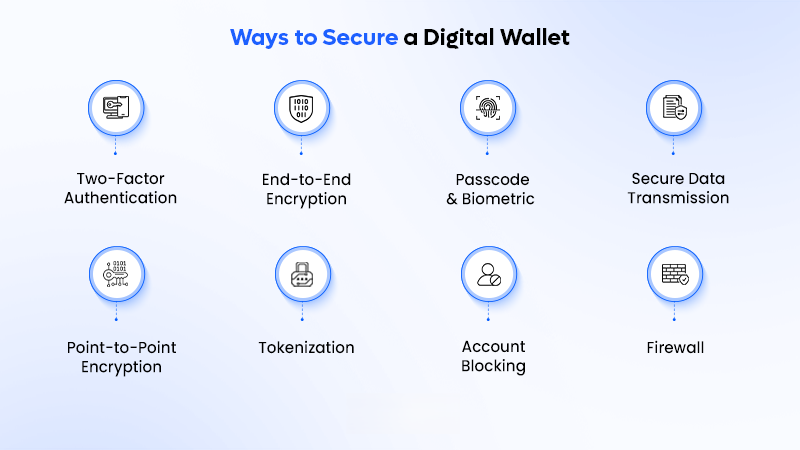
Security for a wallet is not one standard. It is a stack of overlapping obligations, and the smartest architectural move is to shrink how much of your system each one touches.
PCI DSS governs how you handle cardholder data. The cheapest, safest way to comply is to never hold raw card numbers. Route card entry through a PCI-compliant provider that returns a token, so your servers only ever see tokens. This drops most of your platform out of PCI scope, leaving you a much smaller SAQ (self-assessment questionnaire) rather than a full Level 1 audit.
If you do choose to store card data (almost never the right call for a startup), you are signing up for network segmentation, quarterly scans, an annual on-site assessment, and a permanent compliance cost. Build-vs-buy applies here too: buying tokenisation is almost always correct.
For UK and EU operations, PSD2 requires strong customer authentication (SCA): at least two of something the user knows, has, and is. Architecturally this means a step-up authentication service that can challenge on login, on payment, and on risk triggers, with documented exemptions (low-value, trusted beneficiary) applied correctly. Bind sessions to devices and log every authentication decision for audit.
| Layer | Control | Why it matters for a wallet |
|---|---|---|
| Edge | WAF, rate limiting, bot defence | Wallets are credential-stuffing and enumeration targets |
| Identity | SCA, device binding, anomaly-based step-up | PSD2 compliance and account-takeover defence |
| Data | Encryption at rest and in transit, field-level encryption for PII | Breach-cost and data-protection exposure |
| Secrets | HSM or cloud KMS, no keys in code | Key compromise is catastrophic in money systems |
| Ledger | Append-only, cryptographic chaining of entries | Tamper evidence for audit and dispute resolution |
| Access | Least privilege, four-eyes on payouts, full audit logs | Broken access control is the OWASP #1 risk |
That last row is not decoration. Broken access control is the number one risk in the OWASP Top 10:2021 [1], and in a wallet a broken access check means one user moving another user's money. The financial cost of getting this wrong is concrete: the average data breach reached $4.44M in 2025, according to IBM, down from $4.88M in 2024, with security automation saving roughly $1.9M per breach [2]. For deeper threat-modelling and secure-SDLC practice, our companion piece on enterprise application security in 2026 goes into STRIDE and shift-left in detail.
Know Your Customer (KYC) and Anti-Money Laundering (AML) are where wallet projects most often discover, too late, that compliance is an architecture concern. You cannot bolt these on after launch. Regulators ask to see your transaction-monitoring approach during authorisation.
At onboarding you verify identity to a risk-appropriate standard: document verification, liveness checks, and sanctions and politically-exposed-person (PEP) screening. Most teams buy this. Identity verification vendors handle the document parsing and biometric checks far better than you will build in-house, and their coverage across jurisdictions is the point.
The harder, continuous part is transaction monitoring. You need rules and models that flag structuring, velocity anomalies, high-risk corridors, and patterns that suggest layering. Suspicious activity must generate a case, a human review, and where required a regulatory report (a SAR). Architecturally, stream every ledger event into a monitoring pipeline and keep an immutable record of every alert and decision.
Here is a structured way to choose, rather than defaulting to whatever the loudest vendor demos. Score each path against the dimensions that actually matter for your stage, regulatory exposure, and ambition.
| Dimension | Own licence (EMI) | Agent of a principal | BaaS / embedded |
|---|---|---|---|
| Time to first live transaction | 12–24 months | 4–9 months | 2–5 months |
| Upfront capital and setup | High (regulatory capital + build) | Medium | Low |
| Unit economics at scale | Best | Squeezed by principal fees | Worst (provider takes a cut) |
| Control over product and data | Full | Partial | Constrained by provider APIs |
| Regulatory burden you carry | All of it | Shared | Mostly the provider's |
| Differentiation potential | High | Medium | Low |
| Best for | Funded fintechs with a wallet at their core | Brands adding payments to an existing product | Speed-to-market tests and MVPs |
Pick BaaS to validate demand and learn the operations cheaply. Pick the agent model when payments support your core product but are not the product. Pursue your own licence only when the wallet is the business and the unit economics of a third party would eventually kill you. A common, sensible path is BaaS first, then graduate to your own licence once volume justifies the regulatory cost.
The central trade-off is speed and simplicity against margin and control. BaaS gets you live this quarter but caps your margin and ties your roadmap to a provider's priorities and risk appetite. Your own licence frees both, at the cost of a long authorisation process and the obligation to safeguard funds, hold capital, and own every compliance failure.
There is a second, quieter trade-off in the ledger itself: a richer, double-entry model is more work upfront but pays for itself the first time an auditor or a disputed transaction arrives. Teams that took the shortcut of a mutable balance field almost always rewrite it, usually under time pressure, which is the worst time to redesign your money model.
Look at how the wallet category actually evolved and a clear pattern emerges. The large platform wallets (Apple Pay, Google Pay) chose the pass-through model: they tokenise existing cards and sit behind banks' licences rather than holding balances, which keeps them out of e-money licensing entirely. That is a deliberate architectural choice to avoid becoming a regulated money holder.
Contrast that with stored-value players such as PayPal and Wise, which hold customer balances and therefore hold e-money permissions in the markets they operate. Wise, in particular, is a useful reference because it scaled a multi-currency wallet by building a strong internal ledger and treasury operation while obtaining licences market by market. The lesson is not to copy a logo but to copy the decision discipline: they chose their regulatory model first and let it shape the architecture, not the other way round.
For newer entrants, the dominant pattern in 2026 is to launch on embedded-finance rails, prove the product, and selectively bring functions in-house. The differentiation is rarely the payment rails themselves. It is the ledger logic, the user experience, and the risk models layered on top. That is also where most of the custom engineering effort lands.
A phased plan keeps you from boiling the ocean. Each phase has a clear exit gate. Do not start the next phase until the current gate is genuinely met, because in regulated systems shortcuts compound.
This is a realistic 9–15 month path to a live, compliant wallet if you buy the commodity pieces. Teams like Mind Supernova help enterprises compress phases 1 and 2 by bringing engineers who have built ledgers and compliance integrations before, which is where most of the avoidable delay hides. Senior engineers who have shipped financial systems are the difference between a clean ledger and a year of rework.
Costs split into one-off build, ongoing operations, and regulatory. The numbers below are industry estimates for planning, not quotes, and they vary widely by market and ambition. Treat them as ranges to pressure-test your own model.
| Cost area | Typical range (estimate) | Notes |
|---|---|---|
| Core platform build (ledger, wallet core, apps) | $400K–1.2M | Depends heavily on how much you buy vs build |
| Compliance integrations (KYC, AML, screening) | $100K–300K | Plus per-check and per-screen usage fees |
| Licence and regulatory capital | Highly variable | EMI authorisation requires initial capital plus legal and advisory fees |
| Annual compliance and audit | $150K–500K/yr | Audits, MLRO function, reporting, monitoring tooling |
| Cloud and infrastructure | $5K–40K/mo | Scales with volume; ledger needs durable, well-backed-up storage |
| Payment rail fees | Per transaction | Acquiring, FX, and payout fees erode margin at scale |
A pure-build wallet with your own licence typically lands at $750K–2M before first live transaction, plus regulatory capital. A BaaS-led MVP can be an order of magnitude cheaper to launch, with the cost reappearing later as the provider's per-transaction margin. The right answer is rarely the cheapest day-one option; it is the one with the best total cost across the path you actually intend to walk.
These recur across nearly every troubled wallet build. Most are cheap to avoid early and brutally expensive to fix late.
If you are outsourcing any of this build, visibility into these decisions matters as much as the code. Our guide on how to outsource web application development without losing control covers the governance and QA gates that keep a financial build honest. For teams weighing an external partner, the broader question of choosing one well is covered in our piece on how to choose an outsourcing partner without getting burned.
For most teams in 2026, the right answer is hybrid. Buy the commodities. Build the differentiators and the ledger.
| Component | Recommendation | Reasoning |
|---|---|---|
| Double-entry ledger | Build (or use a focused ledger library) | It is your core money model and your audit foundation |
| Wallet orchestration and UX | Build | This is your differentiation |
| KYC and identity verification | Buy | Vendor coverage and accuracy beat in-house |
| Sanctions and PEP screening | Buy | List maintenance is a specialist, regulated job |
| Card tokenisation / PCI | Buy | Keeps you out of PCI scope |
| Acquiring, issuing, bank rails | Buy / partner | Licensing and integration depth make build impractical early |
| AML monitoring engine | Buy base, build rules | Buy the engine, own the risk logic |
| The licence itself | Buy access first, build later | Start on BaaS or as an agent, graduate when volume justifies it |
The one component you should almost never outsource conceptually is the ledger. You can have a partner write it, but your team must understand it cold, because everything else reconciles back to it. This is consistent with how mature financial engineering teams operate, and it is the pattern we steer clients toward.
Only if you hold customer balances yourself. If you launch on a Banking-as-a-Service provider or operate as an agent of a licensed principal, their permission covers you. Holding your own licence (an EMI in the UK, an EMD2 licence in the EU) gives better margin and control but takes 12 to 24 months.
Because it makes your balances provable and your system auditable. Every transaction creates balanced entries that sum to zero, so the books cannot drift. A single mutable balance field gives you no audit trail, no easy reconciliation, and no defensible answer when money goes missing or a dispute arrives.
Never let raw card numbers touch your servers. Route all card entry through a PCI-compliant tokenisation provider that returns a token your systems use instead. This keeps the bulk of your platform out of PCI scope, reducing you from a full Level 1 audit to a much smaller self-assessment questionnaire.
For UK and EU operations, SCA requires at least two independent factors from knowledge, possession, and inherence (something you know, have, and are) on login and payment. You build a step-up authentication service, apply documented exemptions correctly, bind sessions to devices, and log every authentication decision for audit.
A pure build with your own licence typically runs $750K to $2M before the first live transaction, plus regulatory capital and roughly $150K to $500K a year in ongoing compliance. A BaaS-led MVP launches for far less, with the cost reappearing later as per-transaction provider margin.
A compliant digital wallet is not a payments feature with some rules attached. It is a regulated money system whose architecture, licensing, and risk controls have to be designed together. Get the ledger right, choose your licensing path deliberately, minimise your PCI scope, and treat KYC and AML as first-class systems, and the rest is solvable engineering.
This quarter: decide your licensing path, design the chart of accounts and double-entry ledger, and set PCI scope reduction as a hard constraint. Next 90 days: build the core ledger with idempotency and daily reconciliation, integrate one payment-in and one payment-out rail, and stand up KYC plus AML monitoring before you process a single real transaction.
If you want experienced financial-systems engineers to pressure-test your design or build alongside your team, talk to our engineering team. Mind Supernova works as an offshore software engineering partner with senior engineers and 4+ hours of daily UK overlap, and engineers can typically start in 5 to 7 days. The wallet you launch should be one your auditors, your users, and your finance team all trust.
What SaaS development really costs in 2026: cost drivers, MVP vs scale, team makeup, and build-vs-buy, with re...
Custom CRM vs Salesforce vs HubSpot compared: total cost, control, and when building your own CRM creates real...
Custom ERP vs off-the-shelf SAP and Oracle: when packaged ERP fails, the composable alternative, and a clear b...