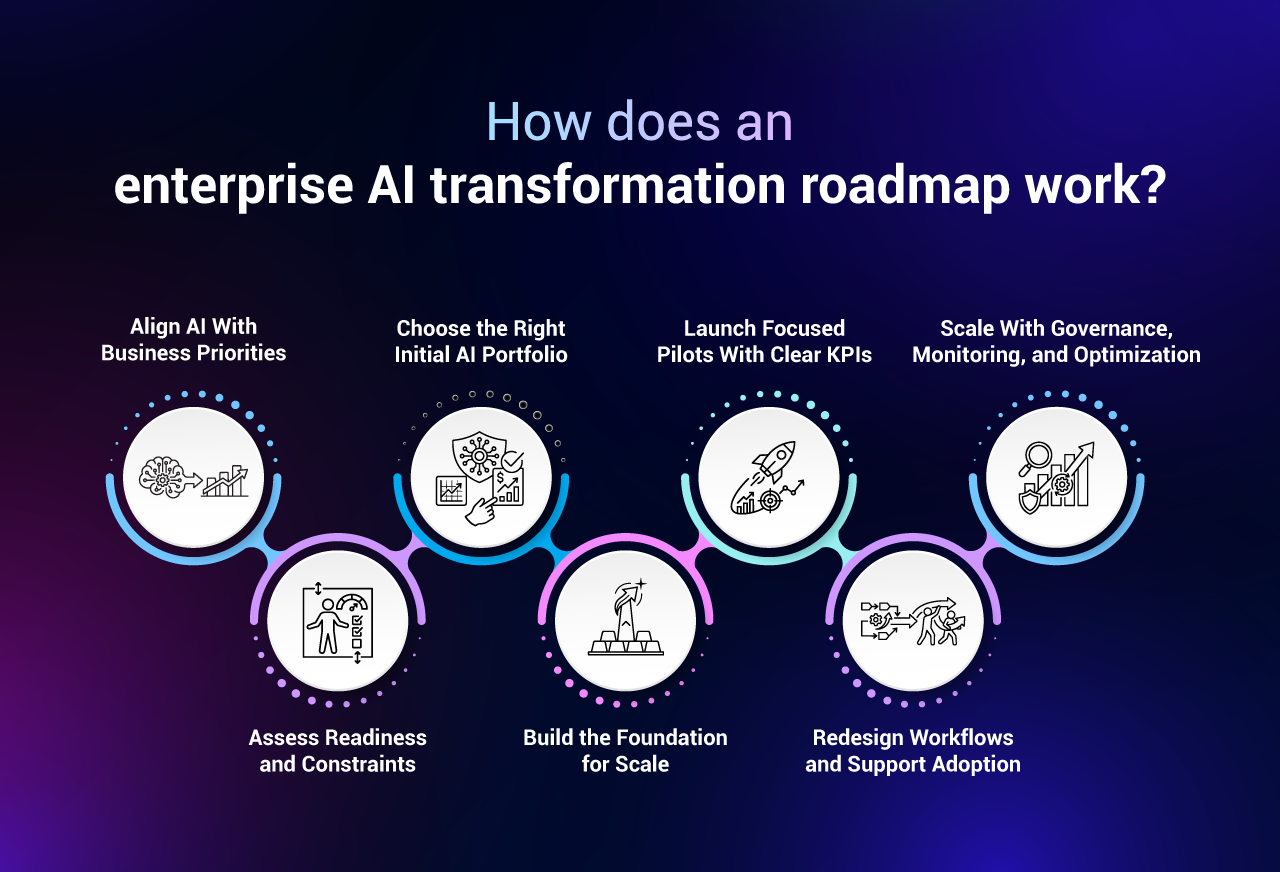
Enterprise AI Transformation Roadmap: From Pilot Projects to Enterprise-Scale AI Adoption
A phased enterprise AI transformation roadmap that takes you from pilot purgatory to enterprise-scale adoption...
An honest enterprise digital transformation playbook for CIOs in 2026: why most stall, the operating model, a phased roadmap, and real pitfalls.
Most enterprise digital transformations fail to deliver their intended value: research from McKinsey and BCG points to only around 30% succeeding against their original goals. That is the honest starting point for any CIO planning enterprise digital transformation in 2026, and it is more useful than the pretense that a new platform or an AI pilot will fix a broken operating model.
This playbook is written for the CIO who has been here before. You have seen the slide deck with the maturity curve, the three-horizon roadmap, and the confident timeline. You have also seen the same programme stall eighteen months in, over budget, with adoption flat and the original sponsor gone. The difference between the 30% that succeed and the rest is rarely the technology. It is the operating model, the sequencing, and the discipline to kill what is not working.
What follows is a phased roadmap, a decision framework for where to start, an honest trade-off analysis, real cost ranges, a named example, and the mistakes that quietly sink most programmes. No hype. Just the mechanics of getting a transformation to actually land.
Key Takeaways
The widely repeated claim that 70% of transformations fail is weakly sourced and worth retiring. The more defensible version, drawn from McKinsey and BCG research, is that roughly 30% of programmes succeed against their original ambition [1]. The gap is instructive. Most transformations do not collapse in a single dramatic event. They erode.
The erosion follows a recognisable shape. A bold vision is set at board level. Funding is approved for year one. Teams stand up programmes, buy platforms, and run pilots. Then the second year arrives, the easy wins are spent, and the hard structural changes (the operating model, the incentives, the legacy estate) turn out to be the actual work. Sponsorship rotates. The programme becomes a cost line to defend rather than a source of growth.
Across the failures, three patterns repeat. First, treating transformation as a technology programme when it is an operating-model change. New tools layered on old processes and incentives produce expensive disappointment. Second, sequencing by ambition rather than readiness, so the hardest, most cross-functional initiatives launch first and stall. Third, under-funding adoption: the budget buys the platform but not the behaviour change, training, and process redesign that make the platform pay back.
None of these are technical problems. A CIO who internalises that will already be ahead of most peers. The technology choices in 2026 are mature and well understood. The cloud platforms work. The data tools work. AI tooling is capable. The constraint is organisational throughput, and that is what this playbook optimises for.
Enterprise digital transformation is the deliberate redesign of how an organisation creates and delivers value, enabled by technology and data, and measured by business outcomes rather than systems delivered. That definition does real work. It excludes the common impostors.
Replacing an on-premise ERP with the same processes in the cloud is modernisation, not transformation. Adding a chatbot to a customer service team that still routes everything to humans is automation theatre. Buying a data warehouse without changing how decisions get made is shelfware. These activities can be valuable, but calling them transformation sets expectations that the work will never meet.
Real transformation changes at least one of three things in a durable way: the customer or employee experience, the operating model and cost structure, or the business model itself. If a programme cannot articulate which of those it is changing and how the change will be measured, it is not a transformation. It is a budget line looking for a narrative.
The single largest determinant of success is the operating model. You can buy any technology. You cannot buy the way your organisation makes decisions, funds work, and holds itself accountable. That has to be redesigned, and most transformations under-invest here because it is uncomfortable and political.
The shift that matters is from projects to products. Project-based delivery funds a fixed scope, staffs a temporary team, ships, and disbands. It is structurally hostile to transformation, which is continuous and uncertain. Product operating models fund persistent, cross-functional teams against business outcomes, give them autonomy within guardrails, and measure them on value delivered. Platform engineering enables this at scale by providing self-service foundations so product teams move fast without rebuilding plumbing each time.
| DimensionTraditional project modelProduct operating model | ||
| Funding | Fixed scope, annual capex | Persistent teams, outcome-based |
| Team structure | Temporary, assembled per project | Stable, cross-functional, long-lived |
| Accountability | On-time, on-budget delivery | Business outcome and adoption |
| Decision speed | Slow, escalates to steering committee | Fast, delegated within guardrails |
| Risk handling | Big upfront plan, late discovery | Small bets, continuous learning |
| Best for | Well-defined, low-uncertainty work | Transformation and uncertain value |
Do not attempt to convert the whole organisation to a product model on day one. That is its own failed transformation. Convert the teams working on the highest-value transformation initiatives first, prove the model, then expand. The operating-model change should be sequenced like any other part of the programme.
A transformation roadmap should be honest about its horizon. Meaningful enterprise change runs 3 to 5 years, and pretending otherwise sets up the credibility collapse that kills sponsorship. The phasing below is deliberately conservative on early scope, because early credibility funds later ambition.
Before funding anything, establish the baseline. What is the current cost-to-serve, the cycle times, the customer and employee pain, the state of the data, and the engineering throughput? Align the executive team on two or three outcomes that matter, expressed as measurable business results. Resist the comprehensive transformation map. You are buying alignment and a defensible starting point, not a five-year plan you cannot keep.
Stand up the platform and data foundations that everything else depends on, and deliver one or two visible wins that prove the model. The foundations are unglamorous: cloud landing zone, integration layer, identity, observability, and a trusted data pipeline for the priority domain. The wins should be real but bounded. This phase establishes credibility and the operating model in microcosm.
Expand the product operating model to more domains, retire or modernise legacy systems on the critical path, and industrialise the platform so new teams onboard in days, not months. Legacy modernisation belongs here, sequenced incrementally rather than as a big bang. The patterns for that are covered in our breakdown of legacy system modernization approaches, where the strangler fig pattern usually beats a rewrite.
Make the new way the default way. Decommission the parallel old processes that quietly persist, fold transformation funding into run-rate operating budgets, and shift from delivering initiatives to compounding capabilities. AI and advanced analytics typically scale here, on top of a data foundation that earlier phases built. The roadmap from pilot to enterprise scale for AI specifically is worth treating as its own track, as set out in the enterprise AI transformation roadmap.
| PhaseDurationPrimary goalKey riskExit signal | ||||
| 0 Diagnose | 0 to 3 months | Baseline and executive alignment | Analysis paralysis | Two or three agreed outcomes |
| 1 Foundations | 3 to 12 months | Platform, data, first proof | Foundations without value | One credible visible win |
| 2 Scale | 12 to 30 months | Expand model, modernise legacy | Sponsorship fatigue | Multiple teams self-sufficient |
| 3 Embed | 30+ months | Make new way default | Reverting to old processes | Old processes decommissioned |
The most common strategic error is starting with the most ambitious, most cross-functional initiative because it has the biggest headline value. Those initiatives also have the highest organisational drag and the longest path to proof. Start instead where value and readiness intersect.
Score each candidate initiative on two axes. Business value is the size and certainty of the outcome. Organisational readiness combines executive sponsorship, data availability, team capability, and the degree of cross-functional change required. Plot them, then sequence accordingly.
The top-right quadrant (high value, high readiness) is where you fund first. The top-left (high value, low readiness) is where you invest in foundations and sponsorship before committing the full programme, because launching here unready is the classic stall. The bottom-right gives cheap early credibility. The bottom-left should be deferred or killed without apology.
Pair the framework with staged funding. Fund the next phase, not the whole programme. Each initiative earns its next tranche by hitting an outcome gate, not by reporting activity. This single mechanism does more to prevent runaway failure than any amount of upfront planning, because it makes stopping a normal, blameless event rather than a career-ending admission of failure.
Transformation strategy is a series of trade-offs with no universally correct answer. Naming them honestly is more useful than a maturity model that implies a single right path.
| Trade-offOption AOption BWhen to lean A vs B | |||
| Pace | Big bang reinvention | Incremental, compounding | B almost always; A only under existential threat with strong sponsorship |
| Scope | Enterprise-wide | Beachhead then expand | B to build credibility; A risks spreading scarce change capacity too thin |
| Talent | Hire and build internally | Partner and augment | Build for differentiating capability; partner to add capacity and skills fast |
| Platform | Single vendor suite | Best-of-breed composable | Suite for speed and lower integration cost; composable for flexibility and avoiding lock-in |
| Governance | Centralised control | Federated autonomy | Federated within guardrails for speed; centralise only what carries real shared risk |
The recurring pattern is that the cautious-sounding option (incremental, beachhead, federated) usually wins, not because it is safer but because it preserves optionality and produces learning faster. Big, centralised, all-at-once approaches assume you already know the answer. In a genuine transformation, you do not.
The most instructive recent example is not a single company but a widely documented engineering pattern that mirrors the transformation lesson exactly. In 2023, Amazon Prime Video published an account of moving one of its monitoring services away from a distributed microservices-and-serverless architecture back toward a consolidated approach, reporting a cost reduction of more than 90% for that workload. The point is not that microservices are bad. The point is that the team chose the architecture that fit the actual problem rather than the fashionable one, and they were willing to reverse an earlier decision when the evidence demanded it.
That willingness to reverse is the transferable lesson for CIOs. Transformations that succeed treat early architectural and operating-model decisions as revisable bets, not commitments to defend. The teams that fail anchor on the original plan and keep funding it past the point where the evidence has turned. The Prime Video team optimised for the outcome (cost and simplicity for that workload) over consistency with a prior decision. A transformation governed the same way, where reversing a bet is normal, is far more likely to land in the 30%.
The broader industry signal points the same direction. ThoughtWorks lists broad microservices adoption as a technique to trial rather than a default, and Martin Fowler's MonolithFirst guidance argues for starting simple and extracting complexity only when scale justifies it. Translate that to transformation: start with the simplest operating model and architecture that can deliver the outcome, and add structural complexity only when you have earned the right to.
Governance is where good intentions become bureaucratic drag. A heavyweight programme management office that audits activity, demands status reports, and routes every decision through a monthly steering committee will slow a transformation to the speed of its meeting cadence. That is a primary cause of the stall most CIOs recognise.
Effective transformation governance is thin and fast. It does three things: it sets clear outcomes and guardrails, it controls funding through stage gates, and it removes blockers that teams cannot remove themselves. It does not approve every decision. It delegates decisions to the teams closest to the work and intervenes only on the things that carry genuine shared risk: security, regulatory compliance, data protection, and architectural choices with enterprise-wide consequences.
Security and compliance deserve special mention because they are where federated autonomy can go wrong. The answer is not centralised approval queues. It is to encode the rules into the platform itself, so the safe path is also the fast path. For AI initiatives specifically, this matters even more, and the controls are well covered in the guidance on AI governance, security and compliance.
If the operating model is where transformations live or die structurally, change management is where they live or die in practice. The platform can be perfect and the data pristine, and the programme still fails because people keep working the old way. Adoption is the metric that matters, and it is the one most programmes measure last.
Change management is not a communications campaign or a training course bolted on at the end. It is the deliberate redesign of incentives, processes, and daily tools so that the new way is easier than the old way. People do not resist change because they are irrational. They resist because the old way still works for them and the new way imposes cost. Remove that cost and resistance largely evaporates.
Budget for this as a first-class line item. A useful planning heuristic, drawn from our team's collective experience, is that change and adoption work often costs as much as the technology build for genuinely transformational initiatives. Programmes that fund the platform and treat change as overhead are funding failure with extra steps.
Most transformation failures are not novel. They repeat a small set of mistakes that are entirely avoidable once named.
Transformation budgets are routinely wrong in two directions. They overestimate the technology cost and dramatically underestimate the change, integration, and run-cost implications. Worldwide IT spending is forecast to reach $6.31 trillion in 2026, up around 13.5%, with generative AI a significant driver [2]. That macro pressure means transformation budgets will be scrutinised harder, not less, so credibility on costs matters.
The honest cost model has four buckets, and the one most often missing is the third and fourth.
| Cost bucketWhat it coversCommon budgeting error | ||
| Build | Platform, integration, data pipelines, custom development | Treated as the whole cost |
| Change and adoption | Process redesign, training, incentive change, communications | Under-funded or treated as overhead |
| Run and operate | Cloud spend, licensing, platform team, ongoing support | Ignored until it surprises finance |
| Decommission | Retiring legacy systems and parallel processes | Never budgeted, so old systems never die |
Cloud run-cost deserves a flag. Flexera's 2025 State of the Cloud report found that 84% of organisations cite managing cloud spend as their top challenge and around 27% of cloud spend is wasted [3]. A transformation that moves workloads to the cloud without a FinOps discipline will see run-costs erode the business case it was sold on. Budget for cost governance from day one, not as a remediation project in year three.
The build-versus-buy decision is where many transformations waste their budget. The default instinct in large enterprises is to build, because internal teams want ownership and external options never fit perfectly. That instinct is usually wrong for the majority of the estate and occasionally right where it matters most.
The rule is simple to state and harder to follow: build what differentiates you, buy or partner for everything else. Your competitive advantage almost never lives in your finance system, your CRM platform, or your CI/CD plumbing. It lives in the specific customer experience, the proprietary data and models, or the unique operating capability that competitors cannot easily replicate. Build there, with senior engineers, and buy the commodity layers.
The partner option is where many transformations quietly de-risk. Building the differentiating layer requires senior engineering capacity that is hard to hire at speed in most markets. This is where an engineering partner adds genuine value rather than just bodies. Teams like Mind Supernova, a Vietnam-based software engineering partner founded in 2023, work as dedicated teams or staff augmentation with 4+ hours of daily UK overlap and engineers who can start in 5 to 7 days, which lets a CIO add senior capacity to the build-worthy parts of the programme without slowing it down to a hiring cycle. The right model depends on the work: a dedicated team for a sustained product build, or staff augmentation to add specific senior skills to an existing team.
For the AI components that increasingly sit inside transformation programmes, the build-versus-buy logic extends to the underlying stack. The architecture choices there are covered in detail in our breakdown of the enterprise AI stack, and the convergence of AI, automation, and analytics into an integrated capability is explored in our piece on building intelligent enterprise platforms. The principle holds across all of it: own the differentiating model and data work, buy the foundational tooling.
Research from McKinsey and BCG indicates only around 30% succeed against their original goals [1]. The dominant cause is treating transformation as a technology programme rather than an operating-model and behaviour change. Platforms get delivered while incentives, processes, and adoption go unfunded, so the new tools sit unused on top of old ways of working.
Plan for 3 to 5 years for genuine enterprise change, delivered in phases. Early phases should produce a credible visible win within the first year to fund continued sponsorship. Anything promising full transformation in twelve months is either redefining the word transformation or setting up a credibility collapse when the hard structural work arrives.
Build what differentiates you and buy or partner for everything else. Competitive advantage rarely lives in finance systems, CRM, or CI/CD plumbing, so buy those. It lives in unique customer experiences, proprietary data, and models, so build there with senior engineers, augmenting capacity with a partner where hiring at speed is the constraint.
Use staged funding tied to outcome gates rather than approving the whole programme upfront. Make stopping an initiative a normal, blameless event. Sequence by readiness so early wins build credibility, fund change management as a primary workstream, and keep governance thin enough that decisions are made in days, not monthly committees.
Change management and adoption. Programmes routinely fund the platform build and treat behaviour change as overhead, which guarantees low adoption. A practical heuristic is that change and adoption work can cost as much as the technology build. Aligning incentives, decommissioning old systems, and recruiting credible peers move behaviour far more than communications campaigns.
The 30% that succeed are not the ones with the most ambitious vision or the largest budget. They are the ones that sequence by readiness, fund adoption as seriously as technology, govern for speed, and treat early decisions as revisable bets. The honest playbook is less about predicting the future and more about building an organisation that learns and adjusts faster than its problems compound.
This quarter: run the Phase 0 diagnostic, agree two or three measurable outcomes with the executive team, and plot your candidate initiatives on the value-versus-readiness framework. Identify the one high-value, high-readiness initiative to fund first.
Next 90 days: stand up the platform and data foundations for that first initiative, convert one team to the product operating model, and set up staged funding gates. Decide explicitly which capabilities you will build and which you will buy or partner for.
If part of your build-worthy work needs senior engineering capacity faster than you can hire it, that is a sensible place to bring in a partner. Schedule a call with our engineering team to talk through where dedicated teams or augmentation fit your transformation roadmap.
A phased enterprise AI transformation roadmap that takes you from pilot purgatory to enterprise-scale adoption...
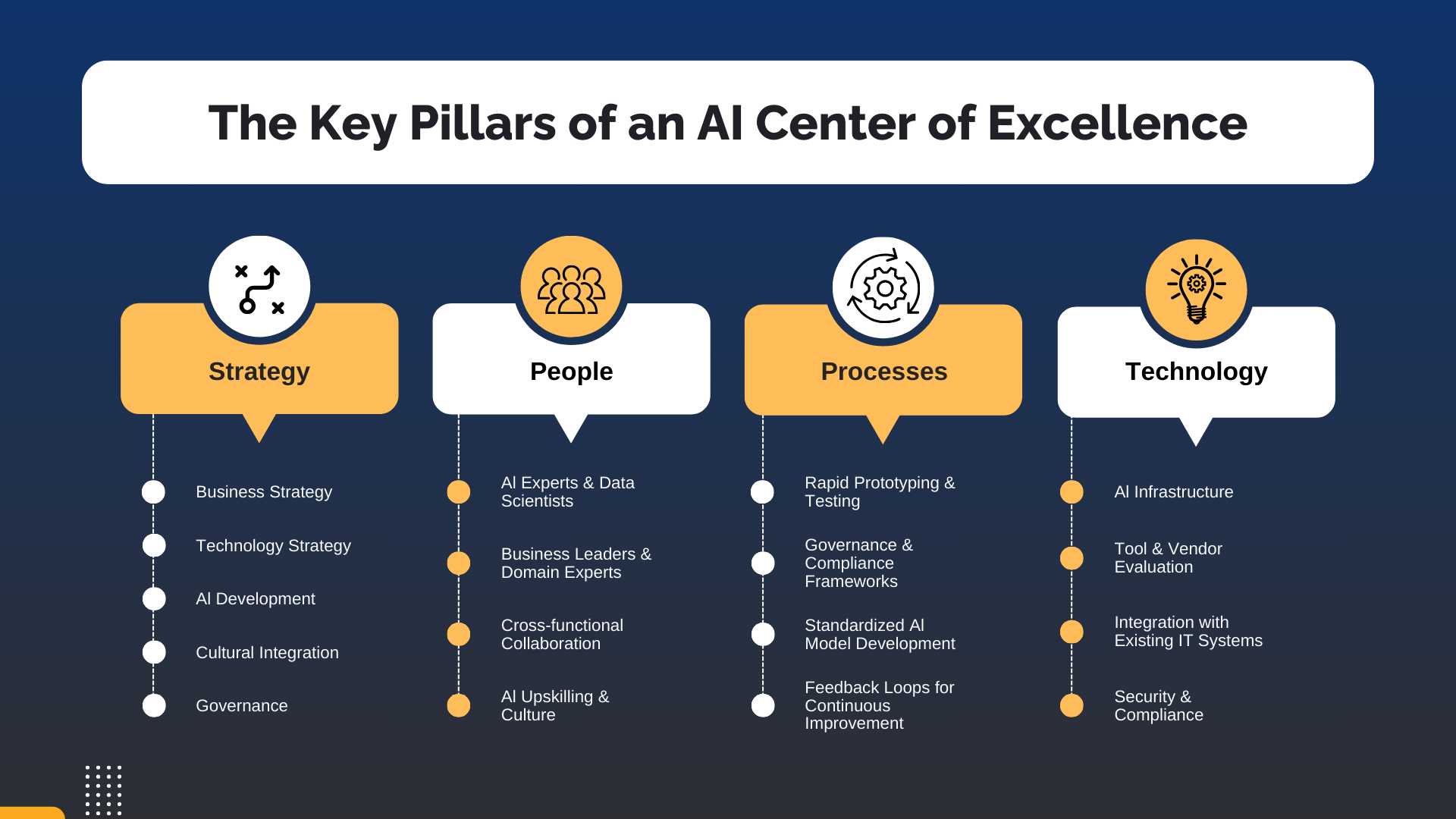
A build-it framework for an AI center of excellence: operating models compared, charter and roles, the capabil...
How to build intelligent enterprise platforms that converge AI, automation, and analytics: the architecture, d...