
SaaS Development Costs in 2026: What It Really Takes to Build and Scale a Modern SaaS Product
What SaaS development really costs in 2026: cost drivers, MVP vs scale, team makeup, and build-vs-buy, with re...
How to build a multi-tenant SaaS platform: tenancy models, tenant isolation, security, and billing, with architecture patterns and a build roadmap.
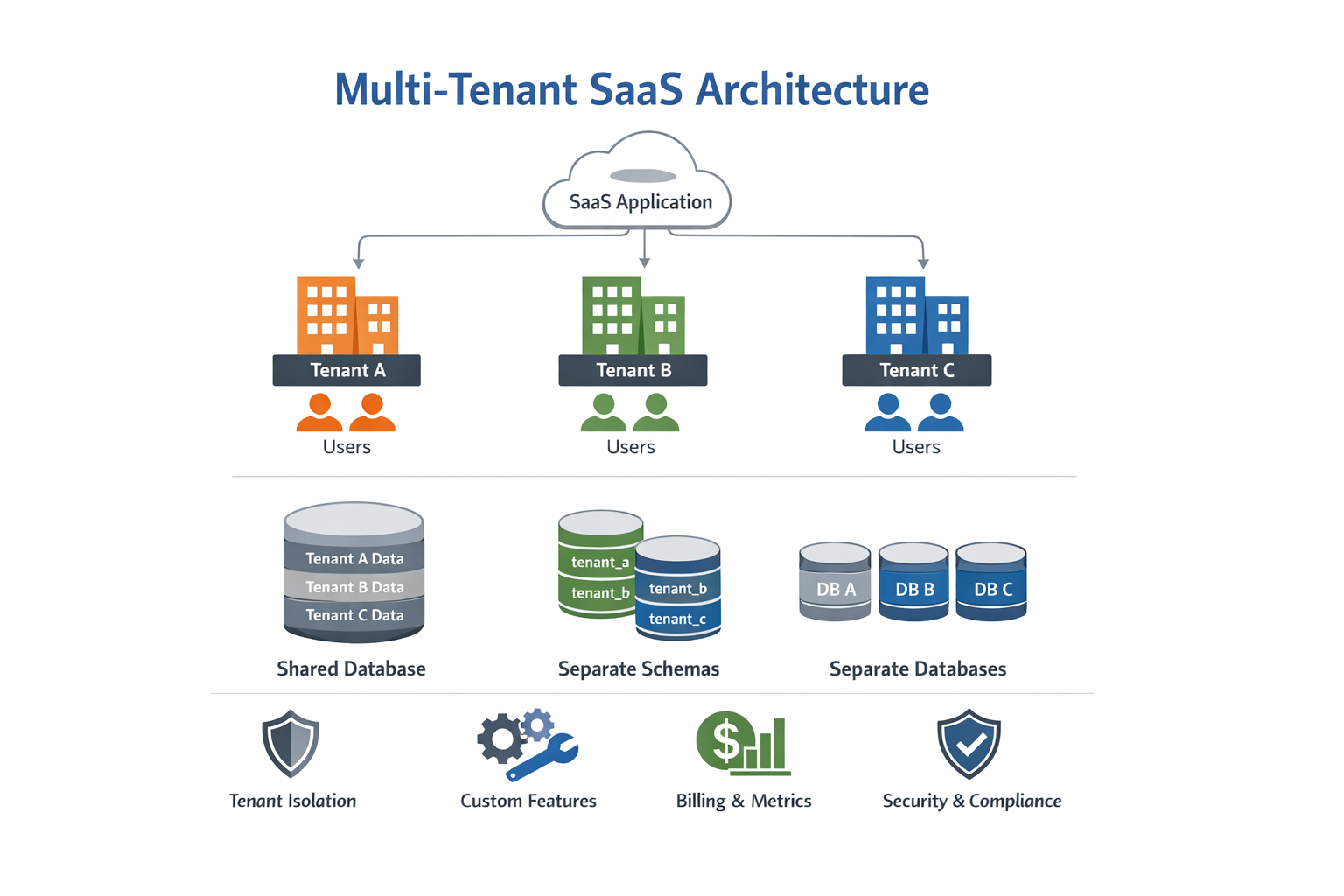
To build a multi-tenant SaaS platform, you choose a tenancy model (silo, pool, or bridge), enforce tenant isolation at the data and identity layers, add per-tenant security controls, and instrument usage so you can meter and bill accurately. Everything else (scaling, observability, onboarding) follows from those four decisions. Get the tenancy model wrong and you pay for it in every release for years.
This guide is written for CTOs, heads of architecture, and SaaS founders who need a defensible architecture rather than a diagram from a vendor deck. The SaaS market reached roughly $315B in 2025 and is growing near 18% annually [2], so the commercial case is rarely the problem. The hard part is engineering a platform where one tenant's spike, breach, or noisy query never reaches another tenant.
We will cover the three tenancy models, isolation patterns, the security model regulated buyers expect, metering and billing, a decision framework, a real cost-driven example, a phased roadmap, the mistakes that quietly kill platforms, and a build-vs-buy verdict. The goal is a multi-tenant SaaS architecture you can still reason about at 500 tenants.
Key Takeaways
- The default starting point for most B2B SaaS is the pool model: a shared database with a
tenant_idcolumn and database-enforced row-level security. Reserve the silo (database-per-tenant) model for regulated or premium tiers [7].- Tenant isolation is not one decision. It spans data, compute, identity, and network. You can mix models per tier, which is exactly what the bridge model is for.
- Instrument usage metering on day one. Retrofitting accurate per-tenant billing onto a platform that was not designed to measure consumption is one of the most expensive rebuilds in SaaS.
- Broken access control is the number one web security risk (OWASP A01:2021), and in multi-tenancy it almost always shows up as cross-tenant data leakage. Test for it deliberately [8].
- Build the tenancy core in-house; buy authentication, billing, and entitlements. The average data breach now costs $4.44M [9], so the isolation layer is the wrong place to save engineering time.
Multi-tenancy is an architecture where a single running instance of your software serves many customers (tenants), while each tenant experiences the system as if it were theirs alone. The shared part is what gives SaaS its margins. The "as if theirs alone" part is the engineering challenge.
A common confusion: multi-tenancy is not the same as having multiple customers. You can run a separate stack per customer and call it SaaS, but you lose the economics that make SaaS attractive. True multi-tenancy means shared infrastructure with logical or physical boundaries that keep tenants apart.
There are four boundaries you decide independently. Data isolation (do tenants share a database?). Compute isolation (do they share application servers?). Identity isolation (how are users mapped to tenants?). Network isolation (do they share ingress and egress paths?). Most teams treat tenancy as a single switch. Senior teams treat it as four switches you can set per tier.
Every feature you ship after the tenancy decision inherits it. Migrations, backups, analytics queries, GDPR deletion requests, per-tenant rate limits, and disaster recovery all behave differently depending on whether data is pooled or siloed. That is why this is the first architectural decision, not a later optimisation.
The AWS SaaS reference vocabulary (silo, pool, bridge) is the clearest way to discuss tenancy because it separates the model from the implementation. Here is what each means in practice.
Each tenant gets its own database, and often its own compute and storage. Isolation is strong and easy to explain to auditors. The cost is operational: 200 tenants can mean 200 databases to patch, back up, and monitor. The silo model suits regulated industries, large enterprise contracts, and tenants who contractually require their data to live alone.
All tenants share the same database and application tier. Isolation is logical, enforced by a tenant_id on every row plus database row-level security (RLS). This is the default for most B2B SaaS because it scales cheaply and keeps operations simple [7]. The risk is concentration: one bad query or one missing tenant_id filter can touch every tenant.
The bridge model uses pool for your standard tiers and silo for tenants who pay for or require dedicated isolation. Most mature platforms end up here. The key is that bridge is a planned architecture, not an accident. You design one application that can route a tenant to a pooled or siloed data store based on tenant metadata.
                         +-------------------------+
   Tenant A (Pro) ---\   |   Shared App / API      |
   Tenant B (Pro) ----\  |   (stateless instances) |
   Tenant C (Pro) -----> |   resolves tenant_id     |
                      /   |   from JWT + subdomain  |
   Tenant D (Ent) --/    +-----------+-------------+
   Tenant E (Ent) -\                 |
                    \        +--------+---------+
                     \       |                  |
                      \   POOL path         SILO path
                       \     |                  |
                        \    v                  v
                    +---------------+   +------------------+
                    | Shared DB     |   | Tenant D DB      |
                    | RLS by        |   +------------------+
                    | tenant_id     |   | Tenant E DB      |
                    | A, B, C rows  |   +------------------+
                    +---------------+
Read the diagram as one decision repeated per tenant: the application is identical for everyone, but the data path forks. Pooled tenants land in a shared database guarded by row-level security. Siloed tenants get a dedicated database. The routing key is the tenant_id resolved from the access token and subdomain at the edge.
| Dimension | Silo (DB per tenant) | Pool (shared DB) | Bridge (mixed) |
|---|---|---|---|
| Isolation strength | Strong (physical) | Logical (RLS) | Per tier |
| Unit cost per tenant | High | Low | Blended |
| Operational complexity | High (N databases) | Low | Medium to high |
| Noisy-neighbour risk | Minimal | Real, needs limits | Contained to pool |
| Per-tenant restore / delete | Trivial | Hard (filtered) | Mixed |
| Compliance story | Easiest | Defensible with RLS | Strong for premium |
| Best for | Regulated, large enterprise | SMB and mid-market volume | Platforms with mixed tiers |
Isolation is the heart of the platform. Treat it as four layers, because a weakness in any one of them is a cross-tenant breach.
In the pool model, the strongest practical control is database-native row-level security. Postgres RLS, for example, attaches a policy to each table so that even a query missing its WHERE tenant_id = ? clause returns only the current tenant's rows. Application-level filtering alone is fragile because one forgotten filter leaks data. Defence in depth means both an ORM-level tenant scope and a database RLS policy as the backstop.
Shared application servers are fine for most tenants if you add per-tenant rate limiting and concurrency caps so a single tenant cannot starve others. For premium tenants, you can pin dedicated worker pools or namespaces. In Kubernetes, which is now in production at 82% of surveyed organisations [7], per-tenant namespaces with resource quotas are a clean way to give heavy tenants isolation without a separate cluster.
Every request must carry a verified tenant context. The pattern that scales: resolve the tenant from the subdomain or a claim in the access token, inject it server-side, and never trust a tenant ID sent in the request body. Each tenant should map to its own identity space so user jane@acme.com in tenant A is never the same principal as the same address in tenant B.
For most pooled tenants, shared ingress with strict authentication is enough. For regulated tenants, you may offer private connectivity, dedicated IP ranges, or per-tenant VPC peering. This is usually an enterprise-tier feature because of the operational cost.
| Layer | Standard tier control | Enterprise tier control | Primary failure mode |
|---|---|---|---|
| Data | Shared DB + RLS + tenant scope | Dedicated DB or schema | Cross-tenant query leak |
| Compute | Shared pods + rate limits | Dedicated namespace / quota | Noisy neighbour |
| Identity | Tenant claim in JWT, SSO | Dedicated SSO / SCIM | Confused-tenant requests |
| Network | Shared ingress, WAF | Private link / dedicated IP | Lateral movement |
| Secrets | Shared KMS, scoped keys | Per-tenant encryption keys | Key blast radius |
Broken access control is the number one risk in the OWASP Top 10:2021 (A01), and in a multi-tenant system it almost always manifests as one tenant reading another's data [8]. Your security model has to assume an authenticated, hostile tenant probing for someone else's records.
The most common cross-tenant vulnerability is an object reference that trusts client input: a user changes an ID in the URL and reads another tenant's invoice. Prevent it by deriving tenant context from the authenticated session, scoping every data access to that tenant, and adding RLS as the last line of defence. Write deliberate negative tests that attempt cross-tenant access and assert they fail.
Encrypt data at rest and in transit as a baseline. For premium isolation, per-tenant encryption keys limit blast radius: compromising one tenant's key never exposes another. Centralise key management so rotation and revocation are auditable.
Maintain per-tenant audit logs for access and administrative actions, because enterprise buyers and regulators will ask for them. The financial stakes are concrete: IBM put the average cost of a data breach at $4.44M in 2025, down from $4.88M in 2024, with organisations using security AI and automation saving roughly $1.9M per breach [9]. For multi-tenant platforms, a single isolation failure can affect every customer at once, which is why this layer justifies real investment.
Billing is where many SaaS platforms discover their architecture is wrong, because they cannot measure what they want to charge for. Decide your value metric early and instrument it from day one.
These are three distinct systems and conflating them is a frequent mistake. Metering records usage events (API calls, seats, storage, compute minutes). Entitlements decide what a tenant is allowed to do right now based on their plan. Billing turns metered usage into invoices on a cycle. Keep them decoupled so you can change pricing without touching enforcement, and change enforcement without rewriting invoicing.
| Model | Revenue predictability | Value alignment | Metering effort | Best fit |
|---|---|---|---|---|
| Per-seat | High | Low to medium | Low | Collaboration tools |
| Usage-based | Low to medium | High | High | Infrastructure, APIs |
| Tiered / feature | High | Medium | Medium | Most B2B SaaS |
| Hybrid | Medium | High | High | Platforms with variable load |
Whatever model you choose, emit usage as an immutable event stream that both your billing system and your product analytics can consume. That single design choice keeps pricing flexible for the life of the platform. For an honest breakdown of what these systems cost to build and run, see our companion guide on SaaS development costs in 2026.
Use this framework to choose a tenancy model deliberately rather than copying whatever your last team built. Score your platform against each factor, then read the recommendation.
The core tension is isolation versus efficiency. Silo maximises isolation and compliance clarity at the cost of unit economics and operational load. Pool maximises efficiency and operational simplicity at the cost of a real (but manageable) noisy-neighbour and blast-radius risk. Bridge is not a compromise that splits the difference; it is a deliberate architecture that pays a complexity premium to serve both segments from one codebase.
A practical heuristic: start pool, design the data-access layer so that swapping a tenant to a dedicated store is a configuration change rather than a rewrite, and you have effectively built the bridge model on day one without paying for silos you do not yet need.
| If your situation is… | Start with | Plan for |
|---|---|---|
| Early-stage, many SMB tenants, no regulatory mandate | Pool | Bridge later for enterprise |
| Mixed SMB and enterprise from launch | Bridge | Silo path for top tier |
| Healthcare, finance, government tenants | Bridge or silo | Per-tenant keys, audit logs |
| Single very large anchor customer | Silo | Pool path for future smaller tenants |
Architecture purity is not the goal; cost-effective isolation is. A widely cited example is Amazon Prime Video's engineering team, who in 2023 moved an audio/video monitoring service from a distributed serverless and microservices design back to a consolidated monolith and reported over a 90% reduction in operating cost [3 context]. The lesson for multi-tenant SaaS is direct: do not assume the most decomposed, most isolated architecture is automatically the right one.
Apply that thinking to tenancy. A team building a B2B analytics SaaS might assume every tenant deserves a dedicated database for "isolation". At 30 tenants that feels safe. At 300 tenants it becomes 300 databases to patch, back up, monitor, and migrate on every schema change, and the cloud bill balloons. The team that instead pooled standard tenants under row-level security and reserved dedicated databases only for the handful of enterprise accounts that paid for it gets stronger unit economics and a smaller operational surface, while still offering silo isolation where it is contractually required. That is the bridge model earning its keep.
The general principle: choose isolation to match the tenant's risk and price, not to match an architectural ideal. Mind Supernova engineering teams apply this same cost-versus-isolation lens when modernising SaaS platforms, because the cheapest isolation that satisfies the contract is usually the right one.
Build the platform in phases so each stage delivers a working slice rather than a half-finished everything. This sequence assumes a pool-first, bridge-ready strategy.
tenant_id.Building this with a partner can shorten phase 1, since senior engineers can start in 5 to 7 days and work async-first with 4+ hours of daily UK overlap. If you are weighing in-house versus a delivery partner, our guide on how to outsource web application development without losing control covers the governance model in detail.
These failures rarely show up in the first demo. They surface at 50, 200, or 1,000 tenants, when fixing them is expensive.
tenant_id filters means one missed query leaks data. Always add database RLS as a backstop.Costs in multi-tenant SaaS split into build cost and run cost, and the tenancy model drives both. Industry estimates put a SaaS MVP at roughly $30K to $100K and an enterprise-grade SaaS platform at $300K and up; treat these as ranges, not quotes.
The isolation and billing layers are the expensive parts. Authentication, the metering pipeline, the entitlements service, and tenant-aware observability are where budgets go. The application features your customers see are often the smaller line item.
Silo run costs scale with tenant count: more databases means more compute, storage, backup, and operational time. Pool run costs scale with aggregate usage and are far more efficient per tenant, which is why pool dominates at volume. Cloud cost remains the top reported challenge, with around 27% of cloud spend wasted according to Flexera's 2025 survey [6], so per-tenant cost visibility is not optional.
| Cost area | Pool | Silo | Bridge |
|---|---|---|---|
| Initial build | Medium | Medium to high | High |
| Per-tenant run cost | Low | High | Blended |
| Operational headcount | Low | High | Medium |
| Cost at 500 tenants | Most efficient | Most expensive | Controlled |
The honest recommendation: build the tenancy core and the data-access layer in-house, because it is the source of your differentiation and your isolation guarantees. Buy the commodity infrastructure around it.
The reasoning is risk-weighted. With the average breach at $4.44M [9] and broken access control as the top web risk [8], the isolation layer is the wrong place to cut corners, so you own it. Identity and billing are well-served by specialists, so you integrate them and spend your senior engineering time where it differentiates. If you need senior people quickly, options like staff augmentation or a dedicated software team let you stand up the tenancy core without a long hiring cycle, and a partner that builds AI features can extend the same multi-tenant foundation later. For a balanced view of when to keep work in-house versus partner, the 2026 checklist for choosing an outsourcing partner and the complete 2026 guide to outsourcing costs and ROI are useful starting points. Want a second opinion on your tenancy model? Schedule a call with our engineering team.
Single-tenant runs a separate software instance per customer, giving maximum isolation but poor economics. Multi-tenant serves many customers from shared infrastructure with logical or physical boundaries between them. Multi-tenancy is what delivers the cost efficiency and rapid onboarding that make the SaaS model commercially attractive at scale.
Most new B2B SaaS should start with the pool model: a shared database using a tenant_id column plus database row-level security [7]. It scales cheaply and keeps operations simple. Design the data-access layer so a tenant can later move to a dedicated database, which gives you the bridge model when enterprise demand arrives.
Use defence in depth. Derive tenant context from the authenticated session, never from client input. Scope every query to that tenant at the application layer, then enforce database row-level security as a backstop. Add negative tests in CI that attempt cross-tenant access and confirm they fail. Broken access control is the top web risk [8].
Database-per-tenant (silo) makes sense for regulated industries, contractual requirements for physical data separation, very large anchor customers, and premium tiers that pay for dedicated isolation. For high volumes of small tenants it is usually too expensive operationally, so reserve it for the cases that genuinely need or pay for it.
Generally no. Build your own usage metering and entitlements, because they encode your product, but integrate a specialist billing platform for invoicing, tax, dunning, and payment compliance. Emit usage as an immutable event stream so your billing provider and analytics can both consume it, keeping your pricing flexible over time.
A defensible multi-tenant SaaS platform comes down to four deliberate decisions: the tenancy model, isolation across data and identity, a security model that survives a hostile tenant, and metering you instrument from day one. Start pooled for efficiency, design so any tenant can graduate to a dedicated store, and you have built the bridge model without paying for silos prematurely.
This quarter: model your tenant entity, add row-level security to every tenant-scoped table, and write the first cross-tenant negative tests. Next 90 days: stand up usage metering as an event stream, separate entitlements from billing, and integrate (not build) authentication and invoicing.
If you want senior engineers who have built isolation-first platforms to pressure-test your architecture or help deliver it, talk to our engineering team. The cheapest isolation that satisfies your contracts and your risk tolerance is almost always the right one.
What SaaS development really costs in 2026: cost drivers, MVP vs scale, team makeup, and build-vs-buy, with re...
Custom CRM vs Salesforce vs HubSpot compared: total cost, control, and when building your own CRM creates real...
Custom ERP vs off-the-shelf SAP and Oracle: when packaged ERP fails, the composable alternative, and a clear b...