

Why Smart Global Startups Are Quietly Building Their AI in Vietnam
Why global startups pick Vietnam for AI development: lower burn rate, fast senior hiring, deep ML talent, and...
A practical framework to choose an AI outsourcing partner: evaluation criteria, red flags, IP and security, and a scoring checklist.
To choose an AI outsourcing partner, score candidates against a fixed set of criteria: proven AI engineering depth, security and IP protections, communication overlap, delivery track record, and commercial fit, then validate the top two with a paid pilot before signing a long contract. The firm that scores highest on a weighted checklist, not the one with the slickest sales deck, is the one to shortlist. This guide gives you that checklist, a scoring table, the red flags that should end a conversation, and the contract and due-diligence terms that protect your data and your code.
AI Outsourcing Vietnam has become a practical option for teams that want senior machine learning talent at 30 to 50 percent below Western rates, but the decision is harder than picking a country. You are choosing a team that will touch your models, your training data, and sometimes your customers. Get it right and you ship faster with less risk. Get it wrong and you inherit brittle pipelines, a security incident, or a vendor you cannot leave.
The framework below works whether you are a seed-stage startup hiring your first ML engineer or an enterprise standing up an agentic AI program. It is vendor-neutral. We mention our own firm, Mind Supernova, only where it illustrates a point you should test in any provider.
Key Takeaways
Before you evaluate a single vendor, write down what you are buying. AI outsourcing is not one thing. You might need a dedicated team to build an LLM application end to end, a few specialists to augment your in-house ML group, or a data-annotation crew to prepare training sets. Each goal points to a different shortlist and a different contract.
Define three things first. What outcome must the partner deliver in the next 90 days? What does success look like in measurable terms, such as a deployed RAG pipeline or a labeled dataset at a stated quality bar? And what is your risk tolerance for data exposure? A team handling regulated financial data needs stricter controls than one building an internal prototype.
If you are still deciding whether Vietnam is the right market at all, the complete guide to AI outsourcing in Vietnam covers the market, costs, and engagement models in depth. This article assumes you have settled on outsourcing and now need to pick a specific partner well.
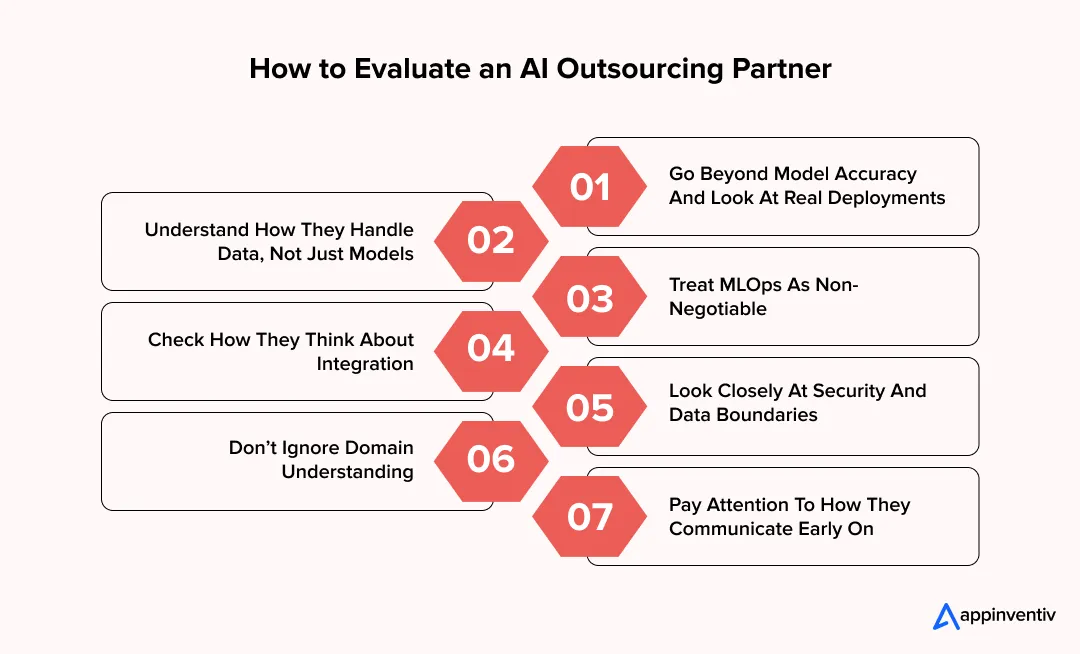
Most buyers over-index on hourly rate and under-weight everything that actually drives outcomes. A cheap team that ships unmaintainable code is expensive. Use these seven criteria, weighted, to compare candidates on the same scale.
This is the criterion people fake most often. Ask to see real LLM integration, RAG, fine-tuning, MLOps, or agentic work, not generic web projects relabeled as AI. Probe how they handle evaluation, hallucination control, retrieval quality, and model monitoring in production. A firm where AI engineering is core, rather than a service bolted onto a web-dev shop, will answer these fluently.
Your training data and model weights are valuable and often sensitive. The partner must assign all IP to you in writing, sign an NDA, and follow a named security standard. Ask where data is stored, who can access it, and how access is revoked when someone leaves.
Distributed AI work fails on coordination, not code. For UK and EU teams, look for offshore delivery with several hours of daily working overlap, async-first habits, and clear written communication. Mind Supernova, for example, runs an async-first model with 4-plus hours of daily UK overlap so reviews and decisions do not stall for a full day.
Ask for two or three references doing work similar to yours, then actually call them. A young firm will not have a decade of history, and that is fine; what matters is the team's collective experience and whether past clients would hire them again.
How do they handle code review, testing, CI/CD, model versioning, and documentation? Mature teams have answers ready. Immature ones improvise, which costs you later in rework and technical debt.
Look beyond the rate at the engagement model, ramp time, minimum commitments, and how you scale up or down. A partner who can place a vetted senior engineer in 5 to 7 days is structurally different from one who needs two months to staff a role.
This is soft but real. Do they push back when your spec is wrong? Do they raise risks early? A partner who only says yes is a liability on an AI project where assumptions need constant testing.
Turn the criteria into a number. Assign each candidate a 1 to 5 score per row, multiply by the weight, and total it. The weights below suit a typical mid-size AI build; adjust them to your situation, but keep AI depth and security highest for any serious project.
| CriterionWeightWhat a 5 looks likeWhat a 1 looks like | |||
| AI engineering depth | 25% | Production LLM/RAG/MLOps work, strong eval discipline | Generic dev shop, AI added to the pitch |
| Security and IP | 20% | Written IP assignment, NDA, ISO 27001 or SOC 2 alignment | No standard, vague on data handling |
| Communication and overlap | 15% | 4-plus hours daily overlap, async-first, clear writing | Minimal overlap, slow or unclear updates |
| Track record and references | 15% | Relevant references who would rehire | No references or unrelated past work |
| Process and engineering maturity | 10% | CI/CD, testing, model versioning, docs | Ad hoc, no review or version control |
| Commercial terms and flexibility | 10% | Fast ramp, scalable, no punitive lock-in | Long minimums, slow staffing, rigid |
| Cultural and working-style fit | 5% | Pushes back, flags risks early | Only says yes, hides problems |
Score at least three candidates. If your top two are within a few points, the pilot breaks the tie. If one runs away with the score, you have probably found your partner, but still validate with a trial. If you are comparing specific firms, our breakdown of the top AI outsourcing companies in Vietnam shows how this kind of scoring plays out across a real shortlist.
Some signals are worse than a low score. They tell you the relationship will go wrong regardless of price or talent. Treat these as near-automatic disqualifiers.
One red flag is a reason to dig deeper. Two or more is usually a reason to walk away, no matter how attractive the price.
Claims in a proposal are starting points, not facts. Due diligence is where you confirm them. Budget a week or two for this; it is far cheaper than discovering problems mid-project.
Ask for a code sample or a small take-home that mirrors your problem. Review it for clarity, testing, and AI-specific concerns such as prompt handling or retrieval design. Have one of your own engineers interview theirs on a real scenario, not a quiz.
Call references and ask pointed questions. Did the team meet deadlines? How did they handle a problem that went wrong? Would you hire them again? Then check the firm's public footprint and the depth of the talent market it draws from. Vietnam's pool of 500,000-plus developers and 1.2 million-plus IT professionals means good firms can staff and retain, but it also means quality varies widely [3].
You want a partner that will still exist in two years. Ask how long they have operated, how they retain staff, and what their delivery looks like at your scale. A firm cannot fake low attrition or a fast 5 to 7 day ramp once you start working together, which is why the pilot matters so much.
Startups in particular should weigh speed and runway against stability. The reasons global startups choose Vietnam for AI development go to exactly these trade-offs of cost, talent, and time-to-team.
The contract is where good intentions become enforceable. Do not let it be an afterthought handled at the last minute. These clauses are the ones that matter most on an AI engagement.
For enterprise buyers, these terms intersect with internal governance and model-risk policies. The patterns shaping enterprise AI adoption trends show why security and IP clauses are now the first thing legal reviews, not the last.
The same partner can be engaged in several ways, and the model you pick shapes cost, control, and risk. Choose the model after you have defined the work, not before.
| ModelBest forYou controlWatch out for | |||
| Staff augmentation | Filling specific ML/AI skill gaps in your team | Day-to-day direction and process | You own management overhead |
| Dedicated team | Ongoing AI product or platform work | Priorities and roadmap | Needs clear long-term scope |
| Project-based outsourcing | A defined deliverable with fixed scope | Outcomes, not daily work | Scope creep and change costs |
| Managed annotation or data ops | Training-data labeling at volume | Quality bar and throughput | Quality control and consistency |
Most AI programs blend models over time. You might start with augmentation to move fast, then graduate to a dedicated team as the work stabilizes. A flexible partner supports both. Mind Supernova structures its staff augmentation and dedicated team offerings precisely so clients can shift between them without renegotiating from scratch. If your need is a full build, software outsourcing as a project model may fit better.
A paid pilot is the single most reliable filter in this whole process. It replaces promises with evidence. Done well, a 2 to 4 week pilot tells you more than any proposal, reference, or interview.
Pick a real problem that is small enough to finish in the window but representative of the larger work. A focused RAG prototype, a fine-tuning experiment with clear metrics, or a labeled dataset at a stated quality bar all work. Define success up front so the result is unambiguous.
Judge the team on more than the deliverable. Did they communicate clearly and on your overlap hours? Did they raise risks and ask good questions? Was the code reviewed and tested, or thrown together? How did they react when something did not work? These behaviors predict the next year of collaboration.
After the pilot, revisit your scoring table with real data instead of sales claims. Often the pilot moves a candidate up or down by a full point on AI depth or communication. Let the combined picture, score plus lived experience, make the call. If you want to see what mature delivery looks like before scoping a pilot, our overview of AI development services in Vietnam maps the service types you can pilot against. You can also schedule a call to scope a pilot directly.
Two to four weeks is the sweet spot for most AI pilots. That is long enough to ship a representative deliverable and observe how the team communicates, handles risk, and writes code, but short enough to limit your cost and exit cleanly if the fit is wrong.
Choosing on hourly rate alone. A cheap team that ships unmaintainable AI pipelines costs far more in rework, security risk, and missed deadlines. Weight AI engineering depth and security highest in your scoring, then treat price as a tiebreaker among qualified candidates, not the first filter.
Put it in the contract. Require written IP assignment on payment, a mutual NDA, defined data-handling and residency rules, a named security standard such as ISO 27001 or SOC 2 alignment, and an explicit clause that your data will not be reused to train other clients' models. Then verify these in due diligence.
It depends on your scope. One capable partner reduces coordination overhead and is usually better for an integrated AI build. Several specialists can make sense if you need distinct skills, such as annotation plus MLOps, that no single firm does well. Either way, score each option on the same rubric.
Vietnam is a strong option, with 500,000-plus developers, 6 to 8 percent attrition, and senior rates of roughly $9 to $25 per hour, well below Western markets [3][4][5]. But "safe" depends on the specific firm, not the country. Apply the same scoring, due diligence, and pilot process you would use anywhere.
Choosing an AI outsourcing partner is a disciplined process, not a leap of faith. Define the outcome you need, score candidates on the seven criteria, watch for the red flags, lock down IP and security in the contract, and prove the fit with a paid pilot. The partner that survives that gauntlet is the one worth a long-term commitment.
This week: write down your 90-day outcome and success metrics, then build your scoring table from the rubric above and identify three candidates to evaluate.
This month: run due diligence on your top two, scope a 2 to 4 week paid pilot on a real problem, and use the results to make a confident, evidence-based choice.
If you want a partner where AI engineering is core, delivery is async-first with 4-plus hours of daily UK overlap, and vetted senior engineers can start in 5 to 7 days, schedule a call with Mind Supernova to scope a pilot. Learn more about our team and how we work before you do.
Why global startups pick Vietnam for AI development: lower burn rate, fast senior hiring, deep ML talent, and...

A guide to AI development services in Vietnam: machine learning, computer vision, NLP, LLM apps, and MLOps, wi...

AI outsourcing is how enterprises close the talent gap and scale faster. See the engagement models, what to ou...