
AI-Powered Software Development: Beyond Coding Assistants
Coding assistants are only the first step. Learn how AI-powered software development now spans the entire SDLC...
Custom ERP vs off-the-shelf SAP and Oracle: when packaged ERP fails, the composable alternative, and a clear build-vs-buy decision framework.
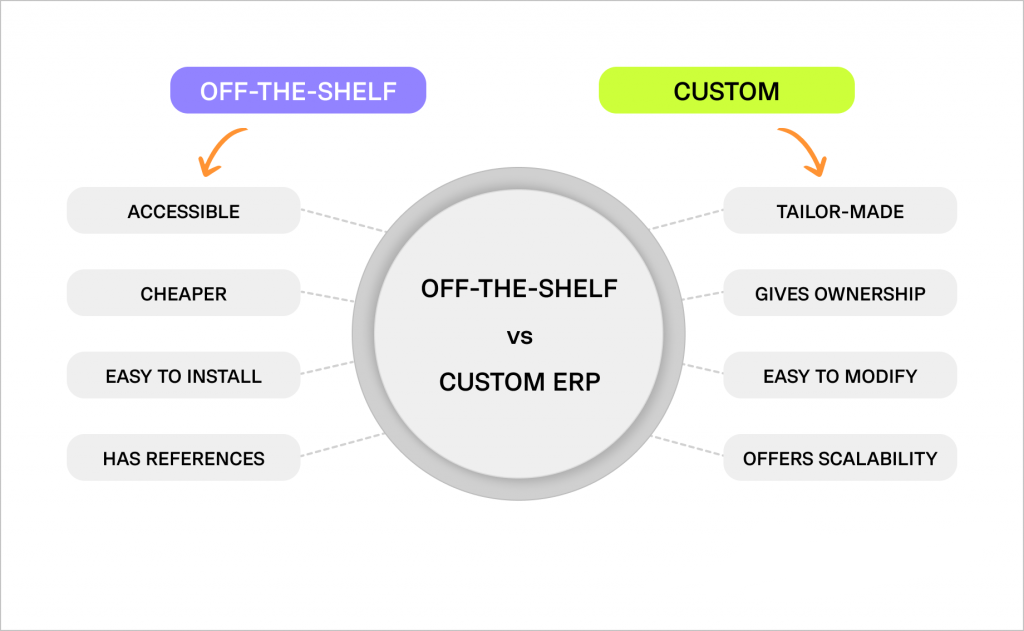
Custom ERP beats off-the-shelf solutions like SAP and Oracle when your core operating model is itself the competitive advantage, when the standard process libraries inside those suites would force you to redesign how you actually run the business. For most companies, a packaged ERP is the right call. For a meaningful minority, it is the most expensive way to make your operations look like everyone else's. The hard part is knowing which group you belong to before you sign an eight-figure licence.
This is a senior buyer's guide to custom ERP vs off-the-shelf solutions: when SAP and Oracle are not the right answer, when they clearly are, and where the modern composable ERP middle ground changes the maths. We will work through a decision framework, real trade-offs, cost considerations, an implementation roadmap, and the mistakes that quietly sink ERP programmes regardless of which path you choose.
If your team is weighing build versus buy right now, it helps to pressure-test the decision with engineers who have shipped both. Teams like Mind Supernova, a Vietnam-based software engineering partner, are often pulled in at exactly this point to model the total cost honestly before a vendor's discount clock starts. You can schedule a call when you reach that stage.
Key Takeaways
- Off-the-shelf ERP wins when your processes are standard and your differentiation lives elsewhere; custom or composable ERP wins when a core process is your moat.
- The real comparison is not licence price. It is five-to-ten year total cost of ownership including implementation, customisation, integration, and the cost of bending your business to fit the software.
- Composable ERP (a stable financial core plus best-of-breed modules connected by APIs) is now the pragmatic middle path and avoids the false binary of pure build or pure buy.
- Most failed ERP programmes fail on data, governance, and over-customisation, not on the choice of vendor. Pick the model that minimises customisation pressure on your weakest area.
- A phased roadmap (assess, pilot a single domain, expand, retire legacy) beats a big-bang cutover for both risk and cost on almost every enterprise estate.
Enterprise resource planning software unifies the systems of record for finance, procurement, inventory, manufacturing, supply chain, HR, and order management into one data model. The promise is a single version of the truth. The reality is that ERP encodes hundreds of business process decisions, and a packaged suite encodes someone else's decisions.
SAP S/4HANA and Oracle Fusion Cloud are extraordinary pieces of engineering. They embed decades of refined process templates across industries. For a manufacturer or distributor running fairly conventional operations, that embedded knowledge is a gift. You adopt proven workflows instead of inventing them.
The friction starts when your operating model does not match the template. Then you face a choice with no good options inside a packaged suite: customise the ERP (expensive, upgrade-fragile), change your business to fit the software (slow, politically painful), or bolt on third-party tools (integration debt). Each of these is a tax. The build-vs-buy question is really a question about how large that tax will be for your specific business.
Start here, because for the majority of enterprises buying is correct. The default should always be buy, and the burden of proof sits with anyone proposing to build.
Off-the-shelf is the right answer when your processes are industry-standard and you have no strategic reason to differentiate on them. General ledger, accounts payable, statutory reporting, and tax compliance are not where you win customers. Let a vendor maintain those, especially the regulatory updates that change every year across the UK, Australia, US, and Singapore.
It is also right when you need breadth fast, when you lack the engineering capacity to own a system of record for a decade, or when auditors and investors expect a recognised platform. A packaged ERP carries credibility in a due diligence room that a homegrown system rarely matches.
Off-the-shelf ERP becomes the wrong answer when a core operational process is itself your differentiation, and the packaged template would force you to standardise away the very thing that makes you better. This is the single most important test.
Consider a logistics business whose routing and yield optimisation is the product, or a vertically integrated retailer whose inventory allocation logic is a genuine edge, or a fintech whose ledger and reconciliation model is regulated in ways no generic suite anticipates. In these cases, bending the business to fit SAP or Oracle does not de-risk the programme. It deletes the moat.
The other failure mode is the slow accumulation of customisation. Heavily customised packaged ERP is the worst of both worlds: you pay vendor licensing and an internal or partner team to maintain modifications that break on every upgrade. Many organisations discover, three years and several million in, that they built a custom system on top of a packaged one and inherited the costs of both.
The build-vs-buy binary is increasingly false. Composable ERP, an approach Gartner has promoted since 2020, treats ERP as a set of interchangeable capabilities rather than one monolith. You keep a stable financial core from a trusted vendor and surround it with modular components, some bought, some custom, connected through clean APIs and an integration layer.
This matters because it lets you buy the commodity and build only the differentiator. Keep the general ledger and statutory reporting packaged. Build the one warehouse allocation engine or pricing module that is your edge. Connect them through an integration platform and an event backbone rather than embedding everything in one suite.
Composable ERP is not free of cost. You take on integration ownership and the discipline of API governance. But it dramatically reduces the customisation tax on the packaged core and the maintenance burden of a fully custom system. For most enterprises that have any genuine differentiation, this is now the pragmatic answer.
                 +-----------------------------+
                 |   Presentation / Portals    |
                 |  (web, mobile, partner UX)  |
                 +--------------+--------------+
                                |
                 +--------------v--------------+
                 |   API Gateway / iPaaS       |
                 |  (integration + identity)   |
                 +----+----------+---------+----+
                      |          |         |
            +---------v-+   +----v-----+  +v-----------+
            | Bought    |   | Custom   |  | Bought     |
            | finance   |   | core-    |  | HR / CRM   |
            | core (GL, |   | diff     |  | modules    |
            | AP/AR)    |   | engine   |  |            |
            +---------+-+   +----+-----+  +-+----------+
                      |          |          |
                 +----v----------v----------v----+
                 |   Event Backbone (Kafka etc.) |
                 +--------------+----------------+
                                |
                 +--------------v----------------+
                 |   Unified Data / Lakehouse    |
                 |   (analytics, reporting, AI)  |
                 +-------------------------------+
A unified data layer is also what makes later AI capability possible. As decision intelligence moves into ERP, a clean event stream and lakehouse foundation matter more than the suite brand. We cover that shift in AI-powered ERP: moving beyond process automation to decision intelligence.
The table below compares the three models across the dimensions that actually drive the decision. Treat the cost figures as industry-estimate ranges, not quotes; they vary enormously by scope, geography, and entity count.
| Dimension | Off-the-shelf (SAP / Oracle / Dynamics / NetSuite) | Composable ERP | Fully custom ERP |
|---|---|---|---|
| Time to first value | Slow to medium (templated but heavy implementation) | Medium (core fast, modules phased) | Slow (engineered from requirements) |
| Fit to unique processes | Low without customisation | High on chosen domains | Highest |
| Upgrade and patching | Vendor-managed, fragile if customised | Vendor core, you own module upgrades | Entirely your responsibility |
| Compliance updates | Vendor-delivered | Vendor core, custom where needed | You build and maintain all of it |
| Vendor lock-in | High | Moderate (core only) | Low (you own the code) |
| Integration burden | Lower within suite, higher outside it | Significant, by design | Significant |
| Engineering ownership required | Low to moderate | Moderate to high | High and permanent |
| 5-year TCO (illustrative estimate) | $1M–20M+ depending on scale | $800K–8M | $1.5M–10M+ plus ongoing team |
| Best for | Standard operations, broad coverage | One or two genuine differentiators | Operations that are the core product |
Notice the pattern: fully custom is rarely the cheapest, and off-the-shelf is rarely as cheap as the licence implies once customisation enters. Composable tends to win on blended cost and risk for differentiated businesses precisely because it isolates the expensive bespoke work to where it pays back.
Use this framework before you talk to any vendor, because vendor conversations anchor you to their model. The goal is to score each core domain (finance, procurement, inventory, manufacturing, order management, HR) independently, since the right answer is usually different per domain.
For every core process, ask two questions. Is this process a genuine competitive differentiator, or a commodity? And is it standard enough that a vendor template fits without heavy change? Plot the answers.
| Process profile | Differentiation | Standardisation | Recommended model |
|---|---|---|---|
| Statutory finance, payroll, tax | Low | High | Buy off-the-shelf |
| Standard procurement / HR | Low | High | Buy off-the-shelf |
| Differentiating ops with partial fit | High | Medium | Compose: buy core, extend or build module |
| Core moat process, no template fits | High | Low | Build custom for this domain |
| Commodity process, no template fits | Low | Low | Re-examine the process before building anything |
Every model trades the same four currencies: speed, control, cost, and risk. Off-the-shelf buys speed and vendor-managed risk at the price of control and per-growth cost. Custom buys control and fit at the price of speed and permanent engineering ownership. Composable splits the difference, buying control where it pays and speed where it does not, at the price of integration complexity.
Be honest about your weakest currency. If you cannot retain senior engineers, do not commit to fully custom core systems. If you cannot tolerate two more years before value, do not big-bang anything. The framework should steer you toward the model that protects your scarcest resource.
Buy the commodity. Build only what makes you money. Compose the two together. If a domain is not a differentiator and a template fits, buying is almost always correct. If a domain is a differentiator and no template fits, that is the case for building, and usually only that domain.
A pattern repeats across mid-to-large enterprises and is worth naming because it is the most common expensive mistake. A company buys SAP or Oracle expecting standardisation. During implementation, business units insist their processes are special. To win adoption, the integrator customises heavily. Three years later, the system is so modified that upgrades require a project of their own, the vendor's roadmap features are unreachable without rework, and the original promise of vendor-managed simplicity is gone.
The instructive lesson is not that SAP or Oracle is bad. They are excellent at what they are designed for. The lesson is that the company never separated commodity from differentiator. Had they bought the standard core and built only the genuinely unique allocation logic as a composable module, they would have paid less, upgraded cleanly, and kept their edge.
The opposite pattern is equally real. Some businesses build entirely custom ERP and end up maintaining their own tax-compliance engine across four countries, a job that delivers zero competitive value and consumes a whole team. Both extremes fail for the same reason: they ignored the differentiation test. The discipline of building only the moat, and buying everything else, is what separates the programmes that pay back from the ones that become legacy on day one.
Licence or subscription price is the smallest honest number in an ERP decision. The figure that matters is five-to-ten year TCO, and it is dominated by implementation, integration, change management, and the ongoing cost of whichever maintenance burden you accepted.
| Cost category | Off-the-shelf | Composable | Fully custom |
|---|---|---|---|
| Licensing / subscription | High and recurring, scales with users and modules | Moderate (core only) | None for the custom parts |
| Implementation / SI fees | Often 2–4x year-one licence | Lower core, plus build cost | Full engineering cost |
| Customisation | Expensive and upgrade-fragile | Contained to chosen modules | Inherent in the build |
| Integration | Variable, high outside the suite | Significant and ongoing | Significant and ongoing |
| Ongoing maintenance | Vendor plus customisation upkeep | Vendor core plus module team | Permanent in-house or partner team |
| Hidden: business change cost | High if you bend the org to the tool | Lower, you bend less | Low, the tool fits the org |
Two cost traps deserve a flag. First, indirect or digital access licensing in some suites charges for system-to-system data use, which can scale painfully as you automate. Second, the cost of bending your business to the software is real but rarely budgeted: retrained staff, redesigned processes, and lost productivity during the change. Put a number on it.
On the build side, the dominant cost is talent and its retention. Owning a system of record means staffing senior engineers indefinitely. This is where an offshore engineering partner with strong overlap helps control cost without sacrificing seniority. Mind Supernova, for instance, works async-first with 4+ hours of daily UK overlap, which keeps a custom ERP module supportable across the markets enterprise buyers operate in. Honest TCO modelling, not vendor discounting, should drive the decision.
Whatever model you choose, a phased rollout beats a big-bang cutover on risk and cost for almost every enterprise estate. The strangler-fig idea from legacy modernisation applies directly: stand up the new capability alongside the old, migrate domain by domain, and retire the legacy system only when each slice is proven.
For deeper modernisation sequencing, the strangler-fig and incremental patterns we describe in legacy modernisation work apply to ERP estates just as they do to application portfolios.
The choice of vendor is rarely the cause of ERP failure. Governance, data, and discipline are. These mistakes recur regardless of whether you buy, build, or compose.
Default to buy for commodity domains, compose for differentiated ones, and reserve fully custom for the rare process that is genuinely your product. Concretely:
The teams that succeed are not the ones who picked the cleverest vendor. They are the ones who separated commodity from differentiator, modelled TCO honestly, and phased the rollout. If you want a build-vs-buy model stress-tested by engineers who maintain both packaged and custom systems, the route is to talk to our engineering team. You can also weigh the same logic in adjacent decisions: custom CRM vs Salesforce vs HubSpot follows an almost identical differentiation test, and building a multi-tenant SaaS platform shows the architecture patterns behind composable systems. If you are evaluating an offshore partner for any custom build, how to choose an outsourcing partner without getting burned and the 2026 guide to outsourcing costs, vendors, and ROI are useful starting points.
Sometimes, but rarely on the whole estate. Fully custom ERP usually costs more once you account for permanent engineering ownership. It becomes cost-effective only for the specific domain that is your competitive differentiator, where a packaged suite would force expensive customisation anyway. Compose the rest.
Composable ERP keeps a stable financial core from a vendor and surrounds it with modular components, some bought, some custom, connected through APIs and an integration layer. It lets you buy commodity processes and build only your differentiators, avoiding both the customisation tax of a suite and the maintenance burden of a fully custom system.
Avoid them as your whole solution when a core operational process is your competitive moat and no template fits, when you would need to customise most of a core module, or when licensing scales punitively with your growth. Even then, most companies still keep a packaged finance core and build only the differentiating domain.
It varies by scope, but a phased approach typically shows first value from a single piloted domain within three to six months, with broader rollout over twelve to eighteen months. Big-bang implementations take longer and carry far more risk. Data quality work usually determines the real timeline more than software choice.
Not the vendor. Most ERP programmes fail on dirty data, weak governance, over-customisation of the packaged core, big-bang cutovers, and treating ERP as an IT project rather than a business one. Pick the deployment model that minimises customisation pressure on your weakest area, and phase the rollout.
Custom ERP vs off-the-shelf is not a contest between vendors. It is a discipline of separating what makes you money from what merely keeps the lights on. Buy the commodity. Build only the moat. Compose the two with a clean integration layer and a unified data foundation. That logic survives every vendor pitch.
This quarter: run the per-domain differentiation and standardisation scoring across finance, procurement, inventory, operations, and HR, and build an honest five-year TCO model for buy, compose, and build on each. Next 90 days: pilot one contained domain with a real data migration, stand up the integration backbone, and prove reconciliation accuracy before committing to a full programme.
If you want that decision pressure-tested, or a composable ERP module built by senior engineers who can start in 5 to 7 days, schedule a call with our engineering team. The cheapest ERP mistake is the one you model before signing.
Coding assistants are only the first step. Learn how AI-powered software development now spans the entire SDLC...
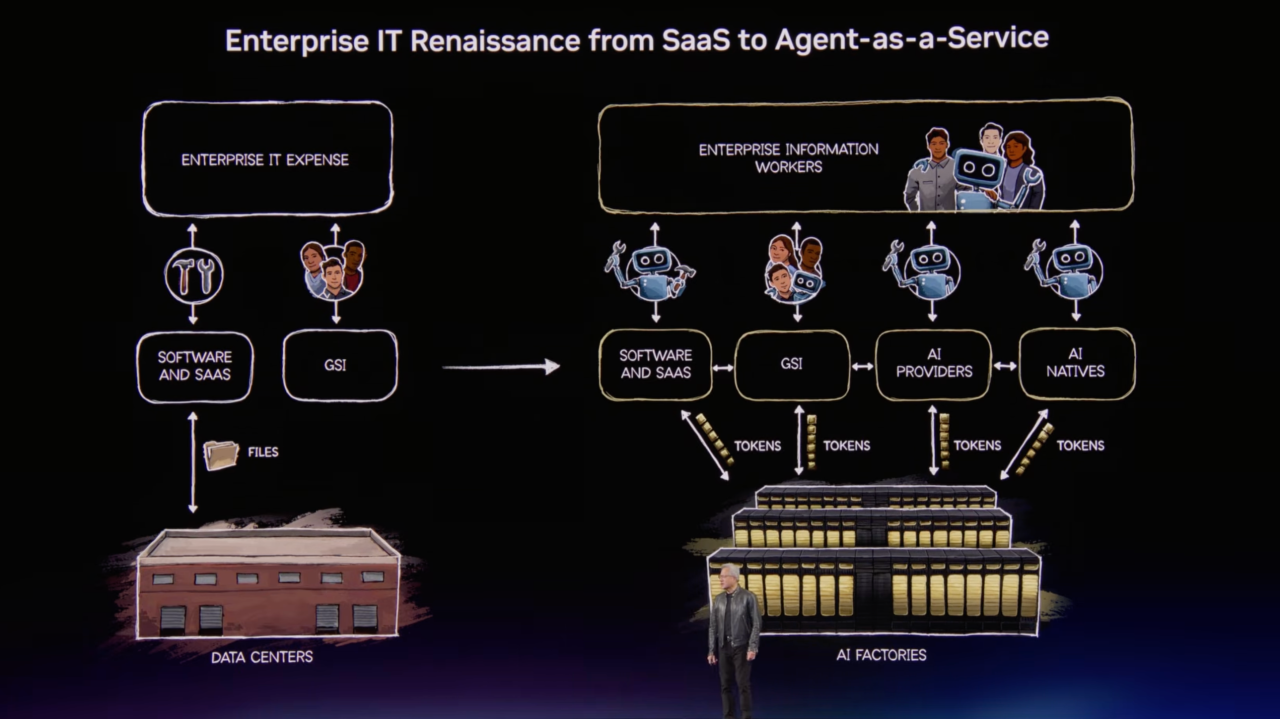
Agent-as-a-service (AaaS) sells completed work, not software seats. Here is how the SaaS-to-AaaS shift rewrite...
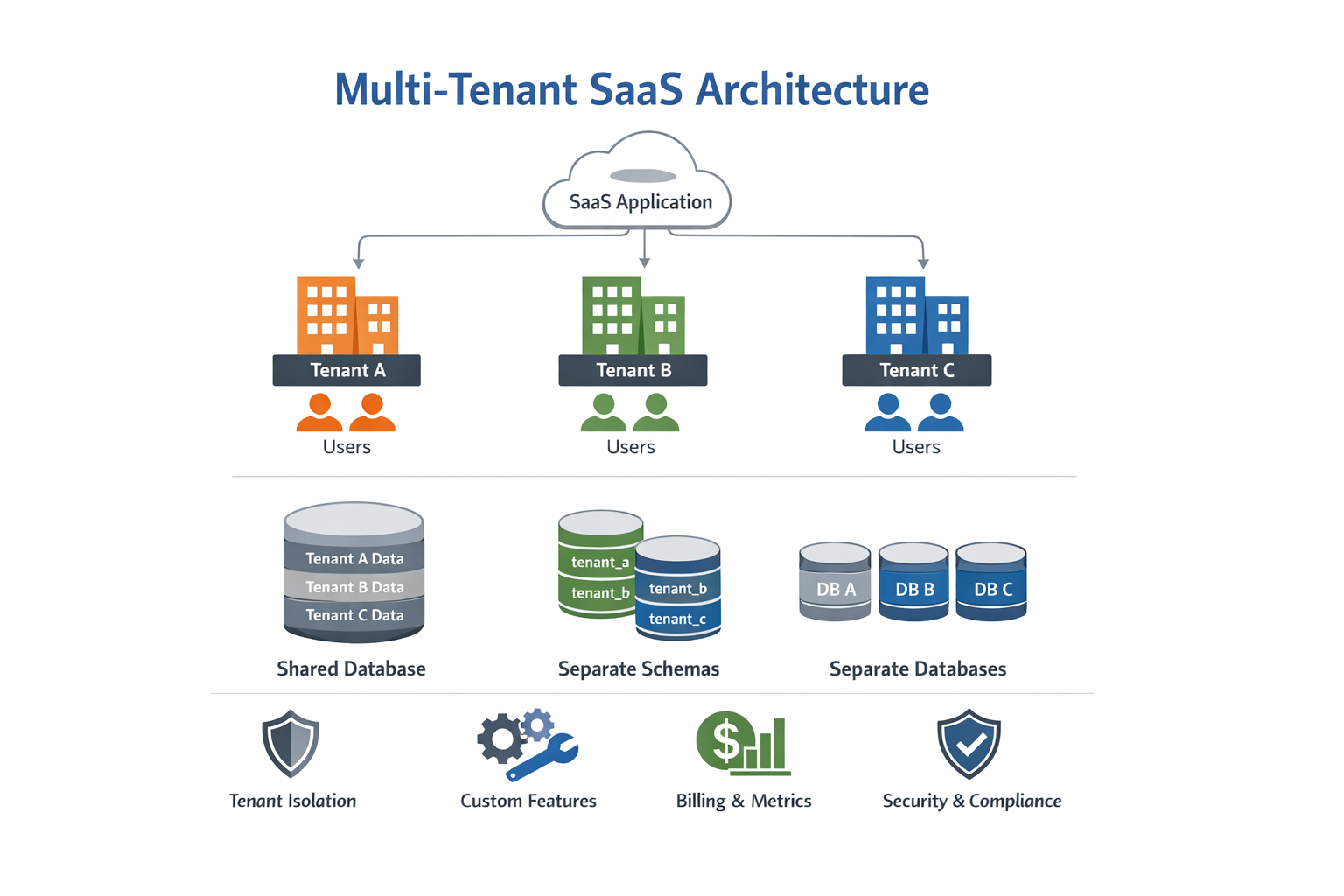
How to build a multi-tenant SaaS platform: tenancy models, tenant isolation, security, and billing, with archi...