
The 10 Best Software Outsourcing Companies in Vietnam for 2026 (Ranked and Compared)
Vietnam's best software outsourcing companies in 2026, ranked. Compare FPT, Mind Supernova, NashTech and more...
Everything you need to outsource AI development to Vietnam in 2026: services, costs, engagement models, risks, and how to pick the right partner.
AI outsourcing Vietnam means hiring Vietnamese engineering teams to build, integrate, and operate artificial-intelligence systems, from LLM applications and AI agents to data annotation and MLOps, at a cost 30 to 50 percent below Western rates. For founders and enterprise leaders weighing where to run AI work in 2026, Vietnam has moved from a low-cost coding destination to a genuine engineering partner for production AI.
This guide is the definitive overview. We cover what AI outsourcing to Vietnam actually involves, why the country has become a magnet for AI development, which services are most commonly outsourced, what they cost, how to structure the engagement, the risks to manage, and a concrete path to get started this quarter.
Whether you are a UK fintech racing to ship a RAG-powered feature, an EU manufacturer piloting computer vision on the factory floor, or a SaaS company that needs an AI roadmap and the people to deliver it, the goal here is simple. Give you a clear, credible picture so you can make a confident decision.
Key Takeaways
AI outsourcing Vietnam refers to delegating part or all of your AI engineering to a Vietnam-based provider. That can be a single specialist embedded in your team, a full dedicated squad, or a fixed-scope project delivered end to end. The distinguishing word is "AI." This is not generic web development with a machine-learning label stuck on top.
The work that companies outsource here in 2026 is specific and demanding. It includes LLM integration, retrieval-augmented generation pipelines, AI agents that take actions across tools, model fine-tuning, MLOps, and the data annotation that feeds all of it. Each of these is labor- and expertise-intensive, which is exactly why they get outsourced rather than built slowly in-house.
It helps to separate AI outsourcing from two neighbours. Traditional software outsourcing ships applications and websites. AI outsourcing ships intelligent behaviour: a model that classifies, generates, predicts, or reasons. The skills overlap, but the AI side adds data engineering, evaluation, and the discipline of keeping non-deterministic systems reliable in production.
Most buyers land on one of three models. Pick based on how much control and process maturity you already have.
We unpack the decision logic in detail in our guide on how to choose an AI outsourcing partner, including a scoring framework you can apply to any vendor shortlist.
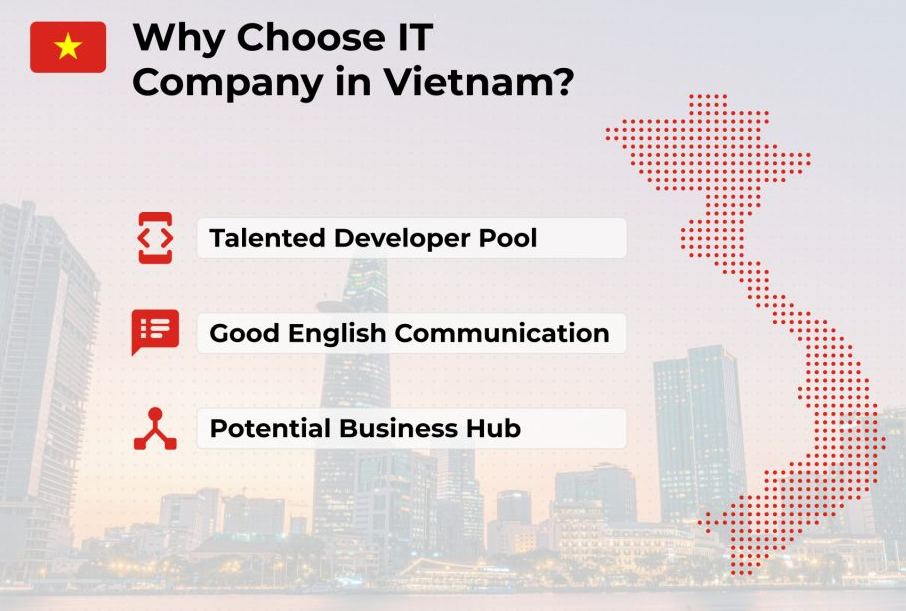
The case for Vietnam rests on four pillars: talent depth, cost, stability, and an improving policy environment. None of these is hype. Each is backed by independent market data.
On talent, Vietnam has more than 500,000 software developers and over 1.2 million IT professionals, mostly clustered in Ho Chi Minh City and Hanoi [3]. The pipeline keeps refilling, with roughly 50,000 to 75,000 IT graduates entering the market each year, though demand still outstrips supply for the most senior AI specialists [3]. That depth matters when you need ML engineers, not just app developers.
On recognition, Vietnam ranks #7 on Kearney's Global Services Location Index and sits in the top three across Southeast Asia [1]. That index weighs financial attractiveness, skills, and the business environment together, so it is a useful sanity check against marketing claims.
On stability, attrition is the quiet differentiator. Vietnamese teams turn over at roughly 6 to 8 percent per year versus 20 percent or more in India [5]. On a multi-quarter AI build, where context about your data and models lives in people's heads, low churn is worth real money. We explore the founder-level version of this argument in why global startups choose Vietnam for AI development.
Be honest with yourself here. Vietnam sits mid-table on the EF English Proficiency Index, ranking around 63rd to 64th of 116 countries [6]. Working English is the norm at established outsourcing firms, and async written communication is excellent in practice. But you should not expect uniformly native-level fluency across every hire. Strong vendors solve this with clear documentation, written-first workflows, and senior leads who communicate confidently.
Core enterprise AI work in 2026 falls into a handful of categories. Each is something a capable Vietnamese provider can deliver, and each carries its own skill profile.
For a fuller catalogue, including computer vision and NLP use cases, see our breakdown of AI development services in Vietnam. If your roadmap centres on autonomous workflows, the deep dive on AI agent development for enterprises covers architectures, governance, and the build-versus-outsource call.
Models are only as good as the data behind them. Two of the most outsourced AI workloads are about data, not models. The data-annotation market is growing at a high double-digit CAGR as demand for training data rises [8], and much of that labour-intensive work is well suited to managed Vietnamese teams. Our guides on data annotation services for generative AI and building AI training data at scale cover quality control, RLHF and preference data, synthetic data, and governance.
Not every problem needs a fine-tuned model. Sometimes prompting or RAG gets you most of the way for a fraction of the cost. Knowing when fine-tuning genuinely pays off is its own skill, and we walk through the methods (LoRA, PEFT, SFT, RLHF) and the economics in LLM fine-tuning services explained.
Cost is usually the headline reason buyers look at Vietnam, and the gap is large. Senior developer rates run roughly $9 to $25 per hour, against $25 to $60 in India, $50 to $90 in Eastern Europe, and $75 to $135 or more in the US and UK [4]. That is a 30 to 50 percent saving versus Western markets for comparable seniority.
One caveat. AI and ML engineers command a premium over general developers everywhere, including Vietnam. So an LLM specialist will not sit at the bottom of that range. Even with the premium, the relative cost advantage versus Western markets holds firmly.
| RegionSenior dev rate (per hour)Relative costTypical strength | |||
| Vietnam | $9–25 | Lowest | Cost, stability, growing AI depth |
| India | $25–60 | Low | Scale, breadth of talent |
| Eastern Europe | $50–90 | Medium | Seniority, EU proximity |
| US / UK | $75–135+ | Highest | Domain context, onshore presence |
The wider market backs the trend. Vietnam's IT services market is near $2.6B in 2026 and growing at roughly 11% CAGR, with outsourcing accounting for about 40 percent of activity [2]. A growing market means a deepening talent pool, which is what you want over a multi-year engagement. For a sense of which providers are competing in this space, see our ranked look at the top AI outsourcing companies in Vietnam.
Cost only matters if delivery works. The practical questions are how you collaborate across time zones, how the work is governed, and who owns the output.
On collaboration, the honest framing is offshore with daily overlap. A Vietnam-based team can structure its day to give UK clients 4+ hours of daily overlap, which is enough for stand-ups, pairing, and fast decisions, while the rest of the day runs async. This is how Mind Supernova delivers: async-first, written communication by default, with reliable live windows when they count.
On governance, agree the operating rhythm up front. That means a named lead, weekly demos, a shared backlog, and clear definitions of done. For AI specifically, insist on an evaluation harness from day one so model quality is measured, not guessed.
AI work touches sensitive data, so contracts matter. Confirm IP assignment in writing, define data-handling and residency rules, and require security practices that match your industry. A serious partner will welcome a security questionnaire rather than dodge it. We cover the full checklist, including red flags, in how to choose an AI outsourcing partner.
No outsourcing decision is risk-free. The good news is that the common risks are well understood and manageable with the right partner and process.
Policy direction is a tailwind here. The government's "Make in Vietnam" strategy plus 2025 corporate-tax incentives for new tech SMEs signal long-term commitment to the sector [2]. That stability reduces the macro risk of betting on the country for a multi-year programme.
Outsourcing AI to Vietnam is not happening in a vacuum. It rides a broader wave of enterprise adoption. A large majority of organizations now use or pilot generative AI, according to McKinsey's State of AI research [7]. As that adoption matures from experiments to production, the bottleneck shifts from "should we" to "who builds it," and that is where capacity and cost decide outcomes.
Most enterprises face the same build-versus-buy tension. Off-the-shelf tools cover generic needs, but differentiated AI requires custom work on your data and workflows, which is labour-intensive. Outsourcing that labour to a region with depth and cost advantages is a rational response. For the trend lines, barriers, and ROI patterns shaping 2026 decisions, see enterprise AI adoption trends.
It is also worth situating AI work within general software outsourcing, since many AI projects sit alongside conventional engineering. If you are evaluating the broader landscape, our list of the top software outsourcing companies in Vietnam for 2026 provides useful context.
Mind Supernova is a Vietnam-based software engineering company founded in 2023, working with UK fintech, EU manufacturing and SaaS, and global enterprise clients. AI engineering is core to the business, not bolted on. The focus areas are AI transformation, LLM integration, agentic AI, MLOps, and data and ML engineering.
Three things shape how we deliver. First, async-first delivery with 4+ hours of daily UK overlap, so you get fast decisions without paying onshore rates. Second, vetted senior engineers who can start in 5 to 7 days, drawing on our team's collective experience across production AI systems. Third, an outcome-driven model with low attrition, so the people who learn your problem stay to solve it.
We will say plainly that Mind Supernova is one strong option among several capable Vietnamese providers. The right choice depends on your domain and constraints. If you want to explore fit, you can schedule a call or learn more about us. For teams that need senior AI talent quickly, our hire senior developers and AI development services pages cover the specifics.
Yes, on headline rates. Senior Vietnamese developers run roughly $9 to $25 per hour versus $25 to $60 in India [4]. Vietnam also has lower attrition, around 6 to 8 percent against 20 percent or more in India [5], which can lower total project cost by protecting continuity on long AI builds.
Capable providers deliver LLM integration, RAG pipelines, AI agents, model fine-tuning, MLOps, and large-scale data annotation. These are the core enterprise AI workloads in 2026. Confirm a vendor's specific track record in your area, since AI depth varies more than general software skill across firms.
The practical answer is offshore with daily overlap. A Vietnamese team can structure its hours to give UK clients 4+ hours of daily overlap for stand-ups and decisions, then run the rest of the day asynchronously. Written-first workflows and clear documentation make this reliable in practice.
Vietnam sits mid-table on the EF English Proficiency Index, around rank 63 to 64 of 116 [6]. Working English is standard at established firms and async written communication is strong, but do not assume uniform native fluency. Good vendors mitigate this with senior leads and documentation-heavy processes.
It depends on the provider and scope, but vetted senior engineers can often start within 5 to 7 days for staff augmentation. Fixed-scope projects take longer to define. Begin with a small proof of concept to validate fit before committing to a larger engagement.
AI outsourcing Vietnam offers a rare combination in 2026: deep and growing AI talent, costs 30 to 50 percent below Western markets, low attrition, and a supportive policy environment. It is not a magic fix, and English fluency and top-end talent scarcity need managing, but for most teams the trade-offs are favourable and the path is well trodden.
This week: define one AI use case with a measurable outcome, decide which engagement model fits (augmentation, dedicated team, or project), and draft the data and IP requirements you will hold any vendor to.
This month: shortlist two or three providers, run a small paid proof of concept against your real data, and evaluate communication and code quality before scaling. Use our partner scoring framework to keep the comparison objective.
If you want a senior, AI-first team that delivers async with 4+ hours of daily UK overlap, schedule a call with Mind Supernova and we will map your use case to a concrete plan.
Vietnam's best software outsourcing companies in 2026, ranked. Compare FPT, Mind Supernova, NashTech and more...
The leading AI-capable software outsourcing companies in Vietnam, compared on AI skills, cost, and UK/EU overl...
Why global startups pick Vietnam for AI development: lower burn rate, fast senior hiring, deep ML talent, and...