Agentic AI in Banking: Beyond Chatbots to Autonomous Operations
A CIO-level guide to agentic AI in banking: high-value use cases, a human-in-the-loop reference architecture,...
What a logistics digital twin really is, the four twin types that matter, how they are built, and how to use simulation to design resilient, optimized supply chains.
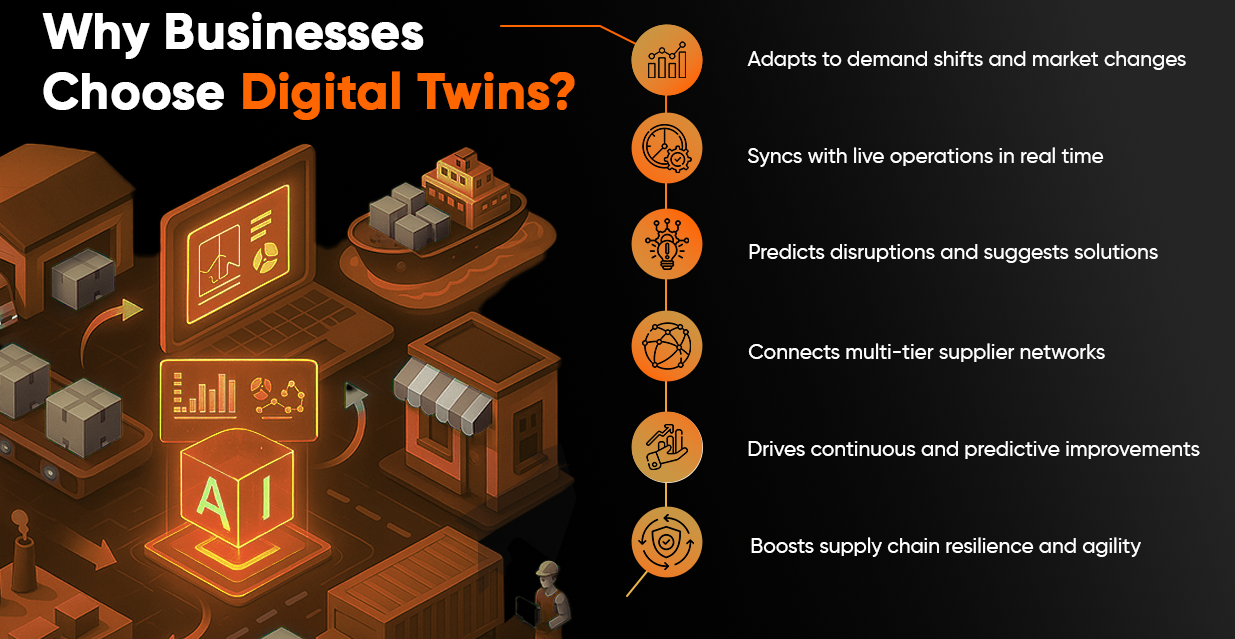
A digital twin for logistics is a living virtual replica of a physical supply chain — its facilities, inventory, transport flows, equipment and decision rules — that runs in software so you can test changes, simulate disruptions and optimize the network before committing a single truck, dollar or square metre to the real world. Unlike a static map or a forecast, a logistics digital twin is dynamic and connected: it ingests live data, mirrors how your operation actually behaves, and lets you ask “what if?” at the speed of a query rather than the speed of a quarter.
For a Head of Supply Chain or COO, that distinction matters more than the technology. Supply chains have spent five years absorbing shocks — pandemic demand swings, canal closures, port congestion, tariff turbulence — and the lesson is consistent: resilience is no longer a hedge, it is a core operating capability. Digital twins are how leading operators move from reacting to disruption to rehearsing for it. You model the failure, evaluate the responses, and pre-position the playbook, all in a sandbox that cannot break anything real.
This guide is the simulation and modeling angle on supply chain digital twins. It explains precisely what a logistics twin is, how it differs from an AI control tower (which is about visibility and command, not simulation), the four twin types that matter, how twins are actually built, where they create value, what they cost, and a phased roadmap to get one into production without boiling the ocean.
Key Takeaways
A digital twin in logistics is a software model of a physical supply chain that stays synchronized with reality through data, and that can be run forward under hypothetical conditions to predict outcomes. Three properties separate a true twin from an ordinary model or report. First, it is a faithful representation of the real system — nodes, lanes, lead times, capacities, constraints and behaviors. Second, it is connected to live or near-live data so the model does not drift from the real world. Third, it is executable: you can simulate, optimize and replay scenarios, then push insight back into planning or operations.
The simplest way to understand a twin is by what it lets you do that nothing else does: change something that does not exist yet — a new distribution centre, a re-routed lane, a 30% demand spike, a supplier failure — and watch the consequences ripple through cost, service and capacity before you act. It is a flight simulator for your supply chain.
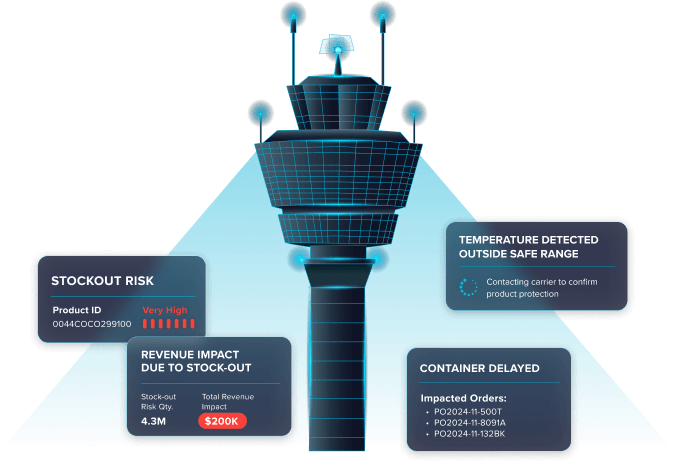
These three capabilities are complementary, frequently confused, and best kept distinct. A control tower answers “what is happening right now, and what should I do about it?” — it is the real-time visibility and command layer that fuses ERP, TMS, WMS and IoT signals into one operating picture. If you need to understand that layer in depth, see our companion piece on AI control towers for supply chain visibility. A digital twin answers “what would happen if?” — it is the simulation and optimization environment. Predictive supply chain capability answers “what is most likely to happen next?” using forecasting and IoT-driven signals, which we cover in predictive supply chains with AI and IoT.
In a mature operation the three feed each other. The predictive layer forecasts demand and risk; the twin simulates responses and finds the optimal plan; the control tower executes and monitors. Treating them as one product is the single most common reason supply chain transformation programmes underdeliver.
| Capability | Core question | Time horizon | Primary output |
|---|---|---|---|
| Predictive forecasting | What will likely happen? | Hours to months ahead | Demand, risk and ETA predictions |
| Digital twin (simulation) | What if we change X? | Days to years (modeled) | Compared scenarios, optimized plans |
| Control tower (visibility) | What is happening now? | Real time | Alerts, decisions, exception handling |
There is no single “supply chain digital twin.” In practice, enterprises build one or more of four twin types, each modeling a different layer of the operation at a different resolution. Choosing the right type for the question you are trying to answer is the first design decision — a high-level network twin will never tell you where to place a conveyor, and a physics-accurate warehouse twin will never help you decide which continent to build a hub on.
| Twin type | What it models | Resolution | Decisions it informs | Typical engine |
|---|---|---|---|---|
| Network twin | Whole supply chain: plants, DCs, suppliers, lanes, demand | Low (nodes & flows) | Where to build, source, and hold inventory; resilience design | Network optimization, discrete-event & Monte Carlo simulation |
| Warehouse twin | A facility: layout, racking, robots, pickers, dock doors | High (often 3D / physics) | Layout, slotting, automation, labor and throughput | Discrete-event & physics simulation; sometimes reinforcement learning |
| Transportation twin | Fleets, routes, hubs, traffic, vessel or vehicle behavior | Medium to high | Routing, scheduling, fuel, maintenance, mode mix | Routing optimization, traffic & simulation models |
| Inventory twin | SKU-level stock, policies, replenishment, multi-echelon flow | Medium | Safety stock, buffer placement, service-level trade-offs | Multi-echelon inventory optimization, simulation |
Network twins are where strategic resilience lives. They let you redesign sourcing and distribution, test dual-sourcing, and stress the network against the loss of a region. Warehouse twins are the most visually mature — platforms such as NVIDIA Omniverse and Isaac Sim let operators build physically accurate 3D replicas of a facility and rehearse automation, robot fleets and layout changes before a single rack moves. NVIDIA's “Mega” blueprint, announced for building and testing industrial robot fleets in a digital twin before deployment, is a clear signal of where physical-AI warehouse simulation is heading (NVIDIA). Transportation twins optimize fleets and lanes — carriers including Maersk have used twins to track fuel efficiency and predict maintenance to avoid unexpected downtime (Maersk). Inventory twins tune the eternal trade-off between working capital and service level across echelons.
A logistics digital twin is built in four layers that stack from raw data up to executive decision. None of the layers is optional, and they tend to fail in the order they are listed — most stalled programmes never get the first layer right.
The twin is only as truthful as the data feeding it. This layer pulls master data and transactions from ERP, warehouse management (WMS), transportation management (TMS) and order systems, then adds sensor and telemetry data from IoT devices — GPS on vehicles, scanners in the warehouse, temperature and humidity in reefer containers, and equipment condition feeds. The hard part is rarely the connectors; it is reconciling inconsistent SKUs, locations, units and lead times into a coherent model. A modern data foundation makes this tractable, which is why a twin programme so often depends on the work described in modern data platforms for AI-driven organizations.
The model is the structured representation of the physical world — the topology of nodes and lanes for a network twin, or the geometry, equipment and process logic for a warehouse twin. It encodes capacities, constraints, costs, times and behavioral rules. Building a good model is an exercise in deliberate simplification: include what changes the answer, abstract away what does not. Over-modeling is as dangerous as under-modeling because it slows simulation and obscures cause and effect.
This is the engine that runs the model forward. Several techniques are combined depending on the question. Discrete-event simulation models flows and queues over time — ideal for warehouses and networks. Monte Carlo simulation runs thousands of randomized scenarios to quantify risk and variability rather than a single expected outcome. Optimization solvers search for the best configuration under constraints — the cheapest network that still meets service. Increasingly, AI and machine learning sit on top: ML models learn demand, lead-time and failure patterns from history, and in advanced warehouse and routing twins, reinforcement learning agents learn policies — robot path planning, task allocation, dynamic routing — by training against the twin millions of times before acting in the real facility.
The final layer turns simulation into action: scenario comparison views, optimization recommendations, sensitivity analysis and the ability to push an approved plan into planning or execution systems. The best twins make the trade-offs legible to a non-technical executive — cost versus service versus risk — so the decision is owned by the business, not the model. A twin that produces beautiful results no one acts on has failed regardless of its technical quality.
The use cases that justify a twin share one trait: the real-world cost of being wrong is high, slow and hard to reverse. That is exactly where simulating first pays off.
Where should the next distribution centre sit? Should you consolidate three hubs into two? What does adding a European node do to landed cost and lead time after a tariff change? A network twin evaluates dozens of configurations against cost, service and carbon, turning a multi-million-pound infrastructure bet into an evidence-based decision. This is the canonical network optimization application and often the first twin an enterprise builds.
This is the resilience core of the discipline. You model named threats — a port closure, a supplier insolvency, a 40% demand surge, a regional weather event — and test the network's response and your contingency options. Gartner has highlighted that a large share of supply chain leaders are piloting or planning digital supply chain twins, and analysts expect AI-enabled twins to move a meaningful portion of enterprises from reactive to predictive planning within a few years (Gartner). The payoff is not a single number; it is having rehearsed the disruption so the response is a decision, not a scramble.
Warehouse twins let you redesign a facility — racking, pick paths, dock scheduling, robot fleets — and measure throughput, congestion and labor in simulation before disrupting a live operation. DHL, for example, has used digital twins to model warehouse operations including inventory control, order picking and packing to optimize layouts and cut processing times. Amazon Robotics builds digital twins of warehouses with NVIDIA Omniverse and Isaac Sim to test fleet behavior virtually. The value is avoided risk: an automation rollout tested in a twin is far less likely to strand capital in a layout that does not perform.
Transportation twins simulate fleets, lanes and hubs to optimize routing, scheduling, mode mix, fuel and maintenance. Ocean carriers have used twins to optimize vessel power consumption and reefer container energy use; Maersk has run digital-twin simulations on vessels to optimize power draw from reefer containers (Maersk). In road and last-mile networks, reinforcement-learning agents trained in the twin can adapt routing dynamically to minimize travel time and energy.
When a disruption hits, a connected twin becomes a rapid-response tool: feed in the real-time event from your control tower, simulate the candidate responses, and recommend the one that best protects service and cost. This is where twin, predictive forecasting and control tower converge into something close to self-running, autonomous operations — the twin proposes, the human approves, the execution layer acts.
Concrete deployments make the value tangible. The examples below are drawn from public reporting by the companies and credible industry coverage.
The pattern across all of these is consistent: twins earn their place by de-risking expensive physical decisions and by compressing the time between a question and a defensible answer.
The honest answer is that ROI varies enormously with scope, and you should be wary of any single headline percentage. What is reliable is the shape of the value and the cost structure.
On the benefit side, twins create value through four channels: lower operating cost (better network, routing and inventory decisions), higher service levels and on-time-in-full performance, reduced working capital tied up in inventory, and avoided losses from disruptions that were rehearsed rather than absorbed. Industry analyses and vendor case studies in 2025 commonly cite operating-cost reductions in the low-double-digit percentage range and improvements in service reliability, but these are directional and depend heavily on baseline maturity — a poorly run network has more to gain than an already-optimized one.
On the cost side, reporting suggests mid-sized programmes often run from the low hundreds of thousands into seven figures depending on the number of twin types, data integration burden and simulation fidelity. The dominant cost is rarely the simulation software; it is the data engineering and the change management to make people trust and act on the results.
The practical way to underwrite ROI is to tie the first twin to one expensive, recurring or imminent decision — a network redesign, a warehouse automation business case, a resilience review demanded by the board — and measure the twin against the cost of getting that one decision wrong. That framing almost always clears the hurdle, and it avoids the trap of justifying a twin on vague “visibility” benefits that a control tower delivers more cheaply.
Successful twins are built incrementally. The following five-phase roadmap reflects how mature programmes sequence the work and where they protect against the common failure modes.
Resist the urge to model everything. Pick a single, expensive, well-bounded decision — “where should our next EU DC go?” or “can this warehouse absorb peak with current automation?” Define the decision, the metrics that matter (cost, service, risk, carbon), and what “good” looks like. Choose the twin type that fits the question.
Audit the source systems, reconcile master data, and stand up the integration to ERP, WMS, TMS and the relevant IoT feeds. Be ruthless about data quality — a twin fed bad data produces confident, wrong answers, which is worse than no twin. This phase is where most timelines actually slip, so budget for it honestly.
Construct the model at the right resolution and — critically — validate it by replaying recent history: if the twin cannot reproduce what already happened, it cannot be trusted to predict what hasn't. Calibrate until simulated outputs match real outcomes within an acceptable tolerance. Validation is the credibility gate; skipping it is how twins lose executive trust.
Run the scenarios, layer in optimization and ML where they add value, and present trade-offs in business terms. Make the recommended decision, document the reasoning, and — where possible — capture the avoided cost or risk as your ROI evidence for the next phase.
Move from a one-off study to a living twin: keep it synchronized with production data, connect it to the control tower for disruption response, and extend to adjacent twin types or network scope. This is also where you decide build-versus-buy for the long term and bring in dedicated engineering capacity. Many enterprises accelerate here by partnering with an Enterprise AI engineering partner such as Mind Supernova to handle the data integration, simulation engineering and MLOps that keep a twin accurate in production — work that is specialized, ongoing, and rarely a fit for a lean internal team.
Twins fail in predictable ways. Knowing the failure modes is most of the defense.
For a Head of Supply Chain, logistics director or COO deciding whether and how to invest, five recommendations consistently separate the programmes that pay off from the ones that stall.
A control tower provides real-time visibility and command — it shows what is happening across the network and helps you respond now. A digital twin is a simulation environment that answers “what if?” by modeling changes and disruptions before they happen. The control tower is about the present; the twin is about possible futures. Mature operations connect both so the twin can simulate responses to events the control tower detects.
At minimum you need master and transactional data from ERP, WMS and TMS systems — facilities, SKUs, lanes, lead times, capacities, costs and orders — plus relevant IoT and telemetry feeds such as vehicle GPS, warehouse scans and condition sensors. The quality and consistency of this data, not the volume, is what determines whether the twin is trustworthy.
A focused first twin tied to one decision typically takes a few months — commonly three to six — with the bulk of that time spent on data integration and model validation rather than simulation itself. Enterprise-wide, multi-type twin programmes are ongoing and expand over years as scope and fidelity grow.
Increasingly, yes. Classic twins rely on discrete-event, Monte Carlo and optimization techniques, but modern twins layer machine learning to predict demand, lead times and failures, and in advanced warehouse and routing twins use reinforcement learning to train robot path planning, task allocation and dynamic routing against the simulation before acting in the real facility.
A network digital twin models the whole supply chain — plants, distribution centres, suppliers, lanes and demand — at the level of nodes and flows. It matters for resilience because it lets you stress-test the network against disruptions like a supplier failure or regional shutdown and evaluate contingency options in software, turning disruption response from improvisation into a rehearsed plan.
Costs vary widely with scope. Reporting on mid-sized programmes suggests a range from the low hundreds of thousands into seven figures, driven mainly by the number of twin types, data integration complexity and simulation fidelity. The simulation software is rarely the largest line item — data engineering and change management usually are.
Yes. By optimizing network design, routing, mode mix and energy use, twins can reduce empty miles, fuel and power consumption — carriers have used vessel twins to cut power draw, and network twins can include carbon as an optimization objective alongside cost and service, making sustainability a measured trade-off rather than an afterthought.
Digital twins for logistics are not another dashboard or a science project — they are a flight simulator for the supply chain, the place where expensive decisions get rehearsed before they get made. Used well, a twin lets you redesign a network, validate an automation business case, optimize routes and, most importantly, rehearse the disruptions that would otherwise catch you flat-footed. The technology is mature enough to deploy and the analyst consensus is clear that simulation-led, predictive planning is becoming table stakes for resilient operations.
The discipline is in the restraint: start with one high-value question, get the data right, validate against reality, and keep your twin distinct from — yet connected to — your visibility and forecasting layers. Enterprises that want to move faster on the engineering behind a living twin — the integration, simulation and MLOps that keep it accurate in production — often partner with an experienced Enterprise AI engineering partner like Mind Supernova to build it right the first time. Whether you build or partner, the strategic point stands: the supply chains that win the next decade will be the ones that learned to fail safely in software before they ever had to in the real world.
A CIO-level guide to agentic AI in banking: high-value use cases, a human-in-the-loop reference architecture,...
What an AI control tower really is, how its architecture turns fragmented data into real-time visibility and p...
A practical guide to real-time AI fraud detection for banks, fintechs, and payment firms: streaming architectu...