
The 10 Best AI Outsourcing Companies in Vietnam to Watch in 2026
The leading AI-capable software outsourcing companies in Vietnam, compared on AI skills, cost, and UK/EU overl...
A practical guide to standing up an offshore AI engineering center: operating models, location strategy, hiring, governance, IP protection, and the real cost model.
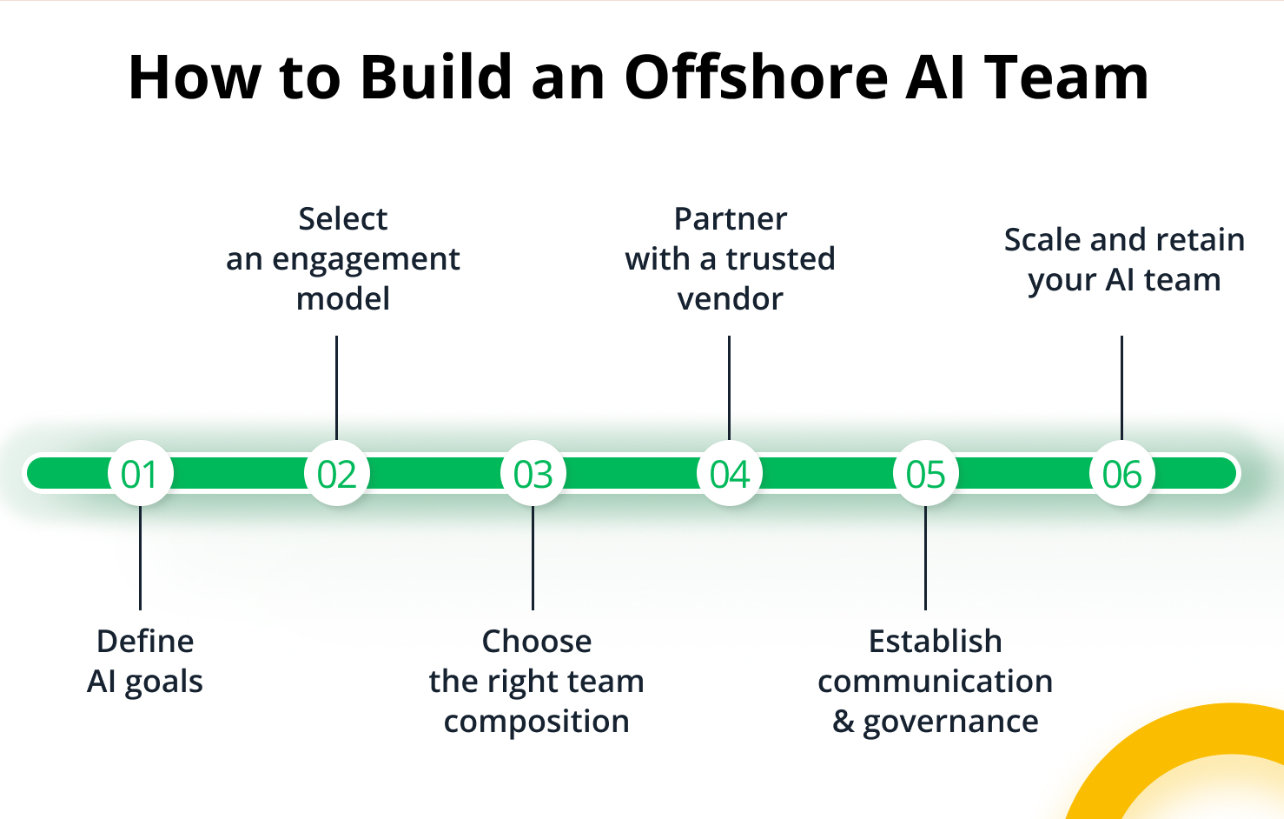
An offshore AI engineering center is a dedicated team of AI and machine learning specialists, located in a lower-cost talent market, that designs, builds, and operates an enterprise's AI systems as an extension of its core engineering organization. Unlike a one-off vendor engagement, it is a standing capability: a stable team, an owned roadmap, shared tooling, and a governance model that ties the center directly to headquarters. Done well, it gives you access to scarce AI talent, meaningfully lower delivery costs, and the throughput to ship AI features continuously rather than in occasional bursts.
For most CTOs and VPs of Engineering, the question in 2026 is no longer whether to build AI capability outside their home market, but how. The talent that matters most for production AI, machine learning engineers, MLOps specialists, applied research leads, and data engineers, is both scarce and expensive in the UK, US, and Western Europe. An offshore AI engineering center is a structured way to solve that scarcity without sacrificing control, security, or quality.
This guide is a practical blueprint. It covers why offshore AI centers work, the operating models you can choose from, how to pick a location, how to hire and retain AI talent, the governance and reporting structures that keep delivery on track, security and intellectual property protection, data residency, a phased ramp plan, and a transparent cost model with an illustrative comparison. It closes with the pitfalls that derail these programs and a set of executive recommendations.
Key Takeaways
The two drivers are access to talent and cost, and in AI specifically, talent usually comes first. Demand for machine learning engineers, applied scientists, and data engineers has outpaced supply in every major Western market, and salaries reflect that imbalance. An offshore center lets you tap deep, fast-growing engineering talent pools while keeping your blended cost of delivery sustainable.
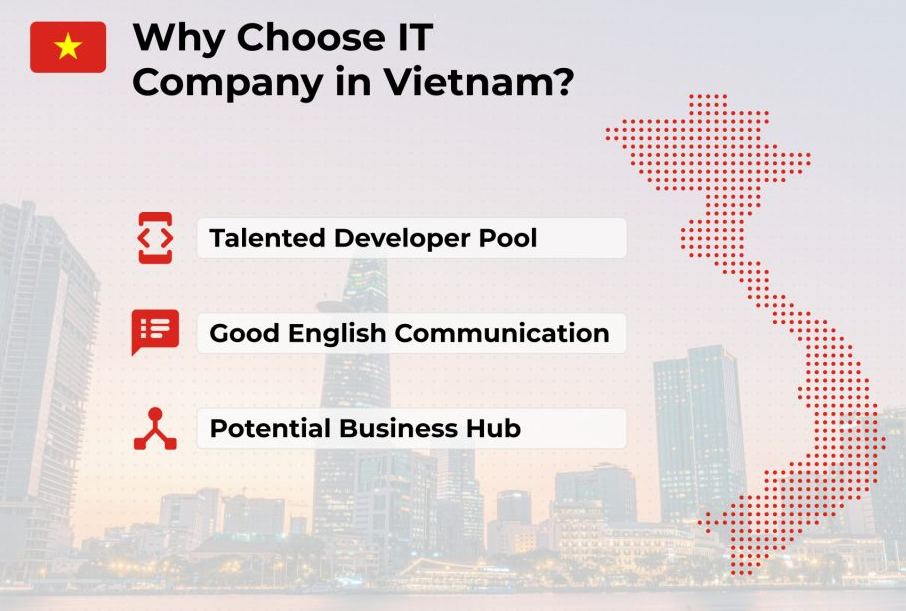
Consider the scale of the offshore engineering ecosystem. India alone now hosts well over 1,700 global capability centers employing more than 1.9 million professionals, and industry analysts such as Zinnov have documented a sharp shift toward AI-aligned roles inside those centers. EY describes the same transition: capability centers moving from cost arbitrage toward becoming AI-native engineering hubs. Vietnam, with a software workforce now exceeding 500,000 professionals and a national push to expand AI-specific university tracks, has emerged as a strong complementary location for teams that value engineering depth alongside cost efficiency.
Beyond raw access, an offshore AI center delivers several business outcomes that a project-by-project outsourcing relationship cannot:
None of this is automatic. The benefits depend on choosing the right operating model, hiring genuine AI specialists rather than generalist developers, and wiring the center into your organization with real governance. The rest of this guide covers exactly that.
There are three primary operating models, and the right choice depends on how much control you want, how fast you need to move, and how much operational risk you are prepared to absorb. The trade-off is consistent: more control means more setup time and risk; more speed means leaning on a partner.
A captive center is a fully owned offshore entity. You incorporate a local subsidiary, sign the leases, hire every employee onto your payroll, and own all infrastructure, compliance, and management directly. This gives maximum control and the tightest cultural and IP integration, but it is the slowest and most capital-intensive route. You take on local employment law, tax, real estate, and HR from day one, typically a 9-18 month effort before the team is productive. Captives make sense for large enterprises with long horizons, strict IP requirements, and the appetite to run a foreign operation themselves.
A managed offshore development center (ODC), sometimes called a managed global capability center, is run by a specialist partner on your behalf. The partner handles the legal entity, recruitment, infrastructure, payroll, and local operations, while you direct the roadmap, set technical standards, and own the output. You get a dedicated team that works exclusively for you, but without standing up a foreign subsidiary yourself. This is the fastest path to a productive AI team and the lowest operational burden, which is why many enterprises start here. The trade-off is that you depend on the partner for talent quality and retention, so partner selection is critical.
The build-operate-transfer model is a hybrid designed for enterprises that want to eventually own a captive but cannot afford the time or risk of building one from scratch. A partner builds the team and infrastructure, operates it until it is stable and performing, then transfers ownership to you, including the entity, the people, and the operations. Industry practitioners generally note that the build phase costs somewhat more than a pure outsourcing arrangement because of setup, while the operate and transfer phases can deliver substantial savings versus a do-it-yourself captive, and a working team in roughly three to six months rather than a year or more. BOT is well suited to IP-critical, long-horizon AI investments where you want a captive end-state but de-risked entry.
| Dimension | Captive | Managed ODC | Build-Operate-Transfer |
|---|---|---|---|
| Control | Highest | Shared (you direct, partner operates) | High after transfer |
| Time to productive team | 9-18 months | 2-4 months | 3-6 months to build, transfer later |
| Upfront investment | Highest | Lowest | Moderate |
| Operational burden on you | Full | Minimal | Low early, full after transfer |
| IP integration | Tightest | Strong with the right contract | Tightest at end-state |
| Best for | Large enterprises, long horizon | Speed, lower risk, scaling fast | Eventual ownership, de-risked entry |
Many enterprises sequence these models. They begin with a managed delivery center to prove value and build domain knowledge, then convert to a build-operate-transfer arrangement once the AI capability is core enough to own outright. For a deeper view of the partnership economics behind these choices, our companion piece on how the smartest companies are scaling faster with AI partners is a useful complement.
Location is a portfolio decision, not a single right answer. You are balancing talent depth, cost, working-hour overlap with headquarters, English proficiency, data and IP legal frameworks, and political and economic stability. The weighting depends on your domain: a UK fintech with strict regulatory requirements will weigh legal frameworks and overlap heavily, while a US SaaS firm chasing throughput may prioritize talent depth and cost.
The leading offshore AI markets each offer a different mix:
A practical pattern for UK and EU enterprises is an async-first center in an Asian market with a guaranteed daily overlap window. With 4+ hours of UK overlap built into the schedule, the team handles synchronous collaboration in the morning and runs heads-down, deep work in the afternoon, when fewer interruptions actually improve the quality of model development and data engineering. Async-first is a design choice, not a compromise: it forces clear written specs, decision logs, and well-defined interfaces, all of which raise engineering quality.
Hiring for an offshore AI center is different from hiring generalist software engineers. AI talent is scarcer, the role mix is specialized, and the cost of a mis-hire is higher because models and data pipelines are harder to hand over than typical application code.
Start by mapping the roles you actually need rather than hiring undifferentiated "AI engineers." A production AI team usually blends:
The hardest gap in most offshore markets is senior depth. Markets like Vietnam produce strong junior and mid-level engineers in volume, but research leads and architects with production-scale experience are scarcer and command premiums. Plan for this: anchor the team with a few senior hires or an embedded partner lead, and build a deliberate mentoring path so mid-level engineers grow into senior roles inside your context.
Retention is where many centers quietly fail. AI engineers are in global demand and can leave easily, so attrition erodes the institutional knowledge that justified the center in the first place. The levers that work are consistent: meaningful, modern AI work rather than maintenance backlog; clear career progression; competitive compensation benchmarked locally; genuine inclusion in the global engineering culture rather than being treated as a back office; and exposure to real production impact. A managed partner that specializes in AI talent often retains people better than a captive precisely because it can offer a portfolio of challenging work and a clear technical ladder.
Governance is the operating system of the center. Without it, an offshore team drifts into a low-trust, ticket-taking relationship; with it, the team becomes a genuine extension of your engineering organization. Good governance covers three layers: delivery, technical standards, and risk.
Delivery governance defines how work flows and how progress is reported. Treat the offshore team exactly like an in-house squad: shared sprint cadence, the same backlog and tooling, joint planning and retrospectives, and a single definition of done. Reporting should roll up real engineering signals, cycle time, deployment frequency, model performance, and incident rates, rather than vanity activity metrics. A weekly delivery review with headquarters and a monthly steering review with leadership keeps the relationship honest.
Technical governance sets the standards the center must meet: architecture decision records, code review policy, model evaluation and validation gates, documentation expectations, and the MLOps practices that make models reproducible and observable. For AI specifically, define how models are versioned, how training data is governed, and what evaluation thresholds must be cleared before a model reaches production.
Risk governance connects the center to your enterprise risk and compliance functions, covering security, data handling, model risk, and regulatory obligations. Establish a clear escalation path and a named accountable owner at headquarters. If your AI systems touch regulated decisions, fold the center into your model-risk and AI-governance processes from the start rather than retrofitting them later. Building the team's role inside a broader human-and-machine operating model, as we discuss in AI workforce solutions that blend human expertise and intelligent automation, helps keep accountability clear as the center scales.
Security and intellectual property protection are the make-or-break concerns for any offshore AI center, and they are entirely manageable with the right controls. The goal is simple: your IP stays yours, and sensitive data stays where it is legally and contractually required to be.
IP ownership is settled in contracts, not assumed. Ensure that every engineer, whether on your payroll or a partner's, is bound by present-assignment IP clauses so that all work product vests in your entity automatically. Use robust master services and confidentiality agreements, define IP ownership explicitly across all jurisdictions involved, and confirm that the partner's local employment contracts enforce the same assignment. In a build-operate-transfer model, the transfer agreement should spell out how IP, code, and operational know-how move to you cleanly at handover.
Apply the same security posture you expect internally. Practical, non-negotiable controls include:
Look for partners and centers that hold recognized certifications. ISO/IEC 27001 for information security management and a SOC 2 attestation are the baseline signals that security controls are documented and independently assessed. For AI specifically, the emerging ISO/IEC 42001 AI management system standard is becoming a useful additional marker of responsible AI governance.
Data residency determines where regulated data may physically live and be processed. For UK and EU enterprises, that often means EU or UK customer data must remain within approved jurisdictions, with no cross-border transfer without an explicit legal basis. The practical pattern is to keep regulated data in cloud regions within the required jurisdiction, give the offshore team access through controlled, audited channels rather than copying data offshore, and, where data sensitivity is highest, work on synthetic or de-identified data for development while production data stays in-region. Architect residency in from day one; retrofitting it after a center is running is expensive and disruptive.
The reliable way to build an offshore AI center is in deliberate phases. A big-bang launch, hiring dozens of engineers before you have proven the operating model, is the most common and most expensive mistake. Stage it instead.
A typical mature center for a mid-sized enterprise AI program lands somewhere between 15 and 40 people, weighted toward engineering with a thin layer of product, QA, and platform support. Resist the urge to over-hire ahead of demand; an idle center burns budget and morale. This staged approach mirrors a broader transformation arc, which we lay out in our enterprise AI transformation roadmap from pilot to enterprise scale.
The headline economics are straightforward: a well-run offshore AI center commonly delivers a 40-60% lower blended cost than an equivalent in-house team in the UK, US, or Western Europe, while giving you access to talent you may simply be unable to hire locally at any reasonable speed. But the headline rate is only part of the picture. The honest way to evaluate cost is total cost of ownership, which includes setup, management overhead, attrition, and the cost of quality.
The table below is an illustrative comparison, not a quote. Actual rates vary by seniority, location, role mix, and operating model, and AI specialists command premiums over generalist developers in every market. Treat it as a directional framework for your own modeling.
| Cost factor | In-house (UK/US/W. Europe) | Offshore managed center | Offshore captive |
|---|---|---|---|
| Fully loaded cost per senior AI engineer | Highest (baseline) | ~40-60% lower | ~40-60% lower at steady state |
| Setup and entity cost | None (existing) | Minimal (partner absorbs) | High (you fund entity, legal, real estate) |
| Time to productive team | Slow (local hiring competition) | Fast (2-4 months) | Slow (9-18 months) |
| Management overhead | Built in | Shared with partner | You own fully |
| Attrition / re-hiring risk | Moderate | Partner-managed | You own fully |
| Flexibility to scale up or down | Low | High | Low |
A few principles keep cost modeling honest. First, compare fully loaded costs, salary, benefits, recruiting, facilities, equipment, and management, not just headline salaries. Second, factor in the cost of quality: a cheaper team that produces models you cannot trust is more expensive than a stronger team that ships reliably. Third, account for ramp time, because savings accrue only once the team is productive. Fourth, remember that the managed and BOT models trade a partner margin for dramatically faster time-to-value and lower operational risk, which is usually a sound trade early on.
Integration is what separates a true engineering extension from a distant vendor. The principle is "one team, two locations." Practically, that means shared tooling and repositories, a common backlog, joint ceremonies, and unified engineering standards, not a parallel process that meets your team only at a handoff boundary.
The mechanics that make integration work:
Most offshore AI center failures trace back to a short list of avoidable mistakes:
For many enterprises, the fastest and lowest-risk way to stand up an offshore AI engineering center is to run it as a managed delivery center with a specialist partner, optionally with a build-operate-transfer path to ownership later. A partner that focuses on AI engineering can supply vetted machine learning, data, and MLOps talent, absorb the entity and operational burden, and bring the governance and security scaffolding that would otherwise take you many months to build.
This is precisely the model Mind Supernova operates. As a Vietnam-based AI engineering partner serving UK, EU, and US enterprises, we run managed AI engineering centers with 4+ hours of daily UK overlap and an async-first delivery discipline, pairing access to a deep and fast-growing AI talent pool with the governance, security, and IP protections that enterprise programs require. Whether you want a dedicated managed center, an embedded AI squad, or a build-operate-transfer arrangement that ends in your own captive, the operating principles in this guide are the same.
An offshore AI engineering center is a dedicated, standing team of AI and machine learning specialists located in a lower-cost talent market that builds and operates an enterprise's AI systems as an extension of its core engineering organization. It differs from project outsourcing in that it is a permanent capability with an owned roadmap, stable team, and shared governance rather than a one-off engagement.
A captive center is a fully owned offshore subsidiary that you build, staff, and run yourself, giving maximum control but taking 9-18 months and significant capital to stand up. A managed offshore center is operated by a specialist partner who handles the entity, hiring, and operations while you direct the roadmap and own the output, which is faster to launch and lower in operational risk.
Build-operate-transfer is a hybrid model where a partner builds and operates your offshore AI team, then transfers full ownership, the entity, people, and operations, to you once it is stable. It typically delivers a working team in three to six months and lets you reach a captive end-state while de-risking the initial setup. It suits IP-critical, long-horizon AI programs.
A well-run offshore AI center commonly delivers a 40-60% lower blended cost than an equivalent in-house team in the UK, US, or Western Europe. The exact figure depends on location, seniority, role mix, and operating model, and should be evaluated on total cost of ownership, including setup, management, attrition, and the cost of quality, not headline rates alone.
Yes, with the right controls. Security is managed through encryption, least-privilege access, secure managed development environments, continuous monitoring, and recognized certifications such as ISO/IEC 27001 and SOC 2. Intellectual property stays with you when contracts include present-assignment IP clauses binding every engineer, backed by clear master services and confidentiality agreements across all jurisdictions.
There is no single best location; it is a trade-off among talent depth, cost, working-hour overlap, and legal frameworks. India offers the deepest talent pool, Vietnam pairs strong engineering depth with cost efficiency and 4+ hours of daily UK overlap under an async-first model, Central Europe offers strong Western European overlap, and Latin America suits US-headquartered firms wanting same-day hours.
It depends on the model. A managed delivery center can have a productive founding team in two to four months. A build-operate-transfer arrangement typically reaches a working team in three to six months. A self-built captive usually takes nine to eighteen months because you must establish the legal entity, infrastructure, and hiring yourself.
An offshore AI engineering center is one of the most effective ways to solve the two hardest problems in enterprise AI at once: scarce talent and unsustainable cost. The enterprises that succeed treat it as a standing capability rather than a cost-cutting exercise, choose an operating model that matches their control and risk appetite, build governance, security, and data residency in from day one, and scale through deliberate phases rather than a big-bang launch.
Start by clarifying your goal: access to talent, cost efficiency, speed, or eventual ownership, and let that choice drive your model. Run a contained pilot before you scale. Insist on senior depth, real governance, and enterprise-grade security. Get those fundamentals right and an offshore AI center becomes a durable engine for innovation rather than a managed risk.
If you are weighing whether to build, buy, or partner, the most useful next step is a candid assessment of your AI roadmap, talent gaps, and risk constraints against the operating models above. Mind Supernova works with enterprise engineering and data leaders to design and run AI engineering centers along exactly these lines, and we are happy to talk through what a right-sized, well-governed center could look like for your organization.
The leading AI-capable software outsourcing companies in Vietnam, compared on AI skills, cost, and UK/EU overl...
Why global startups pick Vietnam for AI development: lower burn rate, fast senior hiring, deep ML talent, and...
A guide to AI development services in Vietnam: machine learning, computer vision, NLP, LLM apps, and MLOps, wi...