
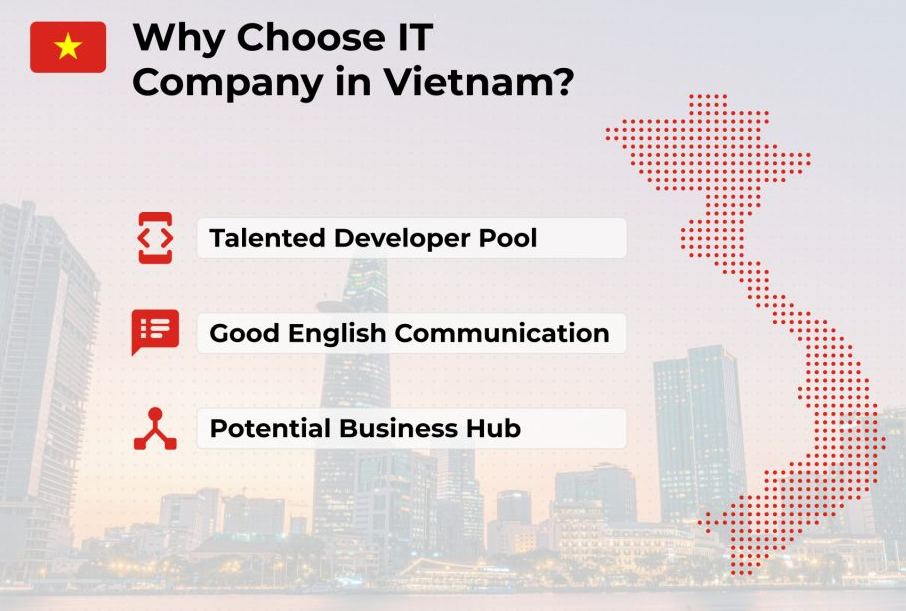
The 10 Best AI Outsourcing Companies in Vietnam to Watch in 2026
The leading AI-capable software outsourcing companies in Vietnam, compared on AI skills, cost, and UK/EU overl...
AI outsourcing is how enterprises close the talent gap and scale faster. See the engagement models, what to outsource, and how to pick a partner.

The future of AI outsourcing is specialization at speed: companies are scaling AI faster by handing discrete, high-skill workloads (data annotation, agent development, fine-tuning, MLOps) to external AI partners instead of trying to hire entire in-house teams from a depleted talent pool. AI outsourcing has shifted from a cost-cutting tactic into a capability-access strategy, and that shift is what separates enterprises shipping production AI from those still stuck in pilots.
The reason is structural. Most enterprises now use AI somewhere, yet very few capture meaningful value from it. Any-AI use among organizations jumped from 78% to 88% in a single year, while only about 4 to 5% of firms capture significant scaled value [1][5]. The gap between adoption and return is rarely a model problem. It is an execution, data, and talent problem, and those are exactly the gaps a focused AI partner is built to close.
This article explains how AI outsourcing accelerates enterprise scaling in 2026: which workloads to outsource, which engagement models fit which risk profiles, what the talent gap is really costing you, and how to run a partner relationship without losing control of your IP or compliance posture. If you are weighing whether to build, buy, or partner, you can schedule a call once you have read the trade-offs below.
Key Takeaways
AI outsourcing is growing because demand for AI capability is outrunning the supply of people who can deliver it. Worldwide AI spending is on track to reach $632 billion by 2028 at a 29% compound annual growth rate [6]. That spending has to be executed by engineers, data specialists, and MLOps practitioners who simply do not exist in sufficient numbers inside most enterprises.
The talent math is the core driver. McKinsey found that 46% of leaders name skills gaps as the top obstacle to deploying generative AI, and only about a fifth of organizations consider their talent highly prepared [1]. Meanwhile the World Economic Forum projects a net gain of 78 million jobs by 2030, with 59% of the workforce needing reskilling, which tells you the skills you need today are still being created [2].
Speed compounds the pressure. The cost of a stalled AI initiative is not just sunk pilot spend, it is the competitive ground lost while a rival ships. When roughly 74% of companies struggle to scale AI value [5], the ones who win treat external partners as a way to compress time-to-production, not as a line item to minimize.
This is also why the relationship has matured. Early outsourcing was about offloading commodity work. AI outsourcing in 2026 is about renting deep, hard-to-build expertise on demand, then transferring it inward over time. Mind Supernova, a Vietnam-based AI engineering firm founded in 2023, was built around that model: vetted senior engineers who start in 5 to 7 days and work async-first with 4+ hours of daily UK overlap.
Not all AI work is equally suited to a partner. The best candidates are workloads that need rare, specialized skills, scale unevenly, or sit outside your core differentiation. Four categories consistently deliver the strongest return when outsourced.
High-quality labeled data is the unglamorous foundation of every working AI system, and it is the workload most enterprises underestimate. The data-labeling market is expanding from $3.77 billion in 2024 to a projected $17.1 billion by 2030, a 28.4% CAGR according to vendor research, which reflects how central annotation has become. Around 70% of organizations report data difficulties as a barrier to AI [1].
Annotation is human-in-the-loop work that needs trained reviewers, quality rubrics, and consistency at scale. Building that internally means hiring and managing a workforce that has nothing to do with your product. Partners like Mind Supernova run dedicated annotation teams as a service, which is why this is the most common entry point for outsourced AI. Our team's collective experience here ties directly to model accuracy, the subject of why high-quality training data matters more than model size.
Agentic systems are the fastest-moving and riskiest category. Gartner predicts that by 2028, 33% of enterprise software will include agentic AI, up from less than 1% in 2024, yet also predicts that more than 40% of agentic-AI projects will be canceled by the end of 2027 due to cost, unclear value, and weak controls [3]. Building agents safely demands skills few internal teams have yet.
This is where a partner that has shipped production agents earns its fee, by bringing orchestration patterns, guardrails, and evaluation harnesses you would otherwise learn the hard way. For a deeper view, see AI agent development for enterprises and the sibling article on how AI agents are replacing traditional software workflows.
Industry surveys put fine-tuned production models at only around 9% and agentic deployments near 12%, which tells you these are specialist skills concentrated in few hands. Fine-tuning done badly wastes budget and degrades performance. Done well, it adapts a base model to your domain language and tasks. A partner with a repeatable fine-tuning and evaluation pipeline reduces the trial-and-error cost dramatically, as covered in LLM fine-tuning services explained.
The reason 95% of pilots show no measurable P&L return is rarely the prototype [4]. It is the missing operational layer: monitoring, retraining, evaluation, cost control, and the workflow redesign that turns a demo into a process. McKinsey identifies workflow redesign as the single biggest driver of EBIT impact [1]. Outsourcing MLOps gives you that operational discipline immediately instead of building it from zero.
The engagement model matters as much as the partner. The right choice depends on how stable the workload is, how strategic it is, and how much control you need. The table below maps the main models to their best-fit scenarios.
| Engagement modelBest forControl levelSpeed to startTypical risk | ||||
| Project-based delivery | Well-scoped, finite builds (a single agent, a fine-tuning run) | Outcome-level | Fast | Scope creep; weak knowledge transfer |
| Dedicated team | Ongoing AI roadmap, evolving requirements | High; you set priorities | Days to weeks | Underused capacity if roadmap stalls |
| Staff augmentation | Filling specific skill gaps inside your own team | Very high; your management | Very fast | Onboarding overhead; integration friction |
| Managed annotation/data ops | Continuous labeling and data quality at scale | SLA-level | Days | Quality drift without strong rubrics |
| Outcome/value-based | Clear, measurable business KPIs | Results-level | Slower to define | Hard to attribute; alignment disputes |
A common pattern is to blend models. An enterprise might start with a project to prove value, expand into a dedicated team for the roadmap, and use staff augmentation to plug a specific gap such as an MLOps engineer. Mind Supernova offers all of these, alongside core AI development services, so the model can flex as the work matures.
Consider a mid-sized European insurer that wanted to deploy an AI assistant to triage claims documents. Its internal data-science team of four could prototype, but it could not annotate 200,000 historical claims, build a production agent, and stand up monitoring at the same time. The roadmap kept slipping because every hire took months to find.
The company restructured the work around an outsourcing partner. A managed annotation team labeled the claims corpus with a domain-specific rubric over six weeks. A small dedicated AI team built the document-extraction agent and a retrieval layer grounded in policy documents, drawing on patterns from enterprise RAG systems. The insurer's own engineers stayed focused on integration with the core policy platform.
The result was a working triage assistant in roughly a quarter rather than the year an all-internal build would have taken. Just as important, the partner ran an evaluation harness from day one, so the insurer could prove accuracy gains before expanding scope. This is the difference between joining the 95% of stalled pilots and the minority that reach production [4]. The combination of human annotators and AI systems reflects the model described in building an AI workforce.
Outsourcing AI well is a discipline, not a handoff. The enterprises that get value follow a deliberate sequence rather than throwing a vague brief over the wall. Here is a practical path.
For a vendor-selection deep dive, the previously published guide on how to choose an AI outsourcing partner walks through evaluation criteria in detail, and the AI outsourcing Vietnam complete guide covers the offshore delivery model end to end.
Outsourcing AI introduces real risks, and pretending otherwise helps no one. The good news is that each major challenge has a known mitigation when you plan for it up front.
Handing data and model artifacts to a third party raises legitimate concerns. Mitigate with contractual IP assignment, scoped data access, data residency clauses, and partners who can demonstrate alignment with frameworks like ISO/IEC 42001 and the NIST AI Risk Management Framework. Treat the OWASP Top 10 for LLM Applications, where prompt injection ranks first, as a shared checklist with your partner.
With about 95% of pilots showing no P&L return, the risk that an engagement produces a demo and nothing more is real [4]. Counter it by demanding workflow redesign as part of scope, since that is the biggest EBIT driver [1], and by tying milestones to measured outcomes rather than deliverables.
Most organizations plan agentic AI within two years, yet only a minority have mature agent governance. Outsourcing does not transfer accountability. Keep a named internal owner, require audit logs, and align with the EU AI Act timeline, where high-risk obligations are provisionally deferred to December 2027 under the Digital Omnibus (confirm the final text).
If the partner holds all the knowledge, you are exposed. Avoid lock-in with documentation requirements, code ownership, and a deliberate transfer plan. The aim is a partner who makes your team stronger, not one you cannot leave. Mind Supernova's low attrition and outcome-driven approach are designed to support that handover rather than resist it.
Strip away the jargon and AI outsourcing comes down to one thing: you cannot hire the people fast enough. The skills gap is the top blocker for 46% of leaders, and only a fifth feel their talent is highly prepared [1]. Local senior AI hires take months to find and longer to ramp.
An offshore partner changes the timeline. Vetted senior engineers can start in 5 to 7 days, and an async-first model with 4+ hours of daily UK overlap keeps collaboration tight without forcing anyone onto a night shift. That speed is the difference between capturing a market window and watching it close. The broader shift in how enterprises combine human and machine capability is the theme of the sibling article on building an AI workforce, and the trends driving all of this are surveyed in top AI trends transforming enterprise growth in 2026.
The strategic posture that wins is hybrid. Keep your differentiating logic and product sense in-house. Rent the specialized, intermittent, hard-to-staff capability (annotation, agents, fine-tuning, MLOps) from a partner. Then transfer what you can internalize. That is how the firms beating the 4 to 5% scaled-value odds are actually structured [5].
Start with data annotation. It is labor-intensive, needs trained reviewers and quality rubrics, and sits outside your core product. Around 70% of organizations report data difficulties [1], and annotation is the lowest-risk, highest-leverage entry point before moving to agents, fine-tuning, or MLOps.
It speeds it up when done well. Internal AI hires take months, while a partner can add vetted senior engineers in 5 to 7 days. With 46% of leaders citing skills gaps as the top blocker [1], outsourcing compresses time-to-production rather than adding overhead, provided you run a paid pilot first.
Use contractual IP assignment, scoped and logged data access, data residency clauses, and partners aligned with ISO/IEC 42001 and the NIST AI Risk Management Framework. Treat the OWASP Top 10 for LLM Applications as a shared security checklist, and keep a named internal owner accountable for governance.
A dedicated team fits an evolving AI roadmap because you set priorities while the partner supplies stable, specialized capacity. Use project-based delivery for finite builds and staff augmentation to fill a single skill gap. Many enterprises blend all three as the work matures.
About 95% of generative-AI pilots show no measurable P&L return [4], usually because they stop at a prototype. The missing piece is workflow redesign and operational discipline (MLOps, evaluation, monitoring), which McKinsey identifies as the biggest EBIT driver [1]. Partners who own that layer move the needle.
AI outsourcing in 2026 is not about cutting costs. It is about accessing scarce, specialized capability fast enough to ship while the opportunity is still open. The enterprises pulling ahead outsource the intermittent, hard-to-staff work (annotation, agents, fine-tuning, MLOps), demand workflow redesign and evaluation, and keep governance firmly in their own hands.
This week: audit which AI workloads are core versus specialized, and identify the one that is currently blocking your roadmap. This quarter: run a paid pilot with a real evaluation harness on your own data, then choose an engagement model that matches the workload's stability.
If you want a partner that can add senior AI engineers in 5 to 7 days, work with 4+ hours of daily UK overlap, and transfer capability back to your team, schedule a call with Mind Supernova to scope your first outsourced AI workload.
The leading AI-capable software outsourcing companies in Vietnam, compared on AI skills, cost, and UK/EU overl...
Why global startups pick Vietnam for AI development: lower burn rate, fast senior hiring, deep ML talent, and...
A guide to AI development services in Vietnam: machine learning, computer vision, NLP, LLM apps, and MLOps, wi...