
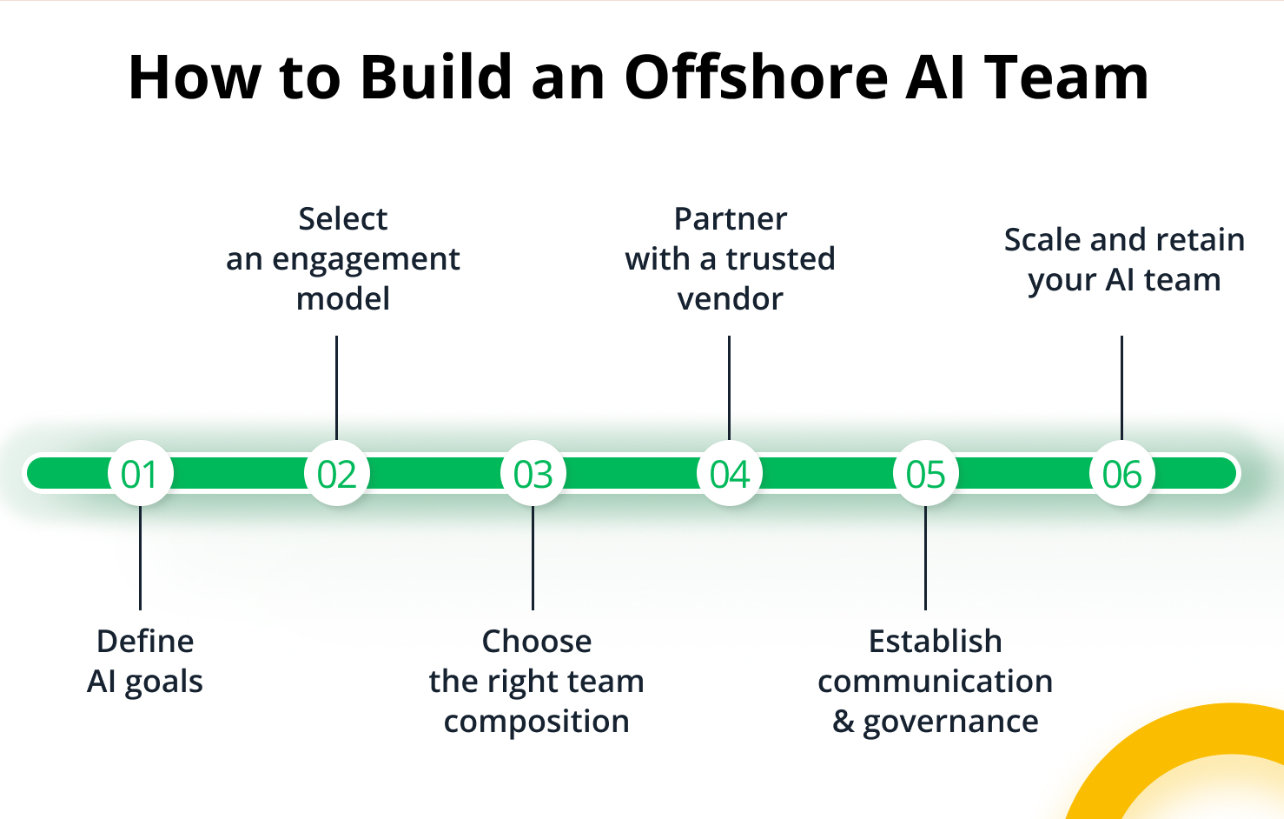
How to Build an Offshore AI Engineering Center That Accelerates Innovation
A practical guide to standing up an offshore AI engineering center: operating models, location strategy, hirin...
Why global startups pick Vietnam for AI development: lower burn rate, fast senior hiring, deep ML talent, and daily UK/EU overlap.

Global startups choose Vietnam for AI development because it stretches their runway: senior AI and ML engineers cost roughly $9–25 per hour, far below Western rates, while the talent pool runs deep enough to staff a team in days rather than months [4][3]. For a venture-backed founder watching cash burn, that combination of price, speed, and depth is hard to find anywhere else at the same quality bar.
This is the startup-focused angle on AI outsourcing Vietnam. If you're a founder deciding where to build your model pipelines, your RAG stack, or your first AI agents, the math and the operating reality both point east. The question isn't only whether Vietnam is cheaper. It's whether you can ship faster, hire smarter, and de-risk the parts that usually go wrong.
Below we break down the founder economics, the hiring speed, the talent reality, the daily UK and EU working overlap, and the pain points that keep founders up at night, plus how to defuse each one. Want the wider context first? Our complete guide to AI outsourcing in Vietnam covers the full landscape; this piece zooms in on the early-stage company.
Key Takeaways
For an early-stage company, engineering spend isn't just an expense. It's the rate at which your runway shrinks. Cut your fully loaded cost per engineer and you buy months, and months are what let you reach the next milestone before the next raise.
The rate gap is large and well documented. Senior developers in Vietnam bill roughly $9–25 per hour, against $25–60 in India, $50–90 in Eastern Europe, and $75–135+ in the US and UK [4]. That puts Vietnamese rates about 30–50% below Western markets for comparable senior work. AI and ML engineers command a premium everywhere, so the absolute numbers rise, but the proportional advantage holds.
Here's what that means in practice. A founder who would burn through a Western senior hire's salary in a quarter can often fund two or three Vietnamese engineers for the same period, or fund one engineer three times as long. When you're pre-revenue, that's the difference between shipping a working AI product and running out of money during the build.
The table below sketches the order-of-magnitude difference for a single senior AI engineer over six months at full-time load. Treat these as planning ranges, not quotes; AI specialists sit at the upper end of each band.
| LocationSenior hourly rate~6 months full-time (approx.)Relative to US/UK | |||
| Vietnam | $9–25 | $9k–26k | Baseline (lowest) |
| India | $25–60 | $26k–62k | 2–3x Vietnam |
| Eastern Europe | $50–90 | $52k–94k | 4–6x Vietnam |
| US / UK | $75–135+ | $78k–140k+ | 6–9x Vietnam |
Cost alone never justifies a hire. But when two options ship the same quality, the cheaper one wins on runway, and runway is the metric that keeps a startup alive long enough to find product-market fit. Ready to model your own numbers? You can schedule a call to scope a team against your budget.
Cost gets the attention, but speed often decides the outcome. A startup that identifies an AI gap today can't wait three months to fill it. The market moves, the roadmap slips, and the founder ends up coding the model pipeline themselves instead of selling.
Building an in-house AI team is slow even in the best markets. You write the spec, post the role, screen a flood of applicants, run technical interviews, negotiate, and wait out a notice period. In tight talent markets that cycle stretches past three or four months for a single senior hire. Multiply that across a team and the timeline becomes a strategic risk.
A capable Vietnamese partner compresses that drastically. At Mind Supernova, vetted senior engineers can start in 5–7 days, because the vetting already happened. The bench exists, the references are checked, and the engineer is matched to your stack rather than recruited from scratch. For a founder, that's the difference between starting the build this sprint and starting next quarter.
If you want a deeper view of the service models that make this speed possible, see our breakdown of AI development services in Vietnam, which catalogs what you can actually buy and how each model is staffed.
Hiring one good engineer is luck. Hiring a team, then growing it, is a function of how deep the talent pool runs. Vietnam's pool is deep and getting deeper, which matters because a startup's AI needs rarely stay still.
The numbers are substantial. Vietnam has more than 500,000 software developers and over 1.2 million IT professionals, concentrated in Ho Chi Minh City and Hanoi [3]. The pipeline keeps refilling: 50,000–75,000 IT graduates enter the market every year, and demand still outstrips supply, which signals a healthy, ambitious ecosystem rather than a stagnant one [3]. The country also ranks #7 on Kearney's Global Services Location Index and sits in the top three across Southeast Asia [1].
Why does depth matter for AI specifically? Because AI projects shift shape. You start with an LLM integration, then need a data engineer for the pipeline, then an MLOps specialist to get it into production, then someone who knows fine-tuning. A shallow pool forces you to compromise on roles; a deep one lets you assemble the right team for each phase.
Core enterprise and startup AI work in 2026 clusters around a handful of disciplines, all of them labor- and expertise-intensive, which is exactly why they get outsourced.
Mind Supernova treats AI engineering as core rather than bolted on, with focus areas spanning AI transformation, LLM integration, agentic AI, MLOps, and data/ML engineering. For a startup, that means you're hiring a team that builds AI for a living, not a generalist shop that added an AI line to its website last year. You can compare providers on this dimension in our roundup of top AI outsourcing companies in Vietnam.
A common founder fear about offshore work is the lag: you ask a question at 9am and get the answer at 9pm. With Vietnam and a partner that runs async-first delivery, that fear is overblown. Vietnam gives you 4+ hours of daily working overlap with the UK and most of the EU, which is enough to keep a real collaboration loop running.
Note the language here. This is offshore with daily UK overlap, not a same-timezone setup. The point is that the overlap window covers the moments that matter: a morning standup for the team, a live pairing session on a tricky model bug, a quick decision on scope before the founder's day fills up. The rest of the work happens asynchronously, with clear handoffs.
For an early-stage company, this rhythm has a hidden benefit. The overlap forces discipline: written specs, recorded decisions, clear acceptance criteria. Those habits make the whole team more legible, which is exactly what a founder needs when context lives in one or two heads.
| UK timeVietnam timeWhat happens | ||
| 08:00–10:00 | 14:00–16:00 | Overlap: standup, pairing, live decisions, demos |
| 10:00–12:00 | 16:00–18:00 | Overlap continues: reviews, unblocking, scope agreement |
| 12:00 onward | Evening | Vietnam team wraps; async handoff written for UK |
| UK afternoon | Vietnam overnight | UK reviews output, queues next-day work |
Used well, the time difference becomes a feature, not a bug. Work moves forward while you sleep, and you wake to progress plus a clear note on what's ready for review. EU founders get an even wider overlap window than the UK, since Central European hours line up slightly closer to the Vietnamese afternoon.
Every founder considering offshore AI development carries the same short list of worries. They're legitimate. Here's each one, honestly stated, with the practical way to defuse it.
The fear is paying less and getting less. The fix is structural, not hopeful. Insist on a paid trial sprint before any long commitment, review real code and model output rather than slide decks, and check that the partner vets for AI/ML depth specifically. Vietnam's #7 GSLI ranking reflects a market judged on quality of delivery, not only price [1].
For a small AI team, losing the one person who understands the pipeline is catastrophic. This is where Vietnam quietly wins: attrition runs 6–8%, versus 20%+ in India [5]. Lower churn means the engineer who built your RAG stack is still there to maintain it. De-risk further by requiring documentation as a deliverable and by pairing on critical systems so knowledge never lives in one head.
English matters, and honesty matters more. Vietnam sits mid-table on the EF English Proficiency Index, around rank 63–64 of 116, though working English is the norm at established software firms [6]. So don't expect native fluency; do expect clear written and spoken working English. De-risk by interviewing your actual engineers, not just the account manager, and by leaning on written communication, which is the default in async-first delivery anyway.
For an AI startup, the model and the training data are the company. Lock this down in the contract: explicit IP assignment, NDAs, clear data-handling terms, and named security practices. A serious partner will have answers ready. Our guide on how to choose an AI outsourcing partner includes a full IP, security, and contract checklist you can take into negotiations.
Outsourcing should extend your control, not surrender it. Choose an outcome-driven model with sprint goals you set, demos you attend, and a backlog you own. With the 4+ hours of daily overlap, you stay in the loop on decisions rather than rubber-stamping work after the fact. If you want engineers embedded in your own process, a staff augmentation model keeps your founder fully in the driver's seat.
Founders are sometimes nervous about betting on a market that might fade. Vietnam is moving the other way. The IT services market is worth around $2.6 billion in 2026 and growing at roughly 11% CAGR, with IT outsourcing making up about 40% of activity [2]. That's a maturing ecosystem, not a fad.
Policy reinforces it. The government's "Make in Vietnam" strategy and 2025 corporate-tax incentives for new tech SMEs are actively pulling investment and talent into the sector [2]. For a startup, a supportive policy environment means the supply of engineers, tooling, and partners keeps expanding rather than drying up.
This is also why so many AI projects flow here. The enterprise AI workload, LLM integration, RAG, agents, fine-tuning, MLOps, and data annotation, is labor- and expertise-intensive, and a large majority of organizations now use or pilot generative AI per McKinsey's State of AI research [7]. Demand for the underlying training data is climbing too, with the data-labeling market growing at a high-double-digit pace [8]. Startups riding that wave need affordable specialist capacity, and Vietnam supplies it.
The right model depends on your stage, your in-house team, and how much process you already have. Most founders pick one of these.
| ModelBest forFounder controlMind Supernova link | |||
| Staff augmentation | You have a lead; you need hands on your roadmap | High (your process) | Staff augmentation |
| Dedicated team | You need a standing AI squad over months | Medium-high | Dedicated teams |
| Project outsourcing | A defined build with a clear spec and deadline | Medium (outcome-based) | Software outsourcing |
| Hire senior developers | One or two specialist seniors, fast | High | Hire senior developers |
A useful default for very early companies: start with one or two augmented senior engineers to validate the working relationship, then scale into a dedicated team once trust and process are proven. That sequence keeps risk low while you learn how the partnership behaves under real deadlines. For the broader AI build capability behind any of these, see our AI development services, and learn more about who we are on the Mind Supernova about page.
Founders move best with a concrete sequence. Here's a practical one for standing up offshore AI development without betting the company on day one.
By day 90 you should have shipped real AI functionality, proven the partnership under pressure, and built the operating habits that let you scale with confidence rather than crossed fingers.
The deciding factor is usually attrition plus cost. Vietnam's developer churn runs 6–8% versus 20%+ in India, so a small AI team keeps the people who understand its pipeline [5]. Rates are also lower, at $9–25 per hour versus $25–60, which extends a startup's runway further [4].
With a partner that maintains a pre-vetted bench, a senior engineer can start in 5–7 days, because the screening and reference checks already happened. That compares with three or more months to recruit one senior AI hire in-house in most Western markets, which is often the difference between shipping this quarter or next.
No, when handled with an async-first process. Vietnam offers 4+ hours of daily working overlap with the UK and most of the EU, enough for standups, live pairing, and same-day decisions. Work continues overnight in Europe and lands ready for review, turning the gap into a throughput advantage rather than a delay.
Working English is the norm at established Vietnamese software firms, though the country sits mid-table on the EF English Proficiency Index at around rank 63–64 of 116 [6]. Expect clear professional English rather than native fluency, and interview your actual engineers, not just the account manager, before committing.
Put it in the contract before any code is written: explicit IP assignment, signed NDAs, defined data-handling terms, and named security practices. A credible partner will have these ready to discuss. Our guide on choosing an AI outsourcing partner includes a full IP and security checklist you can use during negotiations.
Global startups choose Vietnam for AI development because it converts a cost advantage into a speed advantage: cheaper senior engineers, a deep talent pool, fast starts, low attrition, and a daily overlap window that keeps founders in control. The risks are real but manageable, and every one of them has a concrete way to defuse it.
This week: write your one-page AI brief, then shortlist two or three Vietnamese partners and ask each for real engineer profiles plus a paid trial task on a low-risk slice of your problem.
This month: run the trial, lock down IP and security terms, and start one or two senior engineers on your live roadmap with a clear sprint cadence and the overlap rhythm in place.
If you'd like help scoping an AI team against your runway and roadmap, schedule a call with Mind Supernova. We're one strong option among several; bring us your hardest constraint and we'll tell you honestly whether we can solve it. For more context, start with the complete AI outsourcing Vietnam guide or compare the field in top AI outsourcing companies in Vietnam.
A practical guide to standing up an offshore AI engineering center: operating models, location strategy, hirin...
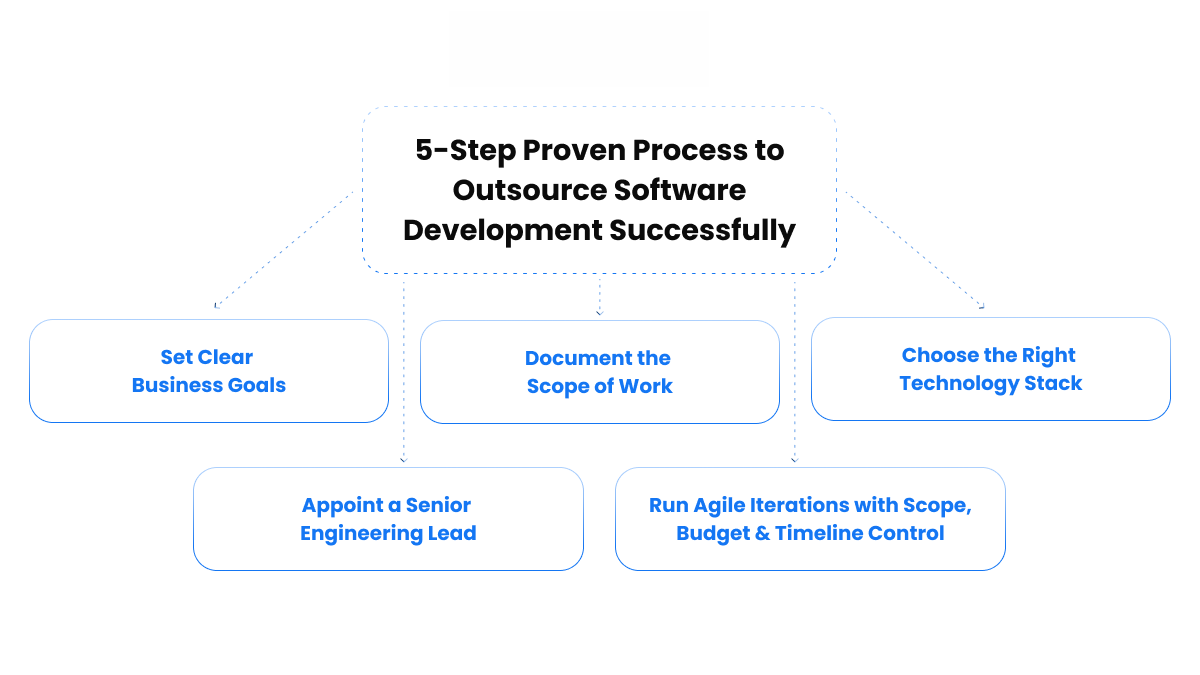
How to outsource web application development without losing control: a governance model, metrics, QA gates, co...
Vietnam's best software outsourcing companies in 2026, ranked. Compare FPT, Mind Supernova, NashTech and more...