
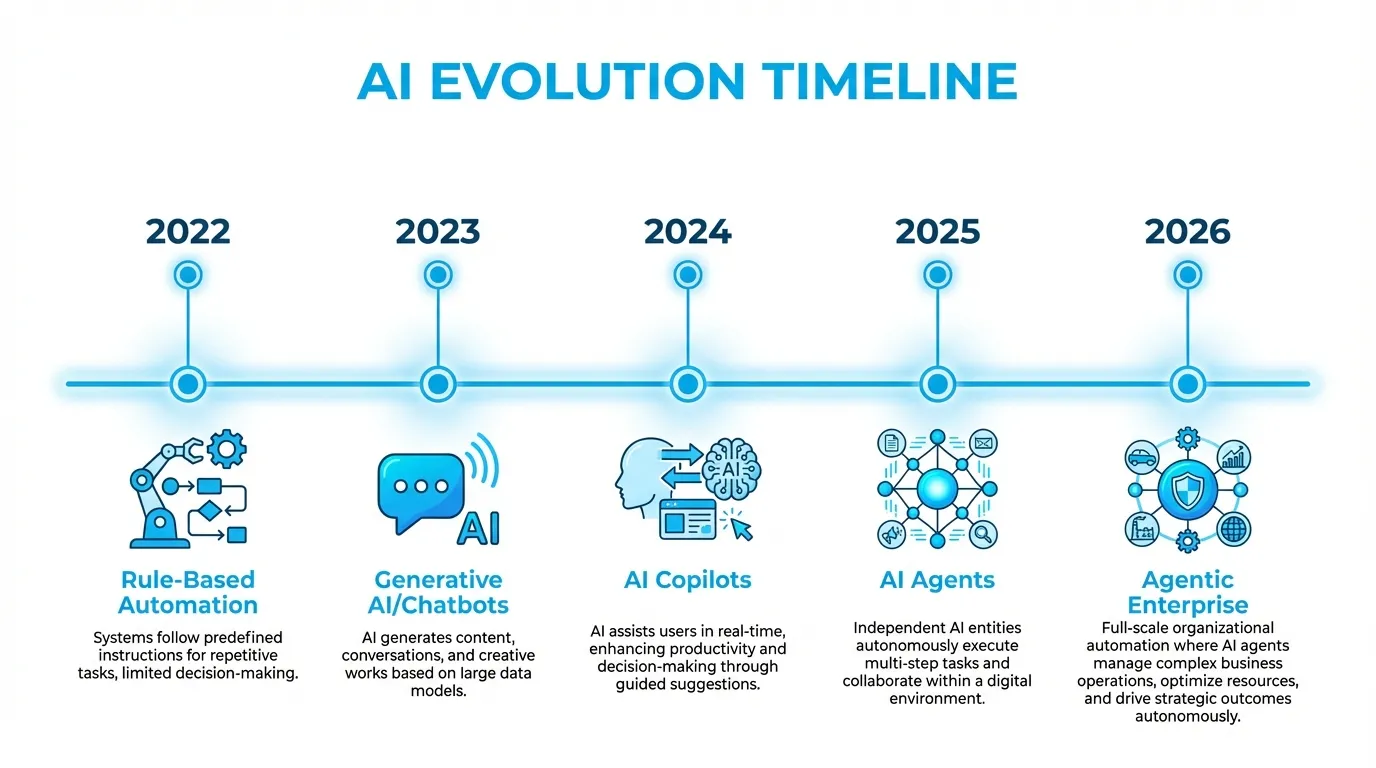
From Chatbots to Autonomous Agents: Understanding the Next Generation of Enterprise AI
A clear, stage-by-stage guide to the evolution from chatbots to autonomous AI agents, including a maturity mod...
The AI trends reshaping enterprise growth in 2026: agentic AI, multimodal models, RAG, governance, and the AI workforce, plus what to do about each.
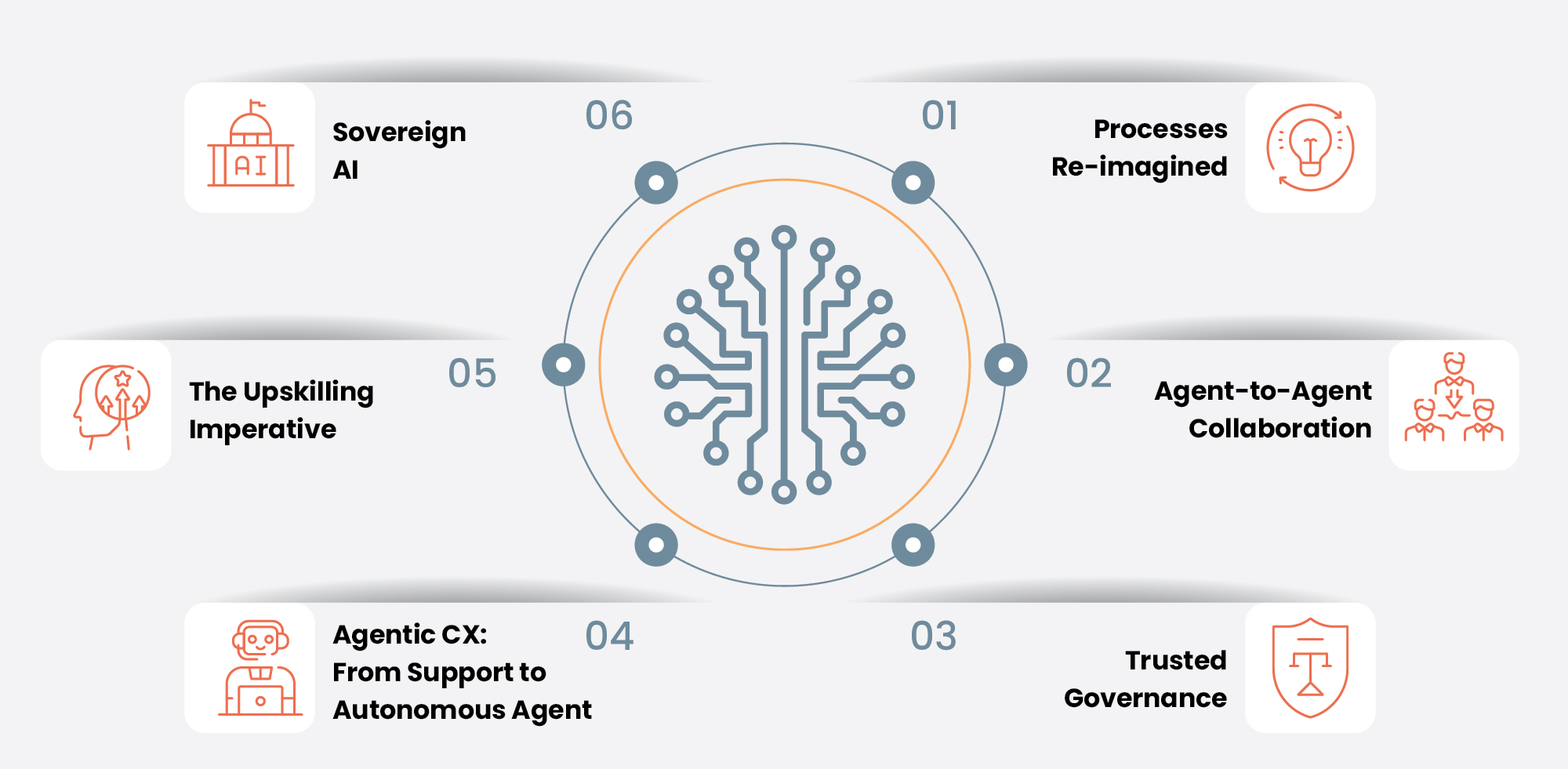
The top AI trends transforming enterprise growth and innovation in 2026 are agentic AI, multimodal models, retrieval-augmented generation (RAG), AI governance, the human-plus-AI workforce, a hard pivot to measurable ROI, smaller efficient models, and data quality as the new differentiator. Together these shifts mark the year enterprise AI stopped being an experiment and became an operating discipline. The question for most boards is no longer whether to adopt AI, but how to turn scattered pilots into durable, governed value.
That pivot is overdue. Generative AI moved from novelty to near-default in two years: regular use jumped from 33% in 2023 to 71% in 2024 per the Stanford HAI 2025 AI Index [2], and McKinsey reports any-AI adoption rising from 78% to 88% across 2024 to 2025 [1]. Yet adoption is not the same as return, and that gap defines the 2026 agenda.
This guide walks through the nine trends shaping enterprise strategy this year, with the mechanisms behind each, an enterprise use case, an implementation path, and the challenges that derail most programs. If you want a partner to help operationalize any of these, you can schedule a call with our team.
Key Takeaways
Agentic AI is the year's defining trend. Unlike a chatbot that answers a prompt, an agent plans multi-step tasks, calls tools and APIs, and acts toward a goal with limited human input. Gartner predicts that by 2028, 33% of enterprise software applications will include agentic AI, up from less than 1% in 2024, and that at least 15% of day-to-day work decisions will be made autonomously [3].
The reality on the ground is earlier-stage. McKinsey finds 62% of organizations are experimenting with agents, but 10% or fewer have scaled them in any single function (2025) [1]. Deloitte reports roughly 74% of companies plan to deploy agentic AI within two years, while only 21% have mature agent governance [as reported in its State of AI in the Enterprise, 2026 edition].
That governance gap is why Gartner expects more than 40% of agentic-AI projects to be canceled by the end of 2027, citing cost, unclear value, and weak controls [3]. The lesson for 2026: treat agents as software systems that need observability, guardrails, and an owner, not as magic. We go deeper on this in our companion pieces on how AI agents are replacing traditional software workflows and the rise of autonomous AI systems.
Models that read text, images, audio, and video together are moving from frontier feature to enterprise default. Gartner projects 40% of generative-AI solutions will be multimodal by 2027, up from just 1% in 2023 [4]. The advantage is practical: a single model can interpret a scanned invoice, a product photo, and a customer voice note in one flow.
For global enterprises, this collapses workflows that once needed separate tools. Document intelligence, visual quality inspection, and voice-driven support all become one capability rather than three integrations. We cover the business cases in detail in how multimodal AI is creating new competitive advantages.
Retrieval-augmented generation grounds a model's answers in your own approved documents, which cuts hallucination and keeps sensitive data inside controlled boundaries. It has become standard infrastructure: RAG is now used in 51% of enterprise gen-AI deployments, up from 31%, while only about 9% of production models are fine-tuned (Menlo Ventures 2024) [7].
The appeal is governance and accuracy at once. Instead of betting on what a base model memorized, RAG retrieves current, citable facts at query time, so answers can be audited back to a source. For regulated industries, that traceability is the difference between a usable system and a compliance risk. See our deep dive on enterprise RAG systems.
Governance graduated from a legal footnote to a board-level requirement in 2026. The EU AI Act has been in force since August 2024, with prohibited-practice and AI-literacy duties applying since February 2025 and general-purpose AI obligations since August 2025 [8]. Under the provisional Digital Omnibus (around May 2026), several high-risk Annex III obligations are expected to be deferred to December 2027, though that text is not yet final as of June 2026.
Enterprises are standardizing on recognized frameworks: NIST AI RMF 1.0 and its Generative AI Profile [9], ISO/IEC 42001:2023 for AI management systems, and the OWASP Top 10 for LLM Applications, which ranks prompt injection as the number-one risk [10]. Shadow AI compounds the pressure; Gartner expects that by 2027, 75% of employees will use technology outside IT visibility. We lay out a full controls checklist in AI governance, security and compliance strategies every enterprise needs in 2026.
The most resilient AI programs in 2026 pair models with people rather than replacing them outright. Human-in-the-loop review, expert data annotation, and operations teams are what keep agent outputs accurate and safe. The talent picture explains the urgency: 46% of leaders cite skills gaps as the top blocker to shipping gen AI (McKinsey 2025) [1], and only about 20% of organizations say their talent is highly prepared (Deloitte 2026).
The macro shift is large but not apocalyptic. The WEF Future of Jobs Report 2025 projects a net gain of 78 million jobs by 2030, with 170 million created and 92 million displaced, and notes 59% of workers will need reskilling by 2030 [11]. For most enterprises, the practical answer is a hybrid model: internal upskilling plus external specialists. Our pieces on building an AI workforce and the future of AI outsourcing cover the org-design choices in depth.
This is where a focused partner helps. Mind Supernova, a Vietnam-based AI engineering firm founded in 2023, runs human-in-the-loop annotation and AI workforce teams alongside its AI development practice, with vetted senior engineers who can start in 5 to 7 days and 4+ hours of daily UK overlap.
2026 is the year the AI honeymoon ends and the spreadsheet opens. The evidence is sobering: roughly 95% of enterprise gen-AI pilots show no measurable P&L return (MIT Project NANDA, 2025) [5], and BCG finds about 74% of companies struggle to scale AI value, with only 4 to 5% capturing significant scaled value [6]. Only around 6% of firms qualify as AI high performers attributing at least 5% of EBIT to AI (McKinsey 2025) [1].
What separates the winners? McKinsey's data points to workflow redesign as the biggest driver of EBIT impact [1]. Bolting a chatbot onto a broken process changes little. Redesigning the process around the model is where value appears. Boards in 2026 are demanding business cases tied to a specific metric before funding the next phase.
The assumption that more parameters always wins is fading. Smaller, fine-tuned, or distilled models often match large ones on narrow enterprise tasks at a fraction of the inference cost, and they can run in more controlled environments. Combined with RAG, a compact model grounded in good data frequently beats a giant model guessing from memory.
This matters for the ROI conversation above. Efficient models lower the per-query cost that quietly sinks many pilots, and they make on-premises or region-specific deployment realistic for data-sensitive enterprises. The strategic takeaway: pick the smallest model that meets the accuracy bar, then invest the savings in data and evaluation.
If 2024 was about access to powerful models, 2026 is about the data you feed them. Roughly 70% of organizations report data difficulties as a barrier to AI value (McKinsey 2024) [1], and the data-labeling market reflects the demand, projected to grow from $3.77B in 2024 to $17.1B by 2030 at a 28.4% CAGR (Grand View Research; vendor research).
Clean, well-labeled, well-governed data is what makes RAG accurate, fine-tuning effective, and agents reliable. This is why high-quality training data increasingly matters more than raw model size, a thesis we expand in why high-quality training data matters more than model size. Two earlier cluster posts add the operational view: data annotation services for generative AI and building AI training data at scale.
Worldwide AI spending is projected to reach $632B by 2028, growing at a 29% CAGR (IDC 2024) [12]. As budgets climb, enterprises are consolidating fragmented tooling and turning to specialized partners to close skills gaps faster than internal hiring allows. The build-versus-buy line is moving toward a blend: build the differentiated core, buy or outsource the rest.
This is the through-line connecting governance, talent, and ROI. Disciplined sourcing, whether dedicated teams, staff augmentation, or full AI development engagements, lets enterprises move from pilot to production without the multi-quarter hiring lag. For context on the broader market shift, see enterprise AI adoption trends and the foundational AI outsourcing guide for 2026.
No single trend stands alone. Agents need RAG to stay grounded; RAG needs clean data; data needs a human workforce; everything needs governance; and the whole stack only earns funding when it shows ROI. The table below summarizes where each trend sits today and what it demands of enterprise leaders.
| Trend2026 maturityKey metricWhat it demands of leaders | |||
| Agentic AI | Early scaling | 33% of software by 2028; 40%+ projects canceled by 2027 [3] | Governance, observability, clear value case |
| Multimodal AI | Accelerating | 40% of gen-AI solutions multimodal by 2027 [4] | Consolidate single-mode tools |
| RAG | Mainstream | 51% of deployments use RAG [7] | Invest in retrieval and data hygiene |
| Governance | Mandatory | EU AI Act in force; NIST/ISO/OWASP adopted [8][9][10] | Stand up an AI risk framework now |
| AI workforce | Constraint | 46% cite skills gaps as top blocker [1] | Reskill plus partner sourcing |
| ROI focus | Reckoning | ~95% of pilots show no P&L return [5] | Redesign workflows, tie to one metric |
| Efficient models | Rising | ~9% of models fine-tuned [7] | Right-size models; cut inference cost |
| Data quality | Foundational | ~70% report data difficulties [1] | Fund annotation and evaluation |
Consider a representative example drawn from our team's collective experience. A multinational insurer had a dozen disconnected gen-AI pilots, none with measurable return, mirroring the broad 95% no-return pattern [5]. Leadership froze new spend until a value case existed.
The fix combined four trends at once. First, the team grounded its claims-triage assistant in a RAG system over approved policy documents, so answers were citable and auditable. Second, it added a human-in-the-loop review queue for low-confidence cases, staffed by trained annotators. Third, it swapped a large general model for a smaller fine-tuned one to cut inference cost. Fourth, it wrapped the system in a NIST-aligned governance process with logging and prompt-injection testing.
The result was a single production workflow rather than a scattered set of demos, with claims-triage handling time reduced and every output traceable to a source. The decisive move was not a better model. It was redesigning the workflow around grounded data and clear ownership, exactly what McKinsey identifies as the top EBIT driver [1].
You do not need to chase all nine trends at once. Sequence them around one high-value workflow and prove value before scaling. Here is a practical path.
If internal capacity is the bottleneck, a partner like Mind Supernova can supply vetted senior AI engineers and annotation teams that start in 5 to 7 days, with 4+ hours of daily UK overlap for async-first delivery.
The trends above are real, but so are the obstacles. Naming them upfront is what separates programs that scale from those that stall.
With roughly 95% of pilots showing no P&L return [5] and only 4 to 5% of firms capturing significant scaled value [6], the biggest risk is funding activity instead of outcomes. Tie every initiative to one measurable metric and redesign the underlying workflow.
Only about 21% of organizations report mature agent governance (Deloitte 2026), and prompt injection tops the OWASP LLM risk list [10]. Shadow AI makes this worse, with Gartner expecting 75% of employees to use unsanctioned tech by 2027. Adopt a recognized framework and make governance a precondition for production.
Skills gaps are the top blocker for 46% of leaders [1], and about 70% of organizations report data difficulties [1]. These two constraints reinforce each other. Pair internal reskilling with external specialists for engineering and annotation rather than waiting on multi-quarter hires.
BCG finds 74% of companies struggle to move from pilot to scaled value [6]. The fix is organizational, not technical: clear ownership, reusable platforms, and a stage-gate that demands evidence before each expansion. Our guide on how to choose an AI outsourcing partner covers the sourcing side of this decision.
The key trends are agentic AI, multimodal models, retrieval-augmented generation, AI governance, the human-plus-AI workforce, a focus on measurable ROI, smaller efficient models, and data quality. They are interdependent: agents need grounded data, data needs people, and everything needs governance and a clear value case.
Most pilots fail because organizations add AI to an existing process instead of redesigning the workflow around it. MIT Project NANDA found roughly 95% of gen-AI pilots show no measurable P&L return [5]. McKinsey identifies workflow redesign, not the model itself, as the biggest driver of EBIT impact [1].
It is maturing fast but needs caution. Gartner projects 33% of enterprise software will embed agents by 2028, yet expects over 40% of agentic projects to be canceled by 2027 due to cost and weak controls [3]. Treat agents as governed software with observability and a clear owner.
Data quality increasingly matters more. Smaller models grounded in clean, well-labeled data through RAG often beat larger models guessing from memory, at lower cost. About 70% of organizations cite data difficulties as a barrier [1], which is why annotation and evaluation now command more investment than raw scale.
Start with one high-value workflow that has a measurable metric, redesign the process, ground the system in your data with RAG, right-size the model, add human review, and stand up governance from day one. Prove value against a baseline before scaling, and partner externally where skills are short.
The nine trends of 2026 point to one conclusion: the winners are not those with the biggest models, but those who pair good data, governed agents, and a human workforce around redesigned workflows that prove their value. Adoption is no longer the differentiator. Disciplined execution is.
This week: pick one workflow with a clear metric and a named owner, and audit whether your AI efforts redesign the process or just decorate it. This quarter: ground that workflow in RAG over clean data, stand up a NIST or ISO 42001 governance baseline, and set a stage-gate that funds the next phase only on measured results.
If you want experienced AI engineers and human-in-the-loop teams to help you move from pilot to production, schedule a call with Mind Supernova. Our offshore teams deliver with 4+ hours of daily UK overlap and senior engineers who start in 5 to 7 days.
A clear, stage-by-stage guide to the evolution from chatbots to autonomous AI agents, including a maturity mod...
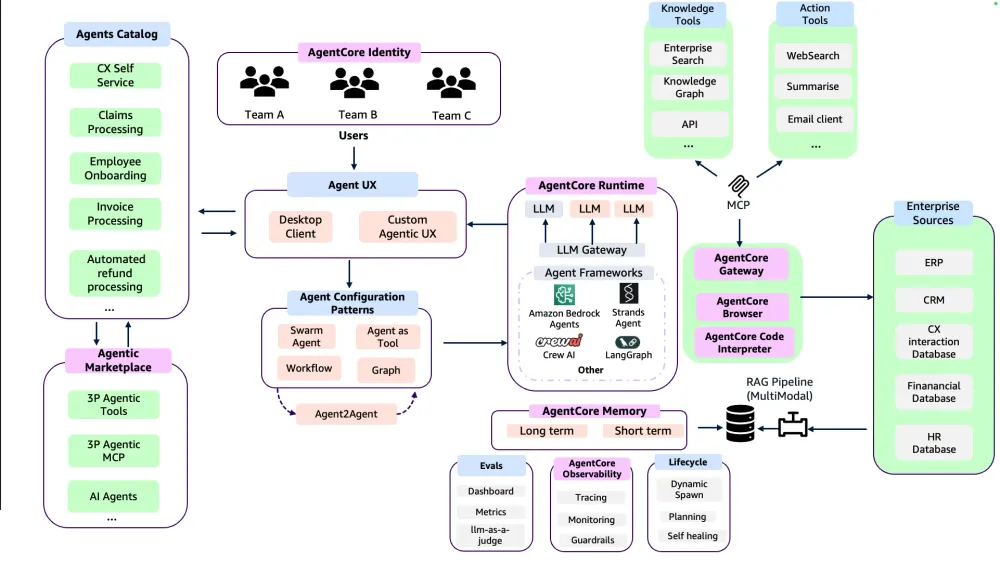
An executive readiness playbook for agentic AI: a six-dimension self-assessment, a phased roadmap, how to pick...
A strategic investment framework for CTOs evaluating agentic AI: where it actually creates value, build vs buy...