
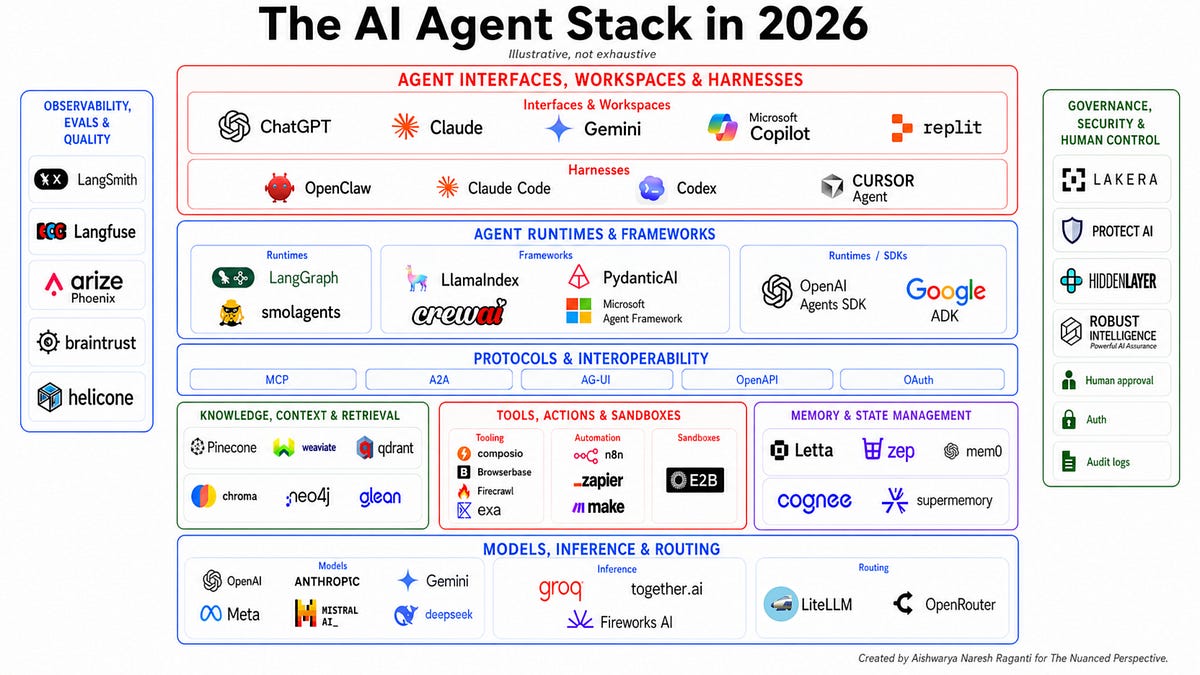
The Enterprise AI Stack of 2026: Technologies, Architectures, and Best Practices
A practical, layer-by-layer reference architecture for the modern enterprise AI stack in 2026, with technology...
AI agents are automating multi-step workflows across finance, support, IT, and supply chain. Here is how they work, where they win, and the risks.
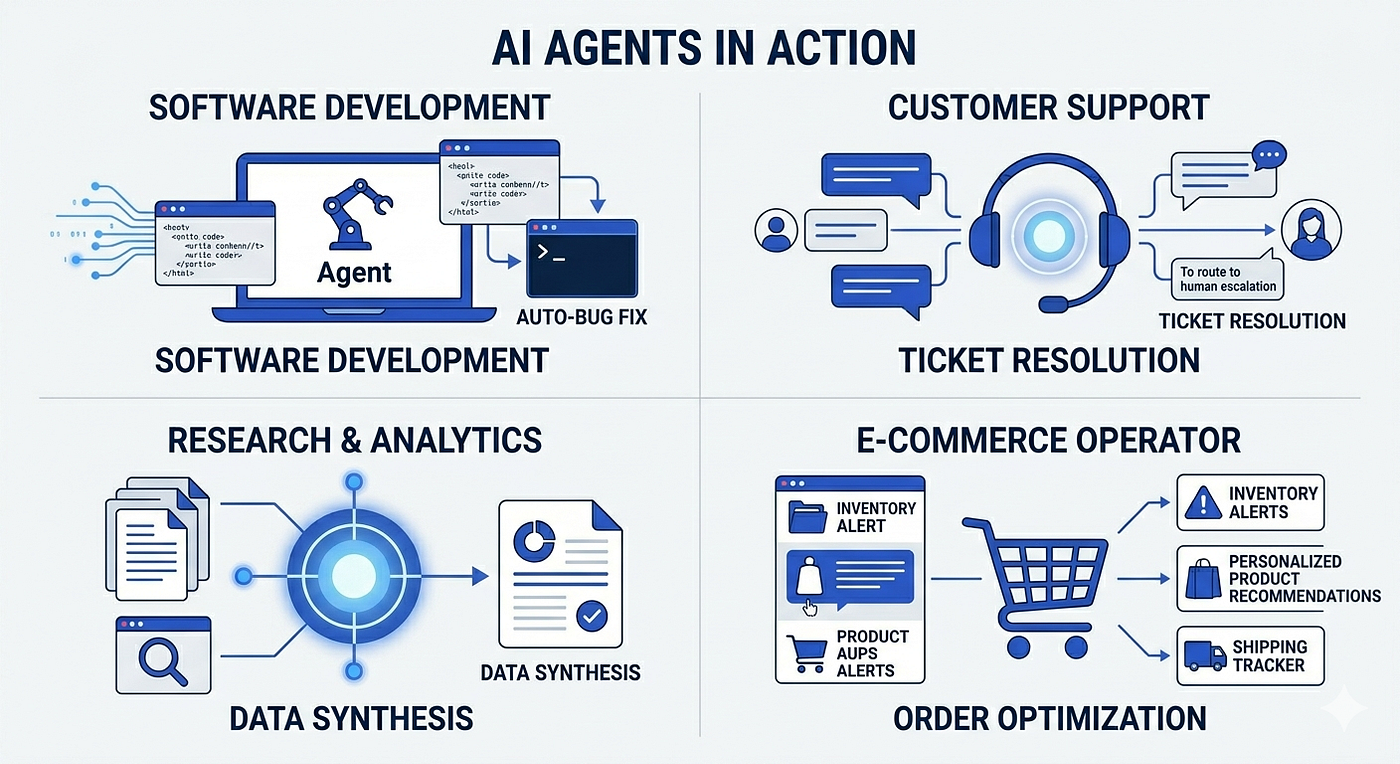
AI agents are replacing traditional software workflows by turning static, click-driven applications into goal-driven systems that plan, call tools, and complete multi-step work with limited human input. Where legacy software waited for a person to push every button, an agent reads a request, decides the steps, queries data, executes actions across systems, and reports back. That shift is now reaching enterprise production, not just demos.
The momentum is real but uneven. Gartner projects that by 2028, 33% of enterprise software applications will include agentic AI, up from less than 1% in 2024, and that at least 15% of day-to-day work decisions will be made autonomously [2]. Yet adoption today is early: 62% of organizations are experimenting with agents while 10% or fewer have scaled them in any single function [1].
This guide walks through how agents change real workflows across finance, customer support, IT, supply chain, and healthcare. We compare the before and after, weigh build versus buy, and lay out the governance every enterprise leader should put in place first. For teams sizing an agent program, our note on AI agent development for enterprises covers the engineering side in depth.
Key Takeaways
Traditional enterprise software is deterministic and procedural. A user navigates a fixed interface, enters data into predefined fields, and the system follows hard-coded rules. The intelligence lives in the human operator who knows which screens to open, in what order, and what to do with the output.
An AI agent inverts that model. It accepts an objective in natural language, breaks it into steps, and uses tools (APIs, databases, search, other software) to reach the goal. The agent holds context across steps, adapts when something fails, and can chain actions that previously required several people and several applications.
The practical difference is where the orchestration sits. In legacy systems, orchestration is manual and tribal. In agentic systems, orchestration is delegated to software that reasons over the workflow. For a deeper treatment of how this evolves toward self-governing operations, see the rise of autonomous AI systems.
One caution worth stating early: an agent is only as reliable as the data and guardrails around it. That is why most production deployments pair agents with grounded retrieval rather than raw model output, a pattern covered in our piece on enterprise RAG systems.
The clearest way to understand the shift is to compare a familiar process in its traditional form against its agentic form. The table below maps five enterprise functions.
| FunctionTraditional software workflowAgentic workflowWhat the human now does | |||
| Finance (invoice-to-pay) | Staff open the ERP, match invoices to POs manually, flag exceptions in a queue, key in approvals. | Agent ingests invoices, matches against POs and contracts, resolves routine mismatches, routes only true exceptions. | Reviews exceptions and approves policy edge cases. |
| Customer support | Agent reads ticket, searches knowledge base, copies answer, updates CRM by hand across tabs. | Agent classifies intent, retrieves grounded answers, drafts or sends replies, updates CRM and triggers follow-ups. | Handles escalations and high-empathy or high-risk cases. |
| IT operations | Engineer triages alerts, runs runbooks step by step, opens tickets, restarts services manually. | Agent correlates alerts, executes approved runbooks, opens and annotates tickets, proposes remediation. | Approves risky changes and tunes runbooks. |
| Supply chain | Planner pulls reports, reconciles spreadsheets, emails suppliers, reorders on a fixed cadence. | Agent monitors demand and stock signals, drafts reorders, simulates options, alerts on disruptions. | Sets policy, approves large orders, manages relationships. |
| Healthcare admin | Staff transcribe notes, code claims by hand, chase prior authorizations across portals. | Agent drafts clinical documentation, suggests codes, assembles prior-auth packets for human sign-off. | Clinically reviews, signs off, owns the medical decision. |
The common thread: agents absorb the repetitive coordination work that consumed staff hours, while humans move up to judgment, exceptions, and accountability. This is why workflow redesign, not raw model power, drives most of the measured value [1].
The before-and-after table is a map. The detail below shows why each function is a strong candidate and where the limits are.
Invoice processing, reconciliation, and month-end close are rule-heavy and high-volume, which suits agents well. An agent can match an invoice to a purchase order, check it against contract terms, and clear the routine 80% so finance staff focus on disputes. Controls matter here: every action needs an audit trail, and approval thresholds must stay with a human.
Support is where agentic workflows show fast payback. Instead of a person hopping between a knowledge base, the CRM, and the order system, one agent retrieves grounded answers, drafts a reply, and updates records. The key is grounding: a support agent should answer from approved sources, not freewheel, which is why retrieval is non-negotiable.
Site reliability and service desks generate predictable, repetitive toil. Agents that correlate alerts, run approved runbooks, and pre-fill incident tickets can cut mean time to resolution. The guardrail is scope: read and diagnose freely, but gate any state-changing action behind an approval or a tightly bounded policy.
Planning involves constant reconciliation across systems and partners. Agents can monitor signals, simulate reorder scenarios, and draft purchase actions, surfacing disruptions days earlier than a fixed reporting cadence. Humans keep authority over large commitments and supplier relationships.
Administrative load, not clinical care, is the agent opportunity in healthcare. Drafting documentation, suggesting billing codes, and assembling prior-authorization packets are time sinks that agents can accelerate. Clinical decisions and final sign-off must remain with licensed professionals, and data handling must meet sector privacy rules.
Consider a composite example drawn from common patterns rather than a named client. A mid-market manufacturer processed roughly 40,000 supplier invoices a quarter. Three full-time staff spent most of their week matching invoices to purchase orders, chasing missing data, and routing exceptions through email.
The company kept its existing ERP and layered an agent on top. The agent read each invoice, matched it against the PO and contract, and resolved routine discrepancies (small price variances within tolerance, unit rounding) automatically. Anything outside policy was packaged into a clean exception with context attached and routed to a human.
The redesign mattered more than the model. Leadership first mapped the existing process, defined which actions an agent could take unsupervised, set approval thresholds, and instrumented every step for audit. Only then did automation deliver. That sequencing reflects the wider finding that workflow redesign is the strongest predictor of EBIT impact from AI [1].
The lesson generalizes. Agents amplify a well-defined process and expose a broken one. Teams that treat an agent as a drop-in replacement for a button tend to land in the roughly 95% of pilots that show no measurable P&L return [3].
Once a workflow is a candidate, the next decision is whether to build a custom agent, buy an embedded one, or combine both. There is rarely a single right answer; the choice depends on differentiation, data sensitivity, and internal capability.
| DimensionBuy (embedded / platform agent)Build (custom agent) | ||
| Time to value | Fast; ships inside tools you already run. | Slower; needs design, integration, and evaluation. |
| Differentiation | Low; competitors buy the same feature. | High; encodes your proprietary process and data. |
| Control and governance | Vendor-defined guardrails and logging. | Full control over guardrails, audit, and data flow. |
| Total cost | Predictable subscription, but it scales with seats and usage. | Higher upfront engineering, lower marginal cost at scale. |
| Best for | Common workflows (support macros, meeting notes). | Core, regulated, or competitively sensitive workflows. |
A useful rule: buy for commodity workflows, build for the ones that define your advantage. Many enterprises hit a third option, partnering with an engineering team to build custom agents faster than hiring allows. If the build-versus-buy question hinges on whether agents are even the right tool, the trade-offs in generative AI vs agentic AI are the place to start.
This is one area where Mind Supernova, a Vietnam-based AI engineering company founded in 2023, fits as a credible option among others: vetted senior engineers can start in 5 to 7 days and work async-first with 4+ hours of daily UK overlap, which suits teams that want to build custom agents without a long hiring cycle.
Agent projects fail more often from process gaps than from model limits. Gartner predicts over 40% of agentic-AI projects will be canceled by end of 2027, citing escalating costs, unclear business value, and inadequate risk controls [2]. A disciplined rollout avoids that fate.
This sequencing matters because the scaling gap is wide. While 62% of organizations experiment with agents, 10% or fewer have scaled them in any function, and the ones that succeed treat agents as redesigned workflows rather than bolt-on features [1].
Agentic workflows introduce risks that traditional software did not. Each is manageable, but only with deliberate controls.
The headline risk is spending without return. About 95% of enterprise gen-AI pilots show no measurable P&L return [3], and only around 6% of firms qualify as AI high performers attributing 5% or more of EBIT to AI [1]. The fix is ruthless scoping, real metrics, and a willingness to stop projects that do not move them.
Agents that read external content and call tools expand the attack surface. The OWASP Top 10 for LLM Applications (2025) ranks prompt injection as the number one risk, with sensitive-information disclosure close behind [4]. Defenses include input and output filtering, least-privilege tool access, and never letting an agent execute high-impact actions without validation.
Capability is outpacing control. Roughly 74% of organizations plan to deploy agentic AI within two years, but only 21% report mature agent governance (Deloitte) [1]. Adopting a recognized framework closes the gap. The NIST AI Risk Management Framework (2023) with its GenAI Profile (2024), ISO/IEC 42001:2023, and OWASP guidance give enterprises a structured starting point.
Employees adopt agents faster than IT can sanction them; Gartner expects that by 2027, 75% of employees will use technology outside IT visibility [2]. Combined with the EU AI Act, in force since August 2024 [6], this makes an inventory of agentic systems and clear usage policy essential. For a full control framework, see AI governance, security and compliance strategies.
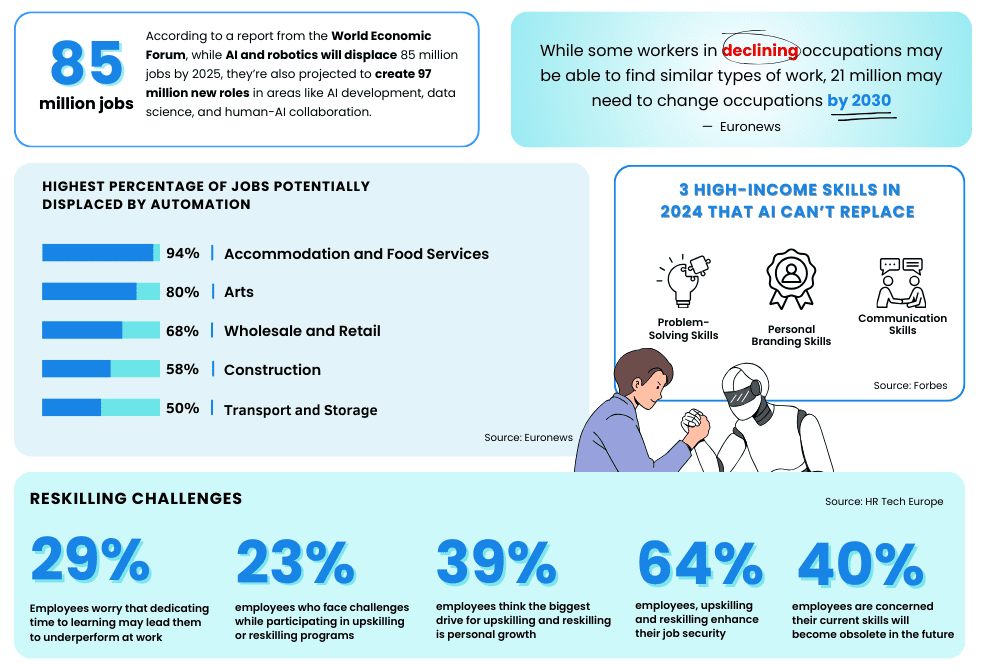
Agents shift work rather than erase the need for skilled people. The WEF Future of Jobs Report 2025 projects a net gain of 78 million jobs by 2030 alongside 59% of workers needing reskilling [5], and 46% of leaders cite skills gaps as the top blocker to shipping gen AI [1]. Pairing internal teams with experienced partners, including enterprise agent development specialists, helps close that gap. Broader context on adoption sits in our AI outsourcing guide.
No, not fully. Agents are increasingly layered on top of existing systems like ERPs and CRMs rather than replacing them. Gartner expects 33% of enterprise software to embed agentic AI by 2028 [2], meaning agents augment and orchestrate established applications more than they eliminate them.
Start with high-volume, rule-based, well-documented workflows that have a clear metric, such as invoice matching, support triage, or IT incident handling. Avoid open-ended tasks. Bounded scope, trusted data, and measurable outcomes are what separate the roughly 10% who scale agents from the majority who stall [1].
Buy for commodity workflows where speed matters and differentiation is low. Build, often with an engineering partner, for core, regulated, or competitively sensitive processes where you need control over guardrails, data flow, and audit. Many enterprises run a hybrid of both depending on the workflow's strategic weight.
The main risks are unclear value, security exposure, and weak governance. Over 40% of agentic projects may be canceled by 2027 for these reasons [2]. Prompt injection tops the OWASP LLM risk list [4], and only 21% of organizations report mature agent governance [1]. Scoping, least-privilege access, and audited oversight are the core mitigations.
Define a baseline metric before deployment (cycle time, cost per transaction, deflection rate) and track the agent against it. This matters because about 95% of gen-AI pilots show no measurable P&L return [3]. Workflow redesign, not model selection, is the strongest driver of EBIT impact, so measure the redesigned process end to end [1].
AI agents are not replacing your software stack so much as changing who, or what, does the coordinating. The enterprises pulling ahead treat agents as a reason to redesign a workflow, ground it in trusted data, fence it with clear autonomy boundaries, and measure it honestly. The ones that bolt an agent onto a broken process join the 95% with nothing to show for it.
This week: pick one bounded, high-volume workflow, map its steps and data sources, and define which actions an agent could take unsupervised. This quarter: stand up a grounded pilot with full logging and an evaluation harness, prove a single metric, and adopt a governance framework before you scale.
If you want senior engineers to help design and build production-grade agents, Mind Supernova can field a vetted team in 5 to 7 days with 4+ hours of daily UK overlap. Schedule a call to map your first agentic workflow, or explore our AI development services.
A practical, layer-by-layer reference architecture for the modern enterprise AI stack in 2026, with technology...
How to design and operate an AI workforce that lasts: the operating model, human-in-the-loop patterns, governa...
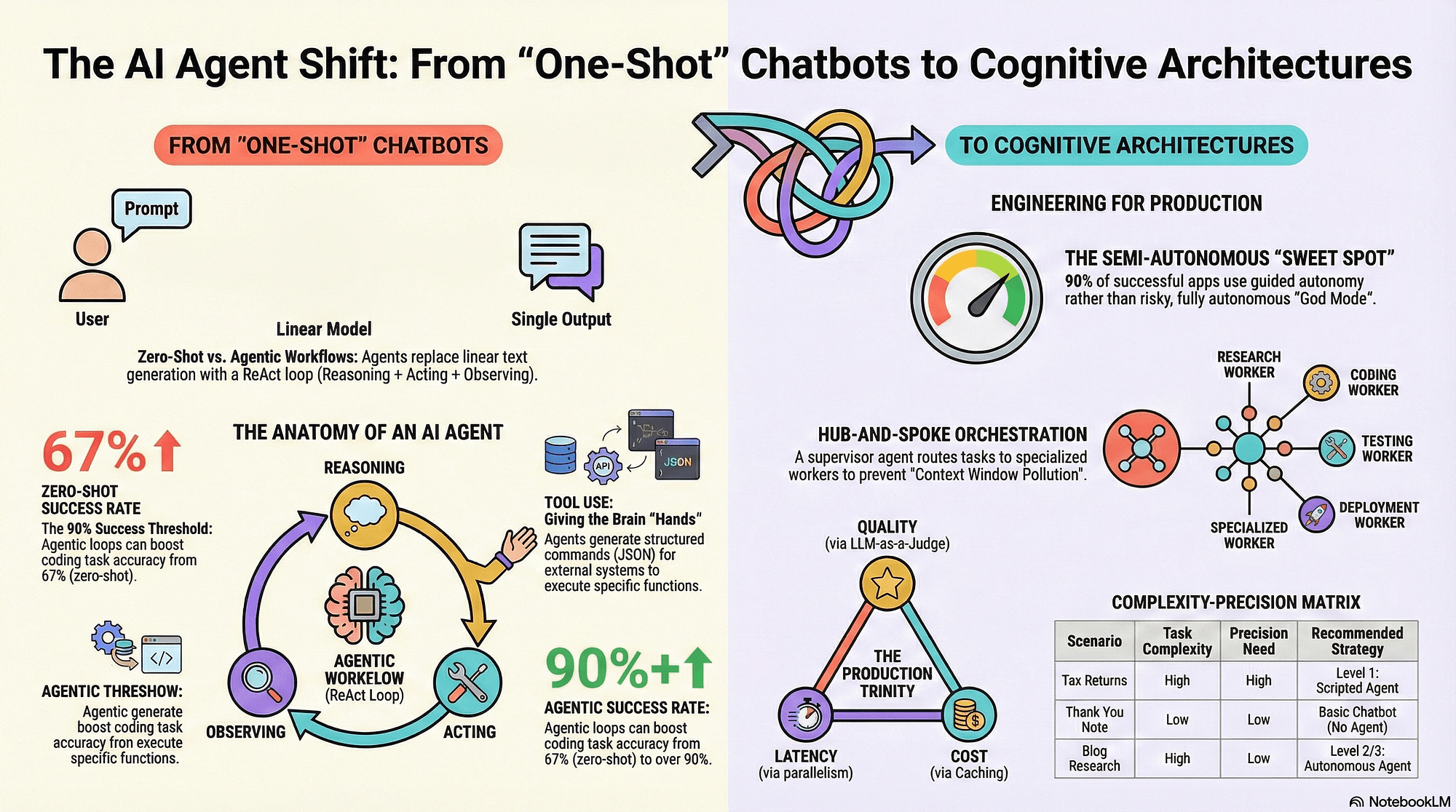
How enterprises build production AI agents: architectures, use cases, governance, and when to outsource agenti...