
Enterprise AI Adoption in 2026: The Trends, Hard Numbers, and Costly Mistakes to Avoid
The 2026 enterprise AI adoption trends that matter: top use cases, barriers, ROI, build vs buy, and the talent...
Generative AI creates content; agentic AI takes actions. This comparison shows the capabilities, costs, risks, and when to invest in each.
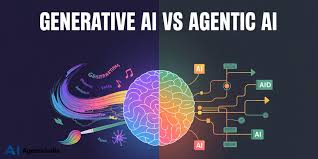
Generative AI and agentic AI differ in one decisive way: generative AI produces content when you prompt it, while agentic AI pursues a goal and takes actions across systems with limited human input. For business leaders deciding where to invest in 2026, that distinction changes the cost, the risk profile, and the governance you need before a single dollar goes into production. Get the comparison wrong and you either overspend on autonomy you cannot control, or you underinvest and miss real efficiency.
This guide gives you a clear, investment-focused comparison of generative AI vs agentic AI: what each one actually does, what it costs, where the risk sits, how mature each is, and a decision table you can take into a budget meeting. The goal is a practical framework, not hype.
If you want a second opinion on which approach fits a specific workflow, you can schedule a call with our team. First, the definitions, because most failed AI investments start with a fuzzy one.
Key Takeaways
Generative AI refers to models that create new content (text, code, images, audio, structured data) in response to a prompt. A large language model predicts the next token based on patterns learned from training data. You ask, it answers. The defining trait is that a human stays in the loop on every meaningful turn: you prompt, you review, you decide what to do with the output.
In an enterprise setting, generative AI usually shows up as drafting assistants, summarization, classification, code completion, and retrieval-augmented generation (RAG) that grounds answers in your own documents. The model itself is stateless between calls. It has no standing goal, no memory of yesterday, and no ability to act on the world unless a person carries the output forward.
Adoption tells the story. Regular generative AI use rose from 33% of organizations in 2023 to 71% in 2024 per the Stanford HAI 2025 AI Index, and McKinsey reports organizational gen-AI use climbing from 65% in early 2024 to 72% in 2025 [1][2]. The reason is simple. Generative AI maps onto existing human workflows without redesigning them. A writer drafts faster. An analyst summarizes a report. The blast radius of a mistake is small because a human reviews before anything ships.
Agentic AI uses one or more language models as the reasoning core of a system that plans, makes decisions, calls tools, and executes multi-step tasks toward a goal, often with little or no human input on each step. The model is no longer just answering. It is the engine inside a loop: observe, plan, act, check the result, adjust, repeat.
The architectural difference matters for your investment. An agent typically has memory, access to tools and APIs (databases, CRMs, ticketing systems, code repositories), and an orchestration layer that decides which action to take next. That is what lets an agent resolve a support ticket end to end, reconcile invoices, or run a research task across dozens of sources. It is also what makes agents harder to test, secure, and govern.
Agentic AI is genuinely early. Gartner projected in June 2025 that by 2028, 33% of enterprise software will include agentic AI, up from less than 1% in 2024, and that at least 15% of day-to-day work decisions will be made autonomously by 2028 [3]. That is a steep curve from a low base. Today, 62% of organizations are experimenting with agents but 10% or fewer have scaled them in any function [1]. Deloitte's State of AI in the Enterprise (2026 edition) found about 74% of companies plan to use agentic AI within two years, yet only 21% have mature agent governance. For a deeper operational view, our sibling article on the rise of autonomous AI systems covers autonomy levels and oversight in detail.
Here is the comparison that should anchor your investment decision. Read it as a risk-and-readiness map, not a ranking. Neither approach is universally better; they fit different problems and different levels of organizational maturity.
| Dimension Generative AI Agentic AI | ||
| Core behavior | Responds to a prompt, produces content. Human in the loop each turn. | Pursues a goal, plans and acts across tools and steps. Limited human input. |
| Autonomy | None. Output waits for a human to act on it. | Partial to high. Takes actions in live systems. |
| State and memory | Stateless between calls (unless you add RAG context). | Maintains memory, goals, and task history. |
| Typical cost | Lower. Per-call inference, modest integration. | Higher. Multi-step token use, orchestration, tools, monitoring. |
| Primary risk | Hallucination, IP and data leakage in outputs. | Compounding errors, unauthorized actions, tool misuse, prompt injection that triggers real actions. |
| Maturity (2026) | Mainstream: ~71% adoption [2]. | Emerging: 62% experimenting, 10% or fewer scaling [1]. |
| Governance needed | Content review, usage policy, data controls. | Action approvals, guardrails, audit trails, kill switches, identity and access scoping. |
| Time to value | Weeks. Bolt onto existing workflows. | Months. Requires workflow redesign and integration. |
| Best for | Content, summarization, search, drafting, code assist. | Multi-step operations: ticket resolution, reconciliation, research, orchestration. |
One pattern from the table is worth stating plainly. Generative AI buys you speed at low risk. Agentic AI buys you leverage at higher risk. Your readiness for that risk, not the appeal of the technology, should set your budget.
The headline cost difference is not the model. It is everything around the model. A generative AI deployment grounded in RAG can run on per-call inference and a modest retrieval layer. An agentic system multiplies token consumption (an agent may make dozens of model calls to complete one task), then adds orchestration, tool integrations, observability, evaluation harnesses, and human oversight roles. Those operating costs are where agentic budgets quietly balloon.
The return picture is sobering on both sides. MIT's Project NANDA found roughly 95% of enterprise gen-AI pilots show no measurable P&L return [4]. McKinsey reports only about 6% of firms qualify as AI high performers attributing 5% or more of EBIT to AI, though 39% report some enterprise EBIT impact, and the single biggest driver of that impact is workflow redesign rather than the model itself [1]. BCG found roughly 74% of companies struggle to scale AI value and only about 4 to 5% capture significant scaled value [5].
Two takeaways follow. First, value comes from redesigning the workflow, not from buying a smarter model, which favors starting where redesign is cheap (generative use cases) before committing to agentic ones. Second, budget for the operating layer, not just the pilot. The pilots that fail to return rarely fail because the model was weak. They fail because nobody costed the integration, evaluation, and governance needed to run the thing in production.
Risk is the dimension where the two approaches differ most sharply, and where many leaders underestimate agentic AI. With generative AI, the worst common outcome is a wrong or fabricated output that a human catches before it ships. With agentic AI, a wrong decision can become a wrong action in a live system before anyone reviews it. Errors also compound: a small mistake early in an agent's plan can cascade through later steps.
The OWASP Top 10 for LLM Applications (2025) ranks prompt injection as the number one risk, with sensitive-information disclosure also near the top. For generative AI, prompt injection might leak data or produce bad text. For an agent with tool access, the same injection can trigger an unauthorized transaction or delete records. That is why Gartner expects more than 40% of agentic AI projects to be canceled by end of 2027, citing cost, unclear value, and weak controls [3].
Map your controls to recognized standards rather than inventing your own. The NIST AI Risk Management Framework 1.0 (2023) with its Generative AI Profile (2024) gives you a govern-map-measure-manage structure. ISO/IEC 42001:2023 provides an auditable AI management system. The EU AI Act, in force since August 2024 with phased obligations, applies if you serve EU users; note that the provisional Digital Omnibus (around May 2026) would defer some high-risk Annex III obligations to December 2027, though that text is not yet final as of June 2026. For agentic systems, layer on action approvals, scoped identity and access, full audit trails, and a kill switch. Our sibling guide on AI governance, security and compliance strategies turns these into a checklist.
Consider a mid-market software company that wanted to cut support resolution time. Their journey illustrates the generative-then-agentic sequence many enterprises are following in 2026. (This is a composite example drawn from common patterns, not a named client.)
Phase one, generative. They started with a RAG assistant that drafted reply suggestions for support agents from the knowledge base. Agents reviewed and sent. Risk was low because a human shipped every message. Within weeks, average handle time dropped and the assistant became trusted. This is generative AI doing what it does best: augmenting a human in an existing workflow.
Phase two, agentic. Once trust and data quality were proven, they introduced a constrained agent for one narrow category: password resets and account-access tickets. The agent could read the ticket, verify identity through approved tools, perform the reset, and close the ticket, with a human approval step for anything outside its scope and a hard limit on the actions it could take.
The lesson. The agentic phase only worked because the generative phase had already produced clean data, clear policies, and organizational trust. Skipping straight to autonomy is how projects end up in Gartner's cancellation statistic. Enterprises that build agents on this kind of foundation, as covered in our guide to how AI agents are replacing traditional software workflows, tend to scale further.
If you are allocating budget across generative and agentic AI for 2026, this sequence reduces wasted spend and matches the evidence on what actually drives returns.
Many enterprises accelerate steps two through five with a specialist partner. Mind Supernova, a Vietnam-based AI engineering company founded in 2023, helps with exactly this work: AI development, RAG and retrieval pipelines, data annotation, and AI agent development, delivered by vetted senior engineers who typically start in 5 to 7 days with 4+ hours of daily UK overlap. You can read more about our approach in AI agent development for enterprises or our AI development services.
Both approaches share a hard truth: the technology is rarely the bottleneck. The blockers are organizational, and they hit agentic projects harder because the stakes are higher.
McKinsey reports that 46% of leaders cite skills gaps as the top blocker to shipping gen AI [1], and only about 20% of leaders say their talent is highly prepared per Deloitte. Agentic AI widens this gap because it demands skills in orchestration, evaluation, and AI security that few teams have in-house. This is where staff augmentation or a dedicated team can close the gap faster than hiring, a theme we explore in the future of AI outsourcing.
Employees are already using generative AI tools outside IT visibility. Gartner predicts that by 2027, 75% of employees will acquire or use technology outside IT's view. For generative AI, shadow use risks data leakage. For agentic tools, ungoverned agents acting in real systems is a far larger exposure. A clear usage policy and an approved-tools list are non-negotiable.
With roughly 95% of gen-AI pilots showing no measurable P&L return and only about 4 to 5% of firms capturing significant scaled value, the real challenge is converting experiments into outcomes [4][5]. This is an argument for the disciplined, sequenced approach above rather than a reason to avoid investing. The enterprises winning are the ones redesigning workflows, not the ones chasing the newest model.
Use this as a fast filter before the detailed table.
If you are still unsure which fits a specific process, that is a good prompt to schedule a call and pressure-test the decision before you commit budget.
Generative AI produces content in response to a prompt, with a human reviewing and acting on each output. Agentic AI pursues a goal by planning, deciding, and taking actions across tools and systems with limited human input. In short, generative AI answers; agentic AI acts.
No. Agentic AI uses generative models as a reasoning core but adds memory, tool access, and an orchestration loop that lets it act autonomously. That added agency changes the cost structure and the risk profile substantially, requiring guardrails, audit trails, and access controls that simple generative deployments do not need.
Generative AI is usually the safer first investment. It bolts onto existing workflows with a human reviewing every output, delivers value in weeks, and carries lower risk. It also builds the clean data and organizational trust that successful agentic AI projects depend on later.
About 95% of enterprise gen-AI pilots show no measurable P&L return, mostly because organizations buy a model without redesigning the workflow around it [4]. McKinsey finds workflow redesign is the biggest driver of EBIT impact, so value comes from process change and good data, not from the model alone [1].
Generative AI budgets center on per-call inference and a retrieval layer. Agentic budgets must include far higher token use from multi-step reasoning, plus orchestration, tool integrations, monitoring, evaluation, and human oversight. Budget for the operating layer around the model, since that is where agentic costs and failures concentrate.
Generative AI vs agentic AI is not a contest with one winner. Generative AI gives you fast, low-risk gains by augmenting people. Agentic AI offers higher leverage at higher risk and demands governance most enterprises are still building. The evidence points to a clear strategy: prove value with grounded generative AI, redesign the workflow, then add agency selectively where the controls and the returns justify it.
This week: identify one high-volume, measurable workflow and confirm whether your data foundation is ready for retrieval. This quarter: ship a generative AI pilot tied to a real metric, define your autonomy boundary, and scope a single constrained agent to test next.
For more context, see our overview of the top AI trends transforming enterprise growth in 2026 and the pillar guide to AI outsourcing in Vietnam. When you are ready to turn this comparison into a build plan, schedule a call with Mind Supernova and we will help you sequence the investment so the value shows up in your P&L, not just your roadmap.
The 2026 enterprise AI adoption trends that matter: top use cases, barriers, ROI, build vs buy, and the talent...
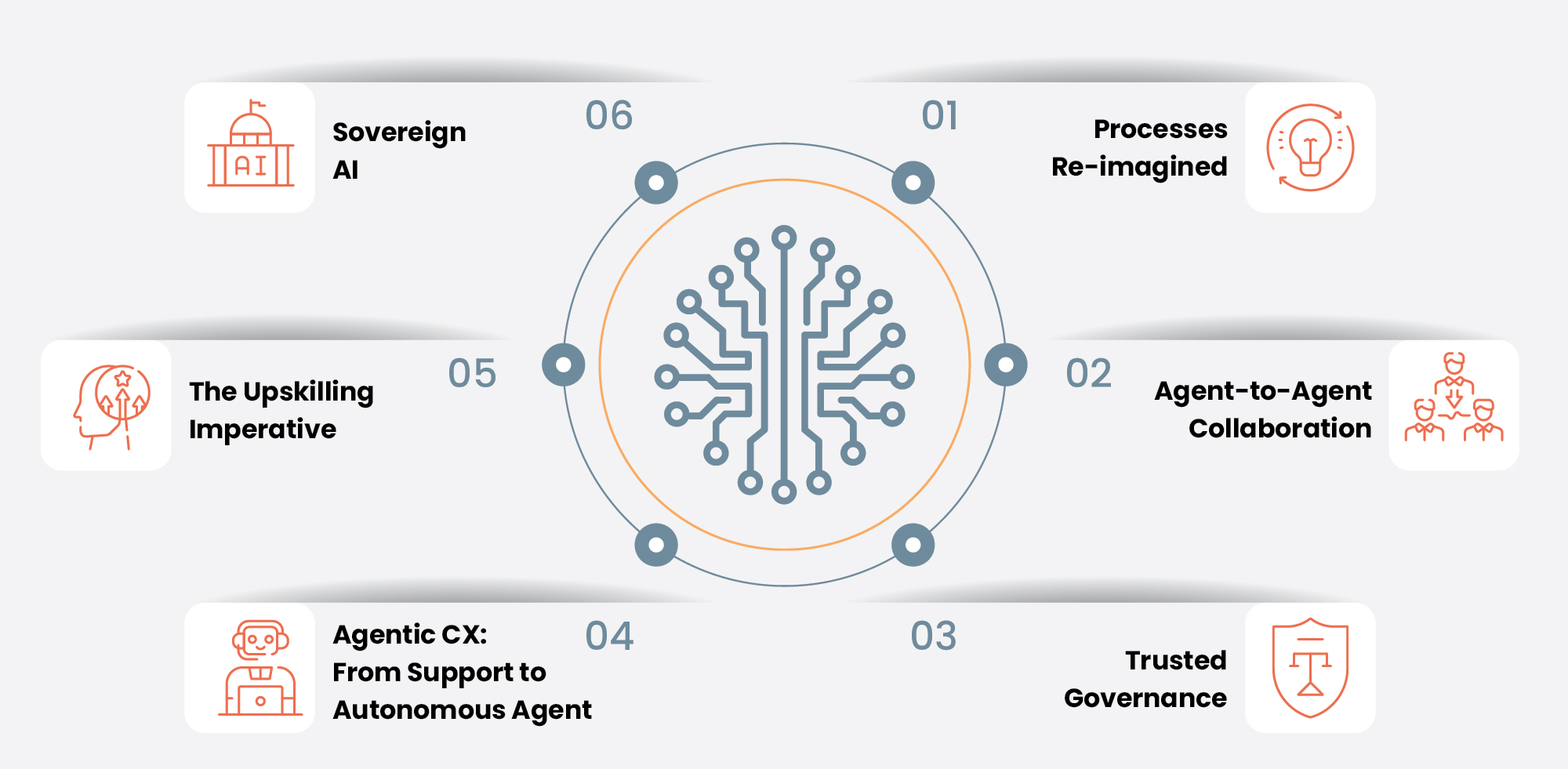
The AI trends reshaping enterprise growth in 2026: agentic AI, multimodal models, RAG, governance, and the AI...
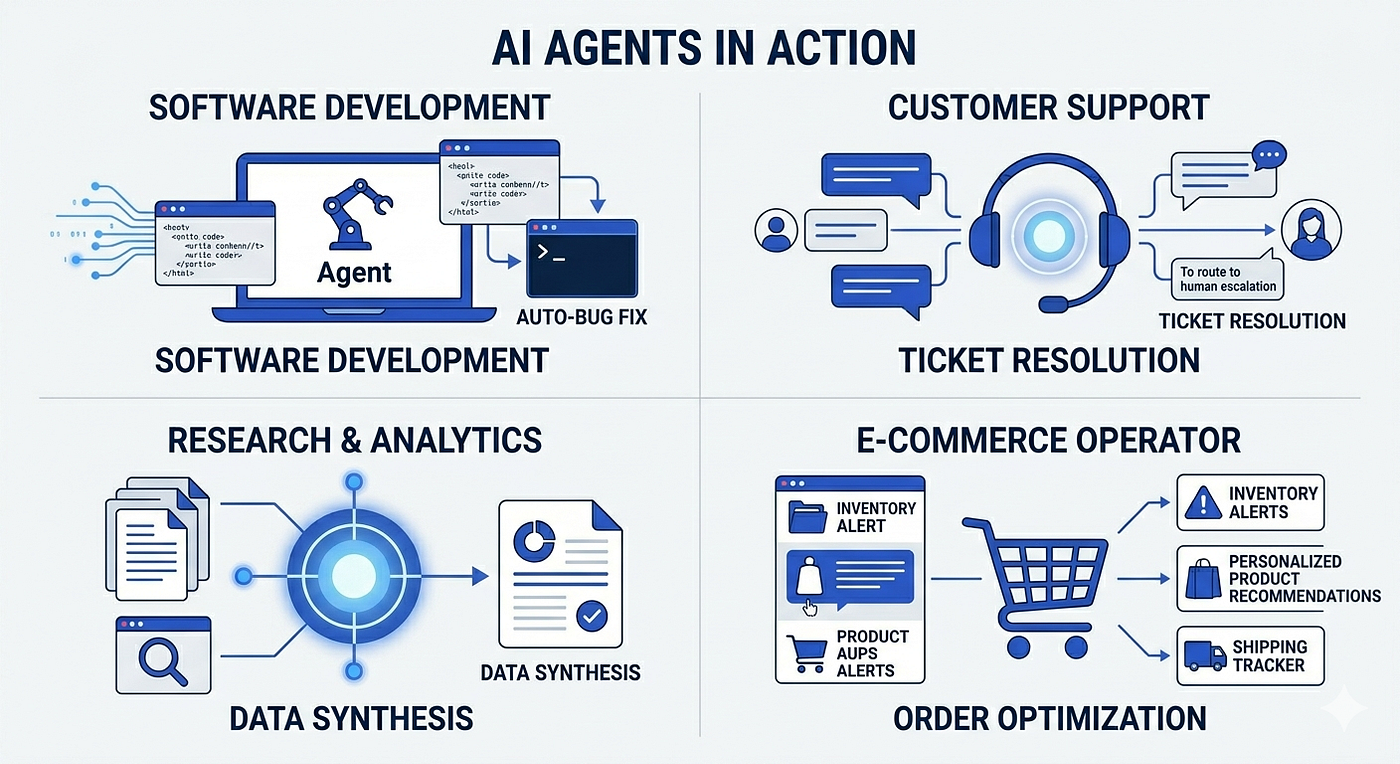
AI agents are automating multi-step workflows across finance, support, IT, and supply chain. Here is how they...