

The Rise of Autonomous AI: How Self-Running Systems Are Reshaping Enterprise Operations
Autonomous AI systems are moving from pilots to operations. Learn the levels of autonomy, the operational impa...
An executive readiness playbook for agentic AI: a six-dimension self-assessment, a phased roadmap, how to pick first use cases, and build-vs-partner guidance.
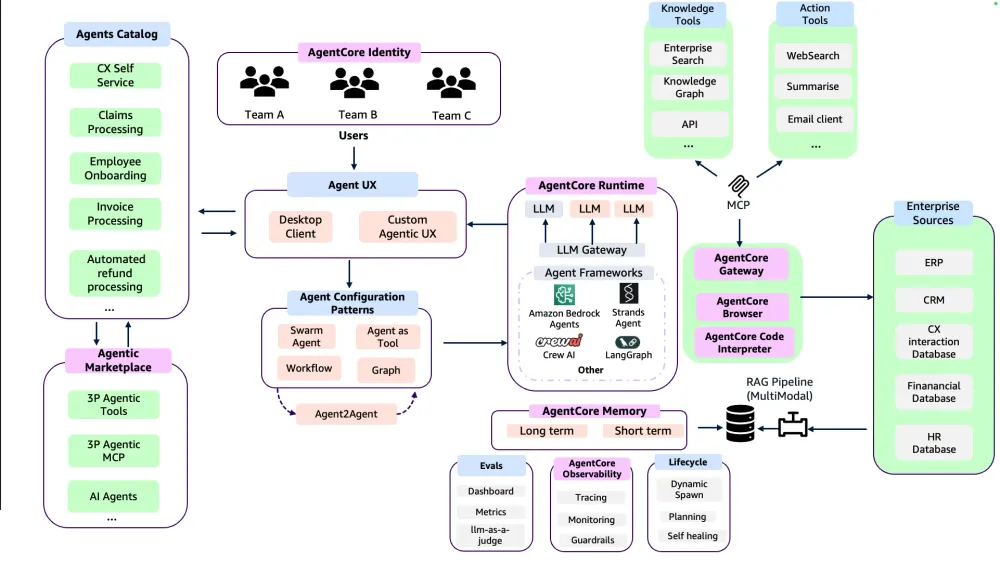
To prepare for agentic AI is to build the data, infrastructure, talent, and governance foundations that let autonomous AI systems act on your behalf safely and at scale, before competitors lock in the advantage. Agentic AI is not a single product you buy. It is a capability you grow, and the organizations that treat it as a disciplined transformation program rather than a series of pilots will compound a lead that becomes very hard to close.
The shift from generative AI to agentic AI is the most consequential change in enterprise technology since the move to cloud. Generative models answer questions. Agentic systems pursue goals: they plan, call tools, retrieve context, take actions across your software stack, and adapt based on outcomes. That difference reshapes how work gets done, and it raises the stakes on readiness. An organization with clean data, integrated systems, clear governance, and a trained workforce can deploy useful agents in weeks. An organization without those foundations will spend a year discovering why its pilots never reached production.
This article is a practical readiness playbook for executives. It gives you a self-scoring assessment across six dimensions, a phased 90-day, six-month, and twelve-month roadmap, a method for picking first use cases, a build-versus-partner decision framework, and the governance and change-management guardrails that keep autonomous systems trustworthy. It avoids hype. The goal is to help you move deliberately while your competitors are still debating.
Key Takeaways
Agentic AI readiness is the degree to which your organization can deploy, govern, and scale autonomous AI systems that take actions toward business goals. It is a competitive issue because the advantages compound. When an agent operates inside a workflow, it generates data about what works, accumulates institutional context, and frees your people to focus on higher-leverage work. Each of those effects feeds the next cycle. A company that starts a year earlier is not one year ahead. It is one year of compounding ahead.
This is different from earlier technology waves where fast followers could buy a mature product and catch up quickly. Agentic systems are deeply entangled with your proprietary data, your processes, and your domain knowledge. That entanglement is the moat. It cannot be purchased off the shelf, and it takes time to build. The practical implication for executives is that readiness work should start now, even if your first production deployment is months away.
If you are still clarifying the underlying concepts, it helps to ground the team in shared definitions first. Our explainers on agentic workflows and intelligent business automation and the shift from chatbots to autonomous agents are useful primers. This piece assumes that grounding and focuses on what to actually do.
The readiness assessment scores your organization across six foundations that every successful agentic program depends on. Rate each dimension from 1 (not started) to 5 (mature and proven), then total your score out of 30. The point is not the number. It is the honest conversation about where the gaps are, because the lowest-scoring dimension usually determines how far your program can go.
Agents are only as good as the context they can retrieve. A strong data foundation means your operational data is accessible, reasonably clean, documented, and governed, with permissions you can reason about. Many enterprises discover that their biggest blocker is not the model but the fact that the knowledge an agent needs is trapped in PDFs, wikis, ticketing systems, and the heads of senior staff. Retrieval-grounded approaches such as enterprise RAG systems depend entirely on this layer being in order.
Autonomous agents create value by taking actions in your systems, which means they need governed, observable connections to those systems. Maturity here means you have APIs or integration points for the systems agents will touch, an emerging standard for how agents connect to tools and data, and the observability to trace what an agent did and why. The Model Context Protocol (MCP) has become the connective tissue many teams adopt to standardize these connections rather than building brittle one-off integrations.
Readiness here is about both skills and structure. Do you have people who can design, deploy, and maintain agentic systems, and a clear operating model for who owns them? Many organizations underestimate the operating-model question. An agent is not a project that ships and ends; it is a system that needs ongoing ownership, monitoring, and improvement. The most mature organizations are evolving toward blended teams of humans and AI, a pattern we explore in building autonomous AI workforces.
Because agents act, governance is non-negotiable. Maturity means you have defined policies for what agents may and may not do autonomously, where humans stay in the loop, how decisions are logged and audited, and how you handle security, data privacy, and regulatory obligations. Frameworks such as the NIST AI Risk Management Framework and standards like ISO/IEC 42001 for AI management systems give you a credible scaffold rather than inventing governance from scratch.
Readiness is also a question of whether you know what to build. A mature organization maintains a prioritized backlog of candidate use cases, scored on value and feasibility, with clear owners and success metrics. Without this, agentic initiatives drift toward whatever is fashionable rather than what moves the business.
The final dimension is the human one. Agentic systems change how people work, and adoption fails when the workforce is surprised, threatened, or untrained. Maturity means you have a communication plan, a reskilling path, and a culture that treats AI as augmentation rather than replacement. This is consistently the dimension where technically capable organizations underperform.
| Dimension | What "mature" looks like (score 5) | Your score (1–5) |
|---|---|---|
| Data foundation | Accessible, documented, governed operational data; retrieval-ready | __ |
| Infrastructure & integration | API-accessible systems, standardized agent-to-tool connections, full observability | __ |
| Talent & operating model | Skilled team plus clear ownership for deployed agents | __ |
| Governance & risk | Policies, human-in-the-loop rules, audit logging, security and compliance mapped | __ |
| Use-case pipeline | Prioritized backlog scored on value and feasibility, with owners | __ |
| Change management | Communication, reskilling, and an augmentation-first culture | __ |
| Total | Sum of the six dimensions | __ / 30 |
Interpreting your total: a score of 24 to 30 means you are ready to scale a portfolio and should focus on velocity and governance discipline. 16 to 23 means you have a solid base and should pursue one production deployment while closing your weakest dimension. 8 to 15 means foundations come first; resist the urge to chase ambitious agents before the data and integration layers are sound. Below 8, your near-term priority is education, data hygiene, and a single low-risk proof of concept.
A readiness roadmap turns your assessment gaps into sequenced action. The mistake most organizations make is trying to do everything at once or, conversely, running disconnected pilots that never accumulate into capability. The phased approach below builds foundations and momentum in parallel, so that each stage earns the right to the next.
The goal of the first quarter is to establish the groundwork and ship one credible proof of value. Concrete actions:
The second phase moves from proof to production and hardens the operating model. Concrete actions:
The third phase is about scaling responsibly and turning agentic AI into an organizational capability rather than a project. Concrete actions:
The right first use case is high in business value and high in feasibility at the same time. Teams that start with the most exciting use case rather than the most winnable one often produce an impressive demo that never reaches production. A simple two-axis scoring approach keeps you disciplined.
Score each candidate on value (revenue impact, cost savings, risk reduction, employee time freed, customer experience) and on feasibility (data availability, workflow clarity, integration effort, tolerance for error, regulatory exposure). Plot the results:
Beyond the matrix, the best first agents share a profile: a well-bounded scope rather than open-ended autonomy, rich and accessible data, a workflow that tolerates error with a human reviewing output, and a clear metric that proves whether it worked. Customer support triage, internal knowledge retrieval, document processing, and structured data extraction frequently fit this profile. Mission-critical financial decisions, ambiguous strategic judgments, and heavily regulated actions do not make good first projects, however tempting their value.
| Good first use case | Poor first use case |
|---|---|
| Bounded scope, clear inputs and outputs | Open-ended, ambiguous goals |
| Data is available and reasonably clean | Data is fragmented or sensitive |
| Errors are recoverable and reviewable | Errors are costly or irreversible |
| Success is measurable in weeks | Success is diffuse or long-horizon |
| Low regulatory exposure | Heavy compliance constraints |
The build-versus-partner question is really a question about how fast you need capability and how much you want to own internally. There is no universally correct answer, but there is a clear way to reason about it. Building entirely in-house gives you maximum control and IP ownership, but it requires hiring scarce talent, assembling infrastructure, and absorbing a long learning curve before your first production agent ships. Partnering gives you speed and access to accumulated expertise, at the cost of some dependency and the discipline of managing a vendor well.
For most enterprises, the pragmatic path is a hybrid: partner for the first one or two deployments to move quickly and learn from experienced practitioners, while building internal capability in parallel so that ownership shifts to your team over time. This avoids the two common failure modes, namely waiting a year to hire a full team before shipping anything, and outsourcing so completely that you never develop the muscle to run agents yourself.
If you do engage a partner, evaluate them on substance rather than slideware. Look for:
Mind Supernova is one such partner. We are a Vietnam-based AI engineering company, founded in 2023, that builds production agentic systems, enterprise RAG, and AI workforce solutions for global enterprise clients, with async-first delivery and several hours of daily UK overlap. We mention it here because the build-versus-partner decision is where an experienced engineering partner is most useful, and because our team's collective experience is concentrated in exactly the integration, governance, and deployment work that determines whether agentic projects reach production. The broader case for partnering as a scaling strategy is laid out in how the smartest companies scale faster with AI partners.
Governance is what separates an agentic program that scales from one that gets shut down after an incident. Because agents take actions, the consequences of a mistake are real, and trust is earned through controls rather than assumed. Strong governance does not slow you down once it is in place; it is what lets you move fast with confidence.
Establish, in writing, what your agents may do autonomously, what requires human approval, and what is prohibited. Define escalation paths, log every consequential action for audit, and review the framework on a regular cadence as your deployments grow. Anchor this in recognized frameworks so you are not reinventing the wheel. The NIST AI Risk Management Framework gives you a structure for identifying and mitigating risk, and ISO/IEC 42001 provides a management-system standard you can certify against. If you operate in the EU, map your systems to the EU AI Act's risk tiers early, because retrofitting compliance is far more expensive than designing for it.
Agentic systems expand your attack surface because they connect to tools, read sensitive data, and act on it. Treat agent permissions with the same rigor as employee access: grant least privilege, scope credentials tightly, and monitor for anomalous behavior. New risk categories such as prompt injection and tool misuse deserve explicit attention; resources like the OWASP Top 10 for LLM Applications are a practical starting point for threat modeling. Standardized connection layers help here too, because a governed protocol for agent-to-tool access is easier to secure and audit than a sprawl of bespoke integrations.
The workforce dimension is where well-funded technical programs most often stumble. People resist what they do not understand or feel threatened by, and an agent deployed without preparation can quietly fail because the humans around it route around it. Communicate early and honestly about what agents will and will not do. Frame the change as augmentation, redeploying people toward higher-value work rather than eliminating them. Invest in reskilling, and involve the people who do the work in designing the systems that will assist them. Organizations that get this right find that their staff become the strongest advocates for expansion, because they have felt the relief of offloading drudgery to a reliable system.
Early and disciplined adoption of agentic AI compounds into an advantage that late movers struggle to close, for three structural reasons. The word that matters is disciplined; reckless early adoption that ignores governance and foundations produces failed pilots, not advantage.
First, there is the data flywheel. Every agent in production generates data about what works, which feeds better retrieval, better prompts, and better evaluation. A competitor starting later begins with an empty flywheel and cannot simply buy yours.
Second, there is accumulated context. The proprietary knowledge an agent needs, your processes, your edge cases, your institutional judgment, has to be captured, structured, and encoded. That work takes time and is specific to your business. It is the moat that off-the-shelf tools cannot replicate, and it deepens with every month of operation.
Third, there is organizational learning. Building, governing, and operating agents is a capability your people develop through repetition. A company on its tenth deployment ships faster, governs better, and avoids mistakes that a first-time team will make. This learning curve is real and cannot be skipped by spending more money.
The honest counterpoint is that being first to a poorly governed deployment is worse than being second to a disciplined one. The recommendation is therefore not to rush, but to start the foundational work now and move deliberately, so that when you scale you scale on solid ground. The cost of waiting is not visible on any single day, which is exactly why it is dangerous. For the hard numbers and the mistakes that derail adoption, see our analysis of enterprise AI adoption in 2026.
Prepare your business for agentic AI by running a readiness assessment across six dimensions: data foundation, infrastructure and integration, talent and operating model, governance and risk, use-case pipeline, and change management. Use the gaps you find to build a phased roadmap, ship one well-bounded proof of concept in the first 90 days, formalize governance and a production deployment by six months, and scale a disciplined portfolio by twelve months. Foundations and a clear use-case come before ambitious autonomy.
Agentic AI readiness is the degree to which your organization can deploy, govern, and scale autonomous AI systems that take actions toward business goals. It spans technical foundations like clean, accessible data and integrated, observable infrastructure, and organizational foundations like skilled people, a clear operating model, governance policies, and a workforce prepared for the change. A weakness in any single dimension caps how far your program can realistically go.
Start with a single use case that is high in business value and high in feasibility: well-bounded in scope, rich in accessible data, tolerant of recoverable errors, and measurable within weeks. Customer support triage, internal knowledge retrieval, and document processing often fit. Avoid starting with mission-critical, ambiguous, or heavily regulated workflows, which make poor first projects regardless of how valuable they appear.
For most enterprises the pragmatic answer is a hybrid: partner for the first one or two deployments to move quickly and learn from experienced practitioners, while building internal capability in parallel so ownership shifts to your team over time. Pure in-house gives maximum control but requires scarce talent and a long ramp. Pure outsourcing is fast but risks dependency. Choose a partner with a real agentic production track record, engineering depth, a governance-first posture, and knowledge transfer built into the engagement.
The biggest risks are poor data and integration foundations that cause pilots to stall before production, weak governance that allows agents to take harmful or non-compliant actions, an expanded security surface including prompt injection and tool misuse, and neglected change management that leads the workforce to resist or route around the system. Each is manageable with deliberate preparation, which is why readiness work should precede ambitious deployment.
A well-bounded first agent can reach a supervised proof of concept within the first 90 days when data and integration foundations are reasonable, and a hardened production deployment with governance by around six months. Scaling to a portfolio of several agents typically takes the first year. Timelines stretch when data is fragmented, systems lack APIs, or governance is treated as an afterthought, which is precisely why the readiness assessment comes first.
Adopting generative AI is largely about giving people tools that produce content and answers. Preparing for agentic AI is about enabling systems to take actions across your software stack toward goals, which raises the bar on data quality, system integration, observability, and especially governance. Because agents act rather than merely respond, the organizational and risk preparation is deeper, and the compounding advantage for disciplined early adopters is greater.
Preparing for the agentic AI revolution is not a single decision or a tool purchase. It is a disciplined program of building data, infrastructure, talent, governance, and change-management foundations, then sequencing your way from a first proof of concept to a scaled portfolio. The organizations that win will not be the loudest about AI; they will be the ones that quietly did the readiness work while competitors debated, and let the data flywheel, accumulated context, and organizational learning compound into a lead that is hard to close.
Start with the assessment. Score yourself honestly across the six dimensions, let the gaps define your roadmap, and pick one high-value, high-feasibility use case to prove the model. If you want an experienced engineering partner to accelerate those first deployments while your team builds internal capability, Mind Supernova is built for exactly that work. Either way, the most important step is the one you take now, while the advantage is still available to claim.
Autonomous AI systems are moving from pilots to operations. Learn the levels of autonomy, the operational impa...
Generative AI creates content; agentic AI takes actions. This comparison shows the capabilities, costs, risks,...

A high-performing AI workforce blends human judgment with automation. Learn the org design, human-in-the-loop...