

Building an AI Workforce: The Human and Machine Blend That Outperforms Either Alone
A high-performing AI workforce blends human judgment with automation. Learn the org design, human-in-the-loop...
A practical reference architecture for the agentic era: how AI agents and MCP turn brittle point-to-point integrations into a governed, composable enterprise stack.
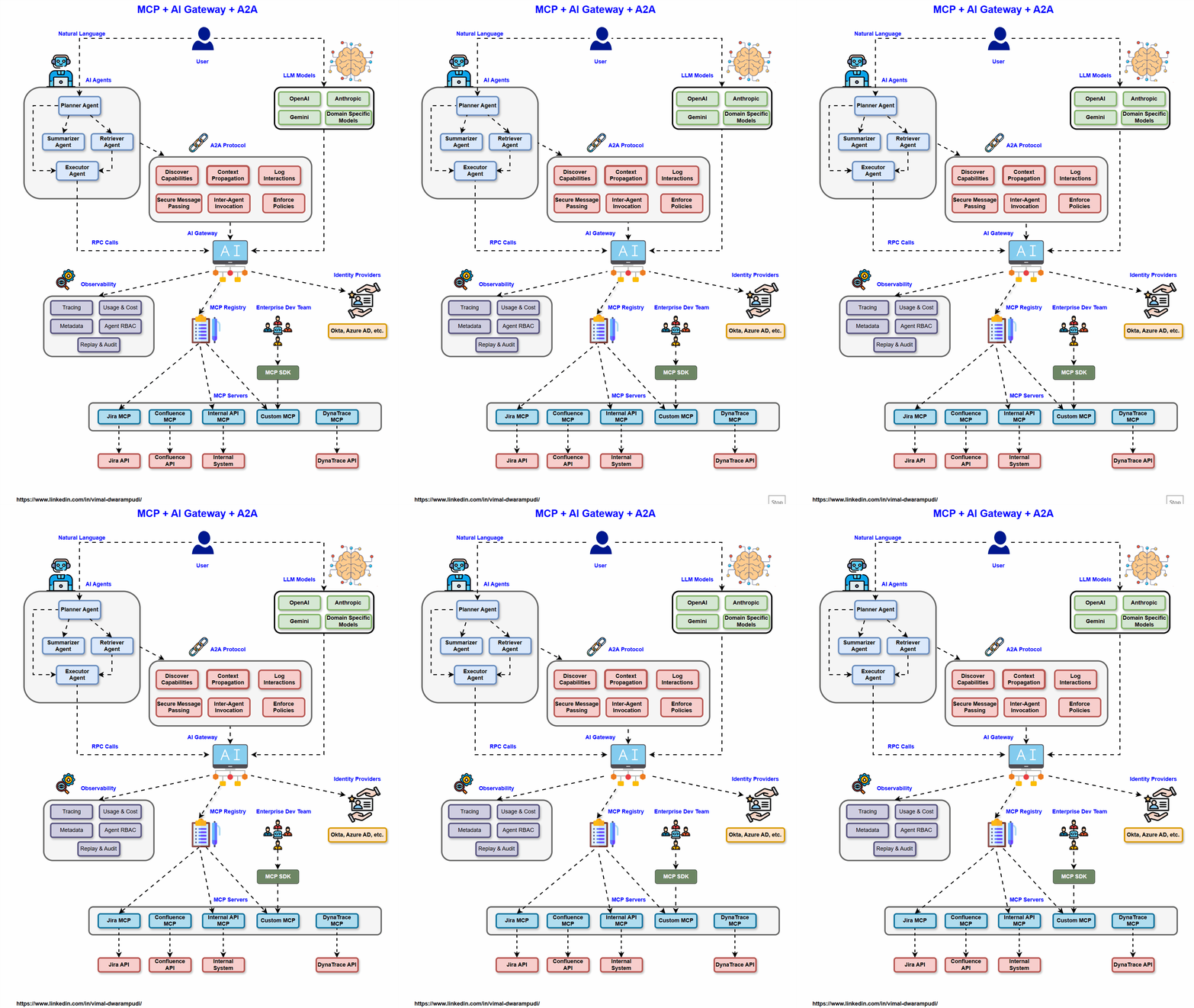
Enterprise software architecture in the AI-agent era is the set of patterns that organize how AI agents, the systems of record they act on, and the humans who supervise them connect and exchange context. The defining shift is structural: enterprises are moving away from request/response monoliths stitched together by brittle, point-to-point integrations and toward an agent-oriented architecture where a standard protocol layer, increasingly the Model Context Protocol (MCP), becomes the integration fabric between reasoning models and the rest of the stack.

For most of the last two decades, enterprise architecture optimized for deterministic flows. A user clicked a button, a service validated input, a database wrote a row, and a response came back. Integrations were hand-built per system: a custom connector to Salesforce, a bespoke ETL job into the data warehouse, a one-off webhook into the ERP. That model scaled to a point, but it produced the integration sprawl that platform teams now spend most of their time maintaining.
Agent-oriented systems invert several of those assumptions. Instead of a fixed sequence of calls, an agent reasons about a goal, decides which tools to invoke, and adapts its plan based on what it observes. The architecture has to support non-deterministic control flow, dynamic tool discovery, persistent memory, and continuous governance. This article describes a practical reference architecture for that world, the migration path from current stacks, the build-versus-buy decisions involved, the failure modes to design against, and what all of this means for the platform teams who will own it.
Key Takeaways
AI agents change software architecture by replacing fixed, pre-coded control flow with model-driven decision-making at runtime. In a traditional application, a developer writes the branching logic: if the order total exceeds a threshold, then route to manual review. In an agentic application, the agent is given a goal, a set of tools, and a policy, and it decides at runtime which tools to call and in what order. The code you write is less about the path and more about the constraints, the tools, and the context.
This has three downstream effects on architecture. First, integration moves from compile-time to run-time: agents discover and select tools dynamically rather than calling hard-wired endpoints. Second, state becomes first-class: because an agent's behavior depends on what it remembers and retrieves, memory and retrieval graduate from optional features to core infrastructure. Third, governance becomes continuous rather than a one-time review: when a system can choose its own actions, you need to constrain, monitor, and evaluate those actions continuously.
None of this means your existing systems disappear. The CRM, ERP, data warehouse, ticketing system, and internal services remain the authoritative sources of truth. What changes is the layer that sits between them and the intelligence consuming them. For a deeper look at how this plays out across day-to-day operations, see how AI agents are quietly replacing traditional software workflows.

Agent-oriented architecture is a style of system design in which autonomous or semi-autonomous AI agents are the primary unit of composition, coordinating work across tools, memory, and other agents to accomplish business goals. It is the agentic equivalent of the move from monoliths to microservices: a shift in the fundamental building block. Where service-oriented architecture composed services behind APIs, agent-oriented architecture composes agents behind goals and policies.
The key distinction is the locus of control. In SOA and microservices, an orchestrating service or workflow engine holds the logic that sequences calls. In agent-oriented architecture, that sequencing is delegated, in part, to a reasoning model operating within guardrails. This makes the architecture more flexible and more capable of handling ambiguous, long-horizon tasks, but it also makes correctness, security, and observability harder, because the system's behavior is no longer fully specified in code.
Agent-oriented architecture is not a rejection of everything that came before. It is a layer that sits on top of a well-architected service estate. The healthier your APIs, the cleaner your data contracts, and the better your identity model, the easier it is to expose those capabilities to agents safely. Teams that have already invested in multi-agent system design tend to adopt this pattern faster, because they have already grappled with coordination and handoff between agents.
In practice, most enterprises will run a hybrid of two control models rather than choosing one. Deterministic orchestration uses workflow code or graph definitions to fix the high-level path, calling on model reasoning only at specific decision points. Autonomous orchestration hands the model a goal and a toolset and lets it plan freely. Deterministic orchestration is safer and more auditable; autonomous orchestration is more adaptable. A mature architecture uses deterministic flows for regulated, high-stakes paths and autonomous flows for exploratory or low-risk tasks, with clear boundaries between them.

A practical reference architecture for agentic enterprise systems separates concerns into distinct layers so that each can evolve, scale, and be governed independently. The layering below is deliberately conventional, because the value of a reference architecture is that it maps cleanly onto how platform teams already think about ownership and boundaries.
| LayerResponsibilityRepresentative components | ||
| Experience layer | How humans and external systems interact with agents | Chat surfaces, copilots embedded in apps, voice, email/ticket triggers, API endpoints for programmatic callers |
| Agent / orchestration layer | Planning, reasoning, tool selection, multi-agent coordination, human-in-the-loop checkpoints | Orchestration framework, agent definitions, routing/supervisor agents, workflow graphs |
| Tool / MCP layer | Standard, governed interface between agents and capabilities; wraps systems of record as callable tools | MCP servers per system, tool schemas, capability catalog, rate limiting |
| Memory layer | Short- and long-term state so agents are coherent across turns and sessions | Conversation/session store, long-term semantic memory, entity and preference stores |
| Retrieval / RAG layer | Grounding answers in current, authoritative enterprise knowledge | Vector and keyword indexes, chunking and embedding pipelines, rerankers, document access controls |
| Systems of record | Authoritative business data and transactions | CRM, ERP, data warehouse, ticketing, identity provider, internal microservices and databases |
| Governance & observability plane | Cross-cutting control: identity, permissions, policy, tracing, evaluation, audit | Agent identity/scopes, policy engine, prompt/response logging, traces, eval harness, cost and rate controls |
The governance plane is drawn as cross-cutting on purpose. It is not a layer you visit at the bottom of a call stack; it wraps every other layer. Every tool call, retrieval, and memory write should pass through identity, permission, and logging controls. Treating governance as an afterthought is the single most common reason agentic pilots stall before production.

The experience layer is where agents meet users and upstream systems. It deliberately stays thin. The temptation is to embed business logic and tool wiring directly into a chat interface or copilot, but that recreates the tight coupling agent-oriented architecture is meant to remove. The experience layer should authenticate the user, capture intent, and pass a request, plus identity and context, into the orchestration layer. The same orchestration layer should be reachable from a chat widget, an internal app, a Slack bot, and an inbound email handler without duplicating logic.
The orchestration layer is the brain of the architecture. It holds agent definitions (their goals, system prompts, allowed tools, and policies), the logic that routes a request to the right agent or sequence of agents, and the human-in-the-loop checkpoints that pause for approval on sensitive actions. In multi-agent designs, a supervisor or router agent decomposes a task and delegates to specialists. This is also where you decide how much autonomy to grant: a tightly scoped customer-service agent with three tools is a very different risk profile from a broad operations agent with twenty.
The tool layer is the integration fabric, and it is where MCP earns its place in the architecture. Rather than each agent framework implementing its own bespoke connector to Salesforce, NetSuite, or your data warehouse, you expose each system through an MCP server that publishes a standard, discoverable set of tools with typed schemas. Any MCP-aware agent can then use any of those tools without custom glue. This is the structural difference between point-to-point integration (N agents times M systems of custom code) and a hub model (M MCP servers that any agent can consume). For a full treatment of the protocol itself, see what MCP is and why it became the enterprise AI standard.
The architectural value is not just convenience. A standard tool layer is where you enforce the controls that matter: which agent can call which tool, what arguments are permitted, what rate limits apply, and what gets logged. When the interface is standardized, the governance is too.
The memory layer gives agents continuity. Without it, every interaction starts from zero and the agent cannot learn a user's context, remember a prior decision, or maintain coherence across a long task. Memory typically splits into short-term working memory (the current session and recent turns) and long-term memory (durable facts, preferences, entity histories, and summaries of past interactions). Designing this layer well is one of the most underrated decisions in agentic architecture, and it is covered in depth in AI memory systems, the missing layer in enterprise AI architecture.
Retrieval grounds the agent in authoritative, current knowledge rather than the model's training data. The retrieval layer indexes enterprise documents, policies, product data, and knowledge bases, and serves the most relevant passages into the agent's context at query time. Crucially in an enterprise setting, retrieval must respect document-level permissions so that an agent never surfaces content the requesting user is not entitled to see. A well-built retrieval layer is the difference between an agent that cites your real policies and one that confidently invents them; see enterprise RAG systems for the patterns that keep retrieval secure and reliable.
The governance plane is what makes the architecture safe to operate. It comprises agent identity (every agent and tool call carries a verifiable identity and scope), a policy engine (what actions are allowed under what conditions), observability (traces of every reasoning step, tool call, and retrieval), evaluation (automated tests and quality scoring on agent behavior), and cost controls (token, rate, and budget limits). Several of these capabilities are emerging as the connective tissue of what some teams now describe as an AI operating system for the enterprise.
MCP fits in the tool layer, serving as the standard interface between AI agents and the systems they act on. Conceptually, MCP plays a role analogous to what a common API gateway or a standard database driver does in conventional architecture: it lets many consumers talk to many providers through one well-defined contract instead of through bespoke point-to-point links.
The strategic reason this matters is decoupling. In a pre-MCP agentic stack, the agent framework, the integration code, and the target system are tangled together. Swap the framework and you rewrite the integrations. Add a new system and you write new connectors for every agent. MCP breaks that coupling: the MCP server owns the connection to the system of record and exposes capabilities as standard tools, while agents remain ignorant of the underlying implementation. You can change models, change frameworks, or add agents without touching the integration layer, and you can upgrade or replace a system of record behind its MCP server without rewriting every agent.
There is a second, often overlooked benefit. Because MCP servers are reusable and discoverable, they become a shared capability catalog for the whole organization. The team that wraps the billing system in an MCP server does that work once; every agent across every department can then use it under the appropriate permissions. That is how you turn integration from a recurring cost into a compounding asset.

No. AI agents do not replace microservices and APIs; they sit above them and consume them. The most common misconception in this space is that an agentic architecture makes traditional services obsolete. The opposite is true. Agents are clients of your services. The cleaner and more granular your APIs, the easier they are to expose as tools that agents can reason about and call reliably.
It helps to think in terms of complementary responsibilities. Microservices and APIs provide deterministic, well-bounded capabilities: validate an address, create an invoice, fetch an account balance. Agents provide adaptive orchestration: understand a vague request, decide which of those capabilities to use, sequence them, handle exceptions, and explain the outcome. You would not want an agent reimplementing transactional invoice logic in free-form reasoning; you want it calling a deterministic service that does that correctly every time. The agent decides what to do; the service guarantees how it is done.
This division has a practical implication for how you expose systems. A good agent tool is usually a slightly higher-level, intent-shaped operation than a raw CRUD endpoint. Rather than exposing twelve granular database operations, you might expose a "create and validate a refund" tool that wraps several internal calls with the right guardrails. Designing tools at the right altitude, business-meaningful but tightly bounded, is one of the core skills the new architecture demands.

You migrate to an agent-oriented architecture incrementally, starting by wrapping one high-value system of record in a governed tool layer and expanding scope as your governance and evaluation capabilities mature. A big-bang re-platform is unnecessary and risky. The whole point of MCP as an integration fabric is that it lets you add the agentic layer on top of the stack you already have.
The following sequence reflects how successful teams stage the move:
The decoupling that makes this safe is the same decoupling MCP provides: because integrations live behind standard servers, you can grow the number of agents and use cases without growing the integration surface proportionally. Teams planning this transition often find it useful to pair the migration sequence with an organizational readiness checklist, such as the one in how to prepare for the agentic AI revolution.

The build-versus-buy decision in agentic architecture is rarely all-or-nothing. The realistic question is which layers you own outright, which you adopt from vendors or open source, and which you have a partner build for you. A useful default is to buy or adopt the commodity infrastructure and build the parts that encode your differentiated business logic and data.
| LayerTypical defaultWhy | ||
| Orchestration framework | Adopt (open source or vendor) | Frameworks are maturing fast; rolling your own rarely pays off |
| MCP servers for your systems of record | Build or have built | These encode your data, permissions, and business rules; off-the-shelf connectors rarely fit exactly |
| Memory and retrieval infrastructure | Adopt the engine, build the pipeline | Use proven vector/search engines; the chunking, permissions, and grounding logic is yours |
| Models | Buy (API) or host | Frontier models via API for most cases; self-host where data residency or cost demands it |
| Governance and observability | Adopt tooling, own the policies | Tracing and eval tools are emerging; your policies and risk thresholds are bespoke |
| Agent definitions and tool design | Build | This is where your competitive advantage lives |
The parts worth building, or having a specialist build, are the MCP tool layer over your systems of record, the agent definitions that encode how your business actually works, and the governance policies that reflect your risk posture. These are not commodities and they are where errors are most expensive. This is one of the few places where an experienced AI engineering partner earns its keep: getting the tool layer, identity model, and evaluation pipeline right early prevents the kind of rework that derails projects later. Mind Supernova builds these foundations with enterprise clients, drawing on our team's collective experience designing agentic systems, MCP integrations, and enterprise RAG pipelines for fintech, manufacturing, and SaaS organizations. The point is not to outsource your strategy, but to avoid relearning hard-won architectural lessons on production systems.

The dominant failure modes in agentic architecture are architectural, not model quality problems, which is good news because architecture is something you control. Designing against them up front is far cheaper than discovering them in production.
The most dangerous failure mode is granting agents more access than they need. If an agent's identity carries broad permissions, a single prompt-injection or reasoning error can trigger actions far outside its intended scope. The defense is least-privilege agent identity: each agent gets a narrow set of tools and scopes, write actions are gated behind approval, and the tool layer enforces these constraints regardless of what the model decides to attempt.
When memory and retrieval are weak, agents lose the thread: they forget prior steps, contradict earlier statements, or act on stale information. This is an architecture problem solved by a deliberate memory layer, summarization strategies for long tasks, and retrieval that always reflects current, authoritative data.
If you cannot trace why an agent took an action, you cannot debug it, improve it, or defend it in an audit. Observability is not optional in agentic systems; every reasoning step, tool call, and retrieval should be logged and traceable to a request and identity. Teams that skip this in the pilot phase pay for it the moment something goes wrong in production.
Agents that can call tools in loops can also loop without bound, consuming tokens and hammering downstream systems. Rate limits, step caps, budget controls, and loop detection belong in the orchestration and tool layers from the start.
In multi-agent systems, one agent's mistaken output becomes another's input, and small errors compound. Clear contracts between agents, validation at handoff points, and supervisor agents that check work reduce this risk. The trade-offs here are explored further in the multi-agent systems guide for business leaders.

You secure an agentic architecture by treating agents as first-class identities, enforcing least privilege at the tool layer, and grounding every action in authentication, authorization, and audit. Security in this world is less about a perimeter and more about controlling what each agent is permitted to do, on whose behalf, and with what oversight.
Several controls are essential. First, agent identity and scoped permissions: every agent authenticates and acts with a defined, minimal set of capabilities, ideally tied to the identity of the human it serves so that access never exceeds that user's own rights. Second, a governed tool layer: the MCP layer is where you validate arguments, enforce permissions, and apply rate limits, so that even a compromised or mistaken agent cannot exceed its bounds. Third, permission-aware retrieval: the retrieval layer must filter results by the requesting user's document entitlements. Fourth, human-in-the-loop gates on sensitive or irreversible actions. Fifth, comprehensive audit logging so every action is attributable and reviewable.
Prompt injection deserves specific mention because it is unique to this architecture. Because agents act on untrusted content, retrieved documents, emails, web pages, an attacker can embed instructions in that content to hijack the agent. The architectural defenses are the same least-privilege and validation principles applied rigorously: an agent that cannot perform a damaging action cannot be tricked into performing it, regardless of how cleverly the injection is phrased.

Agent-oriented architecture changes the platform team's job from building bespoke integrations to operating a reusable agentic platform. The work does not shrink; it shifts toward higher leverage. Instead of writing the hundredth custom connector, the platform team builds and curates the MCP tool catalog, the agent identity model, the memory and retrieval infrastructure, and the observability and evaluation pipelines that every product team consumes.
Several new responsibilities emerge. Platform teams become owners of a tool catalog, treating MCP servers as reusable internal products with versioning, documentation, and SLAs. They own an agent identity and permission model, defining how agents authenticate and what scopes they can hold. They run an evaluation and observability practice, because in a non-deterministic system, quality must be measured continuously rather than assumed. And they curate golden paths, opinionated, paved routes that let product teams ship agents safely without reinventing governance each time.
The cultural shift matters as much as the technical one. Reliability engineering expands to cover probabilistic behavior. Security teams learn to reason about agent identity and prompt injection. Data teams become central, because retrieval and memory quality determine agent quality. The organizations that succeed treat the agentic platform as a shared internal capability, not as a series of disconnected experiments. For the broader operating model this implies, see how AI operating systems are taking shape in the modern enterprise.

AI agents replace fixed, pre-coded control flow with model-driven decisions made at runtime. Instead of developers hard-wiring every branch and integration, agents are given goals, tools, and policies and decide which actions to take. This makes integration dynamic, elevates memory and retrieval to core infrastructure, and turns governance into a continuous concern rather than a one-time review.
Agent-oriented architecture is a design style in which AI agents are the primary unit of composition, coordinating tools, memory, and other agents to accomplish business goals. It is the agentic counterpart to service-oriented and microservice architecture, but the orchestration logic is partly delegated to reasoning models operating within guardrails rather than fully specified in code.
MCP sits in the tool layer as the standard interface between agents and the systems they act on. It plays a role similar to a common API gateway or database driver, letting many agents talk to many systems of record through one well-defined contract. This decouples agents from integrations, so you can change models or frameworks without rewriting connectors, and reuse each integration across the whole organization.
No. Agents sit above microservices and APIs and consume them as tools. Services provide deterministic, well-bounded capabilities; agents provide adaptive orchestration that decides which capabilities to use and in what order. Clean, granular APIs make better agent tools, so existing service investments become more valuable, not obsolete.
Treat each agent as a first-class identity with least-privilege, scoped permissions tied to the user it serves, enforce those permissions and validate arguments at the tool/MCP layer, filter retrieval by document entitlements, gate sensitive actions behind human approval, and log every action for audit. These controls also mitigate prompt injection, because an agent that cannot perform a damaging action cannot be tricked into performing one.
Migrate incrementally. Pick a bounded, high-value use case, wrap the relevant systems of record in MCP servers with permissions and logging, stand up a thin orchestration layer with one tightly scoped agent, add memory and retrieval as needed, instrument everything before scaling, then expand by reusing those foundations. A big-bang re-platform is unnecessary because the agentic layer is designed to sit on top of your existing stack.
Adopt the commodity infrastructure (orchestration frameworks, vector/search engines, models via API, tracing tools) and build the parts that encode your differentiated business logic: the MCP tool layer over your systems of record, your agent definitions, and your governance policies. Those are where competitive advantage and the most expensive mistakes both live, which is why many teams have a specialist partner help establish them early.
The move to agent-oriented architecture is less a rip-and-replace than a re-layering. Your systems of record stay where they are. Your microservices and APIs keep doing what they do well. What you add on top is a governed tool layer, increasingly standardized on MCP, a reasoning and orchestration layer above it, and memory, retrieval, and a governance plane that make the whole thing coherent and safe. The enterprises that get this right will not be the ones that bolt an agent onto a chatbot, but the ones that treat the integration fabric, identity model, and observability as first-class architecture from the start.
If you are mapping your current stack onto this reference architecture and weighing what to build versus adopt, it helps to start with one bounded use case, wrap its systems of record cleanly, and instrument heavily before expanding. Mind Supernova works with enterprise engineering teams to design exactly these foundations, the MCP tool layer, agent orchestration, memory, and governance, so that the first use case becomes a platform the rest of the organization can build on. Wherever you start, the goal is the same: an architecture where intelligence is a layer you can govern, not a feature you bolt on.
A high-performing AI workforce blends human judgment with automation. Learn the org design, human-in-the-loop...
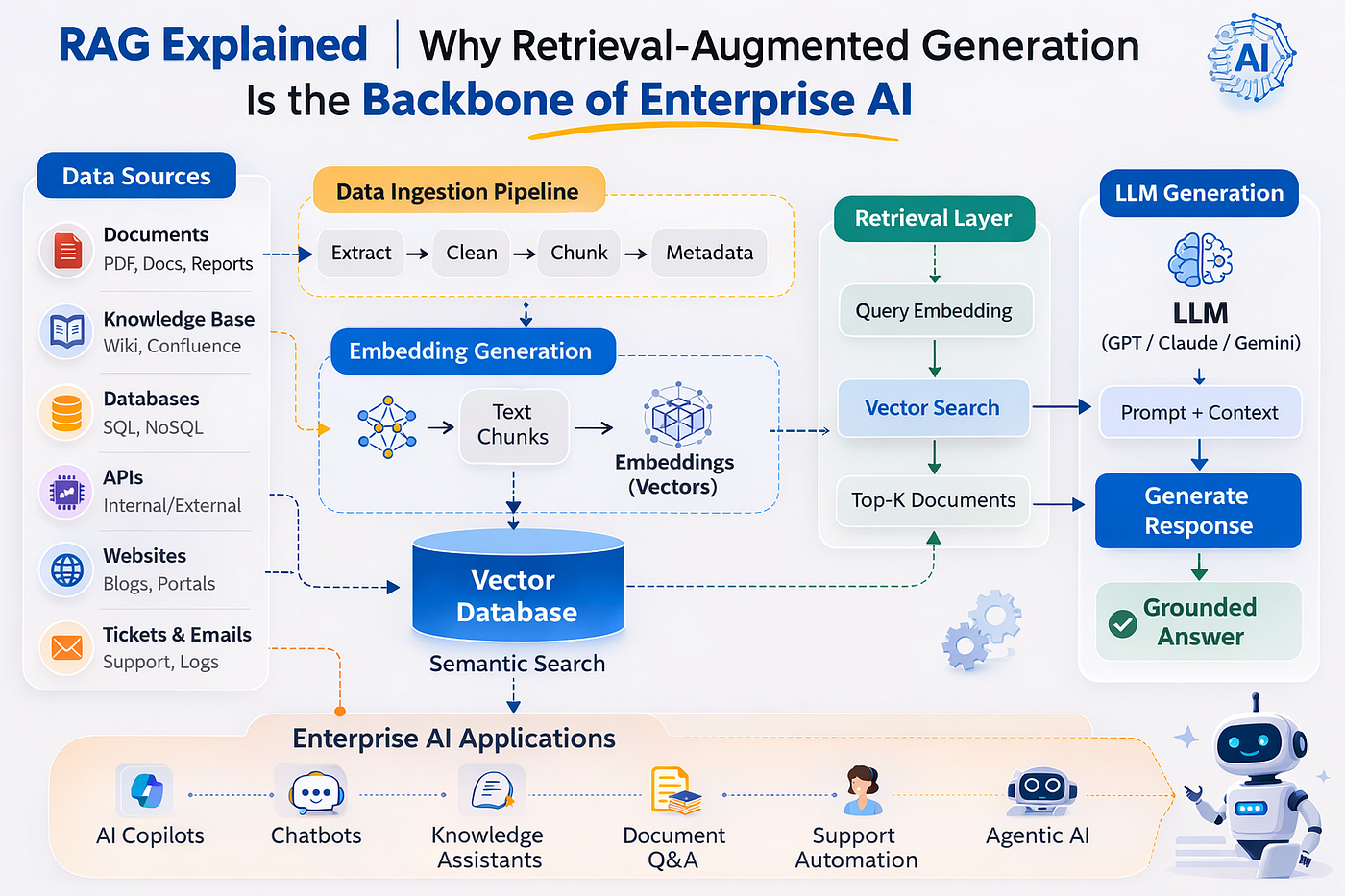
RAG grounds AI in your own data for accuracy and security. Learn the architecture, RAG vs fine-tuning, and how...
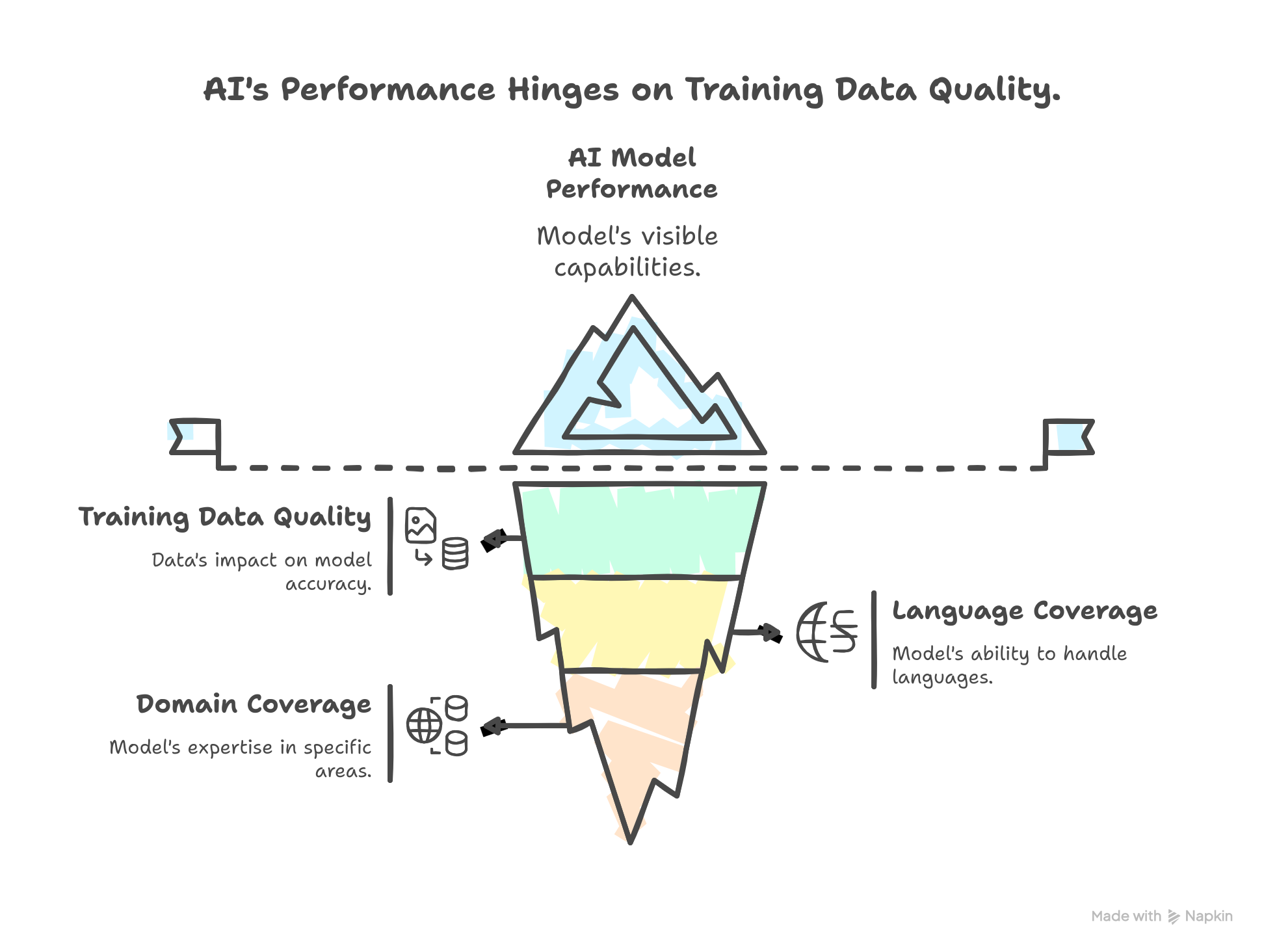
Bigger models do not fix bad data. Here is why high-quality training data drives AI performance, and how to bu...