
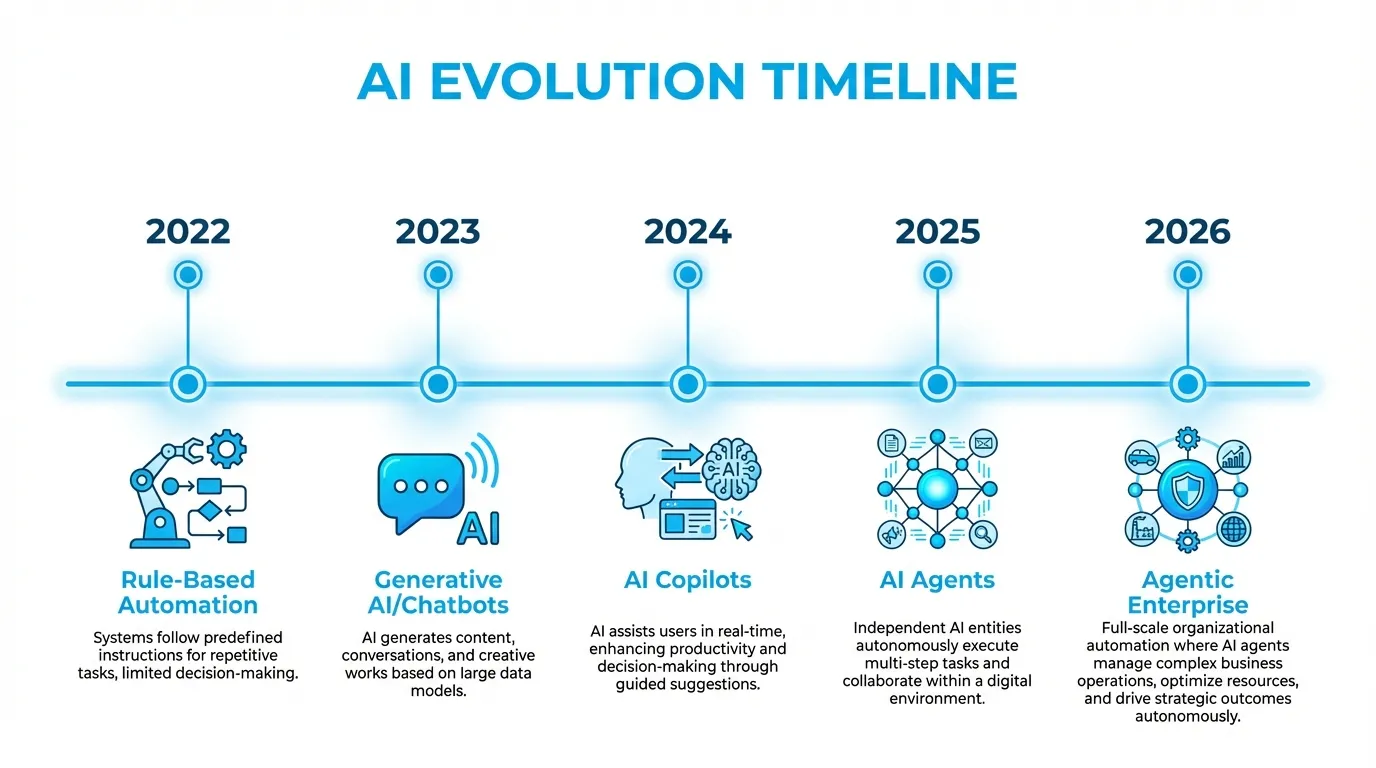
From Chatbots to Autonomous Agents: Understanding the Next Generation of Enterprise AI
A clear, stage-by-stage guide to the evolution from chatbots to autonomous AI agents, including a maturity mod...
What is an AI operating system? A clear, practical guide to the AI OS concept, its enterprise layers, the LLM-as-kernel analogy, and platform strategy decisions.
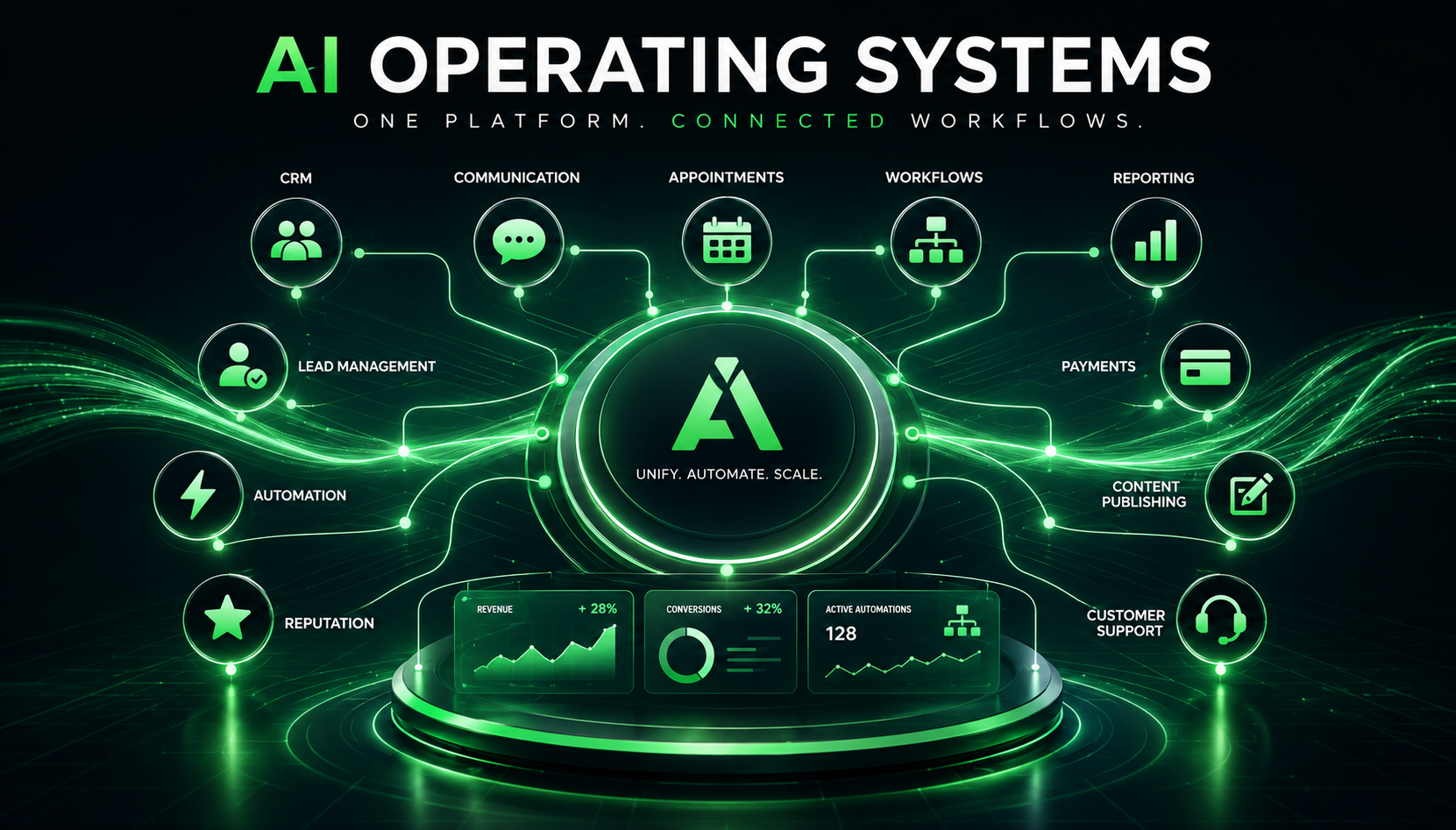
An AI operating system is an architectural layer that coordinates large language models, memory, tools, identity, and governance so that intelligent software can plan, act, and complete work across an enterprise the way a traditional operating system coordinates programs across hardware. Where a conventional OS schedules processes on a CPU and brokers their access to disk, networking, and peripherals, an AI OS schedules reasoning across a model, brokers access to data and external systems, and keeps the whole arrangement secure, observable, and accountable. The term is becoming shorthand for the platform that sits beneath enterprise AI agents, and understanding it is quickly becoming part of any serious AI strategy.
The idea has caught on for a practical reason. Most organizations did not set out to build an operating system. They started with a chatbot, then a copilot, then a handful of agents wired to internal data. At some point the wiring itself became the hard part: who can the agent act as, which tools it may call, where its memory lives, how its decisions are logged, and what happens when two agents need to coordinate. Those questions are operating-system questions. They are about resource management, isolation, scheduling, and policy, not about prompts. The "AI operating system" framing names the layer where those concerns belong.
This article explains the concept in concrete terms. It walks through the now-familiar analogy that maps the model to a kernel, the context window to RAM, tools to system calls, and memory to disk. Then it lays out the real layers of an enterprise AI OS, contrasts that with a single app or copilot, surveys the emerging platform landscape without overclaiming about specific products, and gives practical guidance for IT and platform leaders deciding what to build, what to buy, and what to standardize on. The goal is to keep the discussion grounded. An AI OS is an engineering pattern, not science fiction.
Key Takeaways
An AI operating system is the software layer that manages the shared resources intelligent agents need to do useful work, and enforces the rules that keep that work safe. In a traditional computer, you do not let every application talk to the disk controller directly or grab the whole CPU. The operating system mediates. It allocates memory, schedules processes, isolates programs from each other, controls access to files and devices, and provides a consistent set of system calls so applications do not each reinvent the basics. An AI OS plays the same mediating role for agents.
The resources are different, but the pattern is identical. Instead of CPU cycles, the scarce resource is model reasoning and context. Instead of files and devices, the resources are enterprise data, SaaS APIs, internal services, and databases. Instead of processes, the running units are agents and tasks. The AI OS decides which agent may use which tool, on whose behalf, with what data in context, and records what happened. It is the difference between a pile of scripts calling an API and a managed platform where capability, permission, and accountability are designed in.
This is why the phrase resonates with technical leaders. Once you have more than one or two agents in production, you stop thinking about prompts and start thinking about a runtime. You need the same things every operating system has historically provided: a way to run many things at once without them interfering, a way to control access to shared resources, a consistent interface to the outside world, and visibility into what the system is doing. An AI OS is the name for the layer that provides those guarantees for AI workloads.
The clearest way to understand an AI operating system is through the analogy that maps each part of a classic OS to its AI equivalent. The analogy is not perfect, and it should not be taken literally, but it is a genuinely useful mental model for explaining the architecture to a board, a platform team, or a skeptical engineer.
Start with the model as the kernel or CPU. In a traditional machine, the CPU executes instructions; the kernel is the privileged core that everything else depends on. In an AI OS, the large language model is the compute primitive that turns intent into action. It does the reasoning, the planning, and the language work. Like a CPU, it has a fixed amount of "throughput" per step and a ceiling on how much it can hold in working memory at once. And like a CPU, it is increasingly something you can swap: you might run different models for different tasks, the way a system might dispatch work to different cores or accelerators.
Next, the context window as RAM. RAM is fast, scarce, and volatile: it holds what a program is actively working on and is wiped when the process ends. The context window behaves the same way. It is the working memory the model reasons over right now, it is limited in size, it is expensive to fill, and it disappears when the session ends. Just as good software manages RAM carefully instead of loading everything at once, good AI systems manage context carefully, deciding what to load, what to summarize, and what to leave on "disk." This discipline has a name. We cover it in depth in our guide to context engineering versus prompt engineering, and it is the operating-system-level skill that separates reliable agents from flaky ones.
Then, tools and MCP as system calls and peripherals. A program cannot read a file or send a packet by itself; it makes a system call and the OS performs the privileged operation. An agent cannot query your CRM, run a SQL statement, or file a ticket by itself; it calls a tool, and the AI OS performs the operation under policy. The emerging standard for exposing those tools in a consistent, discoverable way is the Model Context Protocol (MCP), which functions like a device-driver interface for AI: a uniform contract between agents and the systems they act on. We explain it fully in what MCP is and why it is becoming the enterprise AI standard. The key point for the analogy is that MCP turns "integrations" into something closer to a system-call interface, which is exactly what an operating system needs.
After that, memory as disk. RAM is wiped, but disk persists. An AI OS needs durable memory so agents can remember decisions, facts, user preferences, and prior work across sessions. That persistent layer is to an agent what a filesystem is to a program: where knowledge lives when it is not in active context. This is one of the most under-built parts of enterprise AI today, which is why we treat it as a first-class concern in AI memory systems, the missing layer in enterprise AI architecture.
Finally, orchestration as the scheduler. An operating system's scheduler decides which process runs when, manages priorities, and prevents one process from starving the others. An AI OS needs the same thing for agents and tasks: a runtime that decides which agent acts next, manages multi-step plans, handles retries and timeouts, coordinates several agents working together, and keeps a long-running job moving. When the work involves more than one specialized agent, this becomes a coordination problem of its own, which we unpack in our business leader's guide to multi-agent systems.
The table below summarizes the analogy in one place. Treat it as a translation guide, not a literal one-to-one engineering spec.
| Traditional OS concept | AI OS equivalent | What it does |
|---|---|---|
| CPU / Kernel | Large language model (reasoning engine) | Executes reasoning, planning, and language work; the core compute primitive |
| RAM (working memory) | Context window | Holds what the model is actively reasoning over; scarce and volatile |
| System calls | Tool calls | The controlled way an agent performs a privileged action on an external system |
| Device drivers / peripherals | MCP servers and integrations | A uniform interface to data sources, APIs, and enterprise systems |
| Disk / filesystem | Persistent memory and knowledge stores | Durable storage of facts, decisions, and history across sessions |
| Scheduler | Orchestrator / agent runtime | Decides which agent or task runs next; manages multi-step and multi-agent work |
| Process isolation / permissions | Identity, scopes, and policy enforcement | Controls what each agent may do and on whose behalf |
| System logs / monitoring | Observability and tracing | Records every decision, tool call, and outcome for debugging and audit |
| Shell / GUI | Human-and-agent interface | How people invoke, supervise, and hand off work to agents |
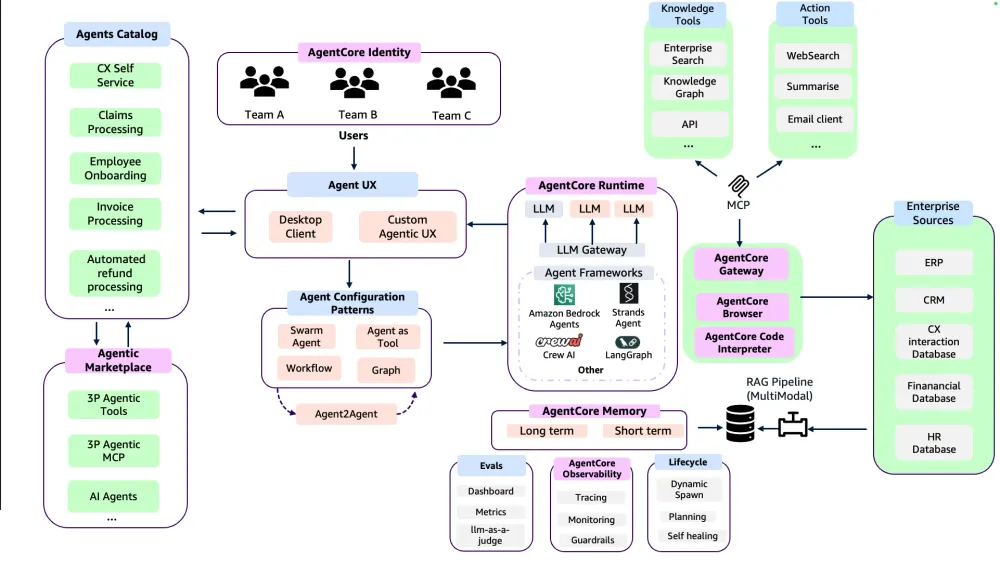
An enterprise AI operating system is best understood as a stack of layers, each solving a different class of problem. You can buy, build, or assemble each layer separately, and most organizations end up with a mix. Laying the layers out explicitly is the single most useful thing a platform team can do, because it turns a vague ambition ("we want agents") into a concrete set of decisions.
The model layer is the reasoning core: the LLMs and supporting models the system can call on. The important architectural decision here is to treat models as interchangeable rather than as the foundation everything is welded to. Different tasks suit different models. A cheap, fast model can triage and route; a stronger model can handle complex planning; a fine-tuned or domain-adapted model can handle specialized work. Designing a clean model layer means you can change providers, run models side by side, and avoid being locked to one vendor's roadmap. Where fine-tuning genuinely pays off versus retrieval is a real decision, and we cover the economics in LLM fine-tuning explained.
The memory layer gives the system continuity. It includes short-term memory (what happened in this conversation or task), long-term memory (durable facts and preferences), and retrieval over enterprise knowledge, usually via a retrieval-augmented generation pipeline. Without a deliberate memory layer, every agent starts from zero every time, repeats mistakes, and cannot build on prior work. With one, agents accumulate context and behave more like a colleague who remembers. For knowledge that must be accurate and grounded in your own documents, the retrieval side of this layer is what keeps answers truthful; we detail that pattern in enterprise RAG systems.
The tool layer is how agents reach the rest of the enterprise: databases, SaaS platforms, internal microservices, file stores, and external APIs. The historical problem with integrations is that everyone builds them differently, so every agent needs bespoke glue for every system. A protocol-based approach fixes this. By exposing capabilities through a consistent interface like MCP, you make tools discoverable and reusable across agents, and you create one place to apply permissions and rate limits. This layer is where an AI OS stops being a demo and starts being able to do real work in real systems, a shift we explore in how AI agents and MCP are reshaping enterprise software architecture.
The orchestration layer is the scheduler and process manager of the AI OS. It is responsible for running agents reliably: managing multi-step plans, deciding the order of operations, handling failures and retries, enforcing timeouts and budgets, and coordinating multiple agents that need to collaborate or hand off work. This is also where the difference between a clever prompt and a production system lives. A single model call can answer a question; an orchestration runtime can run a process that spans dozens of steps, several tools, and a human approval in the middle without losing the thread. If you are designing these flows, our piece on agentic workflows walks through the patterns.
The governance layer encodes the rules: what agents are allowed to do, what data they may touch, which actions require human approval, and what is simply forbidden. In a traditional OS, this is permissions, sandboxing, and resource quotas. In an AI OS, it is guardrails, action approvals, content and data-loss controls, spend limits, and policy that follows the agent regardless of which model or tool it uses. This layer is what lets a regulated enterprise say yes to autonomy without losing control. It is not optional, and it cannot be bolted on at the end. The organizations that move fastest with agents are usually the ones that built governance in from day one, a theme we develop in how to prepare for the agentic AI revolution.
The identity layer answers a deceptively hard question: who is the agent acting as? An agent that books travel, moves money, or changes records must do so as a specific, authorized principal, with scoped permissions, and with a clear audit trail tying the action back to a human or a service account. Most enterprises already have identity infrastructure for people and services; the work is extending it to non-human, autonomous actors. Getting identity right is what prevents an agent from becoming an over-privileged account that quietly does more than anyone intended. As agents proliferate, identity and access management for non-human actors becomes one of the defining security problems of the next few years.
The observability layer makes the system debuggable and auditable. Because an agent's behavior emerges from reasoning rather than fixed code paths, you cannot understand it without tracing what it actually did: which steps it took, which tools it called, what it had in context, what it decided, and why. Good observability captures full traces of agent runs, surfaces failures and loops, tracks cost and latency, and gives compliance teams an evidence trail. Without it, an AI OS is a black box, and black boxes do not survive contact with risk, audit, or production incidents.
The top layer is how people interact with the system: how they invoke agents, supervise long-running work, approve sensitive actions, and take over when judgment is required. The right interface is not always a chat box. It might be an approval queue, a dashboard, an inbox of agent-drafted work, or an existing application with AI woven in. The interface layer is also where the human-in-the-loop design happens, deciding which decisions stay with people. The most effective deployments blend human judgment and machine throughput deliberately, which we explore in building an AI workforce.
An AI OS is different from a chatbot or copilot the way an operating system is different from a single program. A copilot is one application: it lives inside a tool, helps with one job, answers questions, and drafts content. It is genuinely useful, and many organizations should start there. But it is not a platform. It does not manage many agents, it does not provide shared identity and policy across them, and it does not give you a runtime, memory, and observability that other AI work can build on.
The distinction matters because of where it leads. If every team builds its own copilot with its own integrations, its own credentials, and its own logging, you end up with dozens of disconnected AI applications, each a small operational and security liability, none reusable. That is the AI equivalent of every program talking directly to the hardware. An AI OS replaces that sprawl with a shared layer: one place agents are defined, one place tools are exposed, one place policy is enforced, one place everything is observed. The first approach scales linearly in effort and risk; the second amortizes the hard parts.
There is also a behavioral difference. A chatbot responds. An AI OS runs work. The trajectory across the industry is moving from systems that answer to systems that act, complete multi-step tasks, and operate with a degree of autonomy. We trace that progression in from chatbots to autonomous agents. The operating-system framing is really a recognition that once software starts acting on its own behalf across many systems, you need the discipline of an OS to keep it safe and coordinated.
No single product is the AI operating system today, and anyone claiming otherwise is selling a layer, not the whole stack. What exists instead is a fast-moving landscape of components that map onto the layers above. It is more honest, and more useful, to describe the landscape by category than by brand.
Model providers and inference platforms supply the reasoning core and increasingly the surrounding plumbing for tool use and structured outputs. Agent frameworks and orchestration runtimes provide the scheduler: ways to define agents, sequence steps, coordinate multiple agents, and handle the control flow of long-running tasks. Integration and protocol layers, with MCP emerging as a common standard, provide the system-call interface to enterprise systems. Memory and vector data platforms provide the persistent disk and retrieval. Governance, evaluation, and observability tools provide policy, testing, and tracing. And the major cloud and enterprise software vendors are assembling these pieces into agent platforms that bundle several layers together.
The practical takeaway is that "buying an AI OS" usually means choosing components for several layers and integrating them, not purchasing one box. The components are maturing at different speeds. Model and integration layers are advancing quickly; governance, identity for agents, and observability are earlier and are where careful buyers should spend their scrutiny. For a wider view of where the momentum is heading, our roundup of AI trends quietly reshaping enterprise growth in 2026 puts the operating-system idea in context with the broader shifts.
For platform and IT leaders, the rise of the AI OS reframes a set of decisions you are probably already facing. The most important shift is to stop treating each AI project as a standalone integration and start treating AI as a platform capability with shared layers. That reframing changes how you budget, who owns what, and where you accept lock-in.
The layers worth standardizing early are the ones where switching costs are highest and where fragmentation is most dangerous: identity, governance, observability, and the integration protocol. If every agent has its own way of authenticating, its own policy, and its own logging, you will not be able to govern the system or change vendors later. Standardize those, and keep the model layer deliberately portable so you can adopt better or cheaper models as they arrive without re-architecting. A clean separation between "the platform" and "the model" is the single most valuable design choice most enterprises can make this year.
You do not have to build or buy the whole stack at once. Treat each layer as its own decision. Most enterprises should buy or adopt the model layer, lean on emerging standards for the integration layer, and use mature tooling for memory and observability. The layers worth investing your own engineering in are usually the ones specific to your business: your tools and data integrations, your domain memory, your orchestration logic, and the governance rules that match your risk profile. This is also where an experienced AI engineering partner earns its keep. At Mind Supernova, much of the work we do for enterprise clients is exactly this assembly: standing up the orchestration, memory, integration, and governance layers around the models a client already trusts, so the result is a coherent platform rather than a drawer of disconnected pilots. The deeper architectural patterns for that work are covered in our 2026 playbook for building agents that actually work.
The arrival of autonomous, non-human actors in your systems is a security and identity event, not just an application feature. Decide now how agents get identities, how their permissions are scoped and reviewed, how their actions are logged, and how you revoke access when something goes wrong. Organizations that treat this as an afterthought tend to discover, late and uncomfortably, that they have created powerful accounts with weak oversight. Treating agents as governed principals from the start is far cheaper than retrofitting control later.
None of this means you must build a full AI OS before doing anything useful. The right move for most organizations is to ship a focused agent or copilot that delivers real value, and to do it on layers you can reuse: a shared identity approach, a protocol-based integration pattern, a memory strategy, and observability from day one. Then the second project is cheaper than the first, and the tenth is cheaper still. That compounding is the entire point of an operating system. The teams that get this right are usually the ones that prepared the ground deliberately, as we describe in how to prepare for the agentic AI revolution.
Use the following ordered checklist to assess how far along your organization is toward an AI operating system. Each item maps to one of the layers above, and the order roughly reflects what tends to break first when it is missing.
An organization that can answer "yes" to the first four has a working agent platform. An organization that can answer "yes" to all eight has something that genuinely deserves the name AI operating system.
An AI operating system is the coordination layer that manages the model, context, memory, tools, identity, orchestration, governance, and observability needed to run AI agents across an enterprise. It plays the same mediating role for agents that a traditional operating system plays for programs: allocating shared resources, enforcing permissions, scheduling work, and providing a consistent interface to the outside world. In practice it is usually assembled from several platform components rather than bought as a single product.
No. An LLM is the reasoning core of an AI operating system, analogous to the CPU or kernel, but it is not the operating system by itself. An operating system also includes memory, scheduling, a way to access devices and data, permissions, and monitoring. An LLM provides the compute primitive for reasoning; the AI OS is everything around it that turns that raw capability into a safe, coordinated, multi-agent platform. Calling the LLM the kernel is a useful analogy, not a claim that the model does the operating system's whole job.
A chatbot or app is a single program that does one job and answers within one tool. An AI OS is a platform that runs many agents against real enterprise systems with shared identity, policy, memory, and observability. A copilot helps a person; an AI OS runs work, coordinates multiple agents, and amortizes the hard parts, integration, governance, and logging, across every AI initiative instead of rebuilding them per project. The difference is the same as that between one application and the operating system it runs on.
An enterprise AI OS has eight typical layers: a model layer (the reasoning core), a memory layer (short-term, long-term, and retrieval), a tool and integration layer (often using the Model Context Protocol), an orchestration and agent runtime (the scheduler), a governance and policy layer (guardrails and approvals), an identity layer (scoped, auditable agent permissions), an observability layer (tracing and audit), and a human-and-agent interface layer (how people invoke and supervise the system). Most organizations assemble these from a mix of bought and built components.
You need one once you are running more than a couple of agents in production, or once AI work starts touching real systems and sensitive data. A single copilot does not require an AI OS. But the moment you have multiple agents, shared tools, and governance obligations, the absence of a coordination layer becomes the bottleneck and the risk. Most enterprises do not decide to build an AI OS; they discover they need one when per-project wiring stops scaling. The practical answer is to design for the platform early even while shipping something small.
No single vendor owns the AI operating system today. The landscape is made of categories: model providers, agent and orchestration frameworks, integration and protocol layers such as MCP, memory and vector data platforms, and governance, evaluation, and observability tools, with major cloud and enterprise software vendors bundling several layers into agent platforms. Most enterprises build their AI OS by selecting components across these categories and integrating them, often with an AI engineering partner, rather than buying a finished operating system off the shelf.
The term can be used loosely, but the underlying need is real and concrete. The hype is in any claim that one product is "the" AI operating system. The substance is in the recognition that running autonomous software across an enterprise requires the same disciplines, resource management, isolation, scheduling, permissions, and monitoring, that operating systems have always provided. Treat "AI OS" as a useful design lens for organizing those concerns, and be skeptical of anyone who treats it as a single thing you can purchase.
The "AI operating system" is less a product to buy than a lens for seeing what enterprise AI actually requires once it leaves the demo stage. The analogy is worth keeping: the model is the kernel, the context window is RAM, tools and MCP are system calls and peripherals, memory is disk, and the orchestrator is the scheduler. Around those sit the layers that make autonomy safe in a real organization, identity, governance, and observability. Naming these layers turns a vague ambition into a clear set of decisions about what to standardize, what to keep portable, and what to build versus buy.
For platform leaders, the strategic move is to stop treating each AI project as a one-off integration and start treating AI as a platform capability with shared, reusable layers. Standardize the parts that create lock-in and risk, stay portable on the model, design agents as governed actors from day one, and let each successful project make the next one cheaper. That compounding is what an operating system has always delivered, and it is what separates organizations that scale AI from those that accumulate disconnected pilots.
If you are mapping out which layers to build, which to buy, and how to assemble them into a coherent platform, that architectural work is exactly where an experienced AI engineering partner adds the most value. Mind Supernova works with enterprise teams to stand up the orchestration, memory, integration, and governance layers around the models they already trust, so the result is a real platform rather than a drawer of pilots. Wherever you are on the path, the most useful next step is to lay out your own layers honestly and decide, deliberately, what your AI operating system should look like.
A clear, stage-by-stage guide to the evolution from chatbots to autonomous AI agents, including a maturity mod...
An executive readiness playbook for agentic AI: a six-dimension self-assessment, a phased roadmap, how to pick...
A strategic investment framework for CTOs evaluating agentic AI: where it actually creates value, build vs buy...