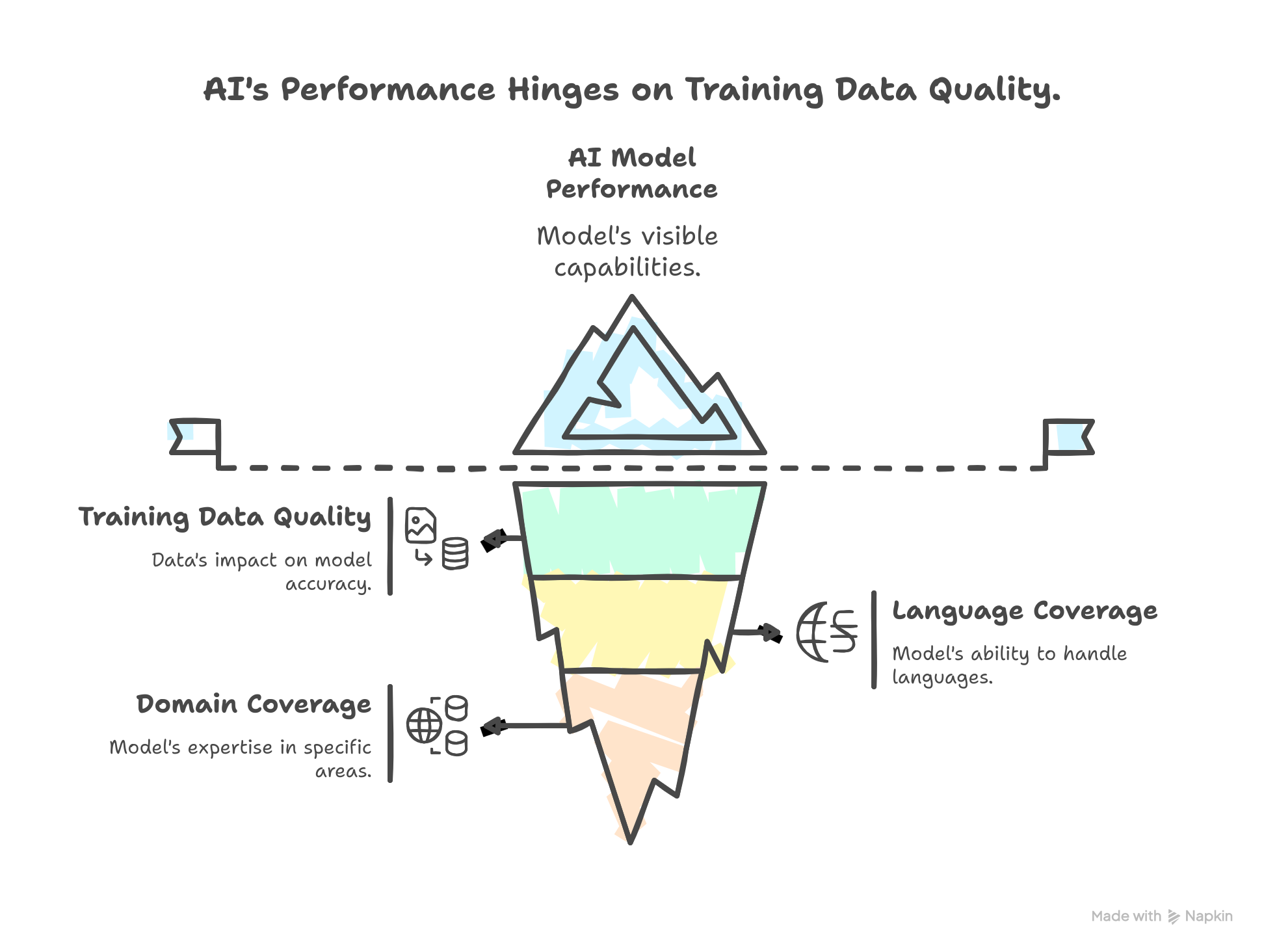
Why High-Quality Training Data Beats a Bigger AI Model Every Single Time
Bigger models do not fix bad data. Here is why high-quality training data drives AI performance, and how to bu...
A high-performing AI workforce blends human judgment with automation. Learn the org design, human-in-the-loop roles, and reskilling that make it work.

Building an AI workforce means deliberately combining human expertise with artificial intelligence so that people and machines do the work each does best, with humans supervising, correcting, and steering the AI at every critical step. It is not a plan to replace your staff with models. It is an operating model where AI handles volume and speed, while skilled people handle judgment, context, and accountability. For enterprise leaders in 2026, this hybrid human-plus-AI workforce is the difference between pilots that stall and systems that produce measurable returns.
The evidence for that gap is hard to ignore. Roughly 95% of enterprise generative-AI pilots show no measurable P&L return [1], and only about 6% of firms qualify as AI "high performers" attributing 5% or more of EBIT to AI [2]. The companies that pull ahead are rarely the ones with the biggest models. They are the ones who built the human scaffolding around those models: the annotators, reviewers, prompt engineers, MLOps staff, and domain experts who keep AI honest.
This article explains how to design that workforce. We cover human-in-the-loop operations, data and annotation teams, reskilling your existing staff, org design, and the very real talent gap that blocks most programs. If your team is short on AI-fluent people right now, a soft option is to borrow capacity: an outsourced AI workforce can stand up annotation and ops functions in days. Schedule a call if that is where you are stuck.
Key Takeaways
An AI workforce is the combined system of human roles and AI agents that together deliver a business outcome. The AI provides scale, recall, and tireless throughput. The humans provide judgment, domain knowledge, ethical guardrails, and accountability for results. Neither half is complete alone, and treating AI as a drop-in headcount replacement is the most common reason programs fail.
Think of it as three interlocking layers. The model layer runs inference. The orchestration layer routes tasks and connects tools. The human layer designs, supervises, corrects, and improves the whole thing. Most enterprises over-invest in the first layer and starve the third.
A bigger model does not fix a broken data pipeline or an unsupervised agent. Workflow redesign is the largest contributor to EBIT impact from AI according to McKinsey [2], and that redesign is human work. The teams that turn pilots into production results are the ones who staffed the human layer first, then chose models to fit.
This is why the discipline of high-quality training data over model size matters so much. The people who curate, label, and evaluate that data are core members of the AI workforce, not a back-office afterthought.
Human-in-the-loop (HITL) means a person reviews, approves, or corrects AI output at defined checkpoints before it reaches a customer or a system of record. It is the mechanism that converts a probabilistic model into a dependable business process. For high-risk use cases, it is also a legal duty: the EU AI Act requires meaningful human oversight of high-risk systems [4].
There are three common patterns, and mature programs use all three depending on stakes.
The risk of skipping these loops is concrete. Gartner predicts more than 40% of agentic-AI projects will be canceled by the end of 2027 because of cost, unclear value, and weak controls [6]. Human oversight is one of the controls that keeps a project on the right side of that statistic. The same discipline underpins autonomous AI systems, where oversight does not disappear, it moves up a level.
A checkpoint is only valuable if the reviewer can act on it. Give reviewers the model's confidence score, the source evidence, and a one-click way to accept, edit, or reject. Capture every correction as labeled feedback. Those corrections become training and evaluation data, which is how the loop compounds into accuracy over time.
An AI workforce is a mix of new specialist roles and reshaped existing ones. You do not need every role on day one, but you do need to know which functions are non-negotiable. The table below maps the core roles, what they own, and whether enterprises typically build, reskill, or outsource them.
| RoleOwnsHuman or AITypical sourcing | |||
| Data annotators | Labeling, RLHF preference data, edge-case curation | Human | Outsource or dedicated team |
| Annotation QA leads | Label quality, inter-annotator agreement, guidelines | Human | Outsource or reskill |
| Prompt and context engineers | Prompt design, RAG context, evaluation sets | Human | Reskill engineers |
| MLOps / AI ops engineers | Deployment, monitoring, drift detection, cost | Human | Build or augment |
| HITL reviewers | Output approval, correction, exception handling | Human | Reskill domain staff |
| Domain experts (SMEs) | Acceptance criteria, ground truth, sign-off | Human | Existing staff |
| AI agents | Drafting, retrieval, classification, routine actions | AI | Build or buy |
| AI product owner | Use-case selection, ROI, governance liaison | Human | Reskill PM/lead |
Notice that most of the roles are human. The agents are one line in a table of eight. That ratio surprises leaders who expected automation to thin their headcount. In practice, a working AI deployment adds specialized human roles even as it removes routine task volume. Many of these agents are built using the same patterns covered in how AI agents replace traditional workflows and AI agent development for enterprises.
Behind every reliable AI system is a human team producing and checking data. Annotation, evaluation, and red-teaming are continuous functions, not one-time projects. The market reflects this: data labeling is projected to grow from $3.77B in 2024 to $17.1B by 2030, a 28.4% CAGR [7]. That growth is demand for human judgment at scale.
The work spans more than simple labeling. Annotators build preference data for reinforcement learning from human feedback, write rationales, capture rare edge cases, and produce the golden evaluation sets that tell you whether a model is actually improving. Without that layer, you are flying blind. About 70% of organizations already report data difficulties [8], and most of those difficulties are human-process problems, not storage problems.
Reliable annotation depends on clear guidelines, inter-annotator agreement metrics, and a feedback loop with the SMEs who define ground truth. This is operational discipline. Teams that have run it before move faster, which is why data annotation services for generative AI and the practice of building AI training data at scale have become core enterprise capabilities rather than commodity tasks.
At Mind Supernova, the human-in-the-loop annotation workforce is a primary service precisely because this engine is where so many programs underinvest. Building it in-house from zero is slow. Renting a proven team while you decide what to keep internal is often the pragmatic first move.
The hardest constraint on an AI workforce is people, not technology. Skills gaps are the number-one blocker: 46% of leaders cite them as the top obstacle to shipping generative AI [2], and only around 20% of organizations say their talent is "highly prepared" for the shift [3]. Demand is rising faster than supply, with worldwide AI spending heading toward $632B by 2028 at a 29% CAGR [9].
The labor picture is not purely subtractive. The WEF Future of Jobs Report 2025 projects a net gain of 78 million jobs by 2030, with 170 million created and 92 million displaced, and finds that 59% of workers will need reskilling or upskilling by 2030 [5]. The opportunity belongs to organizations that treat reskilling as infrastructure.
Reskilling is the right long-term answer, but it is slow, and the market will not wait. A blended approach works best: reskill internal staff for the durable, context-heavy roles, and borrow specialist capacity for the roles you need this quarter. This is where AI outsourcing earns its place. Mind Supernova places vetted senior engineers in 5 to 7 days with 4+ hours of daily UK overlap, which lets you fill the specialist gap while your training programs mature. For the full picture of partner-led scaling, the complete guide to AI outsourcing covers the models in depth.
Structure determines whether your AI workforce compounds or fragments. Two patterns dominate, and most enterprises evolve from one to the other.
A centralized AI center of excellence concentrates scarce talent, sets standards, and avoids duplicated effort. It risks becoming a bottleneck distant from the business. A fully federated model embeds AI people inside each unit for speed and context but fragments standards and tooling. The hub-and-spoke model splits the difference: a central hub owns platform, governance, and shared annotation or MLOps services, while spokes in each business unit own use cases and domain knowledge.
For most enterprises in 2026, hub-and-spoke is the safe default. It keeps governance and the expensive shared functions, annotation and ops, in one place while pushing domain ownership to the edge.
Every AI-assisted process needs a named human owner who is accountable for outcomes, including failures. Models cannot be accountable. Define who signs off, who can pause a system, and who answers to the regulator. The Deloitte data shows the danger of skipping this: about 74% of organizations plan agentic AI within two years, but only 21% have mature agent governance [10]. That gap between ambition and control is exactly where projects get canceled.
Consider a mid-size multinational insurer modernizing claims triage. Their goal was faster decisions without sacrificing accuracy or compliance. They did not buy a model and hope. They designed a workforce.
The before state: adjusters manually read each claim, cross-checked policy documents, and routed cases. Average handling time was high, and backlogs grew during surge events. The after state combined AI and people across a clear division of labor.
The result was not a smaller team. It was a redeployed one. Adjusters moved from rote reading to exception handling and complex judgment, the work humans do best. Throughput rose, the audit trail satisfied compliance, and the override rate became a live measure of model health. This mirrors the EBIT pattern McKinsey found: the win came from redesigning the workflow around a human-plus-AI loop, not from the model alone [2].
You can build a working AI workforce in a quarter if you sequence it well. The mistake is to start with the model. Start with the work and the people around it.
If steps three and five are your bottleneck, that is the most common place to bring in outside help. Staff augmentation and dedicated teams let you add annotation and MLOps capacity without a long hiring cycle, while your internal reskilling catches up.
A hybrid workforce introduces challenges that pure software projects do not. Naming them early is how you avoid the cancellation cliff.
Staff who fear replacement will quietly resist or sandbag the tools. The fix is honest framing: AI removes the rote parts of the job and elevates the judgment parts. Show the redeployment, not just the automation. Involve the people who will run the loop in designing it.
If you do not provide approved tools and training, employees will use unapproved ones. Gartner expects that by 2027, 75% of employees will use technology outside IT visibility [6]. Counter shadow AI with sanctioned tooling, clear policy, and AI-literacy training rather than blanket bans, which only push usage underground.
Low-quality or biased labels propagate into every downstream decision. Manage it with documented guidelines, inter-annotator agreement metrics, diverse reviewers, and SME-defined ground truth. This is process discipline, and it is where an experienced annotation team pays for itself.
Granting autonomy faster than your controls mature is how projects join the 40%-plus that Gartner expects to be canceled by 2027 [6]. Keep humans in or on the loop for anything high-stakes. Widen autonomy only when your instrumentation proves the model earns it. Map your controls to NIST AI RMF and ISO/IEC 42001 so audits are routine, not fire drills [11].
An AI workforce is the combined system of human roles and AI agents that deliver a business outcome together. AI handles scale and speed, while people handle judgment, context, and accountability. It is a hybrid operating model, not a plan to replace staff with models, and it adds specialized human roles even as it removes routine task volume.
Not on net, according to current data. The WEF projects a net gain of 78 million jobs by 2030, with 170 million created and 92 million displaced [5]. AI changes the work more than it removes the worker. The catch is reskilling: 59% of workers will need new skills by 2030 [5], so the displaced and the created jobs are often different ones.
Human-in-the-loop means a person reviews, approves, or corrects AI output at defined checkpoints before it acts. It converts a probabilistic model into a dependable process and is legally required for high-risk systems under the EU AI Act [4]. Related patterns are human-on-the-loop (monitor and intervene) and human-over-the-loop (set policy and audit).
Use a blended approach. Reskill internal staff for durable, context-heavy roles like HITL review and AI product ownership, since 46% of leaders name skills gaps as their top blocker [2]. Then borrow specialist capacity, such as annotators and MLOps engineers, from an outsourcing partner to cover immediate needs while training programs mature.
For most enterprises, start by outsourcing or using a dedicated team, then decide what to internalize. Annotation is a continuous, process-heavy function where experience drives quality, and the market is growing at a 28.4% CAGR [7]. A proven partner can stand up the function in days while you build internal capability deliberately.
The enterprises winning with AI in 2026 are not the ones with the biggest models. They are the ones who built the human workforce around the AI: annotators, reviewers, engineers, and accountable owners working in deliberate loops with the machines. That is what turns a stalled pilot into measurable EBIT impact [2].
This week: pick one bounded, high-volume workflow and map its human-plus-AI division of labor, including the loop pattern and the named owner. This quarter: stand up your data and annotation layer, reskill the reviewers, instrument the loop, and prove ROI before you scale by replication.
If your bottleneck is people, you do not have to wait out a hiring cycle. Mind Supernova builds human-in-the-loop annotation and AI ops teams, with vetted senior engineers starting in 5 to 7 days and 4+ hours of daily UK overlap. Schedule a call to design the workforce behind your AI.
Bigger models do not fix bad data. Here is why high-quality training data drives AI performance, and how to bu...
Multimodal AI reads text, images, audio, and video together. Learn the enterprise use cases and the competitiv...