Enterprise AI Adoption in 2026: The Trends, Hard Numbers, and Costly Mistakes to Avoid
The 2026 enterprise AI adoption trends that matter: top use cases, barriers, ROI, build vs buy, and the talent...
A clear, stage-by-stage guide to the evolution from chatbots to autonomous AI agents, including a maturity model and how enterprises move up the curve.
The shift from chatbots to AI agents is the move from software that answers questions to software that completes work. A chatbot responds to a prompt and waits; an autonomous AI agent perceives a goal, reasons about how to reach it, plans a sequence of steps, calls tools and systems, and acts toward an outcome with limited human intervention. Understanding this distinction matters because it determines what you can safely delegate to AI, how much oversight you need, and where the next generation of enterprise value will be created.
Most enterprises today sit somewhere on a spectrum that runs from simple rule-based bots to fully autonomous multi-agent systems. The terminology gets muddied because vendors apply the word "agent" to everything, and because each generation of technology was layered on top of the last rather than replacing it. A 2002-era decision-tree bot, a 2018 NLU virtual assistant, a 2023 retrieval-augmented copilot, and a 2025 tool-using agent can all be running inside the same organization at the same time. The result is confusion about what is actually possible and what each tier requires to build, govern, and trust.
This article lays out the evolution as a clear maturity spectrum. We walk through five stages, define the capability, autonomy, memory, tool use, and oversight at each, and give a maturity-model table you can map your own systems against. Then we explain the core architectural difference between a chatbot and an agent, and how enterprises move up the curve step by step. Where a topic borders a dedicated piece, we link rather than repeat it.
Key Takeaways
A chatbot is a conversational interface that maps user inputs to responses; an AI agent is a goal-directed system that reasons, plans, uses tools, and takes actions to achieve an objective. The simplest way to hold the difference in your head is that a chatbot finishes its job when it has produced a reply, while an agent finishes its job when the outcome it was asked to deliver actually exists.
Consider a concrete example. Ask a customer-support chatbot "Where is my order?" and it will, at best, look up a tracking number and read it back to you. Ask an agent the same thing and it can authenticate you, query the order-management system, detect that the shipment is stuck in customs, open a ticket with the carrier through their API, draft a proactive email, and schedule a follow-up check in 48 hours. The chatbot communicates; the agent resolves.
Four properties separate agents from chatbots:
For a deeper treatment of how agents differ from the underlying generative models that power them, see our piece on generative AI vs agentic AI. The short version: a large language model is the engine, and an agent is the vehicle built around it that adds memory, tools, planning, and a control loop.
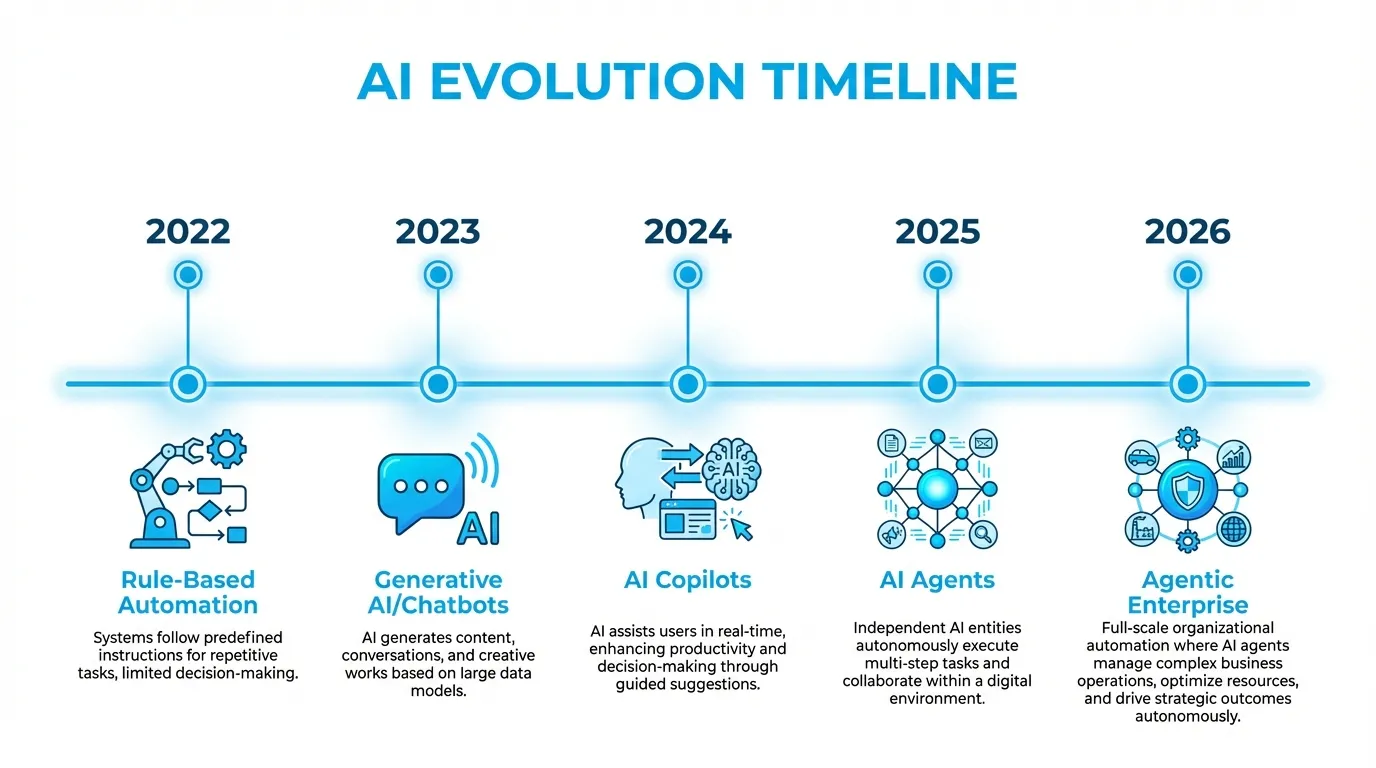
The evolution from conversational AI to agentic AI unfolds across five recognizable stages. Each stage solved the limitation of the one before it, and each introduced new requirements for memory, oversight, and integration. Crucially, later stages do not make earlier ones obsolete: a well-run enterprise still uses rule-based bots for deterministic flows where predictability matters more than flexibility.
Rule-based chatbots are deterministic systems that follow scripted decision trees and keyword matches. They were the first generation of conversational automation, and they still power a large share of IVR menus, website widgets, and FAQ bots. The user is funneled down predefined paths, and any input outside the script produces a fallback message or a handoff to a human.
Capability: answer a fixed set of known questions, route requests, collect structured inputs. Autonomy: none; behavior is fully predetermined by the script author. Memory: session-only, usually limited to the current slot-filling exchange. Tool use: minimal, typically a lookup against one system. Oversight: low ongoing need because behavior is bounded, but high authoring and maintenance cost as the decision tree grows. Typical use: appointment booking, order status, password resets, tier-one deflection.
The strength of rule-based bots is predictability. The weakness is brittleness: they break the moment a user phrases something unexpectedly, and the maintenance burden of mapping every branch becomes unsustainable at scale.
NLU virtual assistants use natural language understanding to classify intent and extract entities, freeing users from rigid scripts. This was the major step from roughly 2016 onward, powering the first wave of branded assistants and smart-speaker skills. Instead of matching keywords, the system maps free-form language onto a defined set of intents and slots, then triggers the appropriate flow.
Capability: understand varied phrasings of known requests, handle multi-turn slot filling, support a broader range of tasks. Autonomy: still low; the assistant selects among predefined intents rather than reasoning about novel goals. Memory: short-term conversational context and basic user profile. Tool use: integration with a handful of back-end systems through fixed connectors. Oversight: moderate, focused on intent-model accuracy and managing misclassifications. Typical use: banking assistants, telecom self-service, HR helpdesks, internal IT support.
NLU assistants are more flexible than rule-based bots, but they share a ceiling: they can only handle the intents they were explicitly trained and built for. Ask a question outside the intent catalog and you are back to a fallback. They understand language better but still cannot reason about a goal they were not designed for.
RAG-grounded copilots combine a large language model with retrieval from a trusted knowledge base, so answers are grounded in current, source-specific information rather than the model's training data alone. This stage arrived with the generative-AI wave and solved two problems at once: the open-ended language fluency of LLMs and the factual grounding that enterprises require. Retrieval-augmented generation fetches relevant documents, then the model composes an answer constrained by that retrieved context.
Capability: answer open-ended questions over private corpora, summarize, draft content, explain policies, assist knowledge workers in real time. Autonomy: low to moderate; the copilot generates and suggests, but a human stays in the loop and approves actions. Memory: retrieval over a document store plus conversational context; emerging long-term memory of user preferences. Tool use: primarily retrieval, increasingly augmented with a few read actions. Oversight: moderate, centered on grounding quality, citation accuracy, and hallucination control. Typical use: support-agent copilots, sales enablement, legal and policy lookup, developer assistants, internal search.
This is where many enterprises sit today, and it is a genuinely valuable plateau. Grounding is what makes generative AI trustworthy enough for regulated work. We cover the architecture in depth in enterprise RAG systems. The limitation of a copilot is that it advises rather than acts: it can tell you what to do, but a person still has to do it.
Tool-using single agents pair an LLM with a control loop, a set of tools, and the ability to act, so the system can take steps toward a goal instead of only answering. This is the threshold where a system stops being a chatbot and becomes an agent. The model is given a goal, a set of callable tools (APIs, database queries, code execution, web search, function calls), and a loop that lets it decide which tool to use, observe the result, and decide the next step.
Capability: complete multi-step tasks, take real actions in connected systems, recover from errors, chain operations toward an outcome. Autonomy: moderate to high within a bounded scope; the agent decides its own steps but operates inside guardrails and permission limits. Memory: working memory for the task, plus durable memory of prior interactions and outcomes. Tool use: central and extensive; tool selection and orchestration are the core of the architecture. Oversight: high during rollout, with approval gates for consequential actions and full audit logging. Typical use: automated ticket resolution, data enrichment, report generation, code refactoring, procurement workflows, research-and-summarize tasks.
The single agent is the workhorse of current enterprise deployments. Standards are emerging to make tool connection reliable and portable, most notably the Model Context Protocol, which gives agents a consistent way to discover and call enterprise tools and data sources. For practical guidance on building these systems, see our AI agent development playbook.
Autonomous multi-agent systems coordinate multiple specialized agents that plan, delegate, and collaborate to complete end-to-end processes with bounded human oversight. At this stage a single agent is no longer enough: complex business processes are decomposed across a team of agents, each with a defined role, that hand work to one another and to humans. An orchestrator or planner agent breaks the objective into sub-goals, specialist agents execute, and reviewer or critic agents check the output.
Capability: run long-horizon, cross-functional processes end to end, with division of labor, parallelism, and self-checking. Autonomy: high; the system manages its own workflow and escalates only on exception or at defined checkpoints. Memory: shared and persistent memory across agents and sessions, enabling continuity and learning. Tool use: broad and governed; agents access many systems under role-based permissions. Oversight: exception-based and policy-driven, supported by strong observability, tracing, and kill switches. Typical use: digital workers handling claims, order-to-cash, IT operations, compliance monitoring, and multi-step research or analysis.
This is the frontier where AI shifts from a tool people use to a capability that operates more like a colleague. We explore the coordination patterns in multi-agent systems explained and the workforce implications in from AI tools to AI employees. The operational reality of running these systems is covered in the rise of autonomous AI.
The table below maps the five stages against the dimensions that matter for planning, governance, and budgeting. Use it to locate your current systems and to see what changes as you move up a tier.
| Dimension | 1. Rule-based chatbot | 2. NLU assistant | 3. RAG copilot | 4. Tool-using agent | 5. Multi-agent system |
|---|---|---|---|---|---|
| Core capability | Scripted answers | Intent understanding | Grounded answers | Goal completion | End-to-end processes |
| Autonomy | None | Low | Low to moderate | Moderate to high (bounded) | High (governed) |
| Memory | Session slots | Short-term context | Retrieval + context | Working + durable memory | Shared persistent memory |
| Tool use | One lookup | Fixed connectors | Retrieval, some reads | Many tools, orchestrated | Broad, role-governed |
| Reasoning | None | Classification | Generation over context | Plan-act-observe loop | Multi-agent planning |
| Human oversight | Authoring-time | Intent tuning | Grounding review | Approval gates + audit | Exception-based + tracing |
| Acts on the world? | Rarely | Limited | Advises | Yes, bounded | Yes, end to end |
| Failure mode | Brittleness | Misclassification | Hallucination | Bad tool actions | Cascading errors |
Three patterns are worth noticing in this table. First, autonomy and the ability to act on the world rise together, and so does the cost of getting it wrong. Second, memory and tool use are the capabilities that enable each jump; an organization cannot reach stage four without solving durable memory and reliable tool access. Third, oversight does not disappear as systems mature; it shifts from designing every path up front to monitoring outcomes and handling exceptions.
An AI agent runs a continuous loop of perception, reasoning, planning, and action, grounded by memory and connected to tools. This loop is the structural difference between stages one through three and stages four through five. Understanding its components clarifies why "an agent is just a better chatbot" is the wrong mental model.
The agent takes in the goal and the current state of the world: the user's request, the contents of relevant systems, the results of previous actions, and any new events. Perception is broader than a single text prompt; it includes reading documents, querying databases, and observing the outcome of its own prior steps.
The model interprets the situation, decides what the goal requires, and determines what is missing. This is where the LLM's general capability is applied to a specific context. Reasoning quality is heavily influenced by how well the relevant context is assembled, which is why context engineering has become a distinct discipline separate from prompt wording.
The agent decomposes the goal into an ordered set of sub-tasks and selects which tools to use for each. Unlike a fixed workflow, the plan is dynamic: the agent can revise it when a step fails or new information arrives. Planning is what lets a single instruction trigger a multi-step process without a developer scripting each branch in advance.
The agent executes by calling tools: querying systems, writing to databases, running code, sending messages, or invoking other agents. Tools are how the agent affects the world rather than merely describing it. The reliability of tool access, including authentication, permissions, and error handling, often determines whether an agent succeeds in production.
Memory spans the working context of the current task, durable records of past interactions and outcomes, and, in multi-agent systems, shared state across agents. Without memory an agent cannot maintain a goal across many steps or learn from what worked before. We argue in AI memory systems that memory is the most underbuilt layer in current enterprise deployments.
Put together, these components form a closed loop: the agent perceives, reasons, plans, acts, observes the result, and loops again until the goal is met or it reaches a checkpoint requiring human approval. A chatbot has none of this loop. It receives input, produces output, and stops. That single architectural fact is the entire difference between answering and doing.
Enterprises advance from chatbots to agents by building the foundations each stage requires, then matching autonomy to the risk and value of each task. The most common and expensive mistake is to jump straight to autonomous agents without the grounding, memory, tooling, and governance that make them safe. The curve is climbed deliberately, not leapt.
Before an agent can act reliably, it needs accurate, current information to reason over. That means building the retrieval layer first: clean, well-structured access to the documents, records, and systems the AI will rely on. Organizations that deploy a solid RAG copilot at stage three create the knowledge foundation that stage-four agents depend on. Skipping this produces agents that act confidently on wrong information.
Stateless systems cannot pursue goals across time. Moving up the curve requires memory infrastructure that persists user context, task state, and outcomes. This is the layer that lets an agent remember what it already tried, respect prior decisions, and improve. Memory is a prerequisite for autonomy, not a nice-to-have added later.
An agent is only as capable and as safe as the tools it can call. Enterprises need a governed way to expose APIs, databases, and actions with proper authentication and least-privilege permissions. Emerging standards like the Model Context Protocol make this connection consistent and auditable, and we explain how this reshapes architecture in how AI agents and MCP are reshaping enterprise software architecture. The principle is simple: never give an agent a tool you would not give a junior employee without supervision.
As autonomy rises, oversight must shift from designing paths to monitoring outcomes. That requires approval gates for consequential actions, policy constraints that bound what the agent may do, comprehensive logging and tracing of every decision and tool call, and kill switches. Observability is what makes agent behavior debuggable and trustworthy. Without it, a stage-four or stage-five system becomes an unaccountable black box.
Once individual agents are reliable, the final step is composing them into coordinated workflows where specialized agents plan, execute, and review. This is where the largest process automation gains appear, and where most of the value of agentic AI is ultimately realized. We cover the design patterns in agentic workflows explained.
Throughout this progression, the decision is not "how autonomous can we make this?" but "how much autonomy does this task warrant given its risk and value?" A low-stakes internal report can run fully autonomously. A customer-facing financial transaction should keep a human at the gate. Mature organizations deliberately place different processes at different stages of the curve rather than forcing everything to the frontier.
Moving from a chatbot to a production agent is less an AI problem than an engineering and governance problem. The model is the easy part; the hard parts are reliable retrieval, durable memory, safe tool integration, evaluation, and the observability needed to trust autonomous behavior. Many teams stall at stage three not because the technology is unavailable but because they lack the engineering discipline to ship and govern stages four and five.
This is where the build-versus-partner decision matters. Building an internal team capable of agent engineering, MLOps, and AI governance takes time that competitive pressure rarely allows. Mind Supernova works with enterprises to design and build this foundation, bringing our team's collective experience in agent development, enterprise RAG, memory systems, and MLOps to move organizations up the maturity curve without learning every lesson the hard way. Whether you build internally, partner, or blend the two, the sequencing principle holds: ground first, add memory, expose tools safely, instrument heavily, then orchestrate.
What comes after chatbots is agents, and what comes after single agents is coordinated systems of agents that function as digital workers. The trajectory is consistent: each generation moves the locus of work further from the human and closer to the machine, while the human role shifts from doing the task to defining goals, setting guardrails, and handling exceptions.
The near-term direction is not a single super-agent but ecosystems of specialized agents, connected through shared standards and memory, operating under enterprise governance. Some organizations are already describing the infrastructure to run them as an emerging AI operating system layer. For leaders, the practical question is readiness: the data, integration, and governance foundations that make agents possible take time to build, and the organizations that start now will compound the advantage. Our guide on how to prepare for the agentic AI revolution lays out the steps.
A chatbot maps inputs to responses and finishes when it has produced a reply. An AI agent pursues a goal: it perceives a situation, reasons about what is needed, plans a sequence of steps, calls tools to take real actions, and loops until the outcome is achieved or it reaches a human checkpoint. In short, a chatbot communicates while an agent completes work. Agents add goals, planning, tool use, memory, and autonomy that chatbots lack.
Autonomous agents are AI systems that can decompose a goal into sub-tasks, choose and call tools, act across connected systems, evaluate the results of their own actions, and self-correct, all with bounded human oversight rather than turn-by-turn instructions. They operate inside guardrails and permission limits and escalate to humans on exceptions or at defined checkpoints. The defining trait is goal-directed action under a control loop, not just better conversation.
The evolution moved through five stages: rule-based chatbots following scripts, NLU virtual assistants that understand intent, RAG-grounded copilots that answer from trusted knowledge, tool-using single agents that take actions toward goals, and autonomous multi-agent systems that run end-to-end processes. Each stage solved the previous one's main limitation, and each added new requirements for memory, tool access, and oversight. Many enterprises run several stages simultaneously.
No. The difference is architectural, not incremental. A chatbot receives input, produces output, and stops. An agent runs a continuous loop of perception, reasoning, planning, and action, grounded by memory and connected to tools, so it can complete multi-step work rather than only respond. Calling an agent a better chatbot misses the point that it can act on the world, not just describe it.
Tool-using single agents come after chatbots, followed by autonomous multi-agent systems and digital workers. The trajectory moves from answering questions to completing tasks to running entire processes. The next frontier is coordinated ecosystems of specialized agents connected through shared standards and memory, operating under enterprise governance, with humans defining goals and handling exceptions rather than executing each step.
Enterprises move up the curve by building foundations in sequence: ground knowledge with reliable retrieval, establish durable memory, expose tools safely with least-privilege permissions, add guardrails, approval gates, and observability, and finally orchestrate multiple agents into workflows. The guiding principle is to match autonomy to each task's risk and value rather than chasing maximum autonomy everywhere. Skipping foundations is the most common cause of failed agent projects.
Not quite. A copilot, typically a RAG-grounded assistant, suggests and advises while a human stays in the loop and approves actions. An agent takes actions itself within bounded permissions. A copilot sits at stage three of the maturity curve and an agent at stage four. Many copilots are evolving into agents as teams give them tools and a control loop, but the distinction between advising and acting remains the key line.
The move from chatbots to AI agents is the most consequential shift in enterprise software since cloud computing, because it changes what software can be trusted to do without a human driving every step. The progression is a maturity spectrum, from scripted bots to intent-aware assistants to grounded copilots to tool-using agents to autonomous multi-agent systems, and each stage demands new foundations in memory, tooling, and governance. The organizations that win will not be those that jump fastest to full autonomy, but those that climb the curve deliberately, placing each process at the stage its risk and value warrant.
If you are mapping where your systems sit on this curve and what it would take to move up, the gap is rarely the model itself; it is the engineering and governance around it. Mind Supernova helps enterprises design and build that foundation, from grounded retrieval and memory to safe tool integration and observability, so agentic AI delivers outcomes you can trust. Wherever you are on the spectrum today, the next stage is reachable with the right sequencing.
The 2026 enterprise AI adoption trends that matter: top use cases, barriers, ROI, build vs buy, and the talent...
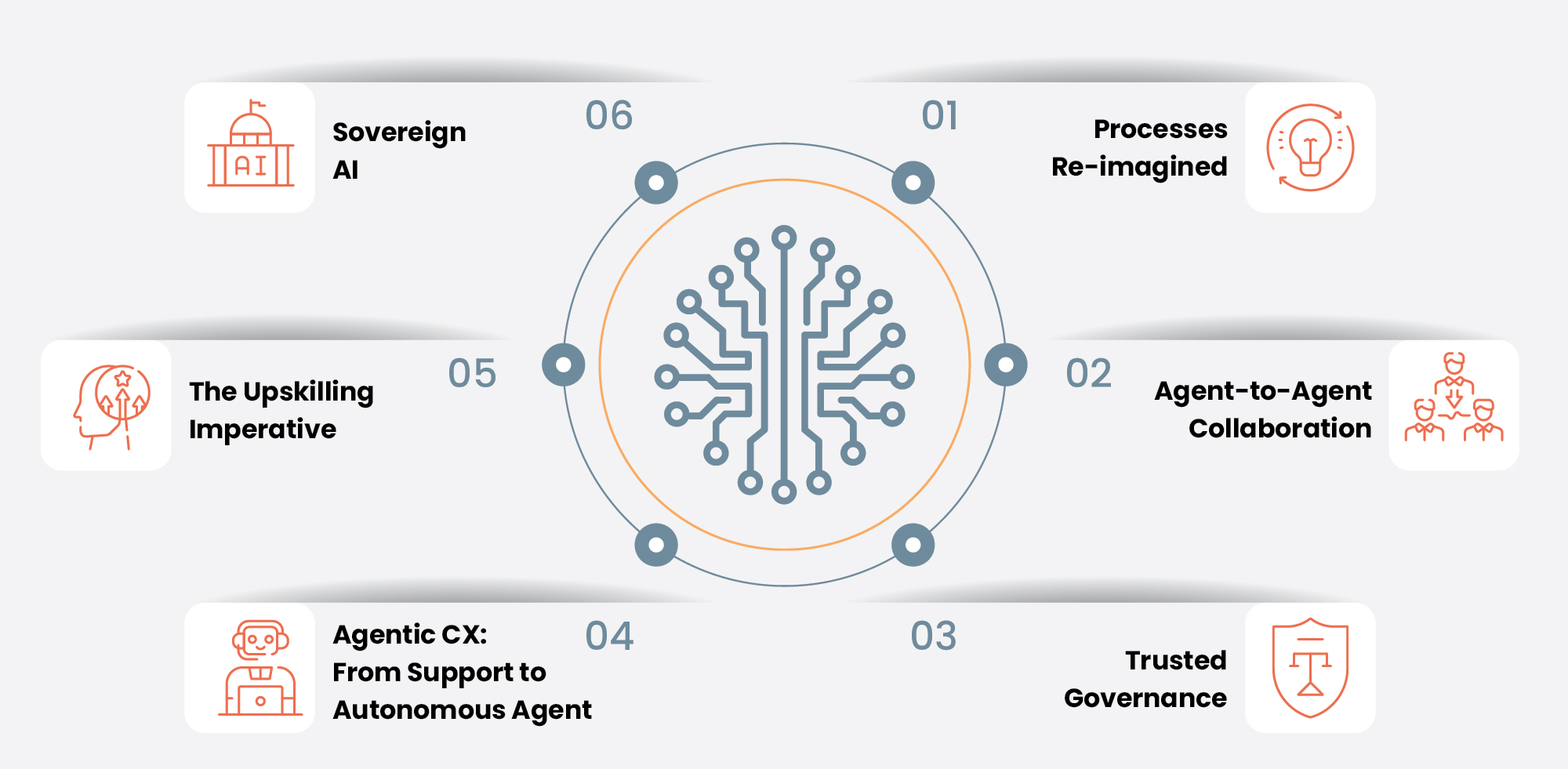
The AI trends reshaping enterprise growth in 2026: agentic AI, multimodal models, RAG, governance, and the AI...
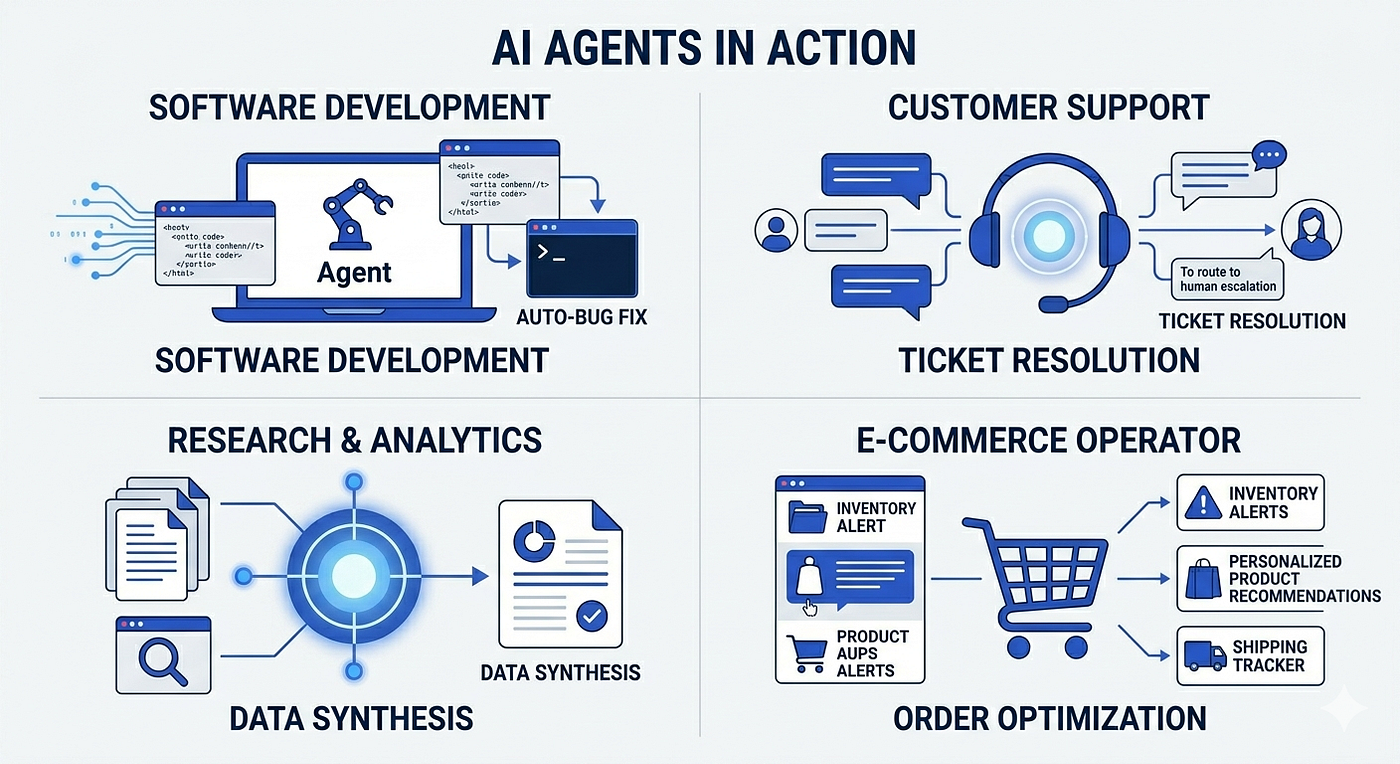
AI agents are automating multi-step workflows across finance, support, IT, and supply chain. Here is how they...